This comprehensive analysis compares BB and DOT, two distinct blockchain projects addressing different infrastructure needs. BounceBit (BB), launched in 2024, focuses on Bitcoin restaking infrastructure with dual-token PoS Layer 1 architecture, while Polkadot (DOT), operational since 2019, specializes in blockchain interoperability through relay chain technology. The article examines critical investment factors including historical price performance—BB declined 94.7% from $0.9 to $0.04755, while DOT fell 97% from $54.98 to $1.66—trading liquidity disparities, 2026-2031 price projections, and risk assessments. BB suits risk-tolerant investors targeting emerging BTC restaking opportunities, whereas DOT appeals to those seeking exposure to established multi-chain ecosystems. Current market conditions reflect extreme fear sentiment, presenting potential opportunities alongside significant volatility risks for both assets.
Introduction: Investment Comparison Between BB and DOT
In the cryptocurrency market, the comparison between BB and DOT has consistently been a topic that investors cannot overlook. The two differ markedly in market capitalization ranking, application scenarios, and price performance, representing distinct positioning within the crypto asset landscape.
BounceBit (BB): Launched in 2024, it has gained market recognition through its positioning in BTC restaking infrastructure, providing a foundational layer for restaking products with a dual-token PoS Layer 1 system that combines Bitcoin security with EVM compatibility.
Polkadot (DOT): Since its launch in 2019, it has been recognized for its role in connecting private chains, consortium chains, public chains, and oracles, facilitating trustless information and transaction exchange through its relay chain architecture.
This article will comprehensively analyze the investment value comparison between BB and DOT, focusing on historical price trends, supply mechanisms, institutional adoption, technological ecosystems, and future projections, attempting to address the question most concerning to investors:
"Which is the better buy right now?"
I. Historical Price Comparison and Current Market Status
BB (Coin A) and DOT (Coin B) Historical Price Trends
- 2024: BB launched in May 2024 with an initial price of $0.46, reaching an all-time high of $0.9 on May 13, 2024.
- 2021: DOT experienced significant price movement, reaching an all-time high of $54.98 on November 4, 2021.
- 2025: BB experienced downward pressure, recording an all-time low of $0.04755 on October 10, 2025.
- 2025: DOT faced market challenges, hitting an all-time low of $1.66 on December 26, 2025.
- Comparative Analysis: During the recent market cycle, BB declined from its high of $0.9 to a low of $0.04755, representing a substantial price decrease, while DOT declined from $54.98 to $1.66, showing a different magnitude of volatility relative to their respective launch prices and market positions.
Current Market Status (January 22, 2026)
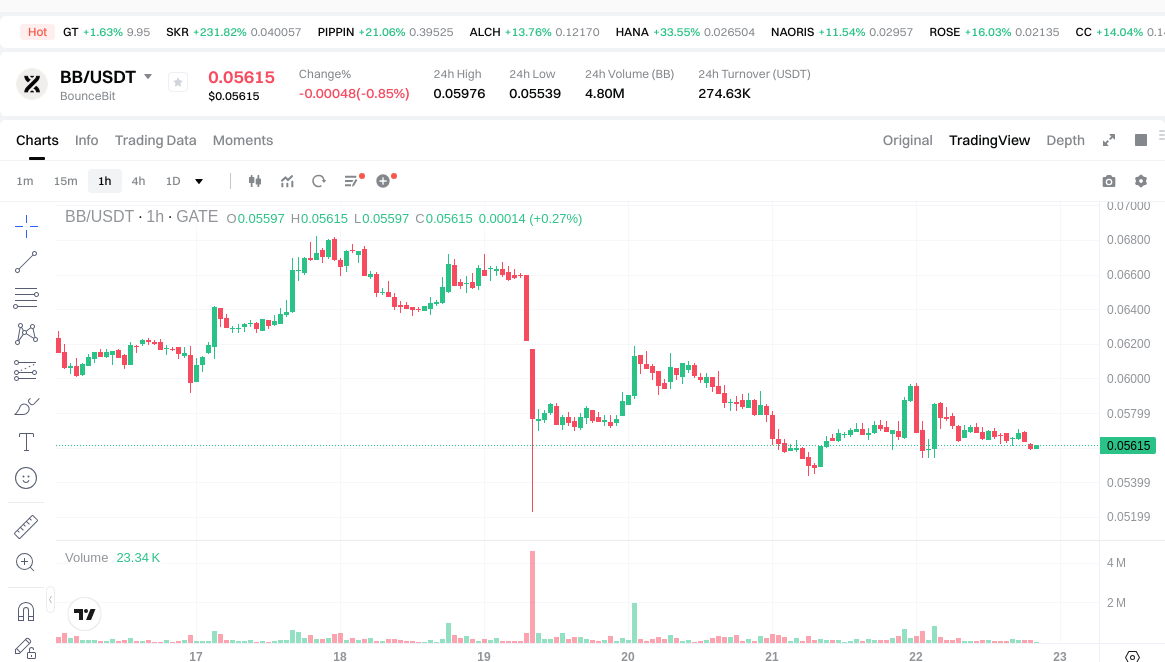
- BB Current Price: $0.05604
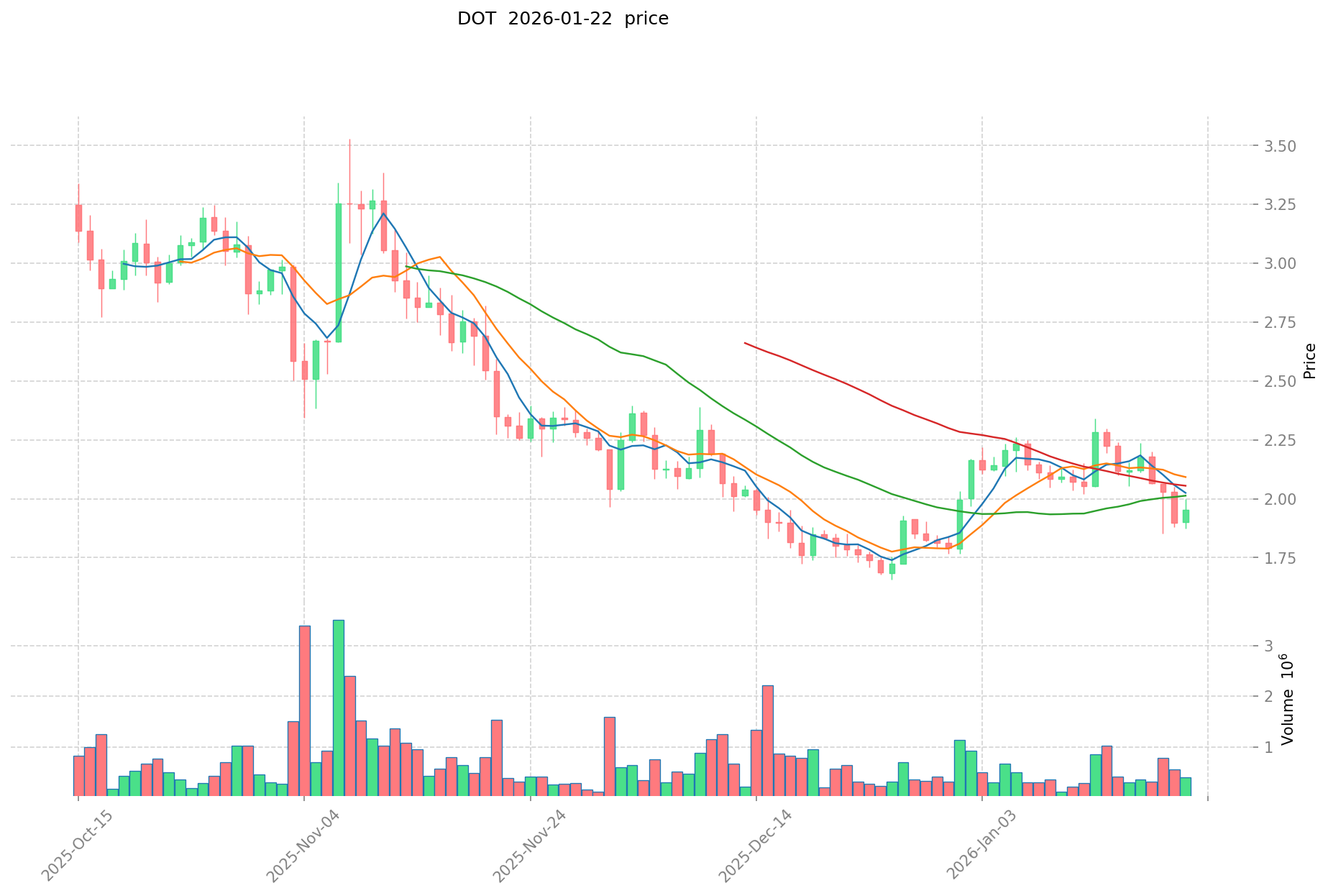
- DOT Current Price: $1.949
- 24-Hour Trading Volume: BB at $274,448.97 compared to DOT at $721,738.57
- Market Sentiment Index (Fear & Greed Index): 20 (Extreme Fear)
- Recent Performance:
- BB: -1.33% (24H), -12.11% (7D), -81.91% (1Y)
- DOT: +1.51% (24H), -11.41% (7D), -70.59% (1Y)
View real-time prices:
II. Core Factors Affecting BB vs DOT Investment Value
Supply Mechanism Comparison (Tokenomics)
Due to insufficient reference materials regarding the supply mechanisms of BB and DOT, this section cannot provide detailed comparisons at this time.
Institutional Adoption and Market Applications
Given the lack of specific data on institutional holdings, enterprise adoption scenarios, and regulatory attitudes toward BB and DOT in the provided materials, a comprehensive analysis of this aspect is not currently feasible.
Technology Development and Ecosystem Building
Without adequate information on recent technology upgrades, development roadmaps, or ecosystem metrics (including DeFi, NFT, payment solutions, and smart contract implementations) for either BB or DOT, this section cannot be substantiated with reliable data.
Macroeconomic Environment and Market Cycles
The reference materials do not contain sufficient information regarding the performance of BB and DOT under inflationary conditions, their correlation with macroeconomic monetary policies (interest rates, dollar index), or geopolitical factors affecting cross-border transaction demand. Therefore, a comparative analysis on these dimensions cannot be completed at this time.
III. 2026-2031 Price Prediction: BB vs DOT
Short-term Forecast (2026)
- BB: Conservative $0.049-$0.056 | Optimistic $0.056-$0.065
- DOT: Conservative $1.19-$1.95 | Optimistic $1.95-$2.63
Mid-term Forecast (2028-2029)
- BB may enter a consolidation phase with projected price range of $0.044-$0.084
- DOT may enter a growth phase with projected price range of $1.83-$4.25
- Key drivers: institutional capital inflows, ETF developments, ecosystem expansion
Long-term Forecast (2030-2031)
- BB: Baseline scenario $0.046-$0.077 | Optimistic scenario $0.081-$0.113
- DOT: Baseline scenario $1.91-$3.68 | Optimistic scenario $5.19-$5.85
View detailed price predictions for BB and DOT
Disclaimer
BB:
| Year |
Predicted High Price |
Predicted Average Price |
Predicted Low Price |
Price Change |
| 2026 |
0.0645725 |
0.05615 |
0.049412 |
0 |
| 2027 |
0.066397375 |
0.06036125 |
0.03138785 |
7 |
| 2028 |
0.07732276125 |
0.0633793125 |
0.05704138125 |
13 |
| 2029 |
0.08371773388125 |
0.070351036875 |
0.04432115323125 |
25 |
| 2030 |
0.080886104647031 |
0.077034385378125 |
0.05546475747225 |
37 |
| 2031 |
0.112913150367986 |
0.078960245012578 |
0.045796942107295 |
40 |
DOT:
| Year |
Predicted High Price |
Predicted Average Price |
Predicted Low Price |
Price Change |
| 2026 |
2.62845 |
1.947 |
1.18767 |
0 |
| 2027 |
3.111306 |
2.287725 |
1.83018 |
17 |
| 2028 |
3.50937015 |
2.6995155 |
1.916656005 |
38 |
| 2029 |
4.25308667025 |
3.104442825 |
1.83162126675 |
59 |
| 2030 |
5.18705829415125 |
3.678764747625 |
1.912957668765 |
88 |
| 2031 |
5.851443207572325 |
4.432911520888125 |
3.5463292167105 |
127 |
IV. Investment Strategy Comparison: BB vs DOT
Long-term vs Short-term Investment Strategies
- BB: May be suitable for investors focusing on emerging BTC restaking infrastructure and those with higher risk tolerance for early-stage projects. The token's relatively recent launch in 2024 and significant price volatility suggest it carries characteristics associated with growth-stage assets.
- DOT: May appeal to investors interested in blockchain interoperability solutions and those seeking exposure to established multi-chain ecosystem infrastructure. With its longer market presence since 2019, it represents a more mature project within the crypto asset space.
Risk Management and Asset Allocation
- Conservative investors: May consider a lower allocation to both assets given current market volatility, with potential distribution such as BB: 5-10% vs DOT: 10-15% of crypto portfolio
- Aggressive investors: Could explore higher allocations such as BB: 15-25% vs DOT: 20-30% of crypto portfolio, depending on individual risk profiles
- Hedging tools: Stablecoin reserves, options strategies, and diversified cross-asset portfolios may help manage exposure
V. Potential Risk Comparison
Market Risks
- BB: Experienced substantial price decline from $0.9 to $0.04755, demonstrating high volatility characteristics. The relatively low 24-hour trading volume of $274,448.97 may indicate liquidity considerations.
- DOT: Declined from $54.98 to $1.66, showing significant price movement during market cycles. Current 24-hour trading volume of $721,738.57 suggests relatively higher market activity compared to BB.
Technical Risks
- BB: As a newer protocol launched in 2024, considerations may include network maturity, scalability testing under various market conditions, and the evolving nature of BTC restaking infrastructure.
- DOT: Considerations may include the complexity of its relay chain architecture, cross-chain communication security, and ongoing network upgrade implementations.
Regulatory Risks
Global regulatory frameworks continue to evolve for crypto assets. Both BB and DOT may face varying degrees of regulatory scrutiny across different jurisdictions, particularly regarding staking mechanisms, cross-chain operations, and compliance requirements in different markets.
VI. Conclusion: Which Is the Better Buy?
📌 Investment Value Summary:
- BB Characteristics: Represents exposure to BTC restaking infrastructure with dual-token PoS Layer 1 architecture combining Bitcoin security and EVM compatibility. The asset demonstrates high volatility with significant price movements since its 2024 launch.
- DOT Characteristics: Provides exposure to established blockchain interoperability solutions through its relay chain architecture, connecting various blockchain networks. With a longer market history since 2019, it represents a more mature ecosystem position.
✅ Investment Considerations:
- New investors: May consider starting with smaller allocations to understand market dynamics, focusing on diversification across different asset categories and maintaining adequate stablecoin reserves for risk management.
- Experienced investors: Could evaluate portfolio positioning based on individual risk tolerance, market cycle assessment, and strategic allocation between emerging infrastructure (BB) and established interoperability solutions (DOT).
- Institutional investors: May conduct thorough due diligence on both projects' technical architecture, governance structures, regulatory compliance frameworks, and long-term ecosystem development roadmaps before making allocation decisions.
⚠️ Risk Disclosure: Cryptocurrency markets exhibit extreme volatility. This article does not constitute investment advice. All investment decisions should be made based on individual circumstances, risk tolerance, and thorough independent research.
VII. FAQ
Q1: What are the main differences between BB and DOT in terms of their core functionality?
BB focuses on BTC restaking infrastructure with a dual-token PoS Layer 1 system that combines Bitcoin security with EVM compatibility, while DOT specializes in blockchain interoperability through its relay chain architecture that connects private chains, consortium chains, public chains, and oracles. BB is an emerging protocol launched in 2024 targeting the BTC restaking sector, whereas DOT has been operational since 2019 as an established multi-chain ecosystem facilitating trustless cross-chain information and transaction exchange.
Q2: Which asset has experienced greater price volatility since launch?
BB has demonstrated higher relative volatility, declining approximately 94.7% from its all-time high of $0.9 (May 2024) to its all-time low of $0.04755 (October 2025). DOT experienced a decline of approximately 97% from its all-time high of $54.98 (November 2021) to its all-time low of $1.66 (December 2025). However, when considering the time frames and market contexts, BB's volatility occurred within a shorter 17-month period, while DOT's price movement spanned over four years across multiple market cycles.
Q3: What is the current liquidity comparison between BB and DOT?
As of January 22, 2026, DOT exhibits higher trading liquidity with a 24-hour trading volume of $721,738.57 compared to BB's $274,448.97. This approximately 2.6x difference in trading volume suggests that DOT may offer better market depth and potentially easier entry and exit positions for investors. Lower liquidity assets like BB may experience larger price slippage during trades, which is an important consideration for position sizing.
Q4: How do the short-term price projections for 2026 compare?
For 2026, BB's conservative forecast ranges from $0.049 to $0.056, with an optimistic scenario of $0.056 to $0.065, representing potential changes of -12% to +16% from the current price of $0.05604. DOT's conservative projection ranges from $1.19 to $1.95, with an optimistic scenario of $1.95 to $2.63, indicating potential movements of -39% to +35% from the current price of $1.949. Both assets show significant uncertainty in near-term projections, reflecting the current "Extreme Fear" market sentiment (Fear & Greed Index: 20).
Q5: What factors should investors consider when choosing between BB and DOT?
Investors should evaluate several key factors: risk tolerance (BB represents higher volatility and emerging technology risk versus DOT's more established but still volatile profile), investment timeline (BB may suit those focusing on BTC restaking infrastructure development, while DOT appeals to those interested in multi-chain interoperability), liquidity requirements (DOT offers higher trading volume), portfolio diversification goals (the two assets represent different technological niches within blockchain infrastructure), and market cycle positioning (both are currently experiencing downward pressure with recent 7-day declines of -12.11% for BB and -11.41% for DOT).
Q6: How do current market conditions affect the investment case for both assets?
The current "Extreme Fear" market sentiment (index: 20) and both assets' significant year-over-year declines (BB: -81.91%, DOT: -70.59%) suggest challenging market conditions. Both assets are trading near historical lows, which may present potential accumulation opportunities for risk-tolerant investors but also indicates continued market uncertainty. The low trading volumes relative to previous bull market periods suggest reduced market participation, which could mean either extended consolidation periods or potential for sharp movements once market sentiment shifts.
Q7: What are the key risks specific to each asset that investors should monitor?
For BB, key risks include its shorter operational history since 2024, lower market liquidity ($274K daily volume), potential technical maturity challenges in BTC restaking infrastructure, and limited reference data on supply mechanisms and institutional adoption. For DOT, primary concerns involve the complexity of its relay chain architecture, potential security considerations in cross-chain communications, ongoing network upgrade implementations, and the challenge of maintaining ecosystem growth amid intense multi-chain competition. Both assets face evolving regulatory frameworks for staking mechanisms and cross-chain operations across different jurisdictions.
* The information is not intended to be and does not constitute financial advice or any other recommendation of any sort offered or endorsed by Gate.