This comprehensive analysis compares Bitcoin Cash (BCH) and Solana (SOL), two major cryptocurrencies serving distinct blockchain ecosystems. BCH, launched in 2017 as a Bitcoin fork, focuses on peer-to-peer electronic cash with fixed 21M supply and low transaction fees. SOL, a high-performance platform enabling thousands of transactions per second, dominates DeFi and NFT sectors with $79.07B market cap versus BCH's $12.19B. The article examines historical price trends, tokenomics, institutional adoption, technical infrastructure, and risk factors to guide investment decisions. Through 2031 price forecasts and allocation strategies, it addresses which asset suits different investor profiles. While BCH appeals to payment-infrastructure investors seeking stable utility, SOL attracts those seeking exposure to growing decentralized application ecosystems. Both face regulatory uncertainty and market volatility requiring independent research before investment decisions on Gate exchange.
Introduction: Investment Comparison Between BCH and SOL
In the cryptocurrency market, the comparison between BCH vs SOL has consistently been a topic investors cannot overlook. The two differ notably in market cap ranking, application scenarios, and price performance, representing distinct positioning within the crypto asset landscape.
BitcoinCash (BCH): Launched in 2017 through a hard fork from Bitcoin's original chain, it has gained market recognition by focusing on on-chain scaling and following Satoshi's vision for global adoption as a peer-to-peer electronic cash system.
Solana (SOL): Founded in 2017 by former engineers from Qualcomm, Intel, and Dropbox, it has been regarded as a high-performance blockchain protocol designed to provide scalability without compromising decentralization or security.
This article will comprehensively analyze the investment value comparison of BCH vs SOL around historical price trends, supply mechanisms, institutional adoption, technical ecosystems, and future predictions, attempting to answer the question that concerns investors most:
"Which is the better buy right now?"
I. Historical Price Comparison and Current Market Status
BCH and SOL Historical Price Trends
-
2017: BCH emerged through a Bitcoin hard fork in August 2017, launching at approximately $555.89. The asset experienced significant volatility, reaching its all-time high of $3,785.82 in December 2017 during the broader cryptocurrency bull market.
-
2020: SOL launched in March 2020 at $0.22. The platform gained traction as developers sought alternatives to congested networks, with its innovative hybrid consensus mechanism attracting attention in the DeFi and NFT sectors.
-
2021: BCH witnessed notable price movements influenced by the broader cryptocurrency market cycle, though it faced downward pressure after initial gains. Meanwhile, SOL experienced substantial growth, driven by increased DeFi developer activity and the expansion of NFT marketplaces on its blockchain.
-
2025: SOL reached an all-time high of $293.31 on January 19, 2025, reflecting strong institutional interest and ecosystem development. BCH continued its established trajectory, maintaining its position within the top 20 cryptocurrencies by market capitalization.
-
Comparative Analysis: During the 2021-2022 market cycle, BCH demonstrated relatively moderate price fluctuations compared to newer Layer 1 platforms. From its historical peak of $3,785.82 to its recorded low of $76.93 in December 2018, BCH experienced approximately 98% retracement. In contrast, SOL showed greater volatility range, moving from its all-time high of $293.31 to a recorded low of $0.500801 in May 2020, representing a significant price discovery journey as a newer blockchain platform.
Current Market Condition (January 13, 2026)
-
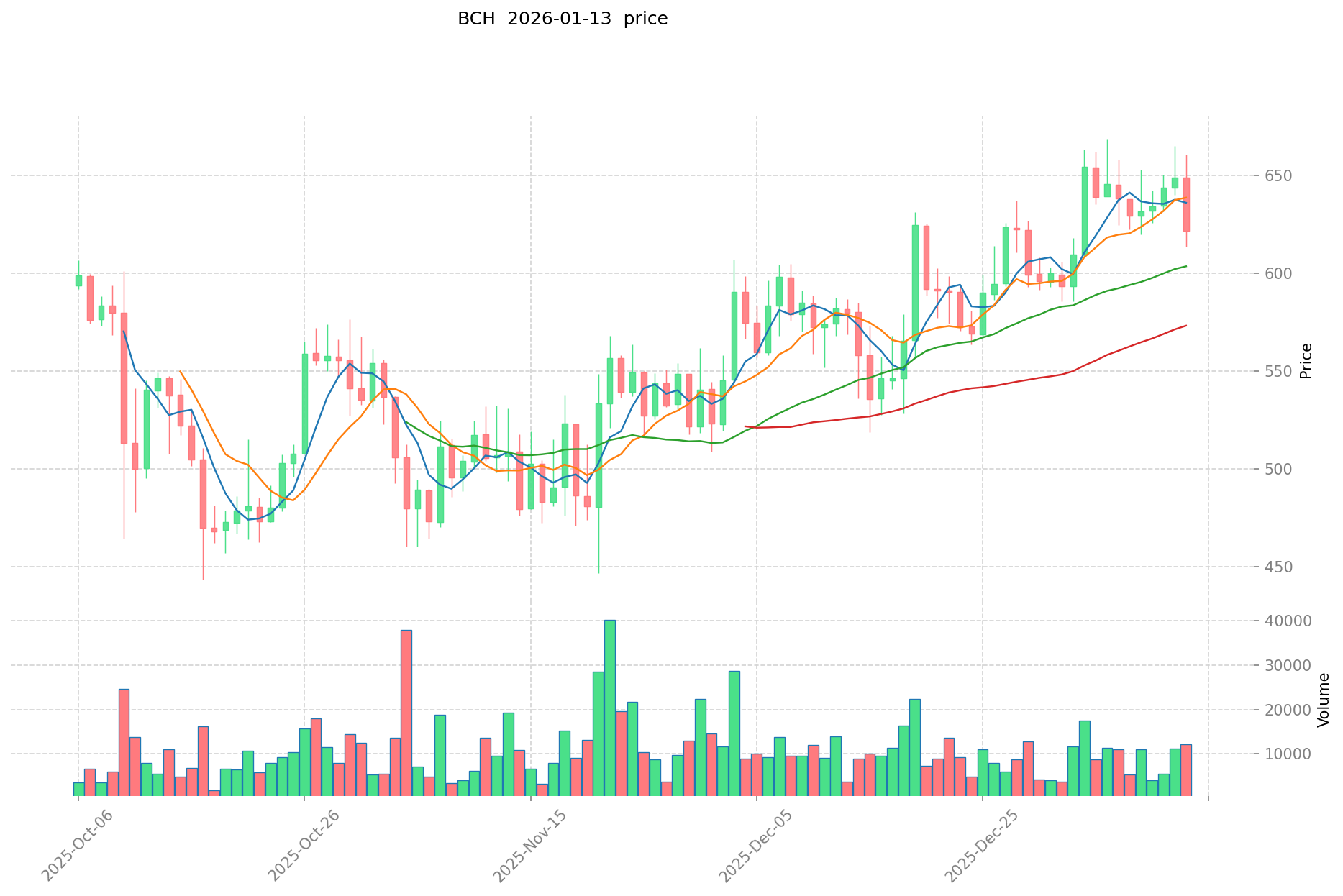
BCH Current Price: $609.90
- 24-hour change: -4.96%
- 24-hour high/low range: $642.75 / $609.01
-
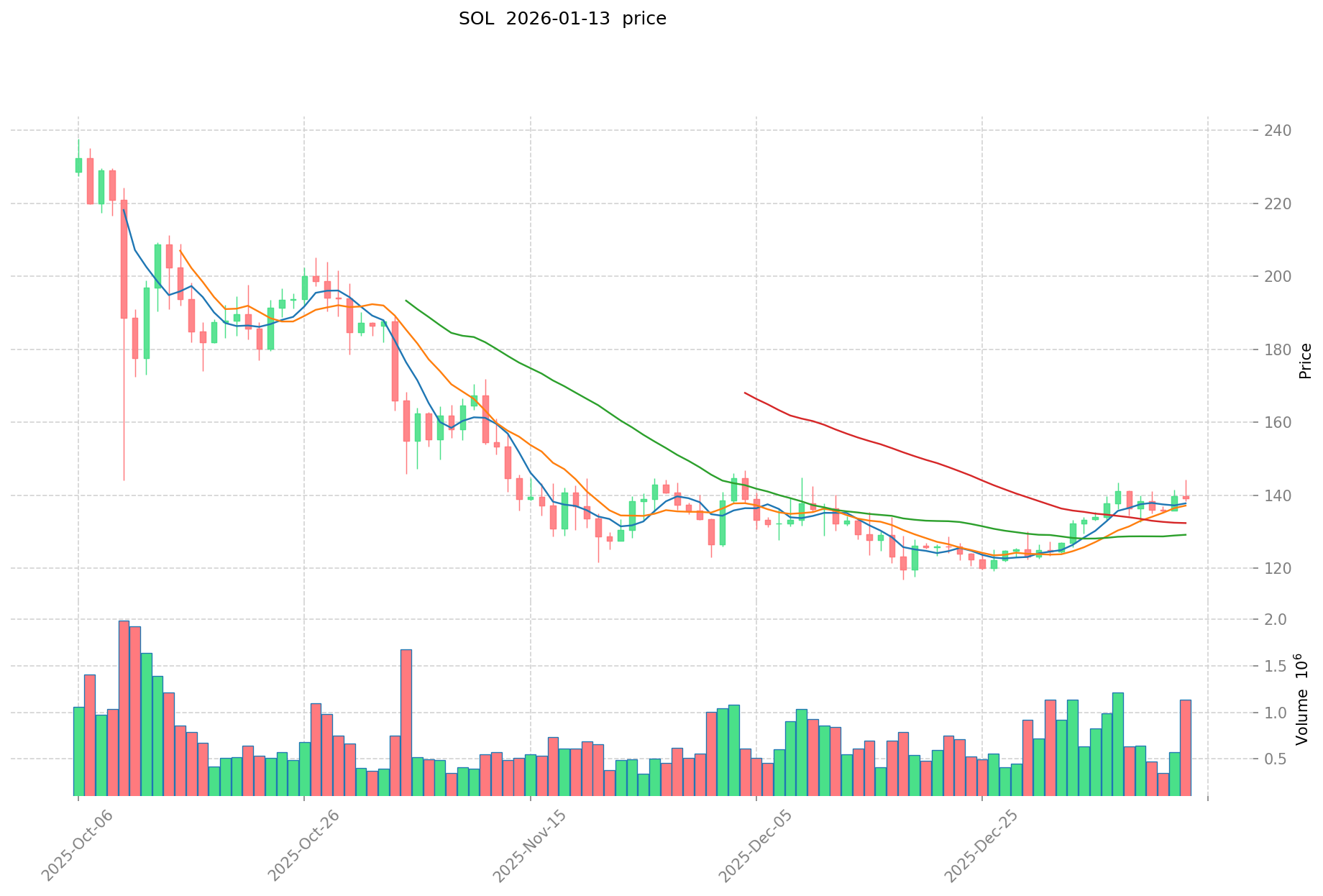
SOL Current Price: $139.90
- 24-hour change: -1.79%
- 24-hour high/low range: $144.30 / $137.85
-
24-Hour Trading Volume:
- BCH: $6,052,833.59
- SOL: $139,676,734.10
-
Market Capitalization:
- BCH: $12.19 billion (market share: 0.37%)
- SOL: $79.07 billion (market share: 2.64%)
-
Market Sentiment Index (Fear & Greed Index): 26 (Fear)
View real-time prices:
II. Core Factors Influencing BCH vs SOL Investment Value
Supply Mechanism Comparison (Tokenomics)
-
BCH: Bitcoin Cash follows a fixed supply model with a maximum cap of 21 million tokens, similar to Bitcoin. The protocol implements a halving mechanism approximately every four years, reducing block rewards and creating deflationary pressure over time.
-
SOL: Solana initially launched with an inflationary token model, though the inflation rate decreases annually. The network employs a staking mechanism where SOL tokens are used to secure the network and participate in consensus.
-
📌 Historical Pattern: Supply mechanisms influence price cycles through scarcity dynamics. Fixed-supply assets tend to experience price appreciation during periods of increased demand, while inflationary models may face dilution pressure unless offset by growing adoption and utility.
Institutional Adoption and Market Application
-
Institutional Holdings: Both assets attract different institutional profiles. BCH appeals to institutions seeking payment-focused solutions, while SOL attracts investment from organizations interested in high-performance blockchain infrastructure.
-
Enterprise Adoption: BCH has been utilized in daily payment scenarios and cross-border transactions due to its focus on fast, low-fee transfers. SOL has gained traction in DeFi and NFT sectors, with enterprise applications emerging in high-throughput transaction environments.
-
National Policies: Regulatory attitudes vary across jurisdictions. Both assets face evolving regulatory frameworks, with compliance requirements potentially affecting adoption trajectories in different markets.
Technical Development and Ecosystem Building
-
BCH Technical Upgrades: Bitcoin Cash has implemented various protocol enhancements aimed at improving transaction capacity and maintaining low fees. The network continues to focus on its core value proposition as a peer-to-peer electronic cash system.
-
SOL Technical Development: Solana employs a Proof of History (PoH) mechanism that enables high transaction throughput. The platform processes thousands of transactions per second while maintaining low transaction costs, making it suitable for applications requiring high performance.
-
Ecosystem Comparison: BCH primarily focuses on payment use cases and value transfer functionality. SOL has developed a broader ecosystem encompassing DeFi protocols, NFT marketplaces, and decentralized applications. The platforms serve different market segments based on their respective technical architectures and design philosophies.
Macroeconomic and Market Cycles
-
Performance in Inflationary Environments: Asset behavior during inflationary periods depends on multiple factors including adoption rates, utility expansion, and market sentiment. Both BCH and SOL may respond differently to macroeconomic conditions based on their distinct use cases and market positioning.
-
Macroeconomic Monetary Policy: Interest rate adjustments and currency valuations influence cryptocurrency markets broadly. Policy shifts by central banks can affect capital flows into digital assets, though the magnitude of impact varies across different cryptocurrencies.
-
Geopolitical Factors: Cross-border transaction demand and international developments may create varying levels of interest in different cryptocurrency solutions. Market dynamics respond to multiple simultaneous factors including technological innovation, regulatory developments, and broader economic trends.
III. 2026-2031 Price Forecast: BCH vs SOL
Short-term Forecast (2026)
- BCH: Conservative $462.35-$608.35 | Optimistic $608.35-$803.02
- SOL: Conservative $106.43-$140.04 | Optimistic $140.04-$170.85
Mid-term Forecast (2028-2029)
- BCH may enter a growth phase, with estimated prices ranging from $684.59 to $1,275.10
- SOL may enter an expansion phase, with estimated prices ranging from $119.52 to $280.28
- Key drivers: institutional capital inflows, ETF developments, ecosystem expansion
Long-term Forecast (2030-2031)
- BCH: Baseline scenario $926.45-$1,356.58 | Optimistic scenario $1,356.58-$1,610.25
- SOL: Baseline scenario $181.09-$272.86 | Optimistic scenario $272.86-$308.33
View detailed price predictions for BCH and SOL
Disclaimer
BCH:
| Year |
Predicted High Price |
Predicted Average Price |
Predicted Low Price |
Price Change |
| 2026 |
803.022 |
608.35 |
462.346 |
0 |
| 2027 |
832.70948 |
705.686 |
508.09392 |
15 |
| 2028 |
1092.2607908 |
769.19774 |
684.5859886 |
25 |
| 2029 |
1275.099093598 |
930.7292654 |
902.807387438 |
52 |
| 2030 |
1610.25470206854 |
1102.914179499 |
926.44791077916 |
80 |
| 2031 |
1519.3745736778224 |
1356.58444078377 |
936.0432641408013 |
121 |
SOL:
| Year |
Predicted High Price |
Predicted Average Price |
Predicted Low Price |
Price Change |
| 2026 |
170.8488 |
140.04 |
106.4304 |
0 |
| 2027 |
206.741052 |
155.4444 |
79.276644 |
11 |
| 2028 |
237.23147106 |
181.092726 |
119.52119916 |
29 |
| 2029 |
280.2772120302 |
209.16209853 |
106.6726702503 |
49 |
| 2030 |
301.005175994523 |
244.7196552801 |
181.092544907274 |
74 |
| 2031 |
308.334529670161995 |
272.8624156373115 |
201.91818757161051 |
95 |
IV. Investment Strategy Comparison: BCH vs SOL
Long-term vs Short-term Investment Strategies
-
BCH: Suitable for investors focused on payment infrastructure and peer-to-peer transaction utility. The fixed supply model and established market presence may appeal to those seeking exposure to payment-oriented digital assets with deflationary characteristics.
-
SOL: Suitable for investors interested in high-performance blockchain ecosystems and decentralized application infrastructure. The platform's focus on DeFi and NFT sectors may attract those seeking exposure to emerging blockchain use cases.
Risk Management and Asset Allocation
-
Conservative Investors: BCH 30% vs SOL 20% (with remaining allocation to established assets and stable positions)
-
Aggressive Investors: BCH 25% vs SOL 35% (with higher allocation to growth-oriented positions)
-
Hedging Tools: Stablecoin allocation for liquidity management, options strategies for downside protection, cross-asset portfolio diversification across different blockchain sectors
V. Potential Risk Comparison
Market Risk
-
BCH: Price volatility influenced by broader cryptocurrency market cycles, competition from other payment-focused digital assets, and potential shifts in adoption patterns for peer-to-peer transaction solutions.
-
SOL: Higher volatility range compared to established assets, sensitivity to DeFi and NFT market sentiment, competitive pressure from other Layer 1 blockchain platforms, and potential impact from ecosystem-specific developments.
Technical Risk
-
BCH: Network scalability considerations related to block size parameters, ongoing development requirements to maintain competitive transaction throughput, and technical coordination across decentralized development communities.
-
SOL: Network stability considerations during high-traffic periods, technical complexity of consensus mechanisms, potential vulnerabilities in high-performance architecture, and dependencies on validator network robustness.
Regulatory Risk
- Global regulatory frameworks continue to evolve, with varying approaches across jurisdictions. Payment-focused assets like BCH may face different regulatory considerations compared to platform-oriented assets like SOL. Both assets operate within regulatory environments that include compliance requirements, disclosure obligations, and potential policy adjustments affecting cryptocurrency markets broadly.
VI. Conclusion: Which Is the Better Buy?
📌 Investment Value Summary:
-
BCH Advantages: Established market presence since 2017, fixed supply mechanism creating deflationary pressure, focus on payment utility and peer-to-peer transactions, recognition within the cryptocurrency sector as a Bitcoin fork with distinct scaling approach.
-
SOL Advantages: High-performance blockchain infrastructure supporting thousands of transactions per second, growing ecosystem in DeFi and NFT sectors, innovative consensus mechanism combining Proof of History with Proof of Stake, strong institutional interest reflected in market capitalization growth.
✅ Investment Considerations:
-
New Investors: May consider starting with smaller allocations across both assets to gain exposure to different blockchain sectors. Understanding the distinct use cases and technical fundamentals of each platform remains important for informed decision-making.
-
Experienced Investors: May evaluate portfolio positioning based on risk tolerance, investment horizon, and conviction in specific blockchain use cases. Diversification across payment-oriented and platform-oriented assets could provide exposure to different growth drivers.
-
Institutional Investors: May assess both assets based on institutional requirements including liquidity profiles, custody solutions, regulatory compliance frameworks, and alignment with investment mandates. Different institutional strategies may favor either payment infrastructure or platform ecosystem exposure.
⚠️ Risk Disclosure: Cryptocurrency markets exhibit significant volatility. This content does not constitute investment advice. Investors should conduct independent research and consider their individual circumstances before making investment decisions.
VII. FAQ
Q1: What are the main differences between BCH and SOL in terms of their fundamental design and use cases?
BCH focuses on peer-to-peer electronic cash with a fixed 21 million token supply and low-fee transactions, while SOL is a high-performance blockchain platform designed for DeFi and NFT applications with an inflationary token model. BCH emerged from Bitcoin's 2017 hard fork prioritizing on-chain scaling for payment scenarios, whereas SOL launched in 2020 with Proof of History consensus enabling thousands of transactions per second for decentralized applications. The platforms serve distinct market segments—BCH targets payment infrastructure and value transfer, while SOL emphasizes ecosystem development across DeFi protocols and NFT marketplaces.
Q2: How do the current market capitalizations of BCH and SOL compare, and what does this indicate?
As of January 13, 2026, SOL maintains a market capitalization of $79.07 billion (2.64% market share) compared to BCH's $12.19 billion (0.37% market share). This substantial difference reflects SOL's stronger institutional interest and broader ecosystem adoption in DeFi and NFT sectors, alongside its higher trading volume of $139.68 million versus BCH's $6.05 million in 24-hour periods. The market cap disparity suggests investors currently place greater value on SOL's platform capabilities and growth potential, though BCH maintains its established position as a payment-focused digital asset with a longer market history since 2017.
Q3: What are the price predictions for BCH and SOL through 2031?
For 2026, BCH forecasts range from $462.35-$803.02 while SOL ranges from $106.43-$170.85. By 2031, BCH predictions extend to $936.04-$1,519.37 (baseline to optimistic scenarios) representing a 121% potential increase, whereas SOL forecasts range from $201.92-$308.33 showing a 95% potential increase. Mid-term forecasts for 2028-2029 suggest BCH may reach $684.59-$1,275.10 driven by institutional capital and potential ETF developments, while SOL could achieve $119.52-$280.28 through ecosystem expansion. These projections reflect different growth trajectories based on their respective adoption patterns and market positioning.
Q4: Which cryptocurrency presents lower risk for conservative investors?
BCH generally presents lower volatility characteristics for conservative investors due to its longer market history, established payment use case, and fixed supply mechanism similar to Bitcoin. The asset experienced approximately 98% retracement from its peak, whereas SOL demonstrated wider price discovery ranges as a newer platform. Conservative portfolio allocation might favor BCH at 30% versus SOL at 20% with remaining holdings in established assets. However, both assets carry inherent cryptocurrency market risks including regulatory uncertainty, technical developments, and broader market cycle influences that require careful consideration regardless of risk profile.
Q5: What are the key technical risks distinguishing BCH from SOL?
BCH faces technical risks related to network scalability through block size parameters, ongoing development coordination across decentralized communities, and competition from other payment-focused solutions. SOL encounters different technical challenges including network stability during high-traffic periods, complexity of its Proof of History consensus mechanism, potential vulnerabilities in high-performance architecture, and dependency on validator network robustness. SOL's network has experienced occasional performance issues during peak usage, while BCH maintains more predictable operation but requires continuous development to remain competitive in transaction throughput against emerging payment solutions.
Q6: How do regulatory considerations differ between BCH and SOL?
BCH as a payment-focused asset may face regulatory scrutiny similar to other cryptocurrencies used for value transfer and cross-border transactions, with compliance requirements varying across jurisdictions. SOL, operating as a platform for DeFi and NFTs, encounters different regulatory considerations related to securities frameworks, decentralized application oversight, and smart contract governance. Both assets operate within evolving global regulatory environments that include disclosure obligations and potential policy adjustments. The distinction lies in BCH's positioning as electronic cash versus SOL's role as infrastructure for decentralized applications, which may attract different regulatory approaches.
Q7: What institutional adoption patterns currently favor each cryptocurrency?
BCH attracts institutions seeking payment-focused solutions and cross-border transaction capabilities, appealing to organizations prioritizing low-fee value transfers. SOL has gained stronger institutional traction reflected in its $79.07 billion market capitalization, with investment from organizations interested in high-performance blockchain infrastructure for DeFi and enterprise applications. The 23x difference in 24-hour trading volume ($139.68M for SOL versus $6.05M for BCH) indicates greater institutional liquidity preference for SOL. However, institutional strategies vary based on investment mandates, with some favoring BCH's established payment utility while others prefer SOL's ecosystem growth potential.
Q8: Which cryptocurrency is more suitable for long-term holding versus short-term trading?
BCH may suit long-term holding strategies for investors focused on payment infrastructure with deflationary characteristics from its fixed 21 million supply and four-year halving cycles. SOL appeals to investors seeking exposure to growing DeFi and NFT ecosystems with higher growth potential but increased volatility. Short-term traders may find SOL's higher 24-hour volume ($139.68M) and volatility range more conducive to active trading strategies. Long-term investors might consider BCH's established market presence since 2017 and predictable supply mechanism, while those accepting higher risk for potential growth may favor SOL's expanding ecosystem and institutional backing reflected in its larger market capitalization.
* The information is not intended to be and does not constitute financial advice or any other recommendation of any sort offered or endorsed by Gate.