This comprehensive guide compares BDX and TRX, two distinct blockchain assets with different market positions and investment characteristics. BDX, a privacy-focused platform launched in 2019, currently trades at $0.10599 with $806.08M market cap, while TRX, an established infrastructure platform from 2017, trades at $0.30281 with $28.68B market cap and significantly higher liquidity. The article analyzes historical price trends, supply mechanisms, institutional adoption, and technological ecosystems to help investors make informed decisions. Price predictions through 2031 suggest BDX potential in $0.1198-$0.3841 range and TRX in $0.2527-$0.6480 range, with recommended allocations varying by risk tolerance. Beginning investors may favor TRX's established presence and superior liquidity, while experienced investors could diversify across both assets, with detailed risk analysis and FAQ guidance provided for optimal portfolio positioning on Gate exchange.
Introduction: Investment Comparison Between BDX and TRX
In the cryptocurrency market, the comparison between BDX vs TRX has consistently been a topic of interest for investors. Both assets demonstrate notable differences in market capitalization ranking, application scenarios, and price performance, representing distinct positioning within the crypto asset landscape.
Beldex (BDX): Launched in 2019, it has gained market recognition through its focus on privacy-centric decentralized applications, building an ecosystem that includes confidential communication and browsing solutions.
TRON (TRX): Emerging in 2017, it has established itself as a major blockchain infrastructure platform, becoming one of the cryptocurrencies with substantial global trading volume and market capitalization.
This article will provide a comprehensive analysis of BDX vs TRX investment value comparison, examining historical price trends, supply mechanisms, institutional adoption, technological ecosystems, and future outlook, attempting to address investors' primary concern:
"Which is the better buy right now?"
I. Historical Price Comparison and Current Market Status
Historical Price Trends of BDX (Coin A) and TRX (Coin B)
- 2018: BDX reached its all-time high of $0.450785 on December 17, 2018, during the broader crypto market rally period.
- 2019: BDX experienced significant decline, reaching its all-time low of $0.00027519 on November 1, 2019, amid market correction.
- 2024: TRX achieved its all-time high of $0.431288 on December 4, 2024, reflecting renewed market interest and ecosystem developments.
- 2017: TRX recorded its all-time low of $0.00180434 on November 12, 2017, shortly after its initial market debut.
- Comparative Analysis: During different market cycles, BDX declined from its peak of $0.450785 to its lowest point of $0.00027519, representing a substantial downward movement. In contrast, TRX demonstrated more recent price strength, with its historical high occurring in late 2024, indicating different developmental trajectories and market positioning between the two assets.
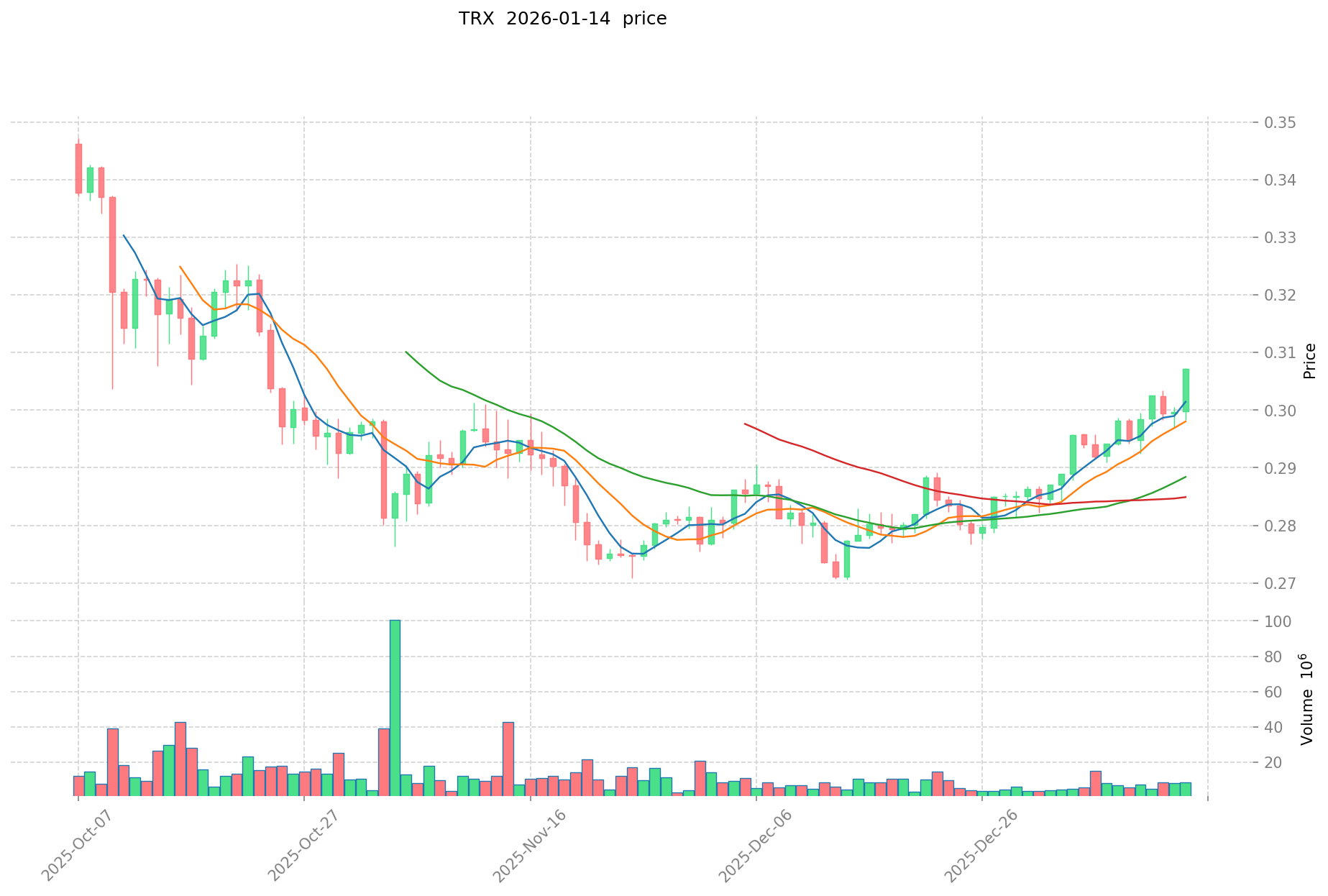
Current Market Situation (January 14, 2026)
- BDX Current Price: $0.10599
- TRX Current Price: $0.30281
- 24-Hour Trading Volume: BDX $24,563.73 vs TRX $3,625,522.35
- Market Sentiment Index (Fear & Greed Index): 48 (Neutral)
- BDX Market Performance: 24-hour change of +3.13%, with trading range between $0.1017 (low) and $0.1072 (high)
- TRX Market Performance: 24-hour change of +1.15%, with trading range between $0.29838 (low) and $0.30734 (high)
- Market Capitalization: BDX $806.08M vs TRX $28.68B
- Circulating Supply: BDX 7.61 billion tokens vs TRX 94.70 billion tokens
View real-time prices:
- Check BDX current price Market Price
- Check TRX current price Market Price

II. Core Factors Influencing BDX vs TRX Investment Value
Supply Mechanism Comparison (Tokenomics)
- BDX: The investment value of BDX is shaped by its supply dynamics and technological framework. Market sentiment plays a significant role in driving demand fluctuations.
- TRX: TRX's value proposition relies on market trends and community-driven adoption patterns. The token's circulation model responds to broader cryptocurrency market cycles.
- 📌 Historical Pattern: Supply mechanisms influence price cycles through community engagement levels and technological milestone achievements.
Institutional Adoption and Market Applications
- Institutional Holdings: Both cryptocurrencies compete for institutional attention, though specific holding data requires independent verification.
- Enterprise Adoption: Cross-border payment applications and settlement use cases remain under development for both assets, with varying degrees of real-world implementation.
- National Policies: Regulatory approaches differ across jurisdictions, creating distinct operational environments for each cryptocurrency.
Technological Development and Ecosystem Building
- BDX Technical Evolution: Technological advancements focus on privacy features and network security enhancements. Development progress impacts community confidence and adoption rates.
- TRX Technical Progress: Platform development emphasizes transaction efficiency and ecosystem expansion. Technical upgrades aim to strengthen network capabilities.
- Ecosystem Comparison: Both projects maintain presence in DeFi and smart contract spaces, with ongoing efforts to expand practical applications.
Macroeconomic Environment and Market Cycles
- Inflation Environment Performance: Both cryptocurrencies respond to macroeconomic conditions through market participant behavior and sentiment shifts.
- Macroeconomic Monetary Policy: Interest rate movements and currency index fluctuations create market conditions affecting cryptocurrency valuations generally.
- Geopolitical Factors: International transaction demand and cross-border use cases influence adoption patterns for both digital assets.
III. 2026-2031 Price Prediction: BDX vs TRX
Short-term Forecast (2026)
- BDX: Conservative $0.0984 - $0.1058 | Optimistic $0.1481
- TRX: Conservative $0.1909 - $0.3031 | Optimistic $0.3122
Medium-term Forecast (2028-2029)
- BDX may enter a phase of moderate growth with projected price range of $0.1051 - $0.2020 in 2028, potentially reaching $0.1582 - $0.2501 by 2029
- TRX may experience gradual appreciation with estimated range of $0.2770 - $0.4553 in 2028, expanding to $0.2205 - $0.4642 in 2029
- Key drivers: institutional capital flows, ETF developments, ecosystem expansion
Long-term Forecast (2030-2031)
- BDX: Base scenario $0.1198 - $0.2104 (2030) | Optimistic scenario $0.2465 - $0.3841 (2031)
- TRX: Base scenario $0.2851 - $0.4255 (2030) | Optimistic scenario $0.2527 - $0.6480 (2031)
View detailed price predictions for BDX and TRX
Disclaimer: These projections are based on historical data patterns and should not be considered as investment advice. Cryptocurrency markets are highly volatile and subject to various unpredictable factors.
BDX:
| Year |
Predicted High Price |
Predicted Average Price |
Predicted Low Price |
Price Change |
| 2026 |
0.148064 |
0.10576 |
0.0983568 |
0 |
| 2027 |
0.14975616 |
0.126912 |
0.06853248 |
19 |
| 2028 |
0.2019677568 |
0.13833408 |
0.1051339008 |
30 |
| 2029 |
0.250121850048 |
0.1701509184 |
0.158240354112 |
60 |
| 2030 |
0.30890048480928 |
0.210136384224 |
0.11977773900768 |
98 |
| 2031 |
0.384087283084627 |
0.25951843451664 |
0.246542512790808 |
144 |
TRX:
| Year |
Predicted High Price |
Predicted Average Price |
Predicted Low Price |
Price Change |
| 2026 |
0.3121518 |
0.30306 |
0.1909278 |
0 |
| 2027 |
0.329138313 |
0.3076059 |
0.209172012 |
1 |
| 2028 |
0.455272112295 |
0.3183721065 |
0.276983732655 |
5 |
| 2029 |
0.464186531277 |
0.3868221093975 |
0.220488602356575 |
27 |
| 2030 |
0.49358501159121 |
0.42550432033725 |
0.285087894625957 |
40 |
| 2031 |
0.647957979009564 |
0.45954466596423 |
0.252749566280326 |
51 |
IV. Investment Strategy Comparison: BDX vs TRX
Long-term vs Short-term Investment Strategies
- BDX: May appeal to investors interested in privacy-focused applications and emerging ecosystem developments, though requiring tolerance for higher volatility and lower liquidity levels
- TRX: May suit investors seeking exposure to established blockchain infrastructure with greater market liquidity and broader ecosystem participation
Risk Management and Asset Allocation
- Conservative Investors: BDX 15-20% vs TRX 80-85%
- Aggressive Investors: BDX 30-40% vs TRX 60-70%
- Hedging Tools: Stablecoin allocation, options strategies, cross-asset portfolio diversification
V. Potential Risk Comparison
Market Risks
- BDX: Lower trading volume of $24,563.73 creates liquidity constraints and potential for price volatility during market stress periods
- TRX: Higher market capitalization of $28.68B provides deeper liquidity but remains subject to broader cryptocurrency market cycles
Technical Risks
- BDX: Scalability considerations and network stability require ongoing development attention
- TRX: Network concentration factors and security architecture remain areas requiring continued monitoring
Regulatory Risks
- Global regulatory frameworks continue evolving, with potential differential impacts on privacy-focused protocols versus general-purpose blockchain platforms
VI. Conclusion: Which Is the Better Buy?
📌 Investment Value Summary:
- BDX Characteristics: Privacy-oriented features, early-stage ecosystem development, lower market capitalization providing potential growth space
- TRX Characteristics: Established infrastructure platform, substantial trading volume, broader ecosystem adoption
✅ Investment Considerations:
- Beginning Investors: TRX may offer greater liquidity and established market presence for initial cryptocurrency exposure
- Experienced Investors: Portfolio diversification across both assets could balance infrastructure exposure with emerging privacy applications
- Institutional Investors: Due diligence should include liquidity requirements, regulatory compliance considerations, and long-term positioning within digital asset frameworks
⚠️ Risk Disclosure: Cryptocurrency markets demonstrate significant volatility. This analysis does not constitute investment advice.
VII. FAQ
Q1: What is the main difference between BDX and TRX in terms of market positioning?
BDX focuses on privacy-centric decentralized applications while TRX operates as a major blockchain infrastructure platform. BDX, launched in 2019, has built an ecosystem centered around confidential communication and browsing solutions with a market capitalization of $806.08M. In contrast, TRX, emerging in 2017, has established itself as one of the cryptocurrencies with substantial global presence, boasting a market capitalization of $28.68B and significantly higher trading volume ($3,625,522.35 vs BDX's $24,563.73 in 24-hour volume). This fundamental difference reflects their distinct development trajectories and target use cases in the cryptocurrency landscape.
Q2: Which cryptocurrency offers better liquidity for investors?
TRX provides significantly better liquidity compared to BDX. As of January 14, 2026, TRX records a 24-hour trading volume of $3,625,522.35, which is approximately 147 times higher than BDX's trading volume of $24,563.73. This substantial difference in trading volume means TRX investors can execute larger transactions with minimal price impact, while BDX's lower liquidity creates potential for higher volatility and may present challenges during rapid market movements. For investors prioritizing ease of entry and exit from positions, TRX's deeper liquidity represents a considerable advantage.
Q3: What are the recommended portfolio allocation strategies for BDX vs TRX?
Portfolio allocation should align with individual risk tolerance levels. Conservative investors may consider allocating 15-20% to BDX and 80-85% to TRX, emphasizing the more established and liquid asset. Aggressive investors seeking higher growth potential could increase BDX allocation to 30-40% while maintaining 60-70% in TRX. This differentiated approach reflects BDX's position as an emerging privacy-focused project with potential upside but higher volatility, versus TRX's role as an established infrastructure platform offering greater stability. Both strategies should incorporate hedging tools such as stablecoin reserves and diversification across other asset classes.
Q4: How have BDX and TRX performed historically, and what does this indicate about future potential?
BDX experienced extreme volatility, reaching an all-time high of $0.450785 in December 2018 before declining to an all-time low of $0.00027519 in November 2019—representing a significant market correction. TRX demonstrated more recent strength, achieving its all-time high of $0.431288 in December 2024, well after its 2017 launch when it hit a low of $0.00180434. These historical patterns suggest TRX has maintained more consistent development momentum and market confidence, while BDX's trajectory reflects the challenges faced by privacy-focused projects in gaining sustained adoption. Current prices of $0.10599 (BDX) and $0.30281 (TRX) indicate both assets remain well below their historical peaks, though TRX's recent high suggests renewed ecosystem strength.
Q5: What are the price predictions for BDX and TRX through 2031?
Short-term 2026 forecasts project BDX in a conservative range of $0.0984-$0.1058 with optimistic scenarios reaching $0.1481, while TRX conservative estimates range from $0.1909-$0.3031 with optimistic potential of $0.3122. By 2030-2031, BDX base scenarios suggest $0.1198-$0.2104 (2030) expanding to $0.2465-$0.3841 (2031) in optimistic conditions. TRX projections indicate $0.2851-$0.4255 (2030) with optimistic 2031 scenarios reaching $0.2527-$0.6480. These predictions reflect different growth trajectories, with BDX showing potential for higher percentage gains from its current lower base, while TRX demonstrates more gradual appreciation from an already substantial market position. However, these forecasts remain subject to high uncertainty due to cryptocurrency market volatility.
Q6: What are the primary risks associated with investing in BDX versus TRX?
BDX faces liquidity risk due to its significantly lower trading volume, creating potential for sharp price swings and difficulty executing large transactions without market impact. Technical scalability and ongoing development requirements also present considerations for BDX's privacy-focused architecture. TRX, while offering superior liquidity, faces risks related to network concentration factors and security architecture that require continued monitoring. Both assets are subject to evolving global regulatory frameworks, though privacy-focused protocols like BDX may face distinct regulatory scrutiny compared to general-purpose platforms like TRX. Additionally, both cryptocurrencies remain exposed to broader market cycles and macroeconomic conditions affecting the entire cryptocurrency sector.
Q7: Which cryptocurrency is more suitable for beginning versus experienced investors?
TRX may be more appropriate for beginning investors due to its established market presence, greater liquidity, and broader ecosystem adoption, providing a more accessible entry point into cryptocurrency investment. The higher trading volume reduces execution risks and allows for easier position management. Experienced investors might consider portfolio diversification incorporating both assets—TRX for infrastructure exposure and core holdings, combined with BDX allocation for potential growth in privacy applications and emerging use cases. Institutional investors should prioritize comprehensive due diligence encompassing liquidity requirements, regulatory compliance considerations, and strategic positioning within broader digital asset frameworks before determining appropriate allocation levels.
Q8: How do supply mechanisms affect the investment value of BDX and TRX?
Supply dynamics significantly influence both cryptocurrencies' value propositions through different mechanisms. BDX's investment value is shaped by its supply structure in relation to privacy-focused demand patterns and technological development milestones, with current circulating supply of 7.61 billion tokens supporting a market cap of $806.08M. TRX operates with a substantially larger circulating supply of 94.70 billion tokens, supporting its $28.68B market capitalization. These tokenomics create different scarcity dynamics—BDX's lower supply base potentially allows for greater percentage appreciation if adoption accelerates, while TRX's larger supply supports higher absolute liquidity and stability. Historical patterns demonstrate that supply mechanisms influence price cycles through community engagement levels and achievement of technological milestones for both projects.
* The information is not intended to be and does not constitute financial advice or any other recommendation of any sort offered or endorsed by Gate.