This comprehensive guide compares BDXN and XTZ, two distinct blockchain assets serving different market segments. BDXN, launched in 2025, positions itself as a next-generation Web3 professional networking platform focused on talent and reputation systems within the freelance economy, while XTZ is an established self-amending blockchain platform operational since 2017 with formal verification and smart contract capabilities. The analysis examines historical price performance, supply mechanisms, institutional adoption, technical ecosystems, and market forecasts through 2031, with BDXN showing consolidation patterns and XTZ demonstrating expansion potential. Investment recommendations vary by investor profile: conservative investors favor 70-80% XTZ allocation due to proven operational history, while experienced investors may allocate 60-70% XTZ and 30-40% BDXN for growth exposure. Key risk considerations include BDXN's substantial volatility and limited trading history versus XTZ's established but cyclical pric
Introduction: Investment Comparison Between BDXN and XTZ
In the cryptocurrency market, the comparison between BDXN vs XTZ continues to be a topic of interest among investors. These two assets exhibit notable differences in market capitalization ranking, use cases, and price performance, representing distinct positioning within the crypto asset landscape.
Bondex (BDXN): Launched in 2025, it has attracted attention with its positioning as a next-generation on-chain professional network focused on talent, reputation, and economic opportunities, targeting professional networking and the freelance economy.
Tezos (XTZ): Since its launch in 2017, it has been recognized as a self-amending blockchain platform with formal verification capabilities, supporting smart contracts and decentralized applications.
This article will provide a comprehensive analysis of BDXN vs XTZ investment value comparison, examining historical price trends, supply mechanisms, institutional adoption, technological ecosystems, and future outlook, attempting to address investors' key questions:
"Which is the better buy right now?"
I. Historical Price Comparison and Market Overview
- 2025: BDXN reached an all-time high of $0.449 in June 2025, reflecting early market interest following its launch in February 2025.
- 2021: XTZ reached its all-time high of $9.12 in October 2021, driven by broader cryptocurrency market momentum during that period.
- Comparative Analysis: During the 2025-2026 market cycle, BDXN declined from its peak of $0.449 to a low of $0.00545 in October 2025, while XTZ experienced a significant decline from its 2021 peak of $9.12 to a historical low of $0.350476 in December 2018, followed by price fluctuations ranging between $0.50 and $0.62 in early 2026.
Current Market Status (January 31, 2026)
- BDXN Current Price: $0.01843
- XTZ Current Price: $0.506
- 24-Hour Trading Volume: BDXN recorded $302,810.84, while XTZ recorded $565,601.99
- Market Sentiment Index (Fear & Greed Index): 16 (Extreme Fear)
View real-time prices:
- Check BDXN current price Market Price
- Check XTZ current price Market Price
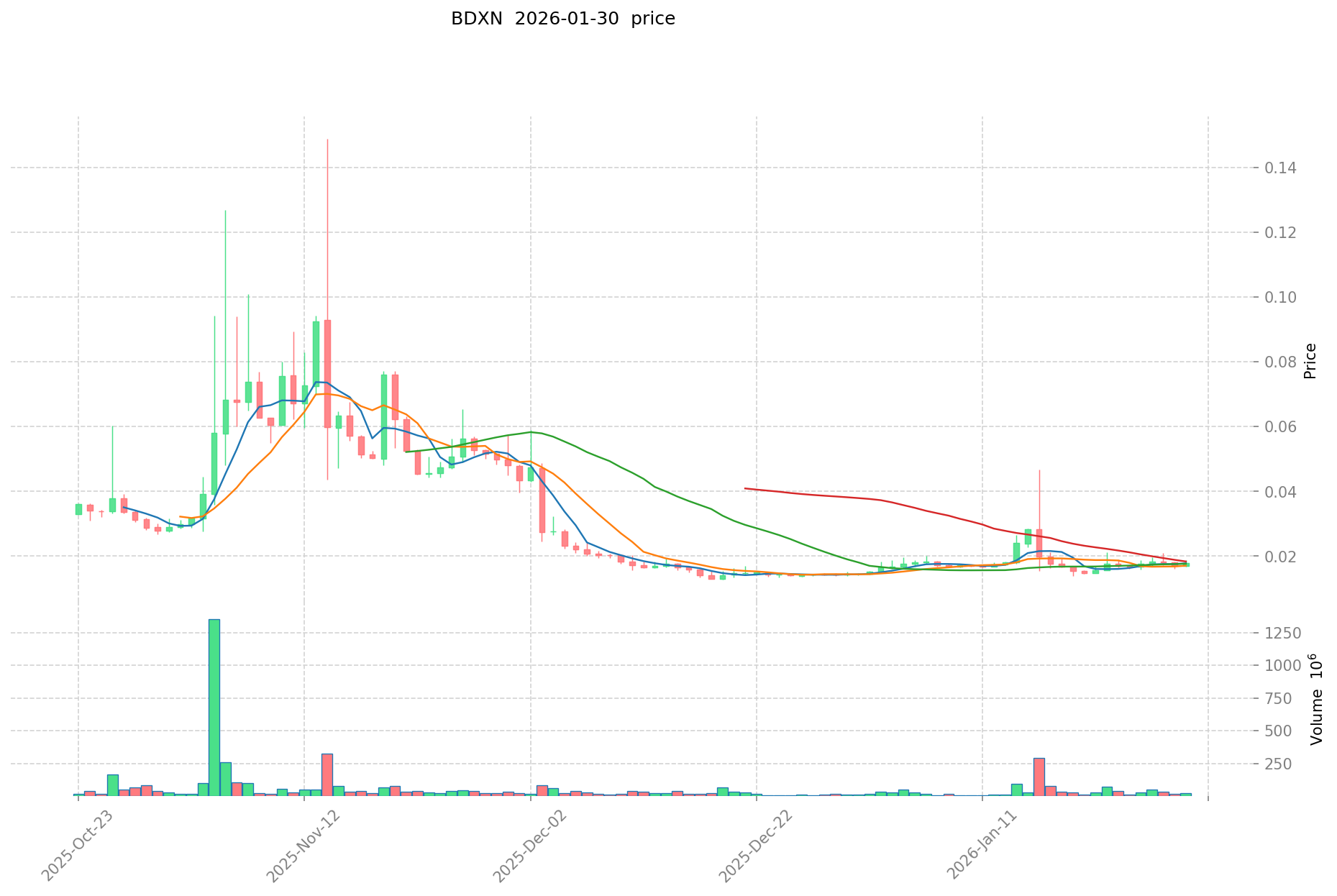
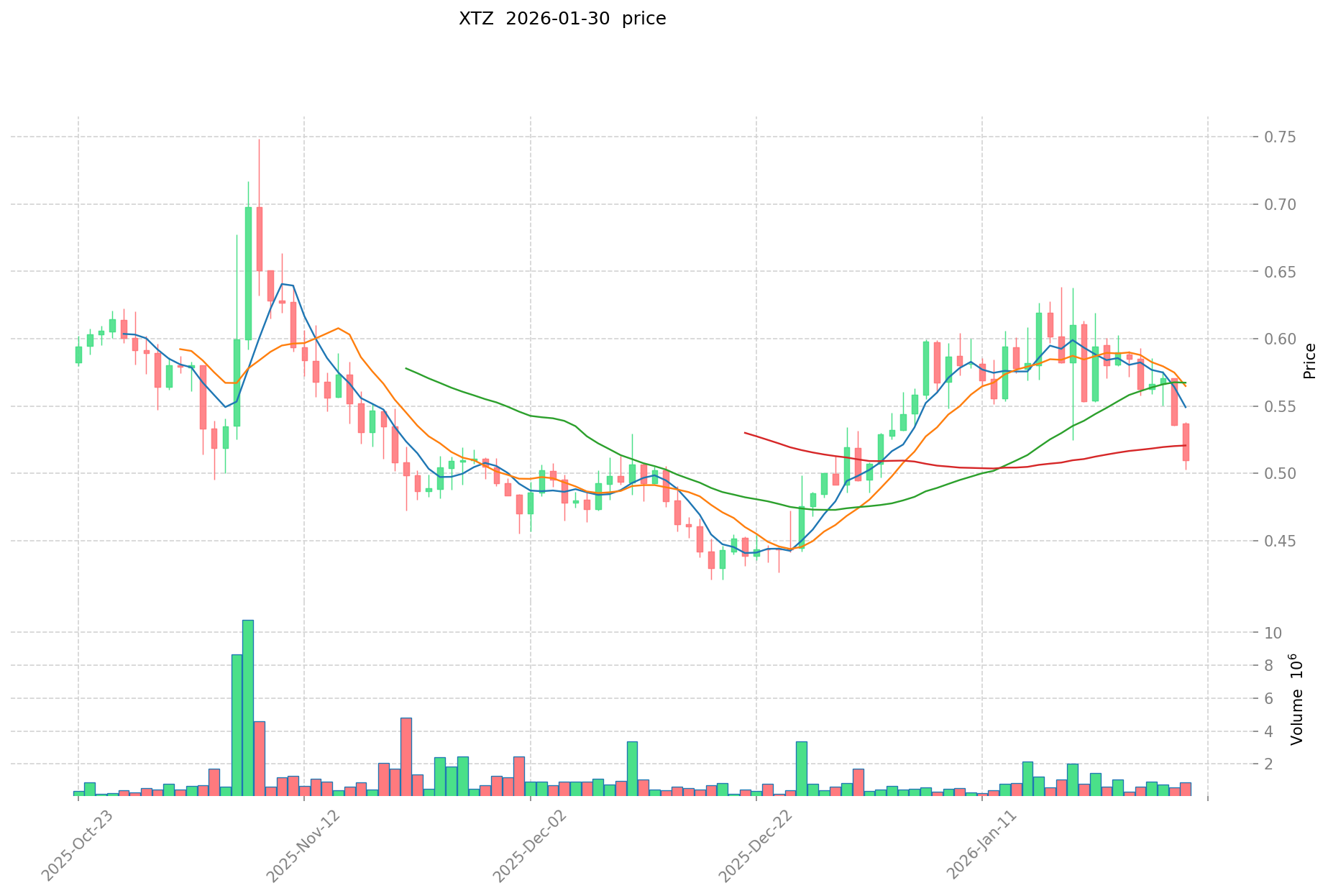
II. Core Factors Influencing BDXN vs XTZ Investment Value
Supply Mechanism Comparison (Tokenomics)
- BDXN: Information regarding the specific supply mechanism is not provided in the available materials.
- XTZ: Supply mechanism details are not available in the referenced materials.
- 📌 Historical Pattern: Supply mechanisms can influence price cycles through factors such as scarcity and demand dynamics, though specific historical data for these tokens is not provided.
Institutional Adoption and Market Application
- Institutional Holdings: The materials indicate that BDXN has received token injections valued at approximately USD 400,000 across multiple exchanges, suggesting some level of market activity, though comparative institutional preference data between BDXN and XTZ is not available.
- Enterprise Adoption: Specific applications of BDXN or XTZ in cross-border payments, settlements, or investment portfolios are not detailed in the provided materials.
- National Policies: Regulatory attitudes toward these tokens across different jurisdictions are not documented in the available resources.
Technical Development and Ecosystem Building
- BDXN Technical Development: BDXN is associated with Web3 professional networking technology and blockchain infrastructure, with emphasis on its potential in the Web3 space. The materials highlight the transformative nature of blockchain technology as a key investment consideration.
- XTZ Technical Development: Network stability is mentioned as a relevant factor for XTZ, though specific technical upgrades or developments are not detailed in the provided materials.
- Ecosystem Comparison: The materials note BDXN's positioning within the Web3 professional network sector. Specific implementations in DeFi, NFT, payment systems, or smart contract applications for either token are not extensively covered.
Macroeconomic Conditions and Market Cycles
- Performance in Inflationary Environments: The materials do not provide comparative data on anti-inflation characteristics for either token.
- Macroeconomic Monetary Policy: The referenced materials acknowledge that the US Dollar remains central to global finance and serves as a key benchmark for international investment and trade, with fluctuations occurring due to economic and political events. However, specific impacts of interest rates or dollar index movements on BDXN or XTZ are not detailed.
- Geopolitical Factors: While the importance of international investment and trade is mentioned, specific geopolitical influences on cross-border transaction demand or international situations affecting these tokens are not provided in the materials.
III. 2026-2031 Price Forecast: BDXN vs XTZ
Short-term Forecast (2026)
- BDXN: Conservative $0.0150-$0.0183 | Optimistic $0.0183-$0.0207
- XTZ: Conservative $0.3849-$0.5064 | Optimistic $0.5064-$0.7292
Mid-term Forecast (2028-2029)
- BDXN may enter a consolidation phase, with projected prices ranging from $0.0121 to $0.0273
- XTZ may enter an expansion phase, with projected prices ranging from $0.3881 to $0.8526
- Key drivers: institutional capital inflows, ETF developments, ecosystem growth
Long-term Forecast (2030-2031)
- BDXN: Base scenario $0.0139-$0.0253 | Optimistic scenario $0.0235-$0.0341
- XTZ: Base scenario $0.5278-$0.7761 | Optimistic scenario $0.6959-$1.1540
View detailed price predictions for BDXN and XTZ
Disclaimer
BDXN:
| Year |
Predicted High Price |
Predicted Average Price |
Predicted Low Price |
Price Change |
| 2026 |
0.0206677 |
0.01829 |
0.0149978 |
0 |
| 2027 |
0.025322505 |
0.01947885 |
0.012856041 |
5 |
| 2028 |
0.0241927317 |
0.0224006775 |
0.01926458265 |
21 |
| 2029 |
0.027257144382 |
0.0232967046 |
0.012114286392 |
26 |
| 2030 |
0.03412384806285 |
0.025276924491 |
0.01390230847005 |
37 |
| 2031 |
0.033561436492925 |
0.029700386276925 |
0.02346330515877 |
61 |
XTZ:
| Year |
Predicted High Price |
Predicted Average Price |
Predicted Low Price |
Price Change |
| 2026 |
0.729216 |
0.5064 |
0.384864 |
0 |
| 2027 |
0.85257504 |
0.617808 |
0.57456144 |
22 |
| 2028 |
0.7866549264 |
0.73519152 |
0.404355336 |
45 |
| 2029 |
0.791360152128 |
0.7609232232 |
0.388070843832 |
50 |
| 2030 |
0.98569994333328 |
0.776141687664 |
0.52777634761152 |
53 |
| 2031 |
1.154006268303218 |
0.88092081549864 |
0.695927444243925 |
74 |
IV. Investment Strategy Comparison: BDXN vs XTZ
Long-term vs Short-term Investment Strategies
- BDXN: May be suitable for investors interested in emerging Web3 professional networking applications and early-stage ecosystem potential, though specific long-term adoption patterns remain to be established.
- XTZ: May be suitable for investors seeking exposure to established blockchain platforms with self-amending capabilities and formal verification features, offering a longer operational history since 2017.
Risk Management and Asset Allocation
- Conservative Investors: BDXN 20-30% vs XTZ 70-80%
- Aggressive Investors: BDXN 40-50% vs XTZ 50-60%
- Hedging Tools: stablecoin allocation, options strategies, cross-asset portfolio diversification
V. Potential Risk Comparison
Market Risks
- BDXN: As a token launched in February 2025, BDXN exhibited substantial price volatility, declining from $0.449 in June 2025 to $0.00545 in October 2025. The token's relatively short trading history and lower 24-hour trading volume of $302,810.84 may present liquidity considerations.
- XTZ: XTZ has demonstrated cyclical price fluctuations, ranging from $9.12 in October 2021 to $0.350476 in December 2018, followed by price levels between $0.50 and $0.62 in early 2026. The current market sentiment index of 16 (Extreme Fear) reflects broader market uncertainty that may affect price stability.
Technical Risks
- BDXN: Scalability and network stability considerations are relevant factors as the platform develops its Web3 professional networking infrastructure, though specific technical performance data is limited given its recent launch.
- XTZ: Network stability is mentioned as a consideration factor, though detailed information regarding potential security vulnerabilities or network concentration metrics is not provided in the available materials.
Regulatory Risks
- Global regulatory frameworks continue to evolve for cryptocurrency assets, with potential differentiated impacts on newer tokens like BDXN versus more established platforms like XTZ. Regulatory developments across jurisdictions may influence market access, institutional adoption, and operational compliance requirements for both tokens.
VI. Conclusion: Which Is the Better Buy?
📌 Investment Value Summary:
- BDXN Advantages: Positioned within the emerging Web3 professional networking sector, offering exposure to blockchain-based talent and reputation systems. The token represents early-stage participation in the freelance economy and on-chain professional networks.
- XTZ Advantages: Established blockchain platform with self-amending protocol features and formal verification capabilities, supported by longer operational history since 2017. XTZ offers exposure to smart contract functionality and decentralized application infrastructure.
✅ Investment Recommendations:
- Novice Investors: Consider starting with XTZ due to its longer operational track record and established ecosystem. Limit exposure to BDXN until more performance data becomes available. Maintain diversified portfolios with stablecoin allocations for risk management.
- Experienced Investors: Evaluate portfolio allocation based on risk tolerance, with potential consideration for XTZ as a core holding (60-70%) and selective exposure to BDXN (30-40%) for growth potential. Monitor technical developments and adoption metrics regularly.
- Institutional Investors: Conduct comprehensive due diligence on regulatory compliance, liquidity profiles, and ecosystem developments for both tokens. Consider phased allocation strategies with emphasis on risk-adjusted returns and portfolio diversification across multiple blockchain platforms.
⚠️ Risk Disclosure: The cryptocurrency market exhibits extreme volatility. This content does not constitute investment advice. Investors should conduct independent research and consult with qualified financial professionals before making investment decisions.
VII. FAQ
Q1: What are the main differences between BDXN and XTZ in terms of use cases?
BDXN is positioned as a next-generation Web3 professional networking platform focused on talent, reputation, and economic opportunities in the freelance economy, while XTZ is an established self-amending blockchain platform with formal verification capabilities supporting smart contracts and decentralized applications. BDXN, launched in February 2025, targets the emerging on-chain professional network sector with blockchain-based talent systems, whereas XTZ has been operational since 2017 as a foundational infrastructure platform with proven network stability and broader ecosystem applications in decentralized finance and application development.
Q2: How do the historical price performances of BDXN and XTZ compare?
BDXN reached an all-time high of $0.449 in June 2025 but experienced significant volatility, declining to $0.00545 by October 2025, while XTZ achieved its peak of $9.12 in October 2021 during the broader cryptocurrency bull market. As of January 31, 2026, BDXN trades at $0.01843 with 24-hour volume of $302,810.84, while XTZ trades at $0.506 with volume of $565,601.99. XTZ has demonstrated more established price cycles over its seven-year operational history, ranging from $0.350476 in December 2018 to its 2021 peak, whereas BDXN's price history reflects its early-stage market positioning with just under one year of trading data.
Q3: What are the projected price ranges for BDXN and XTZ through 2031?
For 2026, BDXN's conservative forecast ranges from $0.0150-$0.0183 while the optimistic scenario projects $0.0183-$0.0207, whereas XTZ's conservative forecast ranges from $0.3849-$0.5064 with an optimistic scenario of $0.5064-$0.7292. By 2031, BDXN's base scenario projects $0.0139-$0.0253 with an optimistic scenario of $0.0235-$0.0341, while XTZ's base scenario forecasts $0.5278-$0.7761 with an optimistic scenario reaching $0.6959-$1.1540. These projections reflect BDXN's emerging market status with consolidation phases expected between 2028-2029, while XTZ shows expansion potential driven by institutional capital inflows, ETF developments, and continued ecosystem growth throughout the forecast period.
Q4: What allocation strategies are recommended for different investor profiles?
Conservative investors should consider a 20-30% BDXN and 70-80% XTZ allocation, emphasizing XTZ's longer operational track record and established ecosystem, while aggressive investors might adopt a 40-50% BDXN and 50-60% XTZ split to capture emerging growth potential. Novice investors are advised to start with XTZ due to its proven operational history since 2017 and limit BDXN exposure until more performance data becomes available, maintaining diversified portfolios with stablecoin allocations for risk management. Institutional investors should conduct comprehensive due diligence on regulatory compliance and liquidity profiles, considering phased allocation strategies with XTZ as a core holding (60-70%) and selective exposure to BDXN (30-40%) based on risk-adjusted return objectives.
Q5: What are the key risks associated with investing in BDXN versus XTZ?
BDXN's primary risks include substantial price volatility evidenced by its decline from $0.449 to $0.00545 within months of launch, lower liquidity with 24-hour trading volume of $302,810.84, and limited operational history as a token launched in February 2025. XTZ faces risks related to cyclical price fluctuations demonstrated over its seven-year history, current extreme fear market sentiment (index of 16), and potential network stability considerations despite its established status. Both tokens are subject to evolving global regulatory frameworks, though newer tokens like BDXN may face differentiated impacts compared to established platforms like XTZ regarding market access, institutional adoption, and compliance requirements across jurisdictions.
Q6: How do the technical developments and ecosystems of BDXN and XTZ differ?
BDXN's technical development focuses on Web3 professional networking technology and blockchain infrastructure within the emerging on-chain talent and reputation systems sector, representing transformative potential in blockchain-based professional networks. XTZ operates as a self-amending blockchain platform with formal verification capabilities, offering proven network stability and supporting smart contract functionality and decentralized application infrastructure since 2017. While BDXN emphasizes innovation in the freelance economy and professional networking space with early-stage ecosystem building, XTZ provides established infrastructure with longer operational validation, though specific implementation details in DeFi, NFT, or payment systems for both tokens require further independent research based on current ecosystem developments.
Q7: What factors should investors monitor when comparing BDXN and XTZ investments?
Investors should monitor institutional adoption patterns, including token injection activities and exchange listings for BDXN versus institutional preference metrics for XTZ's more established platform. Technical development milestones, network stability metrics, and ecosystem growth indicators such as active users, transaction volumes, and developer activity should be tracked regularly for both tokens. Macroeconomic conditions including cryptocurrency market cycles, regulatory developments across jurisdictions, and the current market sentiment index (currently at 16 indicating extreme fear) represent critical external factors. Additionally, investors should assess liquidity profiles through 24-hour trading volumes, price volatility patterns, and portfolio diversification strategies incorporating stablecoin allocations and hedging tools to manage risk effectively in the highly volatile cryptocurrency market environment.
* The information is not intended to be and does not constitute financial advice or any other recommendation of any sort offered or endorsed by Gate.