This comprehensive analysis compares BEL and THETA as two distinct blockchain protocols with different DeFi applications. BEL (Bella Protocol) functions as a one-stop DeFi platform combining automated liquidity mining, lending protocols, and smart advisory services, currently ranked #1181 with $10.18M market cap. THETA Network operates as decentralized video streaming infrastructure, ranked #186 with $272M market cap. The article examines historical price trends, tokenomics, market liquidity, and technical ecosystems to address investors' core question: which asset offers better risk-reward characteristics. Key findings reveal THETA maintains superior liquidity ($177,941.97 vs $21,387.12 daily volume) and market depth suitable for institutional allocations, while BEL presents higher volatility exposure. Price projections through 2031 range from $0.108-$0.284 for BEL and $0.253-$0.740 for THETA. The analysis provides allocation frameworks, risk assessments, and strategic recommendations tailored to different i
Introduction: BEL vs THETA Investment Comparison
In the cryptocurrency market, the comparison between BEL and THETA remains a topic of continuous interest among investors. These two assets exhibit notable differences in market cap ranking, application scenarios, and price performance, representing distinct positioning within the crypto asset landscape.
Bella Protocol (BEL): Launched in 2020, this project has established itself as a one-stop DeFi platform combining automated liquidity mining tools, lending protocols, and smart investment advisory services. Currently ranked #1181 with a market cap of approximately $10.18 million, BEL aims to address key pain points in decentralized finance including high transaction fees and complex user experiences.
Theta Network (THETA): Since its inception in 2017, THETA has positioned itself as a decentralized video streaming infrastructure, leveraging blockchain technology to optimize content delivery. With a market cap of $272 million and ranking #186, THETA represents a more established project in the decentralized content distribution sector.
This article will comprehensively analyze the investment value comparison between BEL and THETA through multiple dimensions including historical price trends, supply mechanisms, technological ecosystems, and future outlook, attempting to address investors' most pressing question:
"Which asset presents more favorable risk-reward characteristics in the current market environment?"
By examining these two projects' fundamentals, market performance, and growth potential, readers will gain insights into how each token fits within different investment strategies and risk profiles.
I. Historical Price Comparison and Market Status
BEL (Coin A) and THETA (Coin B) Historical Price Trends
- 2020: BEL reached a notable price level of $9.99 on September 15, 2020, shortly after its launch in September 2020, reflecting initial market enthusiasm for the Bella Protocol platform.
- 2021: THETA experienced significant price movement, reaching $15.72 on April 16, 2021, driven by growing interest in decentralized video streaming infrastructure.
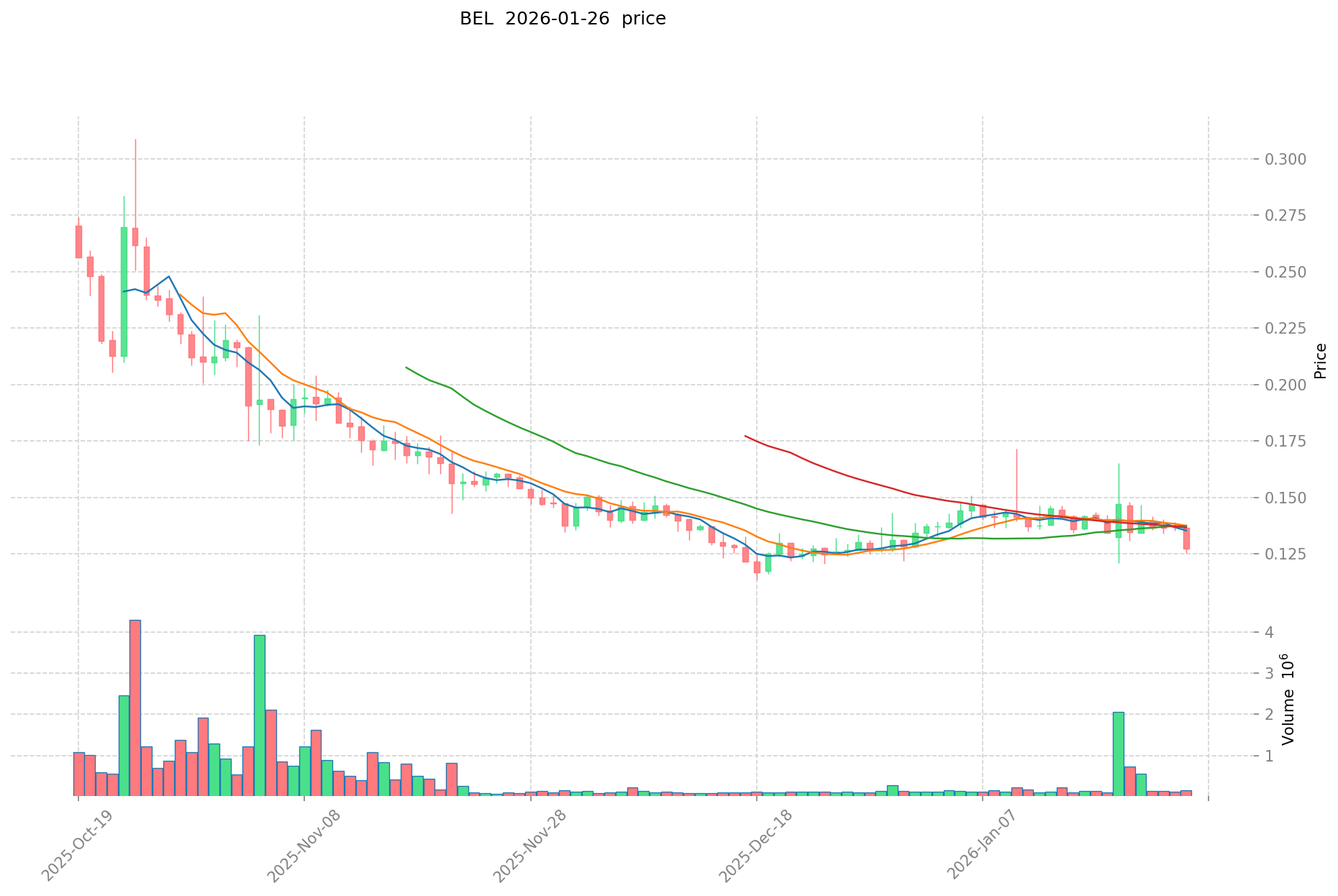
- 2025: BEL recorded a low of $0.098774 on October 11, 2025, while THETA declined from its peak.
- Comparative Analysis: During the recent market cycle, BEL declined from $9.99 to $0.098774, representing substantial volatility, while THETA decreased from $15.72 to current levels, demonstrating similar downward pressure.
Current Market Status (January 26, 2026)
- BEL Current Price: $0.1273
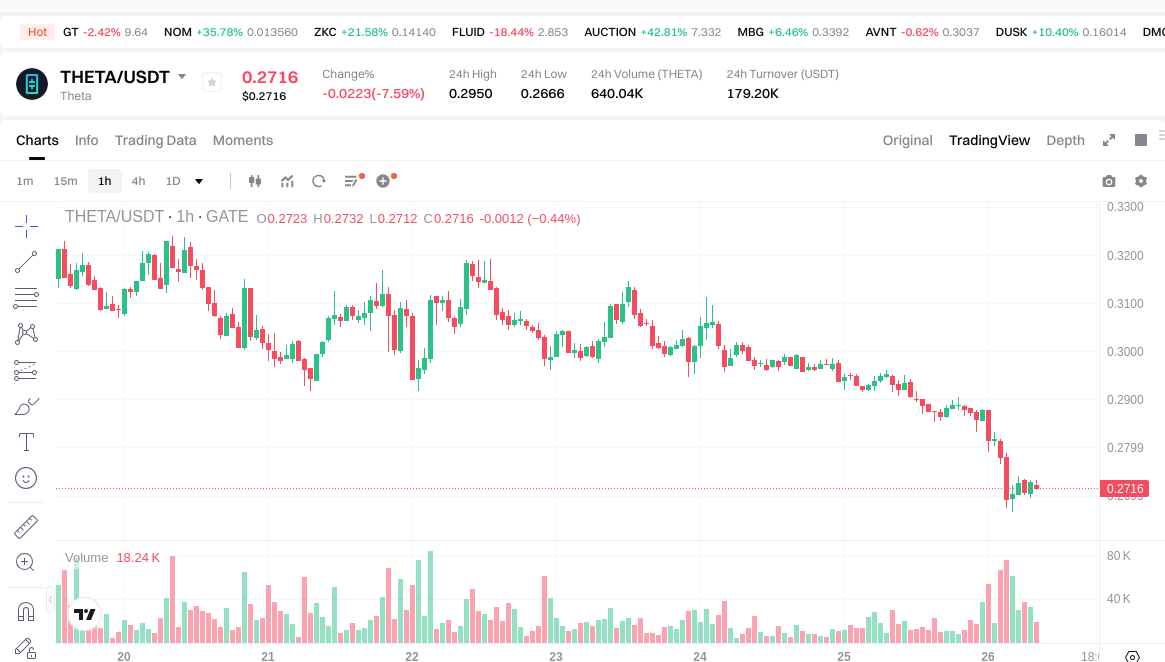
- THETA Current Price: $0.272
- 24-Hour Trading Volume: BEL $21,387.12 vs THETA $177,941.97
- Market Capitalization: BEL $10.18 million vs THETA $272 million
- Market Sentiment Index (Fear & Greed Index): 25 (Extreme Fear)
- 24-Hour Price Change: BEL -6.66% vs THETA -7.90%
View real-time prices:
- Check BEL current price Market Price
- Check THETA current price Market Price
II. Core Factors Affecting BEL vs THETA Investment Value
Supply Mechanism Comparison (Tokenomics)
Due to limited available data on the specific supply mechanisms of BEL and THETA, a comprehensive comparison cannot be provided at this time. Investors should conduct independent research on the tokenomics structure of each asset, including total supply, circulation dynamics, and any deflationary or inflationary mechanisms that may influence long-term value.
Institutional Adoption and Market Application
Without sufficient data on institutional holdings, enterprise adoption patterns, or regulatory positioning for BEL and THETA, it is not possible to draw meaningful comparisons in this area. Market participants are encouraged to monitor official announcements, partnership developments, and regulatory updates independently.
Technology Development and Ecosystem Building
Insufficient information is available regarding recent technical upgrades, development roadmaps, or ecosystem expansion for BEL and THETA. A thorough assessment would require access to project documentation, developer activity metrics, and ecosystem statistics that are not present in the provided materials.
Macroeconomic Context and Market Cycles
The relationship between macroeconomic conditions and the performance of BEL and THETA cannot be adequately addressed based on the available data. Factors such as inflation dynamics, monetary policy shifts, interest rate movements, and geopolitical developments may influence crypto asset valuations, but specific correlations for these two assets remain unclear without further research.
III. 2026-2031 Price Prediction: BEL vs THETA
Short-term Forecast (2026)
- BEL: Conservative $0.108-$0.128 | Optimistic $0.128-$0.156
- THETA: Conservative $0.253-$0.272 | Optimistic $0.272-$0.402
Mid-term Forecast (2028-2029)
- BEL may enter a consolidation phase, with estimated price range of $0.102-$0.254
- THETA may enter a growth phase, with estimated price range of $0.211-$0.485
- Key drivers: institutional capital inflows, ETF developments, ecosystem expansion
Long-term Forecast (2030-2031)
- BEL: Baseline scenario $0.181-$0.245 | Optimistic scenario $0.270-$0.284
- THETA: Baseline scenario $0.385-$0.521 | Optimistic scenario $0.579-$0.740
View detailed price predictions for BEL and THETA
Disclaimer
BEL:
| Year |
Predicted High Price |
Predicted Average Price |
Predicted Low Price |
Price Change |
| 2026 |
0.155672 |
0.1276 |
0.10846 |
0 |
| 2027 |
0.21103764 |
0.141636 |
0.09064704 |
11 |
| 2028 |
0.1922071338 |
0.17633682 |
0.1022753556 |
38 |
| 2029 |
0.254295328122 |
0.1842719769 |
0.134518543137 |
44 |
| 2030 |
0.26971889258853 |
0.219283652511 |
0.1973552872599 |
72 |
| 2031 |
0.283621476157727 |
0.244501272549765 |
0.180930941686826 |
92 |
THETA:
| Year |
Predicted High Price |
Predicted Average Price |
Predicted Low Price |
Price Change |
| 2026 |
0.401968 |
0.2716 |
0.252588 |
0 |
| 2027 |
0.49170464 |
0.336784 |
0.1852312 |
23 |
| 2028 |
0.4846658544 |
0.41424432 |
0.2112646032 |
52 |
| 2029 |
0.476422392432 |
0.4494550872 |
0.355069518888 |
65 |
| 2030 |
0.57867342477 |
0.462938739816 |
0.4166448658344 |
70 |
| 2031 |
0.73954463685606 |
0.520806082293 |
0.38539650089682 |
91 |
IV. Investment Strategy Comparison: BEL vs THETA
Long-term vs Short-term Investment Strategies
-
BEL: May suit investors focused on DeFi infrastructure development and automated yield optimization tools. The platform's one-stop approach to decentralized finance could appeal to those tracking emerging DeFi solutions, though the asset exhibits substantial volatility characteristics.
-
THETA: May suit investors interested in decentralized content delivery networks and video streaming infrastructure. The project's established market presence and application in media distribution could attract those seeking exposure to blockchain-based content platforms.
Risk Management and Asset Allocation
-
Conservative Investors: A potential allocation framework might consider BEL: 20-30% vs THETA: 70-80%, reflecting THETA's relatively larger market capitalization and established market position.
-
Aggressive Investors: A potential allocation framework might consider BEL: 40-50% vs THETA: 50-60%, allowing for exposure to BEL's potential upside while maintaining substantial THETA holdings.
-
Hedging Tools: Stablecoin reserves, options strategies, and cross-asset portfolio diversification remain standard approaches to managing crypto market exposure.
V. Potential Risk Comparison
Market Risk
-
BEL: The asset demonstrates significant price volatility, declining from $9.99 to $0.098774 over its trading history. Current market capitalization of $10.18 million suggests limited liquidity compared to larger-cap assets. The 24-hour trading volume of $21,387.12 indicates relatively thin market depth.
-
THETA: Price movement from $15.72 to current levels reflects substantial downward pressure characteristic of the broader market cycle. With a market capitalization of $272 million and 24-hour volume of $177,941.97, THETA maintains notably greater market liquidity compared to BEL, though still subject to crypto market volatility.
Technical Risk
-
BEL: Scalability considerations and network stability factors require ongoing monitoring. The platform's integration of multiple DeFi protocols introduces complexity that may present operational challenges.
-
THETA: Network decentralization metrics, validator distribution, and potential security vulnerabilities warrant continued assessment. Infrastructure dependencies related to content delivery mechanisms present specific technical considerations.
Regulatory Risk
Global regulatory developments may impact BEL and THETA differently based on their respective use cases. DeFi platforms face evolving regulatory frameworks around automated financial services, while decentralized content networks encounter considerations related to media distribution and data handling. Jurisdiction-specific policies continue to develop, creating ongoing uncertainty for both asset categories.
VI. Conclusion: Which Is the Better Buy?
📌 Investment Value Summary:
-
BEL Characteristics: Offers exposure to DeFi infrastructure combining liquidity mining, lending protocols, and smart advisory services. Currently ranked #1181 with market cap of $10.18 million. Price projections suggest potential range of $0.108-$0.284 through 2031, though substantial volatility persists.
-
THETA Characteristics: Provides exposure to decentralized video streaming infrastructure with established market presence. Ranked #186 with market cap of $272 million. Price projections suggest potential range of $0.253-$0.740 through 2031, supported by larger market capitalization and trading volume.
✅ Investment Considerations:
-
Beginning Investors: May benefit from focusing on assets with established market positions and greater liquidity. THETA's larger market capitalization and higher trading volumes could provide more stable entry and exit opportunities compared to smaller-cap alternatives.
-
Experienced Investors: May consider portfolio diversification across different blockchain sectors. Combining exposure to DeFi infrastructure (BEL) and decentralized content delivery (THETA) offers sector diversification, though requires careful position sizing based on individual risk tolerance.
-
Institutional Participants: Liquidity considerations and market depth become primary factors. THETA's substantially larger market capitalization and trading volume may better accommodate institutional position sizes, while BEL's smaller market footprint presents liquidity constraints for large-scale allocations.
⚠️ Risk Disclosure: Cryptocurrency markets exhibit extreme volatility. This analysis does not constitute investment advice. Market participants should conduct independent research, assess personal risk tolerance, and consider consulting qualified financial professionals before making investment decisions.
VII. FAQ
Q1: What are the main differences between BEL and THETA in terms of use cases?
BEL focuses on DeFi infrastructure while THETA targets decentralized video streaming. BEL (Bella Protocol) operates as a one-stop DeFi platform combining automated liquidity mining tools, lending protocols, and smart investment advisory services, addressing challenges in decentralized finance such as high transaction fees and complex user experiences. In contrast, THETA Network functions as decentralized video streaming infrastructure, leveraging blockchain technology to optimize content delivery and distribution.
Q2: Which asset has better liquidity for trading purposes?
THETA demonstrates significantly better liquidity compared to BEL. THETA maintains a 24-hour trading volume of $177,941.97 and market capitalization of $272 million, while BEL records $21,387.12 in 24-hour volume with a market cap of $10.18 million. This 8x difference in trading volume and 26x difference in market capitalization means THETA offers more stable entry and exit opportunities with reduced slippage risk.
Q3: What is the historical price performance comparison between BEL and THETA?
Both assets experienced substantial volatility from their peaks. BEL reached $9.99 on September 15, 2020, declining to a low of $0.098774 on October 11, 2025, representing approximately 99% drawdown. THETA peaked at $15.72 on April 16, 2021, subsequently declining to current levels around $0.272. While both experienced significant corrections, THETA maintained a relatively higher price point throughout market cycles.
Q4: How do the price predictions differ for BEL and THETA through 2031?
Price projections suggest different trajectories for both assets. BEL's forecasts range from $0.108-$0.156 in 2026, potentially reaching $0.181-$0.284 by 2031 under baseline and optimistic scenarios. THETA's projections span $0.253-$0.402 in 2026, with long-term estimates of $0.385-$0.740 by 2031. These predictions suggest THETA may maintain higher absolute price levels, though both face substantial uncertainty given market volatility.
Q5: What allocation strategy should investors consider between BEL and THETA?
Allocation depends on risk tolerance and investment objectives. Conservative investors might consider a 20-30% BEL and 70-80% THETA allocation, reflecting THETA's larger market capitalization and established position. Aggressive investors could pursue a 40-50% BEL and 50-60% THETA split, allowing greater exposure to BEL's potential upside while maintaining substantial THETA holdings. Portfolio sizing should account for individual risk profiles and liquidity requirements.
Q6: What are the primary risks associated with investing in BEL versus THETA?
Market risk differs substantially between the two assets. BEL's $10.18 million market cap and limited trading volume create liquidity constraints and heightened volatility exposure. THETA's larger $272 million market cap provides better liquidity but remains subject to crypto market cycles. Technical risks include BEL's multi-protocol integration complexity and THETA's network decentralization considerations. Regulatory risk affects both differently—BEL faces evolving DeFi regulations while THETA encounters content distribution and data handling frameworks.
Q7: Which asset is more suitable for institutional investors?
THETA presents more favorable characteristics for institutional participation. The asset's $272 million market capitalization and significantly higher trading volume better accommodate large-scale position entry and exit compared to BEL's $10.18 million market cap. Institutional investors typically require sufficient market depth to avoid substantial price impact, making THETA's liquidity profile more aligned with institutional allocation requirements. BEL's smaller market footprint presents meaningful constraints for institutional-sized positions.
Q8: What role does current market sentiment play in evaluating BEL versus THETA?
Current market sentiment reflects extreme caution across crypto assets. The Fear & Greed Index registers 25 (Extreme Fear), indicating widespread market apprehension. Both BEL and THETA experienced negative 24-hour performance, with BEL declining 6.66% and THETA falling 7.90%. This bearish sentiment environment suggests both assets face near-term headwinds, though established projects like THETA may demonstrate greater resilience during market stress compared to smaller-cap alternatives like BEL.
* The information is not intended to be and does not constitute financial advice or any other recommendation of any sort offered or endorsed by Gate.