This comprehensive analysis compares BID (Creator Bid) and BNB (Binance Coin), two distinct blockchain tokens serving different market segments. BID, launched in 2025, empowers creators through AI Creator Agents with current pricing at $0.01462 and limited liquidity. BNB, established since 2017, serves as Binance's native utility token at $893 with substantial trading volume of $5.7M daily. The article examines historical price performance, tokenomics mechanisms, institutional adoption, technical ecosystems, and risk profiles through 2031. BID offers emerging protocol growth potential with 97% volatility risk, while BNB provides established infrastructure stability with 35% decline resilience. Conservative investors may allocate 85-90% to BNB versus 10-15% to BID, whereas aggressive investors might consider 60-70% BNB with 30-40% BID exposure. The analysis provides detailed price projections, investment strategies, and risk management frameworks for different investor profiles on Gate platform.
Introduction: BID vs BNB Investment Comparison
In the cryptocurrency market, the comparison between BID and BNB has been a topic of ongoing interest for investors. The two assets differ significantly in market cap ranking, application scenarios, and price performance, representing distinct positioning within the crypto asset landscape.
BID (Creator Bid): Launched in 2025, this token has gained market attention through its focus on empowering creators to develop, monetize, and co-own AI Creator Agents, leveraging blockchain and artificial intelligence technologies.
BNB (Binance Coin): Since its inception in 2017, BNB has established itself as the native utility token of the Binance ecosystem, ranking among the top global cryptocurrencies by trading volume and market capitalization.
This article will provide a comprehensive analysis of BID vs BNB investment value comparison, examining historical price trends, supply mechanisms, institutional adoption, technological ecosystems, and future projections, while addressing the question investors care about most:
"Which is the better buy right now?"
I. Historical Price Comparison and Current Market Status
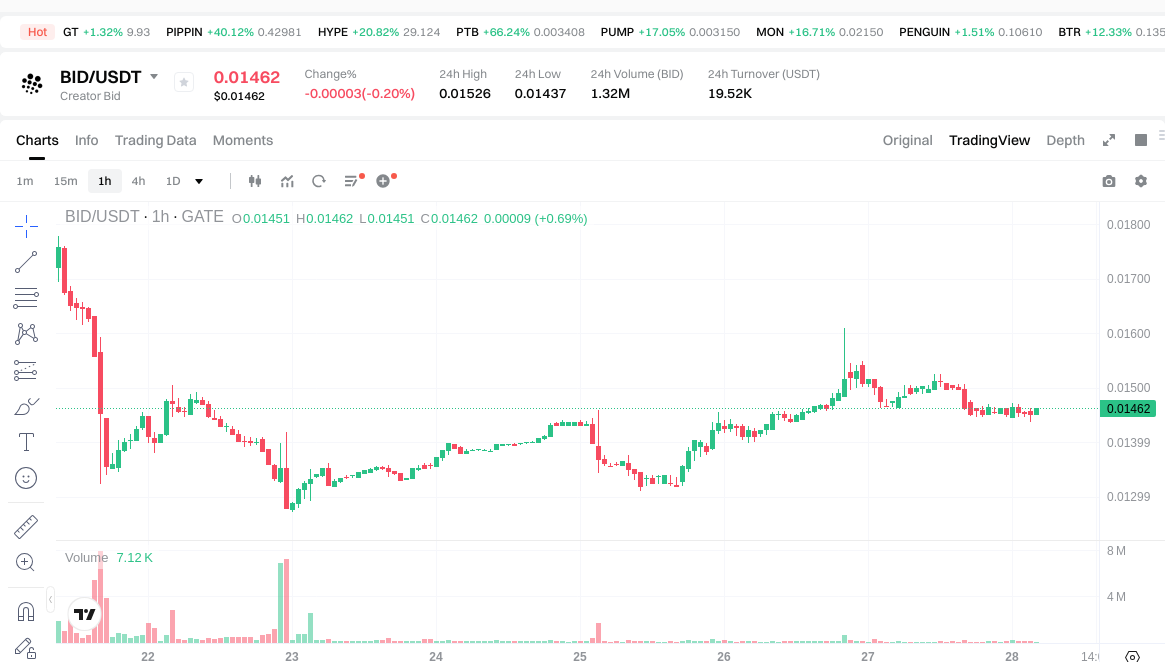
- 2025-03-26: BID reached its all-time high of $0.5, marking a significant milestone in the token's early trading history.
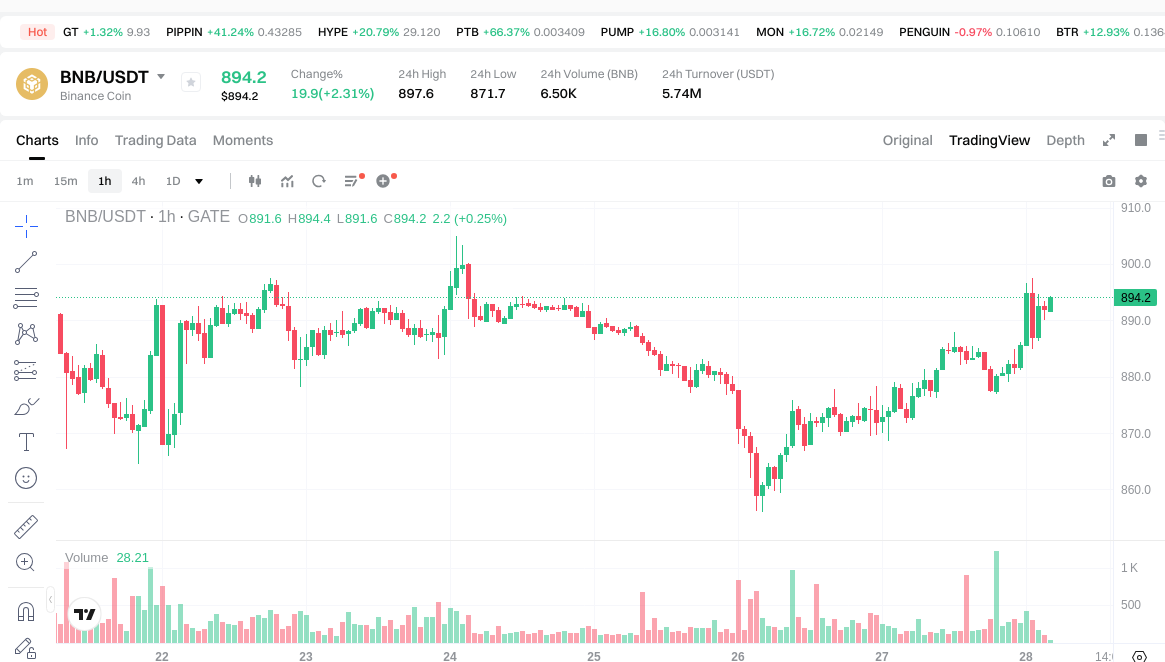
- 2025-10-13: BNB recorded its all-time high of $1,369.99, reflecting strong market momentum during this period.
- 2026-01-22: BID hit its all-time low of $0.01272, representing substantial downward pressure in recent market conditions.
- Comparative Analysis: During the recent market cycle, BID experienced significant volatility from its peak of $0.5 to current levels around $0.01462, representing a decline of approximately 97%. In contrast, BNB demonstrated relative resilience, trading at $893 compared to its historical high of $1,369.99, reflecting a decline of approximately 35%.
Current Market Conditions (2026-01-28)
- BID Current Price: $0.01462
- BNB Current Price: $893
- 24-Hour Trading Volume: BID recorded $19,478.64 compared to BNB's $5,742,060.69, highlighting substantial differences in liquidity and market participation.
- Market Sentiment Index (Fear & Greed Index): 29 (Fear)
View real-time prices:
II. Core Factors Influencing BID vs BNB Investment Value
Supply Mechanism Comparison (Tokenomics)
- BID: The token accumulates value primarily through auction fee mechanisms. Protocols capture a percentage of winning bids or spreads, creating a fee-based value accrual model that depends on protocol scale and transaction volume.
- BNB: BNB Smart Chain implements BEP-95, which introduced real-time token burning mechanisms through the Bruno hard fork upgrade. This creates deflationary pressure on supply over time.
- 📌 Historical Pattern: Supply mechanisms influence price cycles through the relationship between protocol adoption rates and token utility demand.
Institutional Adoption and Market Applications
- Institutional Holdings: Current materials do not provide comparative data on institutional preference between BID and BNB tokens.
- Enterprise Adoption: BNB Chain demonstrates application in network traffic management and ecosystem development, with strategic focus on liquidity provision as a means to capture user adoption. The chain's approach emphasizes using traffic as a tool while positioning essential use cases as the end goal.
- Regulatory Environment: Specific national policies toward these tokens are not detailed in available materials.
Technical Development and Ecosystem Building
- BID Technical Development: BID-style protocols benefit from growing MEV (Maximal Extractable Value) infrastructure development. The protocol design creates conditions for emergence, scaling, and monetization of auction-based mechanisms.
- BNB Technical Progress: BNB Chain has integrated MEV infrastructure, including Bid Relay systems that serve as intermediaries to improve network efficiency, reduce congestion, and enhance security while maintaining blockchain decentralization. This integration supports robust, scalable, and fair MEV infrastructure.
- Ecosystem Comparison: BNB Chain's core logic centers on "traffic as means, essential needs as destination," essentially trading liquidity for time. The chain leverages meme token distribution efficiency to capture user mindshare while providing development windows for essential sectors like AI.
Macroeconomic Factors and Market Cycles
- Inflation Environment Performance: Available materials do not provide specific comparative analysis of anti-inflation characteristics for these tokens.
- Macroeconomic Monetary Policy: The relationship between interest rates, dollar index movements, and these specific tokens is not addressed in source materials.
- Geopolitical Factors: While cross-border transaction demand represents a general market factor, specific geopolitical impacts on BID versus BNB are not documented in available references.
III. 2026-2031 Price Prediction: BID vs BNB
Short-term Forecast (2026)
- BID: Conservative $0.014-$0.015 | Optimistic $0.017-$0.018
- BNB: Conservative $714-$893 | Optimistic $1,000-$1,099
Mid-term Forecast (2028-2029)
- BID may enter a gradual expansion phase, with estimated price range of $0.016-$0.032
- BNB may enter a consolidation and growth phase, with estimated price range of $767-$1,762
- Key drivers: institutional capital inflows, ETF developments, ecosystem expansion
Long-term Forecast (2030-2031)
- BID: Baseline scenario $0.022-$0.027 | Optimistic scenario $0.028-$0.041
- BNB: Baseline scenario $993-$1,806 | Optimistic scenario $2,077-$2,132
View detailed price predictions for BID and BNB
Disclaimer
BID:
| Year |
Predicted High Price |
Predicted Average Price |
Predicted Low Price |
Price Change |
| 2026 |
0.018275 |
0.01462 |
0.0141814 |
0 |
| 2027 |
0.02335545 |
0.0164475 |
0.015625125 |
12 |
| 2028 |
0.02288669625 |
0.019901475 |
0.01592118 |
36 |
| 2029 |
0.03187718758125 |
0.021394085625 |
0.01540374165 |
46 |
| 2030 |
0.028233774799312 |
0.026635636603125 |
0.022107578380593 |
82 |
| 2031 |
0.040603364437803 |
0.027434705701218 |
0.022222111617987 |
87 |
BNB:
| Year |
Predicted High Price |
Predicted Average Price |
Predicted Low Price |
Price Change |
| 2026 |
1098.513 |
893.1 |
714.48 |
0 |
| 2027 |
1135.21941 |
995.8065 |
946.016175 |
11 |
| 2028 |
1331.89119375 |
1065.512955 |
767.1693276 |
19 |
| 2029 |
1762.09204933125 |
1198.702074375 |
611.33805793125 |
34 |
| 2030 |
2131.7717690685 |
1480.397061853125 |
1169.51367886396875 |
66 |
| 2031 |
2076.997077779934375 |
1806.0844154608125 |
993.346428503446875 |
102 |
IV. Investment Strategy Comparison: BID vs BNB
Long-term vs Short-term Investment Strategies
-
BID: May appeal to investors focused on emerging AI-creator economy applications and willing to accept higher volatility in exchange for potential growth in auction-based protocol adoption. The token's value accrual model depends on protocol scaling and transaction volume expansion.
-
BNB: May suit investors seeking exposure to established ecosystem utility with demonstrated institutional adoption patterns. The token benefits from deflationary supply mechanisms through BEP-95 implementation and integration within network infrastructure development.
Risk Management and Asset Allocation
-
Conservative Investors: BID 10-15% vs BNB 85-90%
- Rationale: Prioritizing liquidity depth, historical price stability, and established market infrastructure
-
Aggressive Investors: BID 30-40% vs BNB 60-70%
- Rationale: Accepting higher volatility exposure in emerging protocols while maintaining core positions in established ecosystems
-
Hedging Instruments: Stablecoin allocation for rebalancing opportunities, option strategies for downside protection, cross-token portfolio diversification
V. Comparative Risk Analysis
Market Risk
-
BID: The token demonstrated approximately 97% decline from all-time high of $0.5 to current levels around $0.01462. Limited liquidity as evidenced by 24-hour trading volume of $19,478.64 may amplify price volatility during market stress periods.
-
BNB: Historical price action shows approximately 35% decline from all-time high of $1,369.99 to current levels around $893. Substantially higher trading volume of $5,742,060.69 provides deeper liquidity cushion during market fluctuations.
Technical Risk
-
BID: Dependency on MEV infrastructure development and auction mechanism adoption rates. Protocol scaling challenges may impact value accrual if transaction volumes do not meet growth projections.
-
BNB: Network congestion management during high-activity periods. Continued evolution of MEV infrastructure integration requires ongoing technical development to maintain efficiency standards.
Regulatory Risk
- Global regulatory developments may impact both tokens differently based on their functional classifications. Utility tokens within established exchange ecosystems face different regulatory scrutiny compared to emerging protocol tokens. Specific regulatory frameworks continue to evolve across jurisdictions.
VI. Conclusion: Which Is the Better Buy?
📌 Investment Value Summary:
-
BID Advantages: Exposure to emerging AI-creator economy infrastructure, auction-based value accrual mechanisms tied to protocol adoption, potential for growth as MEV infrastructure matures
-
BNB Advantages: Established market position with substantial liquidity depth, deflationary supply mechanisms through BEP-95, demonstrated ecosystem integration, relatively lower volatility compared to emerging tokens
✅ Investment Recommendations:
-
Beginner Investors: Consider focusing on established tokens with deeper liquidity and lower volatility profiles. Prioritize understanding tokenomics and ecosystem fundamentals before allocation decisions.
-
Experienced Investors: May explore diversified strategies incorporating both established ecosystem tokens and emerging protocol positions based on individual risk tolerance. Consider portfolio rebalancing mechanisms aligned with market cycle phases.
-
Institutional Investors: Evaluate liquidity requirements, custody infrastructure availability, and regulatory compliance frameworks for each token. Consider allocation strategies that balance established market infrastructure with selective exposure to emerging protocol development.
⚠️ Risk Disclosure: The cryptocurrency market exhibits significant volatility. This analysis does not constitute investment advice. Market participants should conduct independent research and consult qualified financial advisors before making allocation decisions.
VII. FAQ
Q1: What is the main difference between BID and BNB's value accrual mechanisms?
BID accumulates value through auction fee mechanisms where protocols capture a percentage of winning bids or spreads, creating a transaction-volume-dependent model. In contrast, BNB utilizes deflationary supply mechanisms through BEP-95 implementation with real-time token burning, reducing circulating supply over time. BID's value directly correlates with protocol adoption and auction activity scaling, while BNB's value benefits from systematic supply reduction regardless of transaction volumes.
Q2: Which token demonstrates higher liquidity and lower volatility risk?
BNB demonstrates significantly higher liquidity and lower volatility risk. The 24-hour trading volume comparison shows BNB at $5,742,060.69 versus BID at $19,478.64, representing approximately 295x higher liquidity depth. Historical volatility analysis reveals BID declined approximately 97% from its all-time high ($0.5 to $0.01462), while BNB declined approximately 35% ($1,369.99 to $893), indicating substantially more stable price performance for BNB.
Q3: How do institutional adoption patterns differ between BID and BNB?
BNB demonstrates established institutional adoption through integration within network traffic management systems, MEV infrastructure deployment including Bid Relay systems, and ecosystem development frameworks. The chain's "traffic as means, essential needs as destination" strategy positions it within mature blockchain infrastructure. BID, as a 2025-launched token, represents emerging protocol adoption patterns focused on AI-creator economy applications, with institutional positioning still developing through MEV infrastructure growth and auction mechanism maturation.
Q4: What are the projected price ranges for BID and BNB through 2031?
For 2026, conservative projections estimate BID at $0.014-$0.015 and BNB at $714-$893. By 2031, baseline scenarios project BID reaching $0.022-$0.027 with optimistic scenarios at $0.028-$0.041, while BNB baseline scenarios range $993-$1,806 with optimistic projections at $2,077-$2,132. These projections reflect BID's higher growth rate potential from a significantly lower base, compared to BNB's steady appreciation from established market positioning.
Q5: Which token is more suitable for conservative versus aggressive investment strategies?
Conservative investors may consider allocation ratios of 10-15% BID versus 85-90% BNB, prioritizing liquidity depth, historical stability, and established infrastructure. Aggressive investors accepting higher volatility may explore 30-40% BID versus 60-70% BNB allocations, balancing exposure to emerging protocol growth potential with core positions in established ecosystems. Conservative strategies emphasize BNB's lower volatility profile and deeper liquidity, while aggressive approaches incorporate BID's higher risk-reward potential.
Q6: How do supply mechanisms impact long-term investment value for each token?
BID's auction fee-based supply mechanism creates value through protocol usage scaling, meaning increased transaction volumes directly enhance token utility and demand. BNB's BEP-95 deflationary mechanism systematically reduces circulating supply through token burning, creating scarcity-driven value appreciation independent of transaction volumes. Long-term investment value for BID depends on successful protocol adoption and ecosystem expansion, while BNB benefits from predictable supply reduction combined with established utility within the Binance ecosystem.
Q7: What are the primary technical risks associated with BID compared to BNB?
BID faces technical risks related to MEV infrastructure development dependencies, auction mechanism adoption rates, and protocol scaling challenges that directly impact value accrual. Transaction volume growth projections must materialize for the fee-based model to generate expected returns. BNB's technical risks center on network congestion management during high-activity periods and ongoing MEV infrastructure integration requirements. BID's risks stem from emerging protocol uncertainty, while BNB's risks relate to maintaining efficiency standards within established infrastructure.
Q8: Which token offers better downside protection during market corrections?
BNB offers substantially better downside protection based on historical performance and structural factors. During recent market cycles, BNB declined approximately 35% from peak levels compared to BID's approximately 97% decline, demonstrating greater resilience. BNB's advantages include 295x higher trading volume providing liquidity depth, established ecosystem integration reducing abandonment risk, and deflationary supply mechanisms supporting price floors. BID's limited liquidity and emerging protocol status create higher vulnerability during market stress periods.
* The information is not intended to be and does not constitute financial advice or any other recommendation of any sort offered or endorsed by Gate.