This comprehensive analysis explores Bitcoin's current market position near $86,000 following a significant correction, examining technical indicators that suggest potential trend reversal. The article reveals how Satoshi Nakamoto's estimated 1.096 million Bitcoin holdings have declined by $41 billion due to recent price weakness, yet highlights promising recovery signals including bullish RSI divergence and support consolidation. Through detailed technical analysis using Fibonacci retracement levels, the article maps recovery targets from $90,774 to $102,000-$104,000. Traders and investors will discover actionable entry strategies, risk management frameworks, and an assessment of Satoshi's influence on Bitcoin market dynamics. The FAQ section addresses critical questions about Satoshi's holdings and Bitcoin's long-term wealth implications, providing both technical trading guidance and fundamental market context for participants on Gate exchange.
Bitcoin Price Prediction
Bitcoin is trading near the $86,000 level, showing signs of stabilization after a month-long decline that erased more than 30% from its peak value observed in recent periods. This significant downturn not only triggered widespread concern among traders but also resulted in a staggering $41 billion reduction in the estimated wealth of Bitcoin's enigmatic creator, Satoshi Nakamoto.
According to data from Arkham Intelligence, Satoshi's holdings of approximately 1.096 million BTC, which were valued at over $137 billion during the previous peak, have declined to roughly $95 billion at current price levels. This temporary wealth reduction has positioned the iconic figure below prominent names such as Bill Gates in global wealth rankings, though this comparison remains largely theoretical given Satoshi's anonymous status and the dormant nature of these holdings.
Despite this market setback, long-term conviction in Bitcoin's fundamental value proposition remains robust. The cryptocurrency's circulating supply has reached 19.95 million tokens, approaching the protocol's hard cap of 21 million. With its market capitalization maintaining levels above $1.71 trillion, Bitcoin continues to reinforce its position as the world's dominant cryptocurrency and a significant asset class in global financial markets.
The current price consolidation near $86,000 represents a critical juncture for Bitcoin's market structure. Historical patterns suggest that such periods of stabilization following sharp corrections often precede significant directional moves, making this an important phase for both short-term traders and long-term investors to monitor closely.
Bitcoin Stabilizes as Downtrend Faces Exhaustion
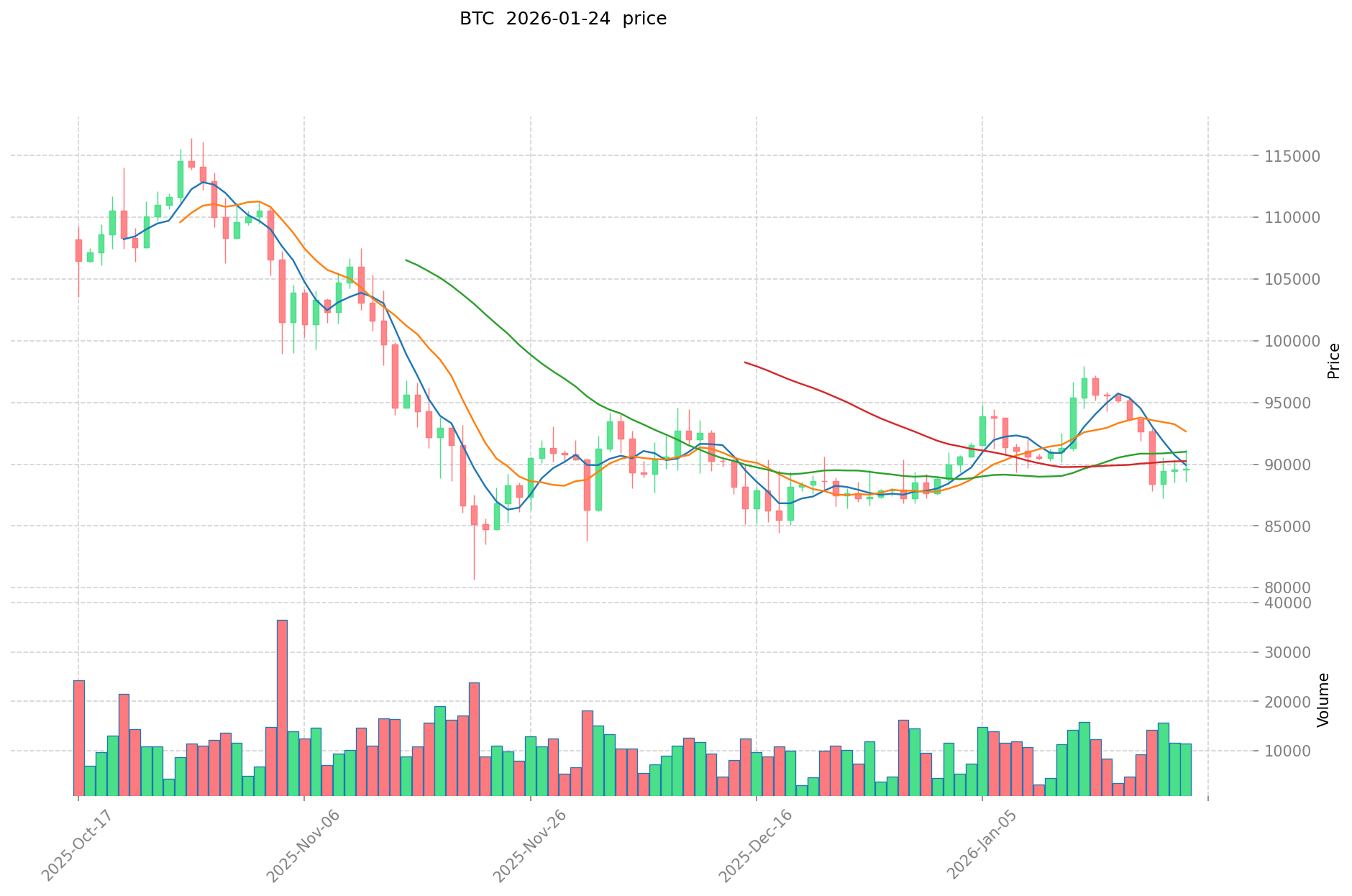
Bitcoin's recent price action provides compelling evidence that selling pressure may be reaching a point of exhaustion. The daily chart reveals a pattern of repeated long downside wicks combined with consecutive spinning top candlestick formations. These technical patterns are widely recognized indicators that suggest sellers are losing momentum, particularly within the $85,500–$86,800 support zone where buyers have consistently stepped in to defend price levels.
The cryptocurrency remains confined within a descending channel pattern that has guided the correction phase since early November. This channel structure provides clear boundaries for price movement, with the upper resistance and lower support lines offering valuable reference points for traders. Importantly, Bitcoin continues to hold above the 23.6% Fibonacci retracement level at $86,878, a technical threshold that frequently marks the initial stages of trend reversals in previous market cycles.
Momentum indicators are beginning to show encouraging signs of a potential shift in market dynamics. The Relative Strength Index (RSI) has formed a bullish divergence pattern, characterized by the indicator printing a higher low while price action registered a lower low during the previous week. This divergence between price and momentum is historically significant, often marking the early stages of trend reversals, particularly when observed in conjunction with other supporting technical factors.
The 20-day Exponential Moving Average (EMA) is showing signs of flattening, which indicates that the intensity of bearish pressure is gradually diminishing. This flattening of the moving average often precedes a directional change, as it reflects a balance being reached between buying and selling forces in the market.
For Bitcoin to confirm a meaningful reversal of the recent downtrend, a decisive move above $90,774 would serve as the first significant confirmation that buyers are regaining control. Such a breakout would likely trigger a cascade of technical buy signals and could propel BTC toward several key resistance levels:
- $90,798 (38.2% Fibonacci retracement level): This represents the first major resistance zone where profit-taking from short-term traders might emerge
- $93,966 (50% retracement level): A psychologically important midpoint that often acts as a pivot for determining the strength of a recovery
- $97,135 (61.8% Fibonacci retracement level): Known as the "golden ratio" in technical analysis, this level carries significant weight in determining whether a full trend reversal is underway
A successful breach of the $97,000 threshold would likely accelerate momentum toward the $102,000–$104,000 zone, which aligns with the upper boundary of the descending channel. This price region would represent a near-complete recovery of the recent correction and could set the stage for a test of previous all-time highs.
Risk Below $85K, but Breakout Path Is Setting Up
While the technical setup shows promising signs of a potential reversal, traders must remain cognizant of downside risks that persist in the current market structure. If Bitcoin fails to reclaim the mid-channel range and loses momentum, a retest of the $85,500 support level becomes increasingly probable. This level has served as a reliable floor during the recent consolidation phase, but its breakdown would expose deeper support zones.
A loss of the $85,500 level would open the door to a test of $80,542, a long-term support level that aligns with deeper Fibonacci projection levels and represents a confluence of technical factors. This price point would mark approximately a 35% correction from recent peaks and could trigger additional selling pressure from leveraged positions and stop-loss orders.
However, market behavior in recent trading sessions suggests that buyers continue to defend the current support region with notable aggression. Each test of the $85,500–$86,000 zone has been met with swift buying activity, resulting in the long downside wicks visible on the daily chart. This defensive action indicates that accumulation may be occurring at these levels, with longer-term investors viewing the current prices as attractive entry points.
The risk-reward profile for Bitcoin at current levels appears increasingly favorable for those with appropriate risk management strategies. The proximity to established support levels provides a relatively tight stop-loss placement for traders, while the potential upside toward the $90,000–$97,000 range offers a compelling risk-reward ratio.
Bitcoin Trade Setup & Forward Outlook
For traders seeking directional clarity and a structured approach to the current market environment, a methodical trade setup can be constructed around key technical levels. The primary trigger for a bullish position would be a decisive break and successful retest of the $90,774 resistance level. A bullish engulfing candlestick pattern forming above this threshold would provide strong confirmation that buyers are taking control and could signal the beginning of a sustained recovery phase.
A comprehensive trading framework for the current setup might include the following parameters:
- Entry Strategy: Initiate long positions above $90,800 following confirmed breakout with volume expansion and a successful retest of the breakout level as support
- Primary Targets: First profit-taking zone at $94,400, with extended targets at $97,100 for positions held through the initial resistance
- Risk Management: Place stop-loss orders below $86,500 to protect against false breakouts and limit downside exposure to approximately 5% from entry
- Position Sizing: Consider scaling into positions rather than committing full capital at once, allowing for averaging if the breakout consolidates before continuation
The broader market structure still warrants a measured approach and disciplined risk management. However, the technical foundation for a relief rally is progressively strengthening with each passing day of consolidation. The combination of bullish divergences, exhaustion patterns, and support at key Fibonacci levels creates a setup that has historically preceded significant recoveries in previous market cycles.
If Bitcoin successfully climbs back into the mid-channel range and establishes support above $90,000, it could mirror recovery patterns observed in previous correction phases. These historical precedents often represent the early chapters of major bullish expansion phases, particularly when accompanied by improving on-chain metrics and renewed institutional interest.
Market participants should also monitor broader macroeconomic factors, including Federal Reserve policy signals, inflation data, and regulatory developments, as these external factors can significantly influence Bitcoin's price trajectory regardless of technical setups. The convergence of favorable technical conditions with supportive fundamental catalysts would provide the strongest foundation for a sustained upward move in the coming weeks.
FAQ
How many bitcoins does Satoshi Nakamoto actually own?
Satoshi Nakamoto is estimated to hold approximately 1 million bitcoins mined during Bitcoin's early years. These coins remain largely unmoved, making Satoshi potentially one of crypto's largest holders.
How does Bitcoin price decline affect Satoshi Nakamoto's wealth ranking?
Bitcoin price drops directly reduce Satoshi Nakamoto's net worth since his estimated 1 million BTC holdings decrease in value. However, his relative wealth ranking remains strong due to massive holdings. Even with recent losses, he could still become history's richest person if Bitcoin reaches significantly higher valuations in future cycles.
According to expert predictions, what could Bitcoin's future price potentially reach?
Based on current market analysis and expert forecasts, Bitcoin could potentially reach $150,000 to $500,000+ in the coming years, driven by institutional adoption, limited supply dynamics, and macroeconomic factors.
Why has Satoshi Nakamoto never moved his Bitcoin?
Satoshi likely keeps his Bitcoin untouched to maintain Bitcoin's credibility and avoid market manipulation. Moving such massive holdings could trigger panic selling and undermine confidence in the network's decentralization principles he established.
If Bitcoin price rises to X dollars, would Satoshi Nakamoto become the world's richest person?
Yes. With approximately 1 million Bitcoin holdings, Satoshi would become the world's richest person when Bitcoin reaches approximately $100,000 per coin, surpassing current wealth records significantly.
How accurate is Bitcoin price prediction? What are the prediction methods?
Bitcoin price prediction combines technical analysis, on-chain metrics, and market sentiment. Accuracy varies with market conditions. Common methods include chart patterns, moving averages, and AI models. Short-term predictions are less reliable; long-term trends show better accuracy when analyzing historical volatility and adoption cycles.
What impact does Satoshi Nakamoto's Bitcoin holdings have on the Bitcoin market?
Satoshi's estimated 1 million BTC holdings significantly influence market sentiment and price dynamics. As the largest individual holder, any potential movement of these coins could affect transaction volume and market confidence, making Satoshi a key figure in Bitcoin's long-term trajectory.
* The information is not intended to be and does not constitute financial advice or any other recommendation of any sort offered or endorsed by Gate.