This comprehensive analysis compares BNC and FLOW, two leading blockchain networks with distinct positioning. BNC operates as a DeFi infrastructure protocol within Polkadot's ecosystem, launched in 2019 and focusing on liquid staking derivatives. FLOW, launched in 2020, serves as a blockchain platform for games and digital assets. The article examines historical price performance—BNC peaked at $6.14 in 2021 while FLOW reached $42.4 in 2021—and current market status showing BNC at $0.05528 and FLOW at $0.0595. Key comparison factors include trading volume, tokenomics, institutional adoption, technological ecosystems, and risk profiles. Price forecasts through 2031 suggest BNC could reach $0.1173 optimistically while FLOW potentially reaches $0.1605. Investment recommendations vary by investor profile, with allocation strategies tailored for conservative, aggressive, and institutional investors seeking either DeFi or NFT sector exposure.
Introduction: BNC vs FLOW Investment Comparison
In the cryptocurrency market, the comparison between BNC vs FLOW has been a topic that investors cannot avoid. The two not only have significant differences in market cap ranking, application scenarios, and price performance, but also represent different crypto asset positioning.
BNC: Since its launch in 2019, it has gained market recognition with its positioning as a DeFi infrastructure protocol within the Polkadot ecosystem, focusing on providing liquidity for staking assets through vToken derivatives.
FLOW: Since its launch in 2020, it has been recognized as a next-generation blockchain platform for games and digital assets, designed specifically for mainstream adoption with protocol-level usability improvements.
This article will comprehensively analyze the investment value comparison between BNC vs FLOW around historical price trends, supply mechanisms, institutional adoption, technical ecosystems, and future predictions, and attempt to answer the question that investors are most concerned about:
"Which is the better buy right now?"
I. Historical Price Comparison and Current Market Overview
BNC (Coin A) and FLOW (Coin B) Historical Price Trends
- 2021: BNC experienced significant price movement, reaching an all-time high of $6.14 on November 3, 2021, during the broader cryptocurrency bull market.
- 2021: FLOW reached its all-time high of $42.4 on April 5, 2021, driven by the growing popularity of NFT projects such as NBA Top Shot and increased adoption of the Flow blockchain ecosystem.
- Comparative Analysis: During the 2021-2022 market cycle, BNC declined from its peak of $6.14 to lower levels, while FLOW experienced a similar downward trajectory from $42.4. Both tokens reflected broader market corrections affecting the cryptocurrency sector.
Current Market Status (February 1, 2026)
- BNC Current Price: $0.05528
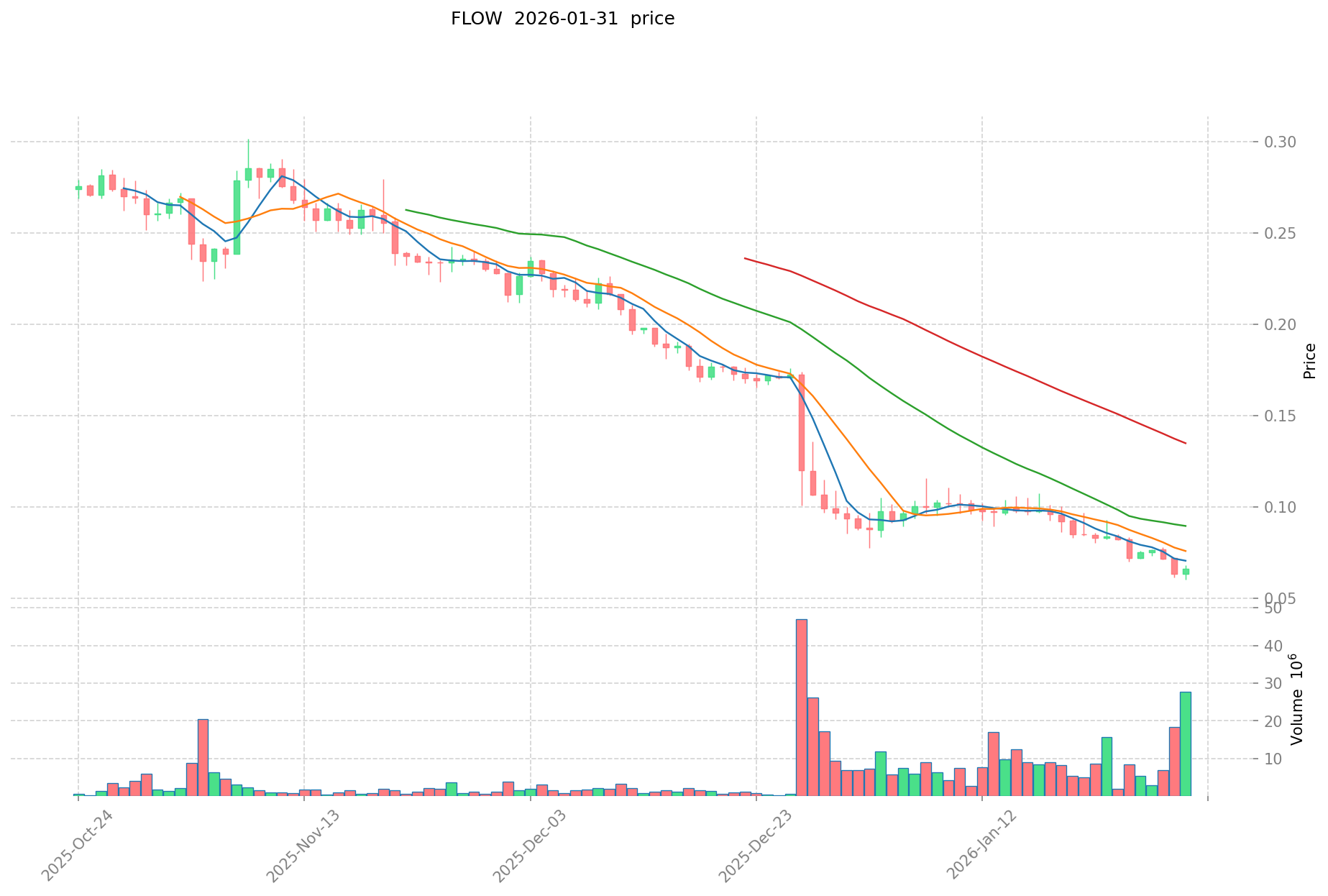
- FLOW Current Price: $0.0595
- 24-Hour Trading Volume: BNC recorded $47,559.26, while FLOW demonstrated higher liquidity with $845,975.07
- Market Sentiment Index (Fear & Greed Index): 20 (Extreme Fear)
View real-time prices:

II. Core Factors Affecting BNC vs FLOW Investment Value
Supply Mechanism Comparison (Tokenomics)
Due to the absence of specific tokenomics information in the available materials, a detailed comparison of supply mechanisms cannot be provided at this time. Understanding supply dynamics—such as fixed supply models, deflationary mechanisms, or halving schedules—typically plays a role in analyzing price cycle patterns.
Institutional Adoption and Market Application
- Institutional Holdings: The materials do not specify which asset demonstrates stronger institutional preference between BNC and FLOW.
- Enterprise Adoption: Information regarding the deployment of BNC or FLOW in cross-border payments, settlement systems, or investment portfolios was not found in the provided resources.
- National Policy: Regulatory attitudes toward BNC and FLOW across different jurisdictions are not documented in the available materials.
Technology Development and Ecosystem Building
- BNC Technology Upgrades: Specific technical advancements and their potential impact are not covered in the reference materials.
- FLOW Technology Development: Details on FLOW's technological evolution and implications are not available in the provided sources.
- Ecosystem Comparison: The extent of deployment in DeFi, NFT, payment systems, and smart contract applications for both assets remains unclear based on the current materials.
Macroeconomic Factors and Market Cycles
- Performance in Inflationary Environments: The materials do not address which asset may exhibit stronger inflation-resistant characteristics.
- Macroeconomic Monetary Policy: The influence of interest rates, dollar index movements, and related factors on BNC and FLOW is not documented in the available resources.
- Geopolitical Factors: The role of cross-border transaction demand and international developments in shaping investment value is not specified in the reference materials.
III. 2026-2031 Price Forecast: BNC vs FLOW
Short-term Forecast (2026)
- BNC: Conservative $0.0514 - $0.0553 | Optimistic $0.0553 - $0.0658
- FLOW: Conservative $0.0373 - $0.0593 | Optimistic $0.0593 - $0.0717
Mid-term Forecast (2028-2029)
- BNC may enter a gradual growth phase, with projected price range of $0.0610 - $0.0843
- FLOW may enter an expansion phase, with projected price range of $0.0662 - $0.1342
- Key drivers: institutional capital inflows, ETF developments, ecosystem expansion
Long-term Forecast (2030-2031)
- BNC: Baseline scenario $0.0629 - $0.0849 | Optimistic scenario $0.0849 - $0.1173
- FLOW: Baseline scenario $0.0619 - $0.1198 | Optimistic scenario $0.1198 - $0.1605
View detailed price predictions for BNC and FLOW
Disclaimer
BNC:
| Year |
Predicted High Price |
Predicted Average Price |
Predicted Low Price |
Price Change |
| 2026 |
0.0657832 |
0.05528 |
0.0514104 |
0 |
| 2027 |
0.072032604 |
0.0605316 |
0.0453987 |
9 |
| 2028 |
0.0828526275 |
0.066282102 |
0.06097953384 |
19 |
| 2029 |
0.0842611221675 |
0.07456736475 |
0.0708389965125 |
34 |
| 2030 |
0.090532237542975 |
0.07941424345875 |
0.068296249374525 |
43 |
| 2031 |
0.11726307189119 |
0.084973240500862 |
0.062880197970638 |
53 |
FLOW:
| Year |
Predicted High Price |
Predicted Average Price |
Predicted Low Price |
Price Change |
| 2026 |
0.0717288 |
0.05928 |
0.0373464 |
0 |
| 2027 |
0.083190588 |
0.0655044 |
0.050438388 |
10 |
| 2028 |
0.10706039136 |
0.074347494 |
0.06616926966 |
24 |
| 2029 |
0.1342418351664 |
0.09070394268 |
0.0662138781564 |
52 |
| 2030 |
0.127094364483216 |
0.1124728889232 |
0.06186008890776 |
89 |
| 2031 |
0.160510059782298 |
0.119783626703208 |
0.087442047493341 |
101 |
IV. Investment Strategy Comparison: BNC vs FLOW
Long-term vs Short-term Investment Strategies
- BNC: May appeal to investors interested in DeFi infrastructure and liquid staking derivatives within the Polkadot ecosystem, particularly those seeking exposure to cross-chain liquidity solutions.
- FLOW: May appeal to investors focused on blockchain platforms designed for digital assets, games, and NFT applications, particularly those interested in user-friendly protocol-level implementations.
Risk Management and Asset Allocation
- Conservative Investors: BNC 40% vs FLOW 60% - a balanced approach considering FLOW's higher trading volume and established ecosystem presence.
- Aggressive Investors: BNC 55% vs FLOW 45% - increased allocation to BNC for potential upside given its DeFi positioning and derivative mechanisms.
- Hedging Tools: Stablecoin allocation for liquidity management, options strategies for downside protection, cross-asset portfolio diversification to mitigate single-token exposure.
V. Potential Risk Comparison
Market Risk
- BNC: Lower trading volume ($47,559.26 as of February 1, 2026) may result in reduced liquidity and increased price volatility during market stress periods.
- FLOW: While demonstrating higher liquidity ($845,975.07), the token has experienced substantial decline from its peak of $42.4 in April 2021 to current levels around $0.0595, reflecting broader market correction patterns.
Technical Risk
- BNC: Scalability considerations related to cross-chain bridging mechanisms and network stability within the Polkadot parachain architecture.
- FLOW: Network reliability considerations, potential smart contract vulnerabilities, and dependency on continued ecosystem development for gaming and NFT applications.
Regulatory Risk
- Global regulatory developments may affect both assets differently based on their use cases - DeFi protocols face evolving compliance frameworks, while NFT and gaming platforms encounter jurisdiction-specific regulations regarding digital assets and consumer protection measures.
VI. Conclusion: Which Is the Better Buy?
📌 Investment Value Summary:
- BNC Advantages: Positioned within DeFi infrastructure with focus on liquid staking derivatives, potential benefits from cross-chain liquidity demand, integration within the Polkadot ecosystem.
- FLOW Advantages: Established presence in NFT and gaming sectors, higher current trading volume indicating better liquidity, protocol-level design oriented toward mainstream adoption.
✅ Investment Recommendations:
- Novice Investors: Consider starting with smaller allocations to both assets while monitoring market conditions, prioritize understanding each project's fundamental value proposition before increasing exposure.
- Experienced Investors: Evaluate portfolio positioning based on sector preferences - DeFi infrastructure exposure through BNC versus digital entertainment and NFT ecosystem exposure through FLOW, implement appropriate risk management through position sizing and stop-loss disciplines.
- Institutional Investors: Conduct comprehensive due diligence on liquidity profiles, custody solutions, and regulatory compliance frameworks for both assets, consider phased allocation approaches aligned with broader portfolio mandates.
⚠️ Risk Warning: The cryptocurrency market exhibits high volatility. This article does not constitute investment advice.
VII. FAQ
Q1: What are the main differences between BNC and FLOW in terms of their core use cases?
BNC focuses on DeFi infrastructure within the Polkadot ecosystem, specifically providing liquidity for staking assets through vToken derivatives, while FLOW is designed as a blockchain platform for games, NFTs, and digital assets with protocol-level usability improvements. BNC serves the liquid staking and cross-chain liquidity sector, whereas FLOW targets mainstream adoption in the digital entertainment and collectibles space. Since their launch in 2019 and 2020 respectively, they have developed distinct ecosystem positions—BNC as a DeFi protocol layer and FLOW as an application-focused blockchain platform.
Q2: Which asset shows better liquidity based on current market data?
FLOW demonstrates significantly higher liquidity with 24-hour trading volume of $845,975.07 compared to BNC's $47,559.26 as of February 1, 2026. This 17x difference in trading volume suggests that FLOW offers better price discovery mechanisms and reduced slippage for larger transactions. Higher liquidity typically benefits investors seeking easier entry and exit positions, though it's worth noting that both assets have experienced substantial declines from their historical peaks—BNC from $6.14 and FLOW from $42.4.
Q3: What are the projected price ranges for BNC and FLOW by 2031?
According to the forecast models, BNC is projected to reach a baseline scenario of $0.0629-$0.0849 and an optimistic scenario of $0.0849-$0.1173 by 2031, representing approximately 53% potential growth. FLOW's projections show a baseline scenario of $0.0619-$0.1198 and an optimistic scenario of $0.1198-$0.1605, indicating approximately 101% potential growth. These forecasts suggest FLOW may offer higher upside potential, though this comes with correspondingly higher risk given the volatility of long-term cryptocurrency predictions and dependence on ecosystem development milestones.
Q4: How should conservative versus aggressive investors allocate between BNC and FLOW?
Conservative investors may consider a 40% BNC / 60% FLOW allocation, reflecting FLOW's higher liquidity and more established ecosystem presence, which may provide relatively more stable trading conditions. Aggressive investors might adopt a 55% BNC / 45% FLOW split, increasing exposure to BNC's potential upside from its DeFi positioning and derivative mechanisms within the growing Polkadot parachain ecosystem. Both strategies should incorporate hedging tools such as stablecoin reserves for liquidity management, options for downside protection, and cross-asset diversification to mitigate single-token concentration risk.
Q5: What are the primary risk factors investors should consider for each asset?
BNC's primary risks include lower trading volume leading to potential liquidity constraints during market stress, scalability considerations related to cross-chain bridging mechanisms, and technical dependencies on Polkadot's parachain architecture stability. FLOW faces risks from its substantial decline from $42.4 to current levels, potential smart contract vulnerabilities in its gaming and NFT applications, and dependency on continued ecosystem growth in competitive digital entertainment markets. Both assets face evolving regulatory frameworks—BNC within DeFi compliance developments and FLOW regarding NFT and gaming platform regulations across different jurisdictions.
Q6: Which asset is more suitable for investors interested in the DeFi sector versus the NFT sector?
BNC is specifically designed for investors seeking DeFi infrastructure exposure, particularly in liquid staking derivatives and cross-chain liquidity solutions within the Polkadot ecosystem, making it the clear choice for DeFi-focused portfolios. FLOW is purpose-built for the NFT, gaming, and digital collectibles space, with proven track record through projects like NBA Top Shot and protocol-level features optimized for mainstream digital asset adoption. Investors should align their choice with their sector conviction—DeFi infrastructure growth favors BNC, while digital entertainment and NFT ecosystem expansion favors FLOW.
Q7: What market conditions would favor BNC over FLOW, and vice versa?
BNC may outperform during periods of increased DeFi adoption, rising staking participation rates, cross-chain interoperability demand, and growth within the Polkadot parachain ecosystem, particularly when institutional capital flows into liquid staking solutions. FLOW would likely benefit from renewed interest in NFT markets, gaming blockchain adoption, mainstream digital asset integration, and consumer-facing blockchain applications gaining traction. Current market conditions show Extreme Fear (index of 20), which historically presents accumulation opportunities, though investors should monitor sector-specific catalysts that may differentially impact each asset's performance trajectory.
Q8: How do the historical price peaks of BNC and FLOW compare, and what does this indicate?
BNC reached its all-time high of $6.14 on November 3, 2021, while FLOW peaked earlier at $42.4 on April 5, 2021, representing a 111x and 712x distance from current prices respectively. FLOW's earlier and significantly higher peak relative to current price suggests greater correction magnitude, which could indicate either more downside risk from prior speculation or potentially greater recovery opportunity if market conditions improve. BNC's later peak and smaller absolute decline may reflect more measured growth patterns, though both assets have followed broader cryptocurrency market correction trajectories and neither has approached previous highs in the current cycle.
* The information is not intended to be and does not constitute financial advice or any other recommendation of any sort offered or endorsed by Gate.