This comprehensive analysis compares BOX and RUNE, two distinct blockchain assets with different market positioning. BOX, a Web3 social platform launched in 2024, currently trades at $0.012598 after declining 97% from its peak. RUNE, an established cross-chain liquidity protocol since 2019, trades at $0.514 with higher trading volume. The article examines historical price trends, tokenomics models emphasizing RUNE's fair launch principles, technological ecosystems, and 2026-2031 price outlooks. BOX offers higher growth potential for aggressive investors but carries liquidity risks, while RUNE provides established infrastructure and community support. Under current extreme fear market conditions, investors should prioritize diversification, risk management, and comprehensive due diligence aligned with their investment profiles and risk tolerance levels.
Introduction: Investment Comparison Between BOX and RUNE
In the cryptocurrency market, the comparison between BOX and RUNE has become a topic of interest for investors. The two assets differ significantly in market cap ranking, application scenarios, and price performance, representing distinct positioning within the crypto asset landscape.
BOX (DeBox): Launched in 2024, it positions itself as an all-in-one Web3 social platform, claiming to be the largest on-chain holding community and next-generation social exchange.
RUNE (THORChain): Operating since 2019, it has established itself as a highly optimized multi-chain protocol designed for cross-chain liquidity and decentralized trading.
This article will comprehensively analyze the investment value comparison between BOX and RUNE, focusing on historical price trends, supply mechanisms, technological ecosystems, and future outlook, attempting to address the question investors care about most:
"Which presents a more compelling investment case based on current market data?"
I. Historical Price Comparison and Current Market Status
Price History of BOX (Coin A) and RUNE (Coin B)
- 2024: BOX experienced significant volatility, reaching an all-time high of $0.4363 in September 2024, before entering a sustained decline phase.
- 2021: RUNE achieved its all-time high of $20.87 in May 2021 during the broader crypto market rally, subsequently experiencing substantial downward pressure.
- Comparative Analysis: During the market correction cycle from 2024 to 2026, BOX declined from its peak of $0.4363 to approximately $0.01260, representing a decline of over 97%. In contrast, RUNE experienced a more pronounced decline from $20.87 to approximately $0.514, reflecting a decline exceeding 97% from its historical peak.
Current Market Status (2026-01-30)
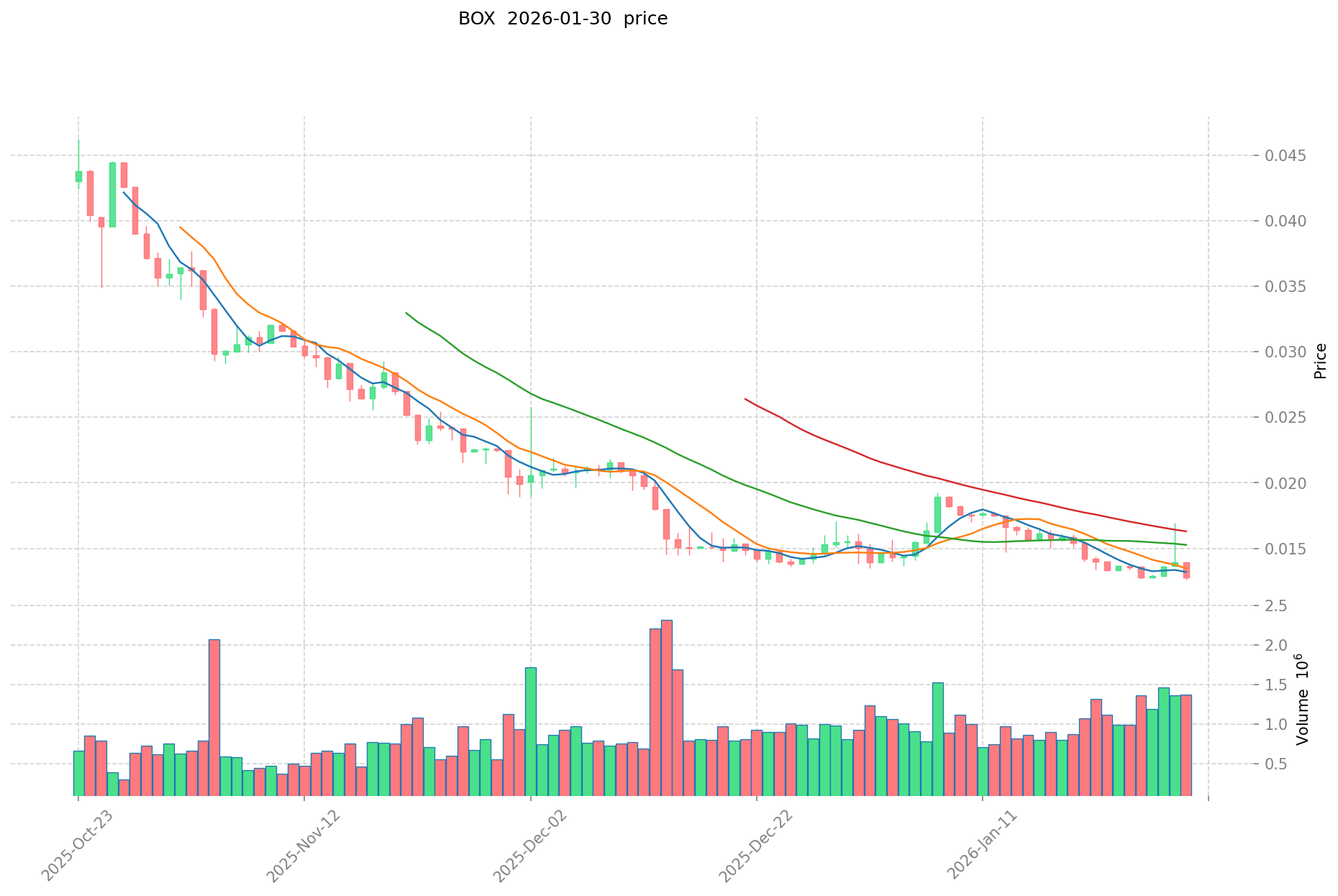
- BOX Current Price: $0.012598
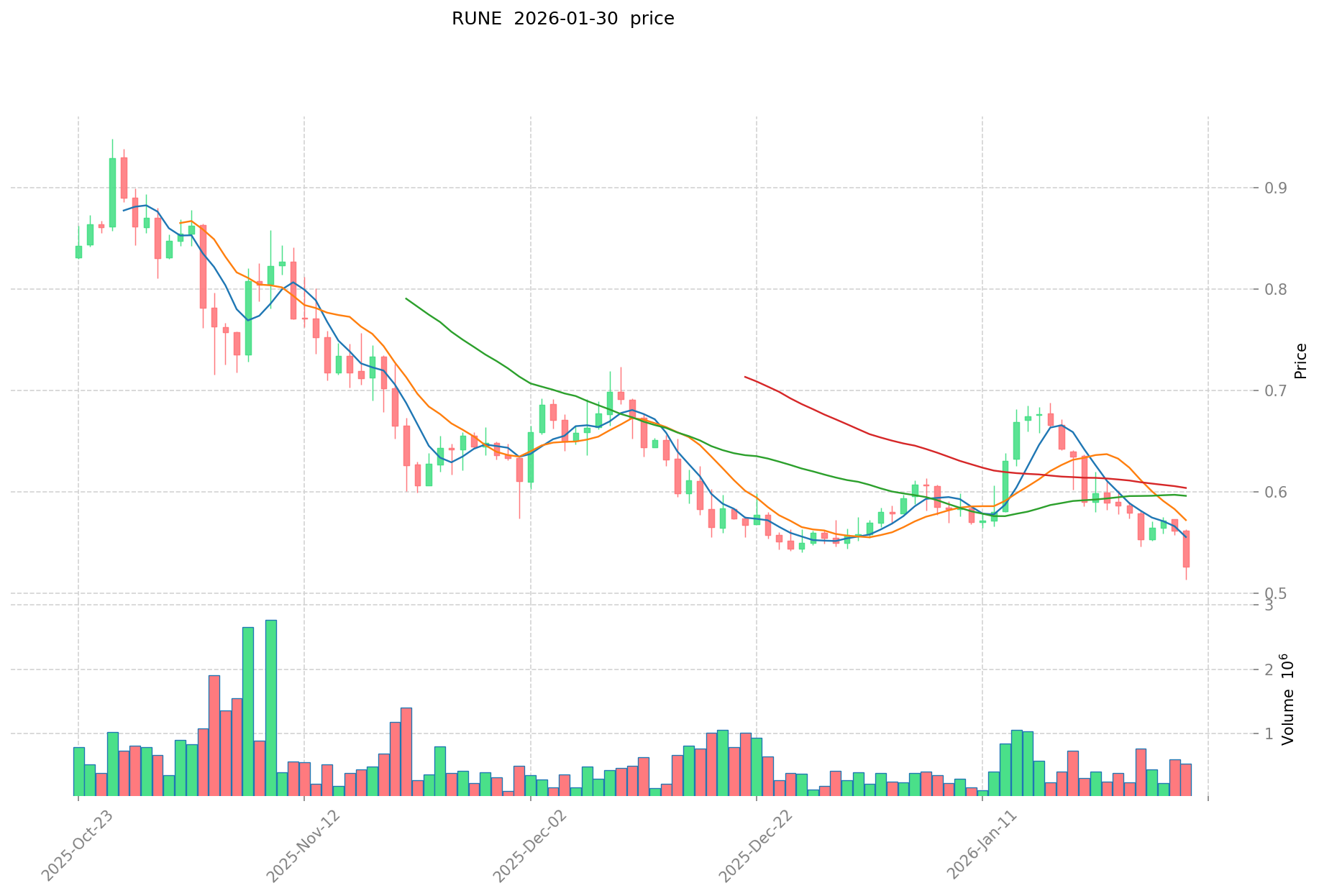
- RUNE Current Price: $0.514
- 24-Hour Trading Volume: BOX recorded $16,547.35 vs RUNE recorded $312,437.42
- Market Sentiment Index (Fear & Greed Index): 16 (Extreme Fear)
View Real-Time Prices:
II. Core Factors Influencing BOX vs RUNE Investment Value
Tokenomics Comparison
- BOX: The reference materials do not provide specific information about BOX's supply mechanism or tokenomics model.
- RUNE: Fairness represents a core value principle within the Runes ecosystem. The protocol emphasizes "fair launch" mechanisms, meaning no pre-allocation for founders or early investors, ensuring all participants have equal access opportunities. The Runes protocol was designed as a complement to the Bitcoin ecosystem, with expectations of bringing substantial liquidity and market attention upon its launch.
- 📌 Historical Pattern: Supply mechanisms and distribution fairness can significantly influence community support and long-term price dynamics, with fair launch models typically attracting stronger community engagement.
Institutional Adoption and Market Application
- Institutional Holdings: The reference materials do not contain comparative data on institutional preferences between BOX and RUNE.
- Enterprise Adoption: Specific applications of BOX or RUNE in cross-border payments, settlements, or investment portfolios are not detailed in the available materials.
- Regulatory Landscape: The materials do not address different jurisdictions' regulatory stances toward these assets.
Technology Development and Ecosystem Building
- BOX Technology: The reference materials lack information regarding BOX's technical infrastructure or development roadmap.
- RUNE Technology: The Runes protocol was positioned as an important addition to the Bitcoin ecosystem, potentially opening new possibilities for BTC development. The protocol was anticipated to launch with significant market interest, though its actual release faced certain controversies.
- Ecosystem Comparison: The Runes project encountered challenges related to its launch methodology and market reception. Community response highlighted concerns about fair distribution, with some observers noting that excessive pre-allocation tends to undermine community support. Applications across DeFi, NFT, payments, and smart contracts for either asset are not specified in the materials.
Macroeconomic Environment and Market Cycles
- Inflation Hedge Properties: The reference materials do not provide analysis comparing BOX and RUNE as inflation hedges.
- Monetary Policy Impact: The influence of interest rates, dollar index movements, or broader macroeconomic conditions on these assets is not addressed in the available materials.
- Geopolitical Factors: Cross-border transaction demand and international developments potentially affecting either asset are not discussed in the reference materials.
III. 2026-2031 Price Forecast: BOX vs RUNE
Short-term Forecast (2026)
- BOX: Conservative $0.010 - $0.013 | Optimistic $0.013 - $0.014
- RUNE: Conservative $0.45 - $0.51 | Optimistic $0.51 - $0.70
Mid-term Forecast (2028-2029)
- BOX may enter a gradual growth phase, with projected price range of $0.009 - $0.018
- RUNE may enter an expansion phase, with projected price range of $0.59 - $0.85
- Key drivers: institutional capital inflows, ETF developments, ecosystem growth
Long-term Forecast (2030-2031)
- BOX: Baseline scenario $0.014 - $0.018 | Optimistic scenario $0.020 - $0.026
- RUNE: Baseline scenario $0.44 - $0.78 | Optimistic scenario $0.79 - $1.05
View detailed price predictions for BOX and RUNE
Disclaimer
BOX:
| Year |
Predicted High Price |
Predicted Average Price |
Predicted Low Price |
Price Change |
| 2026 |
0.01420636 |
0.012572 |
0.01043476 |
0 |
| 2027 |
0.0172720422 |
0.01338918 |
0.011380803 |
6 |
| 2028 |
0.018243427209 |
0.0153306111 |
0.008585142216 |
21 |
| 2029 |
0.01913720183613 |
0.0167870191545 |
0.01477257685596 |
33 |
| 2030 |
0.021554532594378 |
0.017962110495315 |
0.014190067291298 |
42 |
| 2031 |
0.0256858180083 |
0.019758321544846 |
0.011657409711459 |
56 |
RUNE:
| Year |
Predicted High Price |
Predicted Average Price |
Predicted Low Price |
Price Change |
| 2026 |
0.703084 |
0.5132 |
0.451616 |
0 |
| 2027 |
0.6689562 |
0.608142 |
0.50475786 |
18 |
| 2028 |
0.791800884 |
0.6385491 |
0.587465172 |
24 |
| 2029 |
0.85105824048 |
0.715174992 |
0.58644349344 |
39 |
| 2030 |
0.8457659455392 |
0.78311661624 |
0.4385453050944 |
52 |
| 2031 |
1.050629252347584 |
0.8144412808896 |
0.790008042462912 |
58 |
IV. Investment Strategy Comparison: BOX vs RUNE
Long-term vs Short-term Investment Strategies
- BOX: May appeal to investors interested in emerging Web3 social platform opportunities and willing to accept higher volatility in pursuit of potential growth from early-stage projects.
- RUNE: May suit investors focused on cross-chain liquidity infrastructure and decentralized trading protocols with established market presence since 2019.
Risk Management and Asset Allocation
- Conservative Investors: BOX: 10-15% vs RUNE: 20-25%
- Aggressive Investors: BOX: 25-35% vs RUNE: 30-40%
- Hedging Tools: Stablecoin allocation, options strategies, cross-asset portfolio diversification
V. Potential Risk Comparison
Market Risks
- BOX: Experienced significant decline from peak levels, currently trading near historical lows with limited trading volume ($16,547.35 in 24-hour period), indicating potentially lower liquidity and higher price volatility risk.
- RUNE: Has undergone substantial correction from 2021 peaks, with relatively higher trading volume ($312,437.42 in 24-hour period), though still subject to broader cryptocurrency market sentiment fluctuations, particularly during extreme fear conditions (Fear & Greed Index: 16).
Technical Risks
- BOX: Specific technical infrastructure details and scalability considerations are not provided in available materials, representing information gaps for technical risk assessment.
- RUNE: As a cross-chain protocol, faces typical challenges related to multi-chain coordination, network stability, and potential security vulnerabilities inherent in bridge technologies.
Regulatory Risks
- Global regulatory developments may impact both assets differently based on their respective use cases—social platforms versus cross-chain infrastructure—though specific jurisdictional stances are not detailed in available materials.
VI. Conclusion: Which Is the Better Buy?
📌 Investment Value Summary:
- BOX Advantages: Positions itself within the emerging Web3 social platform sector, potentially offering exposure to next-generation community-driven platforms, though with limited historical track record since 2024 launch.
- RUNE Advantages: Established operational history since 2019, addresses cross-chain liquidity needs within the DeFi ecosystem, emphasizes fair launch principles without pre-allocation to founders or early investors.
✅ Investment Recommendations:
- Novice Investors: Consider gaining foundational knowledge of cryptocurrency market dynamics and volatility patterns before allocating capital to either asset. Start with smaller position sizes and prioritize understanding project fundamentals.
- Experienced Investors: Evaluate portfolio diversification needs and risk tolerance levels. Consider both assets as part of a broader cryptocurrency allocation strategy rather than concentrated positions, given the extreme fear market conditions and substantial historical declines from peak levels.
- Institutional Investors: Conduct comprehensive due diligence on technical infrastructure, team backgrounds, governance structures, and regulatory compliance frameworks for both projects. Consider liquidity requirements and execution capabilities given current trading volumes.
⚠️ Risk Disclaimer: The cryptocurrency market exhibits extreme volatility characteristics. This content does not constitute investment advice. Market conditions, project developments, and regulatory environments may change rapidly and materially impact asset valuations.
VII. FAQ
Q1: What are the main differences between BOX and RUNE in terms of their core functionality?
BOX is a Web3 social platform launched in 2024, positioning itself as an all-in-one community-driven social exchange, while RUNE (THORChain) is a cross-chain liquidity protocol operating since 2019, designed for decentralized trading across multiple blockchain networks. The fundamental distinction lies in their use cases: BOX focuses on social connectivity and community building within the Web3 ecosystem, whereas RUNE addresses technical infrastructure needs for cross-chain asset transfers and liquidity provision in the DeFi space.
Q2: How do the current market conditions affect BOX and RUNE differently?
Both assets are currently operating under extreme fear market conditions (Fear & Greed Index: 16), though RUNE demonstrates significantly higher liquidity with 24-hour trading volume of $312,437.42 compared to BOX's $16,547.35. BOX, as a newer asset launched in 2024, faces higher volatility risk due to limited market history and lower trading volume. RUNE's established presence since 2019 provides more historical data for analysis, though both have experienced substantial declines from their respective all-time highs (BOX down over 97% from $0.4363, RUNE down over 97% from $20.87).
Q3: What are the key risk factors investors should consider when comparing these two assets?
For BOX, primary risks include limited operational history, significantly lower trading liquidity, and lack of detailed tokenomics information in available materials. For RUNE, risks center on cross-chain protocol vulnerabilities, multi-chain coordination challenges, and security considerations inherent in bridge technologies. Both assets face market-wide regulatory uncertainties and cryptocurrency sector volatility. Additionally, BOX's position near historical lows with minimal trading volume suggests potential liquidity constraints during market stress periods.
Q4: How do the tokenomics models of BOX and RUNE compare?
RUNE emphasizes fair launch principles with no pre-allocation to founders or early investors, ensuring equal access opportunities for all participants within the Runes ecosystem. This distribution model typically fosters stronger community engagement and support. However, available materials do not provide specific information about BOX's supply mechanism, distribution model, or tokenomics structure, representing a significant information gap for comparative analysis. Understanding tokenomics is crucial for long-term investment assessment, as fair distribution models historically correlate with sustained community participation.
Q5: What is the projected price outlook for BOX and RUNE through 2031?
Based on current analysis, BOX shows conservative projections ranging from $0.010-$0.013 in 2026, potentially reaching $0.014-$0.018 by 2031 under baseline scenarios, with optimistic scenarios projecting up to $0.026. RUNE demonstrates wider projected ranges, with conservative estimates of $0.45-$0.51 for 2026, potentially reaching $0.44-$0.78 by 2031 under baseline conditions, with optimistic scenarios suggesting up to $1.05. These projections depend heavily on institutional adoption rates, ecosystem development progress, and broader cryptocurrency market recovery from current extreme fear conditions.
Q6: Which asset is more suitable for different investor profiles?
Conservative investors might consider smaller allocations (10-15% BOX, 20-25% RUNE) given current market uncertainties and historical volatility patterns. Aggressive investors with higher risk tolerance could consider larger positions (25-35% BOX, 30-40% RUNE) as part of diversified cryptocurrency portfolios. Novice investors should prioritize educational foundations before allocation, starting with minimal position sizes to understand market dynamics. Institutional investors require comprehensive due diligence on technical infrastructure, governance frameworks, and regulatory compliance before commitment, particularly given current low liquidity conditions for BOX.
Q7: What role does technology development play in the investment cases for BOX versus RUNE?
RUNE's established operational infrastructure since 2019 provides demonstrated technical capabilities in cross-chain liquidity provision, representing a more mature technological foundation. The protocol was designed as a complementary addition to the Bitcoin ecosystem, potentially enhancing BTC development possibilities. BOX, as a newer entrant focused on Web3 social platforms, represents emerging technology in community-driven applications, though available materials lack detailed technical specifications. Technology development trajectories significantly impact long-term value propositions: RUNE's focus on infrastructure may benefit from DeFi ecosystem expansion, while BOX's success depends on Web3 social adoption rates.
Q8: How should investors approach portfolio allocation between these two assets during extreme market fear conditions?
During extreme fear conditions (current index: 16), risk management becomes paramount. Recommended approaches include maintaining stablecoin reserves (30-40% of crypto portfolio) for downside protection, implementing dollar-cost averaging strategies rather than lump-sum investments, and diversifying across multiple asset categories beyond BOX and RUNE. Consider combining both assets with more established cryptocurrencies to balance risk-reward profiles. Given BOX's limited liquidity and both assets' substantial declines from peaks, position sizing should account for potential further downside volatility. Regular portfolio rebalancing and stop-loss mechanisms can help manage exposure during continued market uncertainty.
* The information is not intended to be and does not constitute financial advice or any other recommendation of any sort offered or endorsed by Gate.