This comprehensive guide compares BRETT and HBAR cryptocurrencies to help investors identify superior long-term growth potential through 2031. BRETT, a meme token launched in December 2023, demonstrates high volatility and community-driven dynamics, currently trading at $0.01685 with lower institutional adoption. HBAR, an enterprise-focused distributed ledger network since February 2020, offers ISO 20022 compliance for international payments and documented institutional interest including ETF filings, trading at $0.11794 with significantly higher liquidity. The analysis examines historical price trends, tokenomics, institutional adoption, technological ecosystems, and projected price ranges, revealing HBAR's 6x higher trading volume and clearer regulatory positioning. Investment strategy recommendations differentiate between conservative investors favoring HBAR's institutional adoption pathway and aggressive investors seeking BRETT's volatility exposure. The article provides detailed risk assessment, market p
Introduction: Investment Comparison Between BRETT and HBAR
In the cryptocurrency market, the comparison between BRETT vs HBAR has consistently been a topic that investors cannot avoid. Both show significant differences in market cap ranking, application scenarios, and price performance, representing distinct crypto asset positioning.
BRETT (BRETT): Launched in December 2023, this token has gained market recognition as a meme coin inspired by Matt Furie's Boy's Club comic, serving as the blue mascot of the Base chain.
HBAR (HBAR): Since its launch in February 2020, it has been positioned as a fast, secure, and fair distributed ledger network utilizing hashgraph consensus, supporting decentralized applications and payment business models.
This article will comprehensively analyze the investment value comparison between BRETT vs HBAR through historical price trends, supply mechanisms, institutional adoption, technical ecosystem, and future predictions, attempting to answer the question that concerns investors most:
"Which is the better buy right now?"
I. Historical Price Comparison and Current Market Status
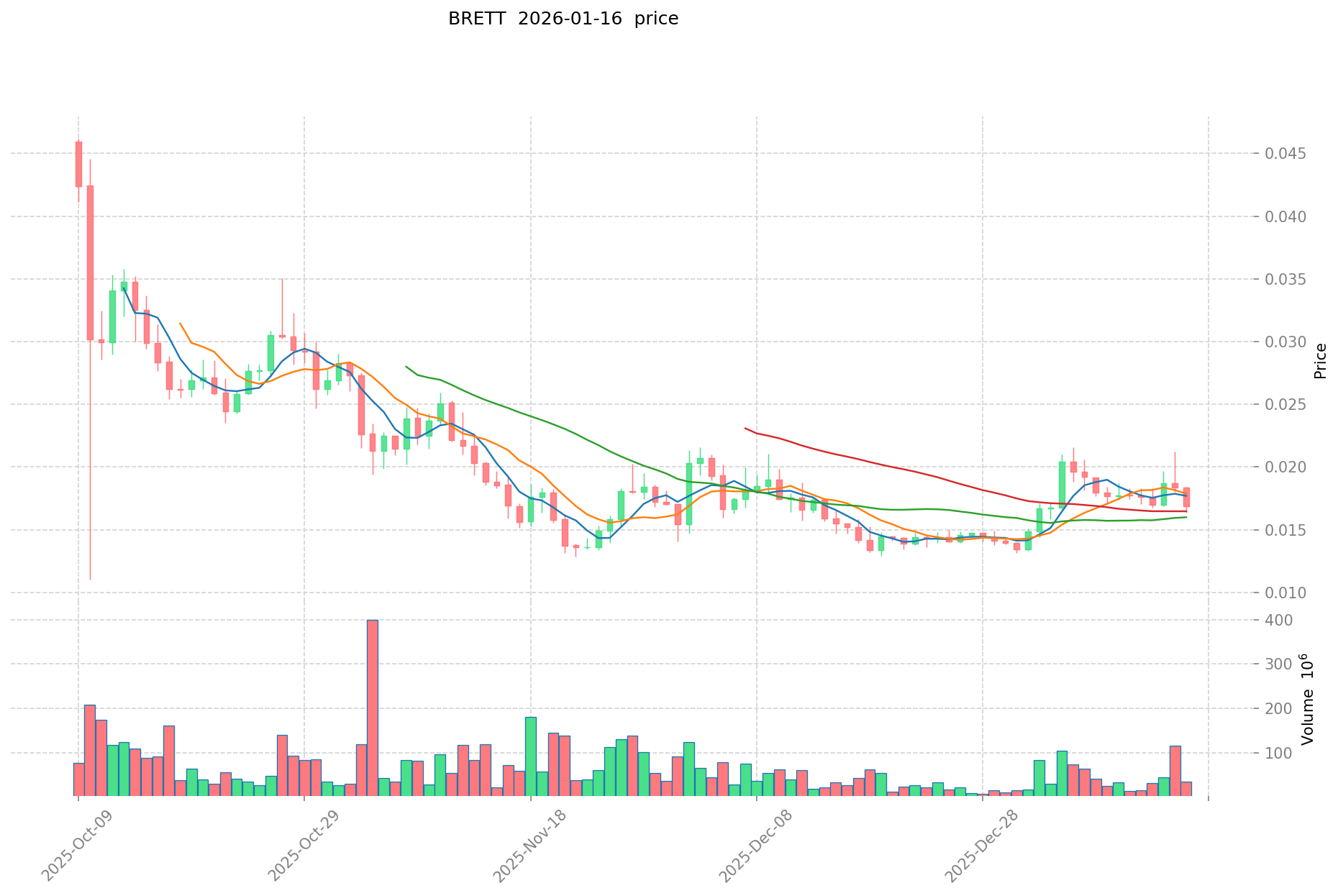
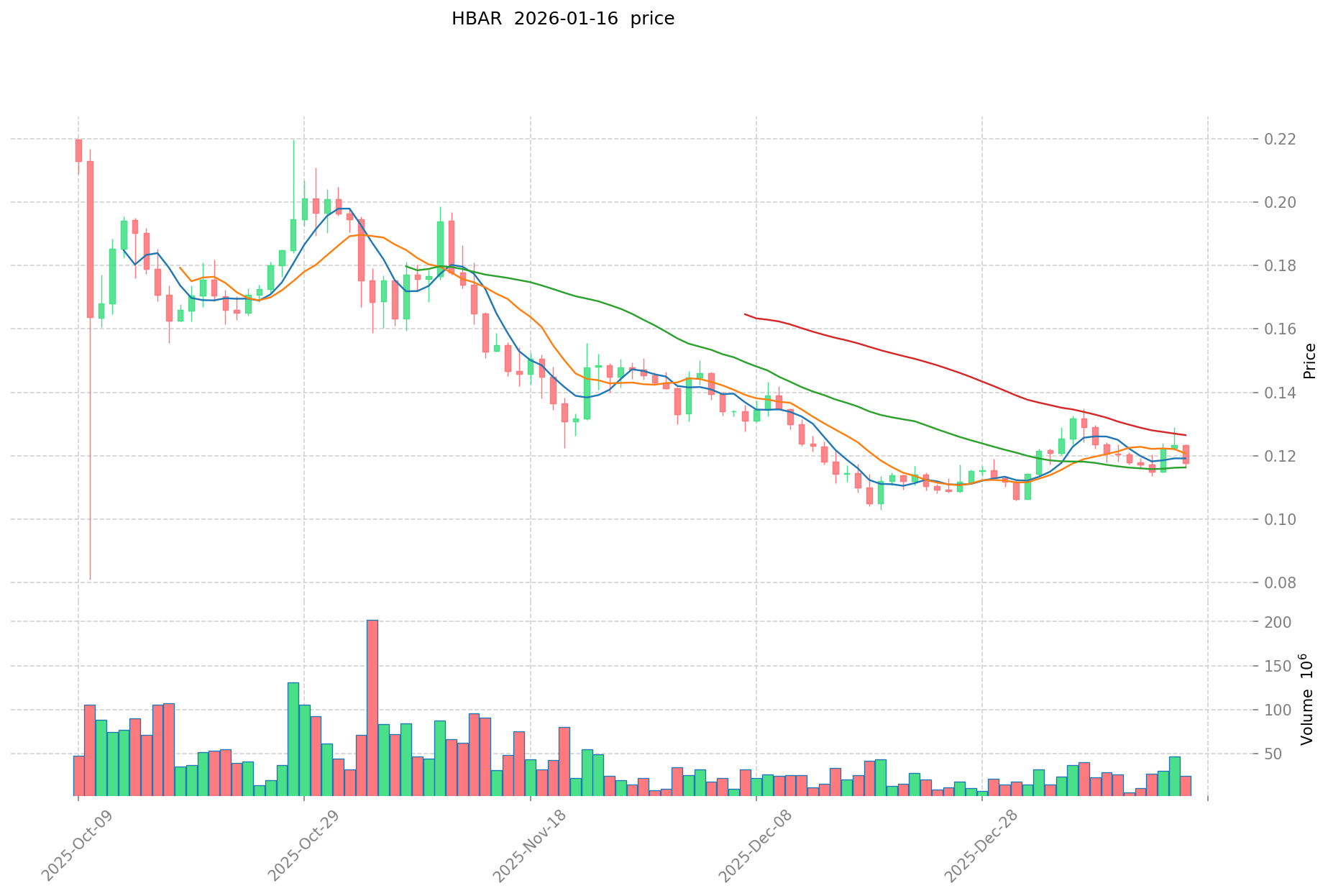
BRETT (Coin A) and HBAR (Coin B) Historical Price Trends
- 2021: HBAR experienced notable price movements during the broader crypto market expansion, with its price reaching $0.569229 in September 2021. This represented a period of strong performance for the asset within the market cycle.
- 2024: BRETT showed significant volatility, with its price reaching $0.23603 in December 2024, marking a notable peak during this period.
- Comparative Analysis: During different market cycles, BRETT moved from its peak of $0.23603 to lower price levels, while HBAR demonstrated a different trajectory, moving from its historical high of $0.569229 in September 2021 to current trading levels around $0.11794.
Current Market Status (2026-01-16)
- BRETT current price: $0.01685
- HBAR current price: $0.11794
- 24-hour trading volume: BRETT $428,797.41 vs HBAR $2,672,675.81
- Market Sentiment Index (Fear & Greed Index): 49 (Neutral)
View real-time prices:
- Check BRETT current price Market Price
- Check HBAR current price Market Price
II. Core Factors Influencing BRETT vs HBAR Investment Value
Tokenomics Comparison
- BRETT: The supply mechanism details were not specified in available materials. As a meme token, its value proposition appears linked to decentralized finance utility and community-driven dynamics.
- HBAR: HBAR serves as the native token of the Hedera network. Specific supply mechanisms such as fixed supply or deflationary models were not detailed in the reference materials.
- 📌 Historical Pattern: Supply mechanisms can influence price cycles through scarcity dynamics and emission schedules, though specific historical data for these tokens was not provided.
Institutional Adoption and Market Applications
- Institutional Holdings: HBAR has attracted institutional attention, particularly through its integration into ISO 20022 standards for international payments. Investment firms have shown interest, with Canary's HBAR ETF filing a 19b-4 application with the SEC. BRETT's institutional adoption status was not documented in available materials.
- Enterprise Adoption: HBAR's integration into ISO 20022 positions it favorably for cross-border payments and financial institution settlements. ISO 20022 represents an advanced standard for electronic data exchange among financial institutions, supporting larger data volumes and faster processing rates. Tokens compliant with ISO 20022 may receive priority consideration for international payment applications. BRETT's enterprise use cases were not specified.
- Regulatory Environment: Different jurisdictions maintain varying approaches to cryptocurrency regulation. The regulatory treatment of specific tokens continues to evolve across markets.
Technological Development and Ecosystem Building
- BRETT Technology: Reference materials did not provide specific details regarding BRETT's technological upgrades or development roadmap. Its utility in decentralized finance remains a component of its value proposition.
- HBAR Technology: Hedera's value proposition includes a commitment to never forking the network, addressing network stability concerns. The network's centralized business nodes serve as authority structures. Specific recent technological upgrades were not detailed in available materials.
- Ecosystem Comparison: HBAR's compliance with ISO 20022 standards suggests potential applications in institutional payment infrastructure. Detailed comparisons of DeFi, NFT, payment solutions, and smart contract implementations between the two networks were not available in reference materials.
Macroeconomic Factors and Market Cycles
- Performance in Inflationary Environments: Neither token's specific inflation-hedging characteristics were documented in available materials. Asset performance during inflationary periods depends on multiple factors including adoption, utility, and market sentiment.
- Macroeconomic Monetary Policy: Interest rates and dollar index movements can influence cryptocurrency markets broadly. Specific correlations for BRETT and HBAR were not provided in reference materials.
- Geopolitical Factors: Cross-border transaction demand and international developments can affect cryptocurrency adoption. HBAR's integration into international payment standards may position it to benefit from increased cross-border settlement needs, though specific geopolitical impacts were not quantified in available materials.
III. 2026-2031 Price Prediction: BRETT vs HBAR
Short-term Prediction (2026)
- BRETT: Conservative $0.0112 - $0.0170 | Optimistic $0.0170 - $0.0214
- HBAR: Conservative $0.0764 - $0.1176 | Optimistic $0.1176 - $0.1575
Medium-term Prediction (2028-2029)
- BRETT may enter a gradual growth phase, with projected price range of $0.0163 - $0.0272 in 2028 and $0.0192 - $0.0260 in 2029
- HBAR may enter an accelerated development stage, with projected price range of $0.1497 - $0.2060 in 2028 and $0.1046 - $0.2569 in 2029
- Key drivers: institutional capital inflows, ETF developments, ecosystem expansion
Long-term Prediction (2030-2031)
- BRETT: Baseline scenario $0.0159 - $0.0248 (2030) and $0.0197 - $0.0308 (2031) | Optimistic scenario $0.0248 - $0.0368 (2030) and $0.0308 - $0.0382 (2031)
- HBAR: Baseline scenario $0.2136 - $0.2202 (2030) and $0.1254 - $0.2323 (2031) | Optimistic scenario $0.2202 - $0.2444 (2030) and $0.2323 - $0.2764 (2031)
View detailed price predictions for BRETT and HBAR
Disclaimer: Price predictions are based on historical data analysis and market trends. Cryptocurrency markets are highly volatile and subject to various risk factors. These projections should not be considered as investment advice. Users should conduct independent research and assess their risk tolerance before making any investment decisions.
BRETT:
| Year |
Predicted High Price |
Predicted Average Price |
Predicted Low Price |
Price Change |
| 2026 |
0.0213822 |
0.01697 |
0.0112002 |
0 |
| 2027 |
0.02109371 |
0.0191761 |
0.014765597 |
13 |
| 2028 |
0.02718212175 |
0.020134905 |
0.01630927305 |
19 |
| 2029 |
0.0260243647125 |
0.023658513375 |
0.01916339583375 |
40 |
| 2030 |
0.03676532978475 |
0.02484143904375 |
0.015898520988 |
47 |
| 2031 |
0.03819619667367 |
0.03080338441425 |
0.01971416602512 |
82 |
HBAR:
| Year |
Predicted High Price |
Predicted Average Price |
Predicted Low Price |
Price Change |
| 2026 |
0.1575438 |
0.11757 |
0.0764205 |
0 |
| 2027 |
0.184326246 |
0.1375569 |
0.081158571 |
16 |
| 2028 |
0.20600521344 |
0.160941573 |
0.14967566289 |
36 |
| 2029 |
0.256862750508 |
0.18347339322 |
0.1045798341354 |
55 |
| 2030 |
0.24438655976904 |
0.220168071864 |
0.21356302970808 |
86 |
| 2031 |
0.276410005821658 |
0.23227731581652 |
0.12542975054092 |
96 |
IV. Investment Strategy Comparison: BRETT vs HBAR
Long-term vs Short-term Investment Strategies
- BRETT: May appeal to investors with higher risk tolerance who focus on meme token dynamics and decentralized finance utility. The asset has shown significant volatility patterns, which may suit traders seeking short-term price movements rather than long-term holding strategies.
- HBAR: May appeal to investors interested in institutional adoption potential and integration into international payment infrastructure through ISO 20022 compliance. The network's commitment to stability and enterprise applications could align with longer-term investment horizons.
Risk Management and Asset Allocation
- Conservative Investors: A potential allocation approach might consider BRETT 20-30% vs HBAR 70-80%, favoring the asset with documented institutional interest and payment infrastructure integration.
- Aggressive Investors: A potential allocation approach might consider BRETT 40-50% vs HBAR 50-60%, balancing volatility exposure with institutional adoption potential.
- Hedging Tools: Stablecoin allocation for portfolio balance, options strategies for downside protection, cross-asset diversification to manage correlation risks.
V. Potential Risk Comparison
Market Risks
- BRETT: As a meme token launched in December 2023, the asset may experience volatility influenced by community sentiment and social media trends. Price movements have shown significant fluctuations between peak levels and current trading ranges.
- HBAR: Market performance may be influenced by institutional adoption timelines, regulatory developments affecting enterprise blockchain applications, and broader cryptocurrency market cycles. The asset has experienced price variations from previous peak levels to current trading ranges.
Technical Risks
- BRETT: Specific technical infrastructure details were not provided in available materials. Meme tokens generally face considerations around network utility and sustained developer activity.
- HBAR: The network utilizes centralized business nodes as authority structures. Considerations include network scalability during high-demand periods and the operational continuity of validator nodes. The commitment to never forking aims to address network stability concerns.
Regulatory Risks
- Different jurisdictions maintain evolving approaches to cryptocurrency regulation. HBAR's integration into ISO 20022 standards may provide positioning within regulated payment infrastructure, though specific regulatory treatment continues to develop. Meme tokens like BRETT may face different regulatory considerations compared to enterprise-focused networks. Global policy developments could affect both assets differently based on their respective use cases and institutional adoption levels.
VI. Conclusion: Which Is the Better Buy?
📌 Investment Value Summary:
- BRETT Characteristics: Represents meme token dynamics with decentralized finance utility positioning. Has demonstrated significant price volatility since launch in December 2023. Current trading at $0.01685 with 24-hour volume of $428,797.41.
- HBAR Characteristics: Positioned as enterprise-focused distributed ledger network with ISO 20022 integration for international payments. Has attracted institutional attention including ETF filing activity. Current trading at $0.11794 with 24-hour volume of $2,672,675.81.
✅ Investment Considerations:
- New Investors: May consider starting with assets that have documented institutional interest and clearer use case applications within regulated frameworks. Understanding fundamental technology and adoption metrics before allocation decisions remains important.
- Experienced Investors: May evaluate portfolio positioning based on risk tolerance, time horizon, and diversification objectives. Balancing exposure between meme token volatility and enterprise adoption potential could align with different strategy goals.
- Institutional Investors: May prioritize assets with regulatory compliance pathways, documented enterprise adoption, and integration into existing financial infrastructure. ISO 20022 compliance and ETF development activity may represent relevant evaluation criteria.
⚠️ Risk Disclosure: Cryptocurrency markets exhibit significant volatility. This content does not constitute investment advice. Market conditions, regulatory developments, and technological factors can materially affect asset performance. Individuals should conduct independent research and assess personal risk tolerance before making any investment decisions.
VII. FAQ
Q1: What is the main difference between BRETT and HBAR in terms of their fundamental purpose?
BRETT is a meme token launched in December 2023 with decentralized finance utility positioning, while HBAR is an enterprise-focused distributed ledger network designed for institutional payment infrastructure and business applications.
BRETT operates primarily within the meme token category, drawing its value proposition from community dynamics and social media engagement patterns. It serves as the blue mascot of the Base chain and was inspired by Matt Furie's Boy's Club comic. In contrast, HBAR utilizes hashgraph consensus technology and has integrated into ISO 20022 standards for international payments, positioning itself as infrastructure for cross-border settlements and financial institution applications. This fundamental difference affects their respective volatility profiles, adoption pathways, and potential use cases within the cryptocurrency ecosystem.
Q2: Which asset has demonstrated stronger institutional interest?
HBAR has shown more documented institutional adoption, particularly through its ISO 20022 integration and ETF filing activity.
The reference materials indicate that HBAR has attracted attention from investment firms, with Canary filing a 19b-4 application with the SEC for an HBAR ETF. Additionally, HBAR's compliance with ISO 20022 standards—an advanced protocol for electronic data exchange among financial institutions—positions it within regulated payment infrastructure frameworks. This integration suggests potential priority consideration for international payment applications by enterprise entities. BRETT's institutional adoption status was not documented in available materials, indicating a more retail-focused or community-driven investor base typical of meme token projects.
Q3: How do the 24-hour trading volumes compare between BRETT and HBAR?
HBAR's 24-hour trading volume of $2,672,675.81 is approximately 6.2 times higher than BRETT's volume of $428,797.41.
This significant difference in trading volume reflects variations in market liquidity, investor interest, and market depth between the two assets. Higher trading volume generally indicates greater market participation and can facilitate easier entry and exit positions with potentially lower slippage. HBAR's larger trading volume correlates with its longer market presence (launched February 2020 versus BRETT's December 2023 launch), broader institutional awareness, and integration into payment infrastructure systems. For investors, higher liquidity assets may offer advantages in execution quality and price discovery mechanisms.
Q4: What are the projected price ranges for BRETT and HBAR by 2030?
By 2030, BRETT's baseline scenario projects $0.0159 - $0.0248 while HBAR's baseline scenario projects $0.2136 - $0.2202.
These projections reflect different growth trajectories based on the assets' respective market positioning and adoption potential. HBAR's higher projected price range correlates with its enterprise adoption pathway, ISO 20022 integration, and institutional interest including ETF developments. BRETT's more modest projections align with meme token market dynamics and the challenges of sustaining long-term value growth without clearly defined enterprise utility. However, cryptocurrency price predictions remain highly speculative and subject to numerous variables including market cycles, regulatory developments, technological advancements, and macroeconomic conditions. These projections should not be interpreted as guaranteed outcomes or investment advice.
Q5: Which asset might be more suitable for conservative versus aggressive investors?
Conservative investors might favor HBAR with a potential 70-80% allocation, while aggressive investors might consider a more balanced 50-60% HBAR and 40-50% BRETT allocation.
Conservative investment strategies typically prioritize capital preservation, documented use cases, and institutional adoption indicators. HBAR's integration into payment infrastructure, regulatory compliance pathway through ISO 20022, and ETF development activity align with these characteristics. The network's commitment to stability through its no-fork policy may also appeal to risk-averse investors. Conversely, aggressive investors with higher risk tolerance might allocate meaningful exposure to BRETT to capture potential meme token volatility and community-driven price movements. This allocation approach balances exposure to both enterprise adoption potential and speculative growth opportunities, though individual circumstances including time horizon, risk capacity, and portfolio objectives should determine actual allocation decisions.
Q6: What regulatory advantages might HBAR have compared to BRETT?
HBAR's integration into ISO 20022 standards provides positioning within regulated payment infrastructure frameworks, while BRETT's regulatory status as a meme token remains less defined.
ISO 20022 represents an internationally recognized standard for electronic data exchange among financial institutions, supporting cross-border payments and settlements. HBAR's compliance with these standards may facilitate adoption by regulated entities and provide clearer pathways for integration into traditional financial systems. This positioning could potentially offer advantages as cryptocurrency regulations continue to evolve globally. Meme tokens like BRETT typically face different regulatory considerations, as their value proposition derives primarily from community dynamics rather than clearly defined utility within regulated frameworks. However, regulatory treatment varies across jurisdictions and continues to develop, meaning both assets face evolving compliance landscapes that could materially affect their market positioning.
Q7: How have BRETT and HBAR performed relative to their historical peak prices?
BRETT has declined from its December 2024 peak of $0.23603 to the current $0.01685, while HBAR has moved from its September 2021 high of $0.569229 to current levels around $0.11794.
These price movements reflect each asset's response to different market cycles and adoption phases. BRETT's significant decline from recent peaks demonstrates the volatility characteristic of meme tokens, which often experience rapid price appreciation followed by substantial corrections. HBAR's movement from its 2021 peak occurred during the broader cryptocurrency market correction that affected most digital assets. The current price levels for both assets represent substantial discounts from historical highs, though past performance does not indicate future results. Market cycles, technological developments, adoption metrics, and macroeconomic conditions all influence price trajectories. Investors should evaluate current fundamentals and future potential rather than focusing exclusively on historical price comparisons when making allocation decisions.
Q8: What are the primary risk factors that could affect BRETT and HBAR differently?
BRETT faces greater exposure to meme token sentiment shifts and community dynamics, while HBAR's risks center on enterprise adoption timelines and institutional regulatory developments.
As a meme token, BRETT's value proposition relies significantly on social media trends, community engagement, and market sentiment that can shift rapidly based on factors unrelated to fundamental utility. This creates volatility patterns that may not correlate with traditional market analysis frameworks. HBAR's risk profile includes considerations around enterprise adoption rates, the operational continuity of its centralized business nodes, regulatory developments affecting blockchain integration into payment systems, and competition from other enterprise-focused networks. Additionally, HBAR's performance may be more closely tied to institutional investment cycles and corporate technology adoption timelines. Both assets remain subject to broader cryptocurrency market risks including regulatory changes, macroeconomic conditions, and technological vulnerabilities, though the specific nature and magnitude of these risks differ based on their respective positioning within the digital asset ecosystem.
* The information is not intended to be and does not constitute financial advice or any other recommendation of any sort offered or endorsed by Gate.