This comprehensive investment analysis compares Bitcoin (BTC) and The Graph (GRT) across multiple dimensions including historical price trends, market capitalization, supply mechanisms, and institutional adoption. BTC, established since 2008, functions as digital gold with fixed 21-million-token supply and widespread institutional acceptance, currently trading at $91,166.40. GRT, launched in 2020 as a decentralized Web3 data indexing protocol, offers sector-specific infrastructure exposure at $0.04065 with significantly lower trading volume. The article evaluates long-term growth potential through 2031 price forecasts, technological ecosystems, regulatory landscapes, and tailored investment strategies for different investor profiles. Both assets present distinct risk-return profiles: BTC suits conservative investors seeking established market presence and stability, while GRT appeals to aggressive investors targeting Web3 infrastructure growth. Detailed risk analysis and FAQ sections provide actionable guidan
Introduction: Investment Comparison Between BTC and GRT
In the cryptocurrency market, the comparison between Bitcoin (BTC) and The Graph (GRT) has consistently been a topic that investors cannot overlook. These two assets exhibit significant differences in market capitalization ranking, application scenarios, and price performance, representing distinct positions within the crypto asset landscape.
Bitcoin (BTC): Since its launch in 2008, it has gained market recognition as digital gold and remains one of the cryptocurrencies with the highest global trading volume and market capitalization.
The Graph (GRT): Launched in 2020, it has been positioned as a decentralized protocol for indexing and querying blockchain data, primarily serving the Ethereum ecosystem.
This article will comprehensively analyze the investment value comparison between BTC and GRT, focusing on historical price trends, supply mechanisms, institutional adoption, technological ecosystems, and future forecasts, aiming to address the question most concerning to investors:
"Which is the better buy right now?"
I. Historical Price Comparison and Current Market Status
Bitcoin (BTC) and The Graph (GRT) Historical Price Trends
- 2021: Bitcoin experienced significant price movements during this period. In February 2021, BTC reached a notable price level, while The Graph (GRT) also saw considerable activity during its early market phase.
- 2025: Bitcoin reached a notable price point of $126,080 in October 2025, representing a significant milestone in its price history.
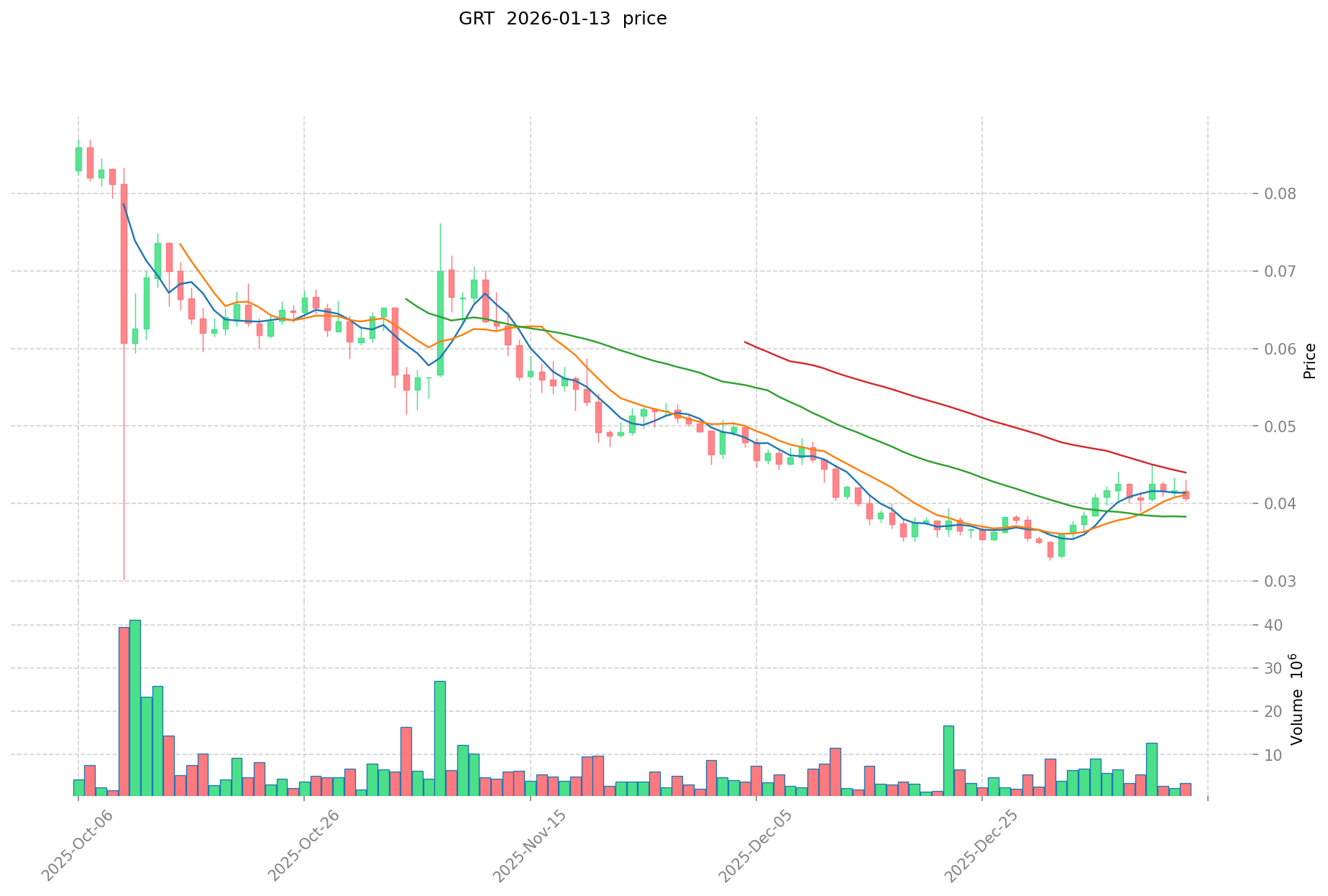
- Comparative Analysis: During various market cycles, Bitcoin has demonstrated substantial volatility, with its price ranging from a historical low of $67.81 to its peak of $126,080. The Graph has shown its own price dynamics, with its historical high of $2.84 recorded in February 2021 and a historical low of $0.03272768 observed in January 2026.
Current Market Status (2026-01-13)
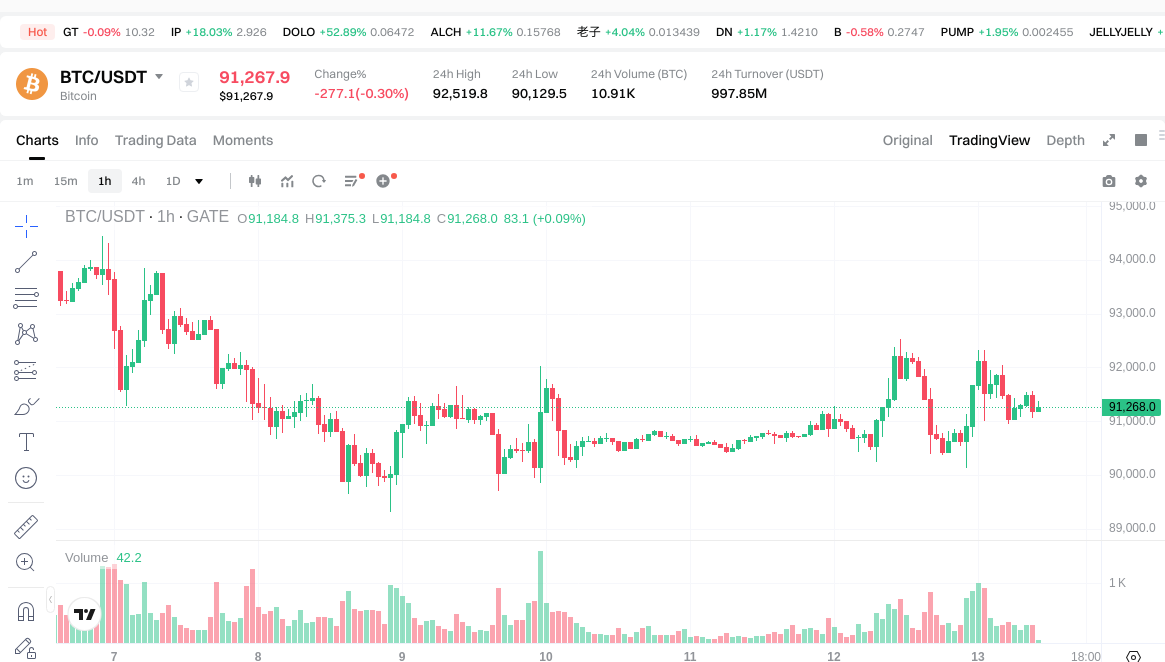
- Bitcoin (BTC) current price: $91,166.40
- The Graph (GRT) current price: $0.04065
- 24-hour trading volume: BTC recorded $999,320,285.05 versus GRT's $142,880.68
- Market sentiment index (Fear & Greed Index): 26 (Fear)
View real-time prices:
II. Key Factors Influencing Investment Value: BTC vs GRT
Supply Mechanism Comparison (Tokenomics)
- BTC: Features a fixed supply cap of 21 million tokens with a deflationary model. The halving mechanism occurs approximately every four years, reducing block rewards and constraining new supply entry into the market.
- GRT: The token economics are tied to network utility, with supply influenced by indexing rewards, curator incentives, and query fee structures within The Graph protocol ecosystem.
- 📌 Historical Pattern: Supply mechanisms have historically driven cyclical price movements. Bitcoin's halving events have been associated with supply shocks that preceded periods of price appreciation, while utility token value correlates with network adoption and usage metrics.
Institutional Adoption and Market Application
- Institutional Holdings: BTC has gained substantial institutional acceptance, with corporations, investment funds, and financial institutions adding it to balance sheets as a treasury asset and portfolio diversification tool.
- Enterprise Adoption: BTC is increasingly utilized in cross-border settlement, remittance services, and as a hedge instrument in institutional portfolios. GRT's application remains concentrated within Web3 infrastructure, serving decentralized applications requiring blockchain data indexing services.
- Regulatory Landscape: Different jurisdictions have established varied regulatory frameworks for both assets. BTC benefits from clearer regulatory classification in multiple markets, while GRT's regulatory status remains tied to evolving Web3 and utility token guidelines.
Technology Development and Ecosystem Building
- BTC Technology Evolution: Development focuses on Layer 2 solutions, Lightning Network expansion for payment scalability, and staking protocols (such as Babylon) that enable yield generation for holders while maintaining network security.
- GRT Technology Progress: Continued development of The Graph's decentralized indexing protocol, subgraph deployment optimization, and integration with expanding blockchain networks to support data query requirements.
- Ecosystem Comparison: BTC maintains dominance in payment infrastructure, store of value narratives, and increasingly in DeFi through wrapped tokens and staking mechanisms. GRT's ecosystem centers on Web3 data infrastructure, serving DeFi protocols, NFT platforms, and decentralized applications requiring efficient blockchain data access.
Macroeconomic Environment and Market Cycles
- Performance in Inflationary Conditions: BTC has been positioned as a potential inflation hedge due to its fixed supply characteristics, though correlation with traditional financial markets varies during different economic phases.
- Monetary Policy Impact: Interest rate adjustments and dollar index movements influence both assets, with BTC showing sensitivity to liquidity conditions and risk appetite in global markets. GRT's price dynamics are influenced by both macro conditions and sector-specific Web3 adoption trends.
- Geopolitical Factors: Cross-border transaction demand, capital flow restrictions, and international regulatory developments create varying impacts. BTC benefits from increased demand during periods of currency instability, while GRT's value proposition depends on decentralized technology adoption across different regions.
III. 2026-2031 Price Forecast: BTC vs GRT
Short-term Forecast (2026)
- BTC: Conservative $71,212.83 - $91,298.50 | Optimistic $91,298.50 - $99,515.37
- GRT: Conservative $0.0376 - $0.0409 | Optimistic $0.0409 - $0.0454
Mid-term Forecast (2028-2029)
- BTC may enter a potential growth phase, with estimated price range of $89,304.32 - $153,801.89
- GRT may enter an expansion phase, with estimated price range of $0.0305 - $0.0813
- Key drivers: institutional capital flows, ETF developments, ecosystem expansion
Long-term Forecast (2030-2031)
- BTC: Baseline scenario $72,237.27 - $153,504.21 | Optimistic scenario $153,504.21 - $173,459.76
- GRT: Baseline scenario $0.0416 - $0.0776 | Optimistic scenario $0.0776 - $0.1117
View detailed price predictions for BTC and GRT
Disclaimer
BTC:
| Year |
Predicted High Price |
Predicted Average Price |
Predicted Low Price |
Price Change |
| 2026 |
99515.365 |
91298.5 |
71212.83 |
0 |
| 2027 |
108763.90305 |
95406.9325 |
68692.9914 |
4 |
| 2028 |
145982.14741825 |
102085.417775 |
95960.2927085 |
11 |
| 2029 |
153801.890419815 |
124033.782596625 |
89304.32346957 |
36 |
| 2030 |
168090.5821749462 |
138917.83650822 |
72237.2749842744 |
52 |
| 2031 |
173459.756555988903 |
153504.2093415831 |
89032.441418118198 |
68 |
GRT:
| Year |
Predicted High Price |
Predicted Average Price |
Predicted Low Price |
Price Change |
| 2026 |
0.0454101 |
0.04091 |
0.0376372 |
0 |
| 2027 |
0.055244864 |
0.04316005 |
0.038844045 |
6 |
| 2028 |
0.07035951351 |
0.049202457 |
0.03345767076 |
21 |
| 2029 |
0.0813021399468 |
0.059780985255 |
0.03048830248005 |
47 |
| 2030 |
0.08464987512108 |
0.0705415626009 |
0.041619521934531 |
73 |
| 2031 |
0.111737835159825 |
0.07759571886099 |
0.07371593291794 |
90 |
IV. Investment Strategy Comparison: BTC vs GRT
Long-term vs Short-term Investment Strategies
- BTC: Suitable for investors seeking store of value characteristics, portfolio diversification, and exposure to established digital asset infrastructure with institutional adoption momentum
- GRT: Suitable for investors focused on Web3 infrastructure growth, decentralized data indexing adoption, and emerging protocol utility within blockchain application ecosystems
Risk Management and Asset Allocation
- Conservative Investors: BTC 70-80% vs GRT 20-30%
- Aggressive Investors: BTC 40-50% vs GRT 50-60%
- Hedging Instruments: Stablecoin allocation, options strategies, cross-asset portfolio diversification
V. Potential Risk Comparison
Market Risk
- BTC: Exposure to macroeconomic cycles, correlation with traditional financial markets during certain periods, liquidity fluctuations in high-volatility environments
- GRT: Lower trading volume relative to major assets, price sensitivity to Web3 sector adoption rates, potential impact from competing data indexing solutions
Technology Risk
- BTC: Network scalability challenges, Layer 2 implementation dependencies, mining infrastructure centralization concerns
- GRT: Protocol adoption requirements for value generation, technical complexity in subgraph deployment, competition from alternative blockchain data solutions
Regulatory Risk
- Varying global regulatory frameworks affect both assets differently; BTC faces scrutiny regarding energy consumption and transaction monitoring, while GRT's classification and treatment depend on evolving utility token regulations across jurisdictions
VI. Conclusion: Which Is the Better Buy?
📌 Investment Value Summary:
- BTC Advantages: Established market position, institutional adoption trajectory, fixed supply mechanism, broader liquidity, regulatory clarity in multiple jurisdictions
- GRT Advantages: Web3 infrastructure exposure, protocol utility value proposition, potential growth aligned with decentralized application expansion
✅ Investment Recommendations:
- Beginner Investors: Consider BTC as primary allocation due to established market presence, broader liquidity, and relatively clearer regulatory status across major markets
- Experienced Investors: Evaluate portfolio allocation between both assets based on risk tolerance, with BTC providing stability and GRT offering sector-specific exposure to Web3 data infrastructure
- Institutional Investors: Assess BTC for treasury diversification and portfolio hedging characteristics, while evaluating GRT within specialized Web3 technology investment strategies
⚠️ Risk Disclaimer: Cryptocurrency markets exhibit significant volatility. This analysis does not constitute investment advice.
VII. FAQ
Q1: What is the fundamental difference between Bitcoin (BTC) and The Graph (GRT)?
Bitcoin (BTC) serves as a store of value and digital currency with a fixed supply of 21 million tokens, operating as "digital gold" in the cryptocurrency market. The Graph (GRT), on the other hand, is a decentralized protocol for indexing and querying blockchain data, functioning primarily as Web3 infrastructure within the Ethereum ecosystem. While BTC focuses on value preservation and payment functionality, GRT's utility centers on enabling efficient data access for decentralized applications.
Q2: Which asset has better liquidity for trading?
Bitcoin (BTC) demonstrates significantly superior liquidity. As of January 13, 2026, BTC recorded a 24-hour trading volume of $999,320,285.05 compared to GRT's $142,880.68—approximately 7,000 times greater. This substantial difference means BTC offers easier entry and exit positions, tighter bid-ask spreads, and reduced slippage during transactions, making it more suitable for investors requiring flexible trading capabilities.
Q3: How do institutional investors view these two assets differently?
Institutional investors have adopted Bitcoin extensively as a treasury asset and portfolio diversification tool, with corporations, investment funds, and financial institutions adding BTC to their balance sheets. Bitcoin benefits from clearer regulatory classification in multiple markets and broader institutional acceptance. The Graph, however, remains primarily within specialized Web3 technology investment strategies, with adoption concentrated among entities focusing on decentralized application infrastructure rather than mainstream institutional portfolios.
Q4: What are the projected returns for BTC and GRT through 2031?
Based on conservative projections, Bitcoin may reach a price range of $72,237.27 to $173,459.76 by 2031, representing potential growth from current levels of $91,166.40. The Graph's projected range extends from $0.0416 to $0.1117 by 2031, compared to the current price of $0.04065. While GRT shows higher percentage growth potential, BTC demonstrates more stable appreciation within an established market framework. Both projections depend on factors including institutional adoption, ecosystem development, and broader cryptocurrency market conditions.
Q5: How should beginners allocate between BTC and GRT?
Beginner investors should prioritize Bitcoin as the primary allocation due to its established market presence, superior liquidity, broader institutional acceptance, and relatively clearer regulatory status across major markets. A recommended starting allocation might be 80-90% BTC with only 10-20% in GRT if seeking Web3 infrastructure exposure. This approach provides stability through BTC's established position while allowing limited exposure to GRT's growth potential within the decentralized data indexing sector.
Q6: What market risks differentiate BTC from GRT?
Bitcoin faces risks including correlation with traditional financial markets during certain periods, macroeconomic cycle exposure, and liquidity fluctuations in high-volatility environments. The Graph encounters distinct risks such as lower relative trading volume, price sensitivity to Web3 sector adoption rates, and potential impact from competing data indexing solutions. Additionally, GRT's value generation depends directly on protocol adoption and usage metrics, while BTC's value proposition rests on broader acceptance as a store of value and payment mechanism.
Q7: How do supply mechanisms impact the investment case for each asset?
Bitcoin's fixed supply cap of 21 million tokens creates a deflationary model, with halving events approximately every four years reducing new supply entry and historically preceding price appreciation periods. This scarcity mechanism supports the store of value narrative. The Graph's token economics tie directly to network utility, with supply influenced by indexing rewards, curator incentives, and query fee structures. Therefore, BTC's value correlates with scarcity and adoption as digital gold, while GRT's value depends on actual protocol usage and ecosystem growth within Web3 infrastructure.
Q8: What role does the current market sentiment play in investment decisions?
The current Fear & Greed Index reading of 26 (Fear) as of January 13, 2026, indicates cautious market sentiment. During fear phases, established assets like Bitcoin historically demonstrate relative stability compared to smaller-cap tokens like GRT, which may experience amplified volatility. This environment typically favors conservative positioning with higher BTC allocation for risk management, while aggressive investors seeking discounted entry points might consider increased GRT exposure if confident in long-term Web3 infrastructure adoption trends.
* The information is not intended to be and does not constitute financial advice or any other recommendation of any sort offered or endorsed by Gate.