This comprehensive comparison analyzes BTT and LINK, two leading blockchain utility tokens with distinct market positioning and investment profiles. BTT operates within the Tron ecosystem as a decentralized file-sharing and bandwidth incentivization platform, while LINK serves as oracle infrastructure connecting blockchain applications with external data sources. The article examines historical price performance, tokenomics, institutional adoption patterns, and technical ecosystem developments to evaluate investment value across different investor profiles. Current market data reveals LINK's larger market capitalization of $10.09 billion with higher trading volume, while BTT offers differentiated exposure at $433.28 million. Price forecasts spanning 2026-2031 suggest varying growth trajectories, with detailed risk analysis covering market volatility, technical considerations, and regulatory factors. The comparison provides actionable allocation strategies for conservative and aggressive investors, addressing
Introduction: BTT vs LINK Investment Comparison
In the cryptocurrency market, the comparison between BTT vs LINK has consistently been a topic investors cannot overlook. The two differ significantly in market cap ranking, application scenarios, and price performance, representing distinct crypto asset positioning.
BTT (BitTorrent): Launched in 2019, it has gained market recognition through its positioning in decentralized file sharing and bandwidth incentivization economy.
LINK (Chainlink): Since its inception in 2017, it has been regarded as a leading oracle solution, serving as one of the infrastructure projects with substantial adoption across blockchain ecosystems.
This article will comprehensively analyze the investment value comparison between BTT vs LINK, focusing on historical price trends, supply mechanisms, institutional adoption, technical ecosystems, and future predictions, attempting to answer the question investors care about most:
"Which is the better buy right now?"
I. Historical Price Comparison and Current Market Status
BitTorrent (BTT) and Chainlink (LINK) Historical Price Trends
-
2022: BTT reached its all-time high of $0.00000343 on January 21, 2022, during a period of broader cryptocurrency market expansion. The token subsequently experienced significant price decline as market conditions shifted.
-
2021: LINK achieved its historical peak of $52.7 on May 10, 2021, driven by growing adoption of decentralized oracle solutions and expanding DeFi ecosystem integration.
-
2023: BTT recorded its all-time low of $0.000000365368 on October 13, 2023, reflecting challenging market conditions and reduced trading activity.
-
Comparative Analysis: During the 2021-2023 market cycle, BTT declined from its peak of $0.00000343 to lows near $0.000000365368, representing substantial value erosion. LINK experienced a decline from $52.7 to a low of $0.148183 (recorded on November 29, 2017), though its recent performance has shown relative resilience with current levels considerably above historical lows.
Current Market Status (January 15, 2026)
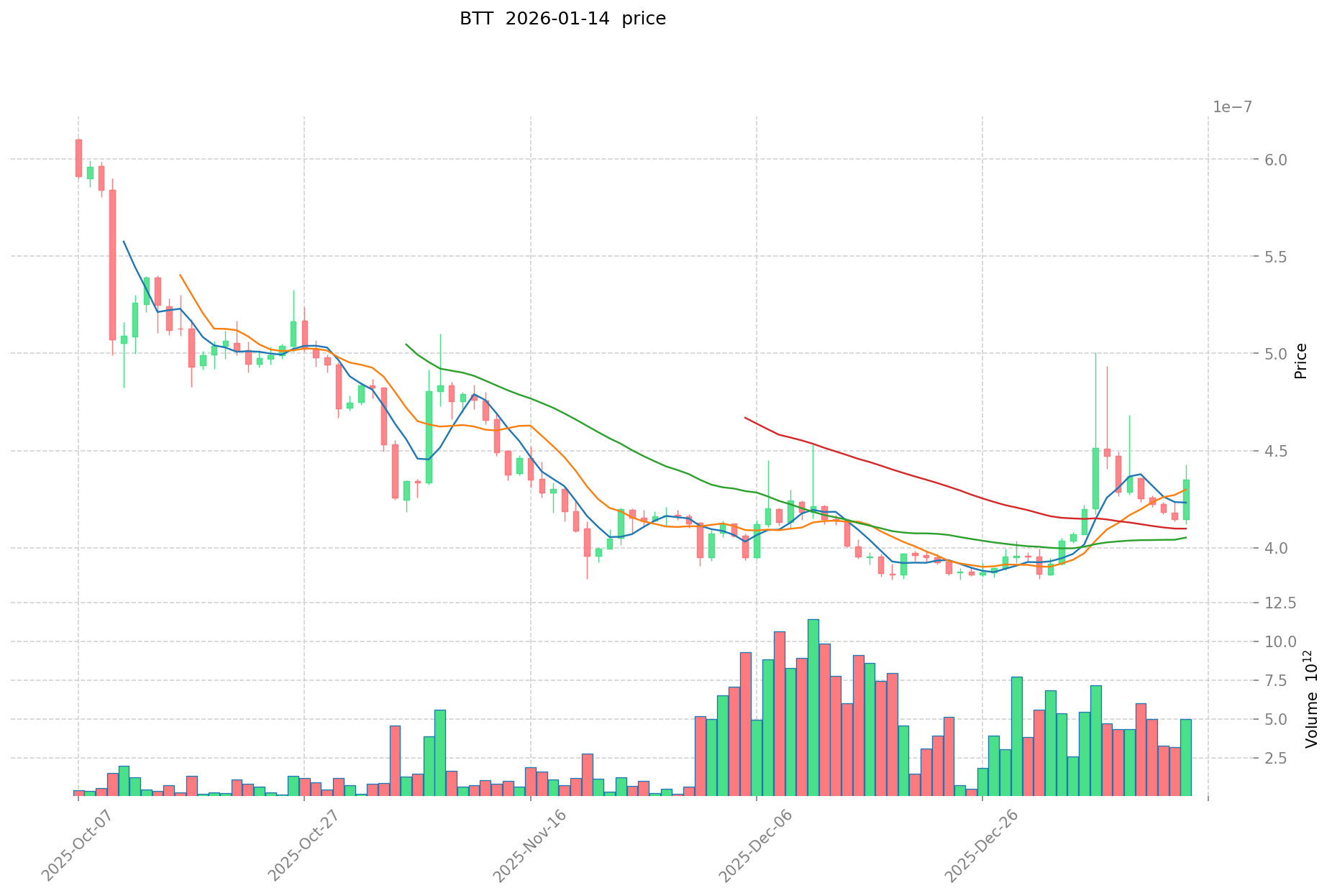
- BTT Current Price: $0.0000004394
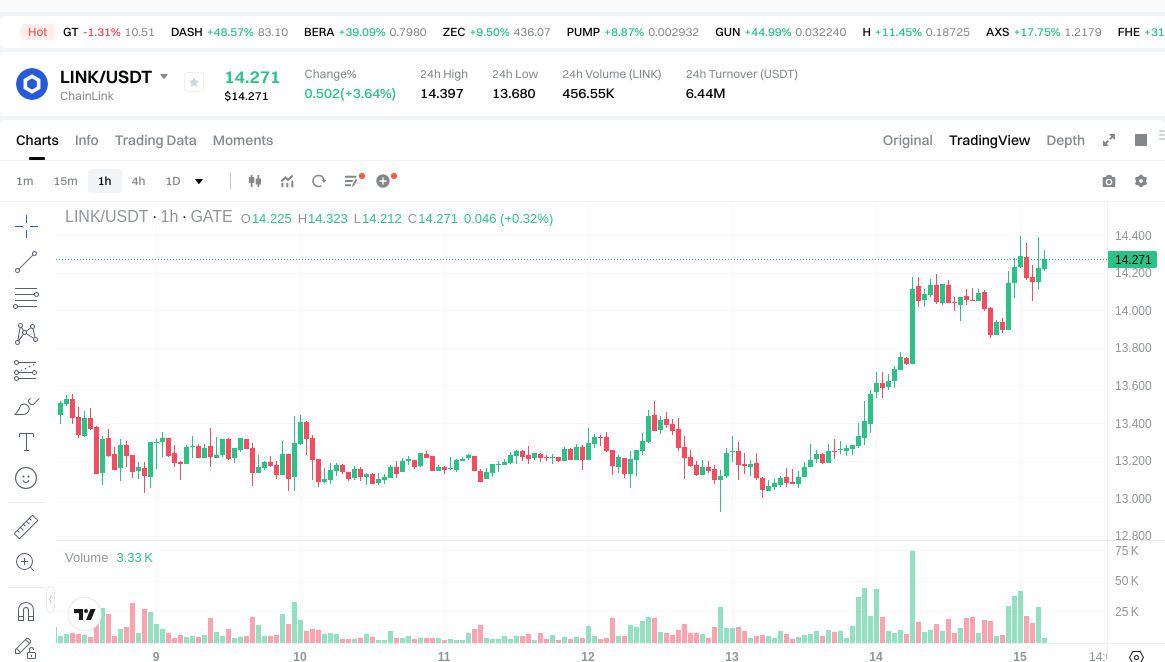
- LINK Current Price: $14.248
- 24-Hour Trading Volume: BTT $2,281,194.99 vs LINK $6,429,461.85
- 24-Hour Price Changes: BTT +3.04% vs LINK +3.63%
- Market Capitalization: BTT $433.28 million vs LINK $10.09 billion
- Market Sentiment Index (Fear & Greed Index): 48 (Neutral)
View real-time prices:
II. Core Factors Influencing BTT vs LINK Investment Value
Supply Mechanism Comparison (Tokenomics)
- BTT: The token operates within the Tron ecosystem with a substantial token supply structure. The project aims to develop an internet-like network supporting computing and content creation activities.
- LINK: Information regarding specific supply mechanisms was not detailed in available materials, though the project has connections to supply chain and logistics applications.
- 📌 Historical Pattern: Supply mechanisms play a role in shaping price cycles, though specific historical data for these tokens requires further observation.
Institutional Adoption and Market Applications
- Institutional Holdings: Available materials indicate varying levels of institutional interest, with investment patterns influenced by project utility and market positioning.
- Enterprise Adoption: BTT's integration with the Tron network suggests potential applications in decentralized file sharing, while applications in cross-border payments and settlement require further development.
- Regulatory Landscape: Different jurisdictions maintain evolving regulatory approaches toward digital assets, affecting both projects' operational frameworks.
Technical Development and Ecosystem Building
- BTT Technical Framework: Developed by Tron Foundation and BitTorrent Foundation, the project focuses on building decentralized infrastructure for content distribution and computing.
- LINK Development Direction: Materials suggest involvement in supply chain and logistics sectors, though specific technical upgrades were not extensively documented.
- Ecosystem Comparison: Both projects operate within broader blockchain ecosystems, with varying degrees of integration in DeFi, payment systems, and smart contract applications.
Macroeconomic Environment and Market Cycles
- Performance Under Economic Conditions: Cryptocurrency market dynamics are influenced by broader attention economy trends and capital allocation patterns.
- Monetary Policy Impact: Interest rate environments and currency valuations affect digital asset markets generally, though specific correlations vary by project fundamentals.
- Geopolitical Considerations: Cross-border transaction demand and international developments may influence adoption patterns for blockchain-based projects.
III. 2026-2031 Price Forecast: BTT vs LINK
Short-term Forecast (2026)
- BTT: Conservative $0.000000347205 - $0.0000004395 | Optimistic $0.0000004395 - $0.000000575745
- LINK: Conservative $13.00572 - $14.292 | Optimistic $14.292 - $20.0088
Mid-term Forecast (2028-2029)
- BTT may enter a gradual appreciation phase, with estimated price range of $0.00000047513466 - $0.000000771618687
- LINK may enter a steady growth phase, with estimated price range of $18.85514976 - $30.12725016
- Key drivers: institutional capital inflows, ETF developments, ecosystem expansion
Long-term Forecast (2030-2031)
- BTT: Baseline scenario $0.000000422124413 - $0.000000692007235 | Optimistic scenario $0.000000692007235 - $0.000000818298556
- LINK: Baseline scenario $17.381056201236 - $30.899655468864 | Optimistic scenario $30.899655468864 - $39.55155900014592
View detailed price predictions for BTT and LINK
Disclaimer
BTT:
| Year |
Predicted High Price |
Predicted Average Price |
Predicted Low Price |
Price Change |
| 2026 |
0.000000575745 |
0.0000004395 |
0.000000347205 |
0 |
| 2027 |
0.0000005482323 |
0.0000005076225 |
0.00000029442105 |
15 |
| 2028 |
0.000000696864168 |
0.0000005279274 |
0.00000047513466 |
19 |
| 2029 |
0.000000771618687 |
0.000000612395784 |
0.000000502164542 |
39 |
| 2030 |
0.000000795808321 |
0.000000692007235 |
0.000000422124413 |
57 |
| 2031 |
0.000000818298556 |
0.000000743907778 |
0.000000438905589 |
68 |
LINK:
| Year |
Predicted High Price |
Predicted Average Price |
Predicted Low Price |
Price Change |
| 2026 |
20.0088 |
14.292 |
13.00572 |
0 |
| 2027 |
23.839056 |
17.1504 |
9.604224 |
20 |
| 2028 |
30.12725016 |
20.494728 |
18.85514976 |
43 |
| 2029 |
29.8669671144 |
25.31098908 |
19.9956813732 |
77 |
| 2030 |
34.210332840528 |
27.5889780972 |
17.381056201236 |
93 |
| 2031 |
39.55155900014592 |
30.899655468864 |
23.79273471102528 |
116 |
IV. Investment Strategy Comparison: BTT vs LINK
Long-term vs Short-term Investment Strategies
-
BTT: May appeal to investors focused on decentralized file-sharing ecosystems and bandwidth incentivization models. The token's positioning within the Tron network suggests potential alignment with those interested in content distribution infrastructure development.
-
LINK: May attract investors seeking exposure to oracle infrastructure and blockchain data services. The project's established market presence and integration across various blockchain ecosystems could appeal to those prioritizing protocol-level utility.
Risk Management and Asset Allocation
-
Conservative Investors: A balanced approach might consider BTT 20-30% vs LINK 70-80%, reflecting LINK's larger market capitalization and established ecosystem presence.
-
Aggressive Investors: A more balanced allocation such as BTT 40-50% vs LINK 50-60% could provide exposure to both established infrastructure (LINK) and emerging ecosystem applications (BTT).
-
Hedging Tools: Considerations may include stablecoin allocation for liquidity management, options strategies for downside protection, and cross-asset diversification to manage portfolio volatility.
V. Potential Risk Comparison
Market Risk
-
BTT: The token exhibits substantial price volatility, with historical data showing significant fluctuations between peak and trough levels. Trading volume of $2.28 million (as of January 15, 2026) suggests varying liquidity conditions that may impact execution during market stress.
-
LINK: While demonstrating relatively higher trading volume at $6.43 million, the asset remains subject to broader cryptocurrency market dynamics. Historical price movements indicate sensitivity to market cycles and ecosystem adoption trends.
Technical Risk
-
BTT: Considerations include network scalability requirements for file-sharing operations and dependency on Tron ecosystem development trajectory. Technical infrastructure stability remains subject to ongoing platform evolution.
-
LINK: Oracle network reliability and data feed accuracy represent operational considerations. The project's role as infrastructure for smart contract applications means technical performance affects dependent protocols.
Regulatory Risk
- Global regulatory developments affect both projects differently based on their operational models. BTT's file-sharing focus and LINK's data oracle services may face varying regulatory interpretations across jurisdictions. Evolving digital asset frameworks in different regions could impact operational parameters and market access for both tokens.
VI. Conclusion: Which Is the Better Buy?
📌 Investment Value Summary:
-
BTT Considerations: Integration with Tron ecosystem infrastructure, positioning in decentralized content distribution, current market capitalization of $433.28 million providing differentiated exposure within the digital asset landscape.
-
LINK Considerations: Established market presence with $10.09 billion market capitalization, infrastructure role across blockchain ecosystems, historical adoption patterns in DeFi and smart contract applications.
✅ Investment Considerations:
-
Newer Investors: May consider starting with assets demonstrating larger market capitalizations and established operational histories. Gradual portfolio construction with appropriate position sizing relative to risk tolerance could support learning while managing exposure.
-
Experienced Investors: Could evaluate portfolio allocation based on specific thesis regarding infrastructure development, ecosystem adoption patterns, and risk-return profiles aligned with investment objectives.
-
Institutional Investors: Assessment frameworks might incorporate liquidity analysis, custody considerations, regulatory compliance requirements, and portfolio construction methodologies appropriate for fiduciary standards.
⚠️ Risk Disclosure: Cryptocurrency markets exhibit substantial volatility and uncertainty. This content does not constitute investment advice, financial guidance, or recommendations for specific investment actions. Market participants should conduct independent research and consult qualified professionals before making investment decisions.
VII. FAQ
Q1: What are the main differences between BTT and LINK in terms of their core functionality?
BTT (BitTorrent) focuses on decentralized file sharing and bandwidth incentivization within the Tron ecosystem, serving as infrastructure for content distribution and computing activities. LINK (Chainlink), conversely, operates as oracle infrastructure providing data feed services and smart contract connectivity across multiple blockchain ecosystems. The fundamental distinction lies in their operational focus: BTT addresses decentralized storage and content delivery, while LINK serves as middleware connecting blockchain applications with external data sources.
Q2: Which token shows better historical price stability between BTT and LINK?
LINK demonstrates relatively stronger historical price resilience compared to BTT. While BTT declined from its January 2022 peak of $0.00000343 to an October 2023 low of $0.000000365368 (representing substantial value erosion), LINK's current price of $14.248 remains considerably above its historical low despite declining from its May 2021 peak of $52.7. The significant disparity in market capitalization ($10.09 billion for LINK vs $433.28 million for BTT) further suggests LINK's more established market position and potentially reduced volatility characteristics.
Q3: What allocation strategy should conservative investors consider for BTT vs LINK?
Conservative investors might consider a BTT 20-30% vs LINK 70-80% allocation strategy. This approach reflects LINK's larger market capitalization, established ecosystem presence, and infrastructure-level utility across blockchain networks. The heavier weighting toward LINK provides exposure to more established oracle infrastructure, while the smaller BTT allocation offers diversified exposure to decentralized content distribution development within the Tron ecosystem. Risk management considerations should include maintaining stablecoin reserves for liquidity and implementing appropriate position sizing relative to overall portfolio risk tolerance.
Q4: How do the price forecasts for 2026-2031 compare between BTT and LINK?
The 2026-2031 forecasts suggest different growth trajectories for each token. BTT's conservative estimate ranges from $0.000000347205 in 2026 to $0.000000692007235 by 2030, representing potential gradual appreciation. LINK's baseline scenario projects growth from $13.00572 in 2026 to $30.899655468864 by 2031. In percentage terms, LINK's predicted price changes show 0% to 116% growth through 2031, while BTT projects 0% to 68% growth over the same period. These forecasts suggest LINK may demonstrate stronger absolute and relative appreciation potential, though both projections remain subject to market conditions, adoption patterns, and ecosystem development factors.
Q5: What are the primary risk factors investors should evaluate when choosing between BTT and LINK?
Market risk assessment should consider BTT's substantial price volatility and lower trading volume ($2.28 million) versus LINK's higher liquidity ($6.43 million). Technical risk differs between projects: BTT faces considerations around network scalability for file-sharing operations and dependency on Tron ecosystem development, while LINK's oracle network reliability and data feed accuracy represent operational factors affecting dependent protocols. Regulatory risk varies based on operational models, with BTT's file-sharing focus and LINK's data oracle services potentially facing different regulatory interpretations across jurisdictions. Both projects remain subject to evolving digital asset frameworks and market cycle dynamics affecting the broader cryptocurrency landscape.
Q6: How does institutional adoption differ between BTT and LINK?
Available information suggests varying levels of institutional engagement between the two projects. LINK's established role as infrastructure for smart contract applications across multiple blockchain ecosystems indicates broader institutional recognition within the blockchain development community. The project's oracle services support various DeFi protocols and enterprise blockchain applications, suggesting utility-driven institutional interest. BTT's positioning within the Tron ecosystem and focus on decentralized file sharing represents a different adoption profile, potentially appealing to institutions interested in content distribution infrastructure and bandwidth incentivization models. The significant disparity in market capitalization ($10.09 billion for LINK vs $433.28 million for BTT) may reflect differences in institutional capital allocation and ecosystem maturity levels.
Q7: What trading volume characteristics should investors consider when evaluating liquidity between BTT and LINK?
As of January 15, 2026, LINK demonstrates 24-hour trading volume of $6,429,461.85 compared to BTT's $2,281,194.99, representing approximately 2.8 times higher trading activity. This volume differential suggests LINK offers potentially better liquidity conditions for order execution, particularly during periods of market volatility. Higher trading volumes generally facilitate more efficient price discovery and reduced slippage for larger position sizes. Investors should consider these liquidity characteristics when determining appropriate position sizing and execution strategies, as lower trading volumes in BTT may present execution challenges during market stress periods or when implementing larger allocation adjustments within portfolio rebalancing activities.
Q8: How do the technical development trajectories compare between BTT and LINK ecosystems?
BTT's technical framework, developed by Tron Foundation and BitTorrent Foundation, concentrates on building decentralized infrastructure for content distribution and computing within the Tron network architecture. The project's development path focuses on expanding file-sharing capabilities and bandwidth incentivization mechanisms. LINK's development direction involves oracle network enhancements and expanding integration capabilities across various blockchain platforms, positioning the project as cross-chain infrastructure. The ecosystem comparison reveals BTT's more specialized focus on content distribution versus LINK's broader positioning as data infrastructure serving multiple blockchain networks. These divergent development approaches reflect different strategic priorities: BTT emphasizing vertical integration within content delivery, while LINK pursues horizontal expansion across blockchain ecosystems.
* The information is not intended to be and does not constitute financial advice or any other recommendation of any sort offered or endorsed by Gate.