This comprehensive analysis compares BZZ and BAT, two prominent Web3 tokens representing distinct investment narratives. BZZ, launched in 2021 as Ethereum's decentralized storage infrastructure protocol, has declined 99.1% from its $21.11 peak to current $0.1798 levels. BAT, introduced in 2017 for digital advertising through the Brave browser ecosystem, has fallen 90.9% from $1.9 to $0.1733. The article examines historical price trends, tokenomics, institutional adoption, technical ecosystems, and risk profiles, while presenting 2026-2031 price projections indicating BZZ may reach $0.229-$0.392 and BAT $0.132-$0.380 under optimistic scenarios. Investors can explore allocation strategies via Gate's real-time price data, with conservative investors favoring BAT's established ecosystem and higher liquidity ($68K daily volume), while aggressive investors may emphasize BZZ's infrastructure potential despite lower trading volume ($30K daily).
Introduction: Investment Comparison Between BZZ and BAT
In the cryptocurrency market, the comparison between BZZ vs BAT has consistently been a topic investors cannot overlook. The two differ notably in market cap ranking, application scenarios, and price performance, representing distinct positioning within the crypto asset landscape.
BZZ (Swarm): Launched in 2021, it has gained market recognition for its positioning as a decentralized storage platform and content distribution service protocol, serving as a native service layer for Ethereum Web3.0.
BAT (Basic Attention Token): Introduced in 2017, it has been recognized for its role in revolutionizing digital advertising through the Brave browser ecosystem, establishing a unique attention-based economy between advertisers, content creators, and users.
This article will comprehensively analyze the investment value comparison between BZZ vs BAT across historical price trends, supply mechanisms, institutional adoption, technological ecosystems, and future predictions, attempting to answer the question investors care about most:
"Which is the better buy right now?"
I. Historical Price Comparison and Current Market Status
BZZ (Coin A) and BAT (Coin B) Historical Price Trends
- 2021: BZZ launched in June 2021, reaching an all-time high of $21.11 on June 22, 2021, during the initial token distribution phase.
- 2021: BAT reached its all-time high of $1.9 on November 28, 2021, driven by increased adoption of the Brave browser and broader market momentum.
- Comparative Analysis: During the 2021-2025 market cycle, BZZ declined from its peak of $21.11 to a low of $0.110009 recorded on November 14, 2025, while BAT experienced a more moderate decline from $1.9 to its all-time low of $0.072394 first recorded on July 16, 2017.
Current Market Status (January 26, 2026)
- BZZ Current Price: $0.1798
- BAT Current Price: $0.1733
- 24-Hour Trading Volume: BZZ recorded $29,929.39 compared to BAT's $68,336.17
- Market Sentiment Index (Fear & Greed Index): 25 (Extreme Fear)
Click to view real-time prices:
- View BZZ Current Price Market Price
- View BAT Current Price Market Price
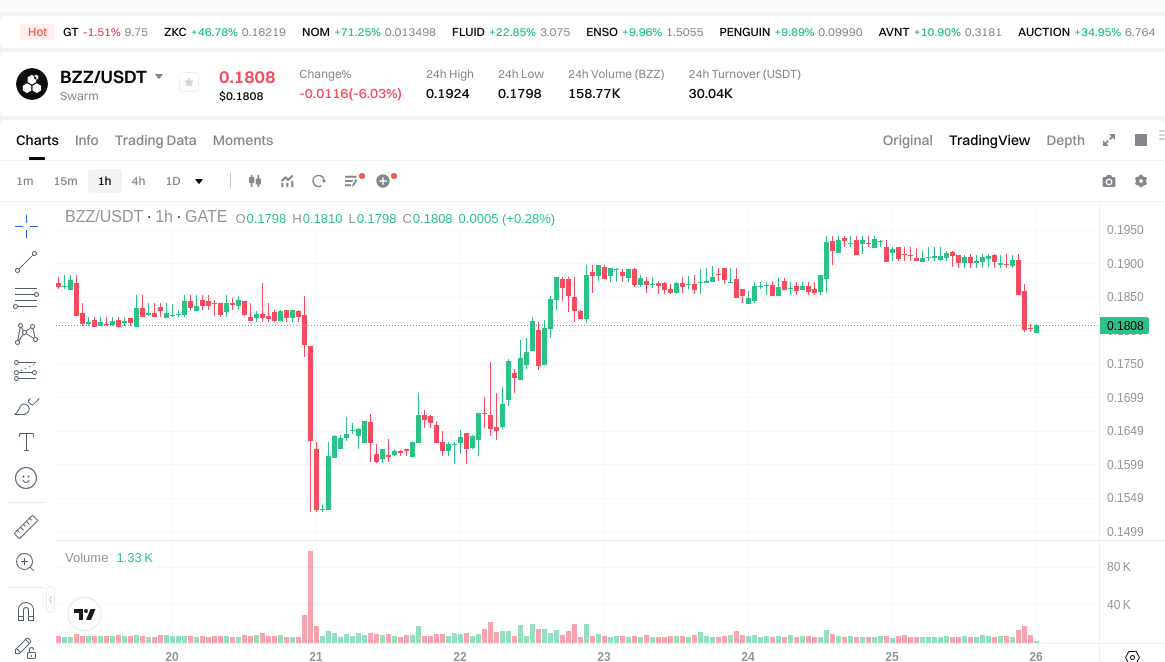
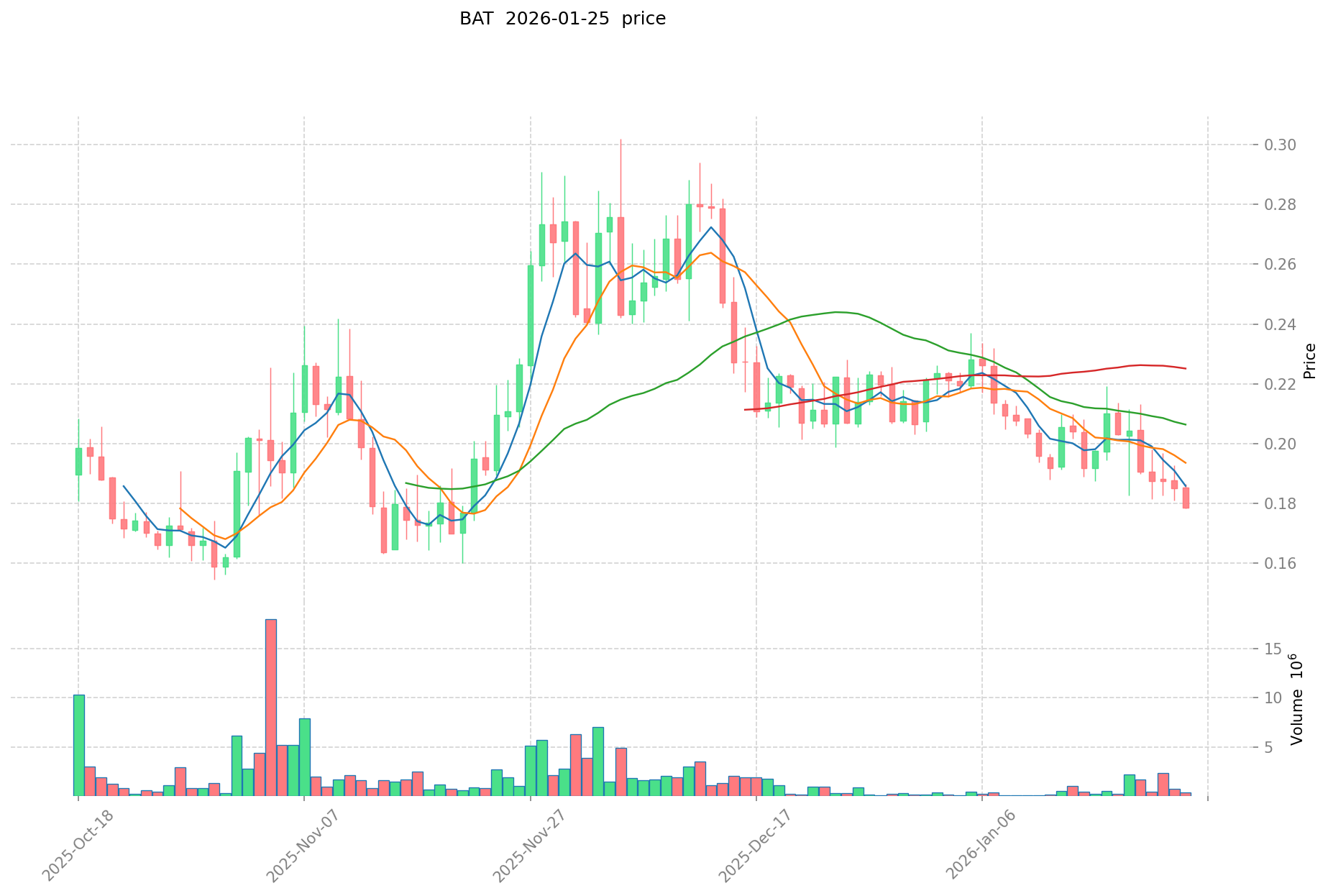
II. Core Factors Influencing BZZ vs BAT Investment Value
Supply Mechanism Comparison (Tokenomics)
Due to limited available data on the specific supply mechanisms of BZZ and BAT, a detailed comparison cannot be provided at this time. Generally, token supply mechanisms including fixed supply models, inflationary models, and deflationary mechanisms can influence long-term price dynamics through scarcity effects and market circulation patterns.
Institutional Adoption and Market Application
Institutional Holdings: Current data does not provide sufficient information regarding institutional preference between BZZ and BAT.
Enterprise Adoption: Information on the comparative adoption of BZZ and BAT in cross-border payments, settlements, and investment portfolios is not available in the provided materials.
National Policies: Regulatory attitudes toward both tokens vary across jurisdictions, though specific comparative policy frameworks are not detailed in the available data.
Technical Development and Ecosystem Construction
Specific information regarding recent technical upgrades for BZZ and BAT is not available in the provided materials.
Ecosystem Comparison: Both projects operate within the broader blockchain ecosystem, though detailed comparative analysis of their respective DeFi integration, NFT support, payment functionality, and smart contract implementation cannot be provided based on current data availability.
Macroeconomic Environment and Market Cycles
Performance in Inflationary Environment: The comparative anti-inflation properties of BZZ and BAT require further data analysis that is not available in the current materials.
Macroeconomic Monetary Policy: Interest rates and dollar index movements typically affect cryptocurrency markets broadly, though specific differential impacts on BZZ versus BAT are not documented in the provided materials.
Geopolitical Factors: Cross-border transaction demand and international circumstances can influence cryptocurrency adoption patterns, though specific comparative effects on these two tokens are not detailed in available data.
III. 2026-2031 Price Prediction: BZZ vs BAT
Short-term Prediction (2026)
- BZZ: Conservative $0.128 - $0.181 | Optimistic $0.181 - $0.240
- BAT: Conservative $0.114 - $0.173 | Optimistic $0.173 - $0.178
Mid-term Prediction (2028-2029)
- BZZ may enter a moderate growth phase, with projected price range of $0.182 - $0.320
- BAT may enter a consolidation phase, with projected price range of $0.158 - $0.277
- Key drivers: institutional capital inflows, ETF developments, ecosystem expansion
Long-term Prediction (2030-2031)
- BZZ: Base scenario $0.229 - $0.339 | Optimistic scenario $0.339 - $0.392
- BAT: Base scenario $0.132 - $0.319 | Optimistic scenario $0.319 - $0.380
View detailed price predictions for BZZ and BAT
Disclaimer
BZZ:
| Year |
Predicted High Price |
Predicted Average Price |
Predicted Low Price |
Price Change |
| 2026 |
0.240464 |
0.1808 |
0.128368 |
0 |
| 2027 |
0.21695096 |
0.210632 |
0.13269816 |
17 |
| 2028 |
0.2907564128 |
0.21379148 |
0.181722758 |
18 |
| 2029 |
0.320387911928 |
0.2522739464 |
0.229569291224 |
40 |
| 2030 |
0.39227337295468 |
0.286330929164 |
0.2290647433312 |
59 |
| 2031 |
0.383411430697054 |
0.33930215105934 |
0.295192871421625 |
88 |
BAT:
| Year |
Predicted High Price |
Predicted Average Price |
Predicted Low Price |
Price Change |
| 2026 |
0.177675 |
0.1725 |
0.11385 |
0 |
| 2027 |
0.24162075 |
0.1750875 |
0.098049 |
0 |
| 2028 |
0.27294390375 |
0.208354125 |
0.158349135 |
20 |
| 2029 |
0.27674636653125 |
0.240649014375 |
0.1684543100625 |
38 |
| 2030 |
0.380285604966093 |
0.258697690453125 |
0.131935822131093 |
49 |
| 2031 |
0.341856063049282 |
0.319491647709609 |
0.246008568736399 |
84 |
IV. Investment Strategy Comparison: BZZ vs BAT
Long-term vs Short-term Investment Strategies
- BZZ: May appeal to investors interested in decentralized storage infrastructure and Web3.0 ecosystem development, with potential consideration for mid-to-long-term holding strategies given its positioning in the Ethereum service layer.
- BAT: May appeal to investors focused on digital advertising transformation and browser ecosystem adoption, with attention to the Brave browser's user growth trajectory as a potential value driver.
Risk Management and Asset Allocation
- Conservative Investors: Suggested allocation framework could consider BZZ: 30-40% vs BAT: 60-70%, reflecting a preference for the more established BAT ecosystem while maintaining exposure to BZZ's infrastructure potential.
- Aggressive Investors: Alternative allocation might explore BZZ: 60-70% vs BAT: 30-40%, emphasizing higher exposure to BZZ's decentralized storage narrative with acceptance of elevated volatility.
- Hedging Tools: Portfolio risk management approaches may include stablecoin reserves for liquidity management, options strategies for downside protection, and cross-token diversification to reduce concentration risk.
V. Potential Risk Comparison
Market Risk
- BZZ: Experiences notable volatility patterns, having declined from $21.11 to current levels around $0.1798, with 24-hour trading volume of $29,929.39 indicating lower liquidity conditions that may amplify price movements.
- BAT: Demonstrates moderate volatility characteristics, declining from $1.9 to current levels around $0.1733, with comparatively higher 24-hour trading volume of $68,336.17 suggesting relatively improved liquidity profiles.
Technical Risk
- BZZ: Considerations include network scalability requirements for decentralized storage infrastructure and operational stability of storage node networks.
- BAT: Technical considerations involve browser ecosystem dependencies and integration stability with the Brave platform architecture.
Regulatory Risk
Both tokens face evolving regulatory landscapes across jurisdictions. Decentralized storage platforms and attention-based advertising models may encounter different regulatory frameworks as governments develop policies for blockchain infrastructure and digital advertising technologies. Investors should monitor regulatory developments in major markets that could differentially impact these projects.
VI. Conclusion: Which Is the Better Buy?
📌 Investment Value Summary:
- BZZ Characteristics: Positioned within decentralized storage and Ethereum Web3.0 infrastructure development, with current price of $0.1798 and projected ranges suggesting potential for moderate growth scenarios through 2031 ($0.229 - $0.392 in optimistic projections).
- BAT Characteristics: Established presence in digital advertising transformation through the Brave browser ecosystem, with current price of $0.1733 and projected ranges indicating consolidation with selective growth potential through 2031 ($0.132 - $0.380 in various scenarios).
✅ Investment Considerations:
- Beginner Investors: May consider starting with smaller allocations to understand volatility patterns, focusing on projects with clearer use cases and established ecosystems while maintaining diversification across multiple assets.
- Experienced Investors: Could evaluate allocation strategies based on individual risk tolerance, technical analysis of ecosystem developments, and correlation with broader market cycles, potentially employing dollar-cost averaging approaches.
- Institutional Investors: May assess both tokens within broader portfolio frameworks, considering liquidity profiles, regulatory compliance requirements, and alignment with institutional investment mandates for digital asset exposure.
⚠️ Risk Disclosure: The cryptocurrency market exhibits high volatility characteristics. This analysis does not constitute investment advice, financial recommendations, or predictions of future performance. Investors should conduct independent research, assess personal risk tolerance, and consider consulting qualified financial advisors before making investment decisions. Past performance does not guarantee future results.
VII. FAQ
Q1: What is the main difference between BZZ and BAT in terms of their core use cases?
BZZ focuses on decentralized storage infrastructure as part of Ethereum's Web3.0 service layer, while BAT targets digital advertising transformation through the Brave browser ecosystem. BZZ (Swarm) operates as a distributed storage network enabling content distribution services, positioning itself as foundational infrastructure for decentralized applications. BAT (Basic Attention Token) establishes an attention-based economy connecting advertisers, content creators, and users within the Brave browser environment, fundamentally reimagining how digital advertising value flows between stakeholders.
Q2: Which token shows better liquidity based on current market data?
BAT demonstrates superior liquidity with 24-hour trading volume of $68,336.17 compared to BZZ's $29,929.39. This higher trading volume indicates that BAT offers better market depth, potentially allowing investors to execute larger trades with reduced price impact. The 2.3x difference in trading volume suggests BAT maintains more active market participation, which can translate to tighter bid-ask spreads and improved order execution for traders.
Q3: How have BZZ and BAT performed since their respective all-time highs?
Both tokens have experienced significant declines from their peaks. BZZ reached its all-time high of $21.11 on June 22, 2021, and has since declined approximately 99.1% to current levels around $0.1798. BAT peaked at $1.9 on November 28, 2021, declining roughly 90.9% to current levels around $0.1733. While both have faced substantial corrections, BZZ has experienced a more severe drawdown, reflecting either initial overvaluation, market repositioning, or ecosystem development challenges during its early launch phase.
Q4: What are the projected price ranges for BZZ and BAT by 2031?
Long-term projections suggest varied potential outcomes. For BZZ, base scenarios estimate $0.229 - $0.339 while optimistic scenarios project $0.339 - $0.392 by 2031. BAT's projections indicate base scenarios of $0.132 - $0.319 and optimistic scenarios of $0.319 - $0.380 for the same timeframe. These ranges reflect an 88% projected change for BZZ and 84% for BAT from 2026 baselines, suggesting relatively parallel growth trajectories with BZZ showing marginally higher optimistic scenarios.
Q5: What allocation strategy should conservative versus aggressive investors consider?
Conservative investors may consider a BZZ: 30-40% vs BAT: 60-70% allocation, emphasizing BAT's more established ecosystem and relatively higher liquidity profile while maintaining exposure to BZZ's infrastructure narrative. Aggressive investors might explore reversed allocations of BZZ: 60-70% vs BAT: 30-40%, accepting higher exposure to BZZ's decentralized storage potential along with elevated volatility risks. Both strategies should incorporate risk management tools including stablecoin reserves for liquidity, options for downside protection, and cross-token diversification to mitigate concentration risk.
Q6: How does the current market sentiment affect investment timing for these tokens?
The current Fear & Greed Index reading of 25 (Extreme Fear) suggests widespread market pessimism, which historically can present accumulation opportunities for long-term investors. Both BZZ at $0.1798 and BAT at $0.1733 are trading significantly below their all-time highs, potentially offering entry points for investors with extended time horizons. However, extreme fear conditions can persist or intensify, making dollar-cost averaging strategies particularly relevant to mitigate timing risk while building positions during periods of market uncertainty.
Q7: What are the primary risk factors differentiating BZZ and BAT investments?
BZZ faces risks related to network scalability requirements and operational stability of distributed storage nodes, alongside lower liquidity evidenced by reduced trading volumes. BAT's primary risks center on dependencies within the Brave browser ecosystem and integration stability with platform architecture changes. Both tokens encounter evolving regulatory landscapes, though they may face different frameworks—decentralized storage infrastructure versus digital advertising models. Additionally, BZZ's higher historical volatility (99.1% decline from peak) suggests elevated price risk compared to BAT's 90.9% decline trajectory.
Q8: Should beginner investors consider starting with BZZ or BAT?
Beginner investors may find BAT's more established ecosystem, higher liquidity profile ($68,336.17 vs $29,929.39 in 24-hour volume), and clearer use case within the existing Brave browser platform easier to understand and monitor. Starting with smaller allocations to comprehend volatility patterns is recommended for both tokens. However, regardless of choice, beginners should prioritize diversification across multiple assets, avoid concentration risk, and invest only capital they can afford to lose while developing experience with cryptocurrency market dynamics and price movements.
* The information is not intended to be and does not constitute financial advice or any other recommendation of any sort offered or endorsed by Gate.