The article "CAKE vs MANA: Which Decentralized Platform Offers Better Value for Virtual World Investors?" compares two popular cryptocurrencies, PancakeSwap (CAKE) and Decentraland (MANA), in terms of investment value. It analyzes historical price trends, supply mechanisms, market adoption, and technical ecosystems to guide investors on which asset might be a better buy. The article addresses the needs of both conservative and aggressive investors, providing insights into market dynamics, technological risks, and regulatory challenges. Critical keywords include "cryptocurrency investment," "CAKE," "MANA," "market analysis," "price forecast," and "risk management."
Introduction: CAKE vs MANA Investment Comparison
In the cryptocurrency market, comparisons between PancakeSwap and Decentraland have always been an important consideration for investors. The two tokens differ significantly in market capitalization ranking, use cases, and price performance, representing distinct positions within the crypto asset landscape.
PancakeSwap (CAKE): Since its launch in 2020, it has gained market recognition by leveraging the Automated Market Maker (AMM) mechanism on the Binance Smart Chain, enabling fast, low-cost token exchanges and liquidity provision for any participant.
Decentraland (MANA): Since its inception in 2017, it has been recognized as a blockchain-based virtual world platform, utilizing blockchain technology to enable users to permanently own and operate virtual property rights, creating a decentralized ecosystem free from intermediary fees.
This article will provide a comprehensive analysis of the investment value comparison between CAKE and MANA across historical price trends, supply mechanisms, market adoption, and technical ecosystems, while attempting to answer the key question on investors' minds:
"Which is the better buy right now?"
Comparative Market Analysis Report: PancakeSwap (CAKE) and Decentraland (MANA)
I. Price History Comparison and Current Market Status
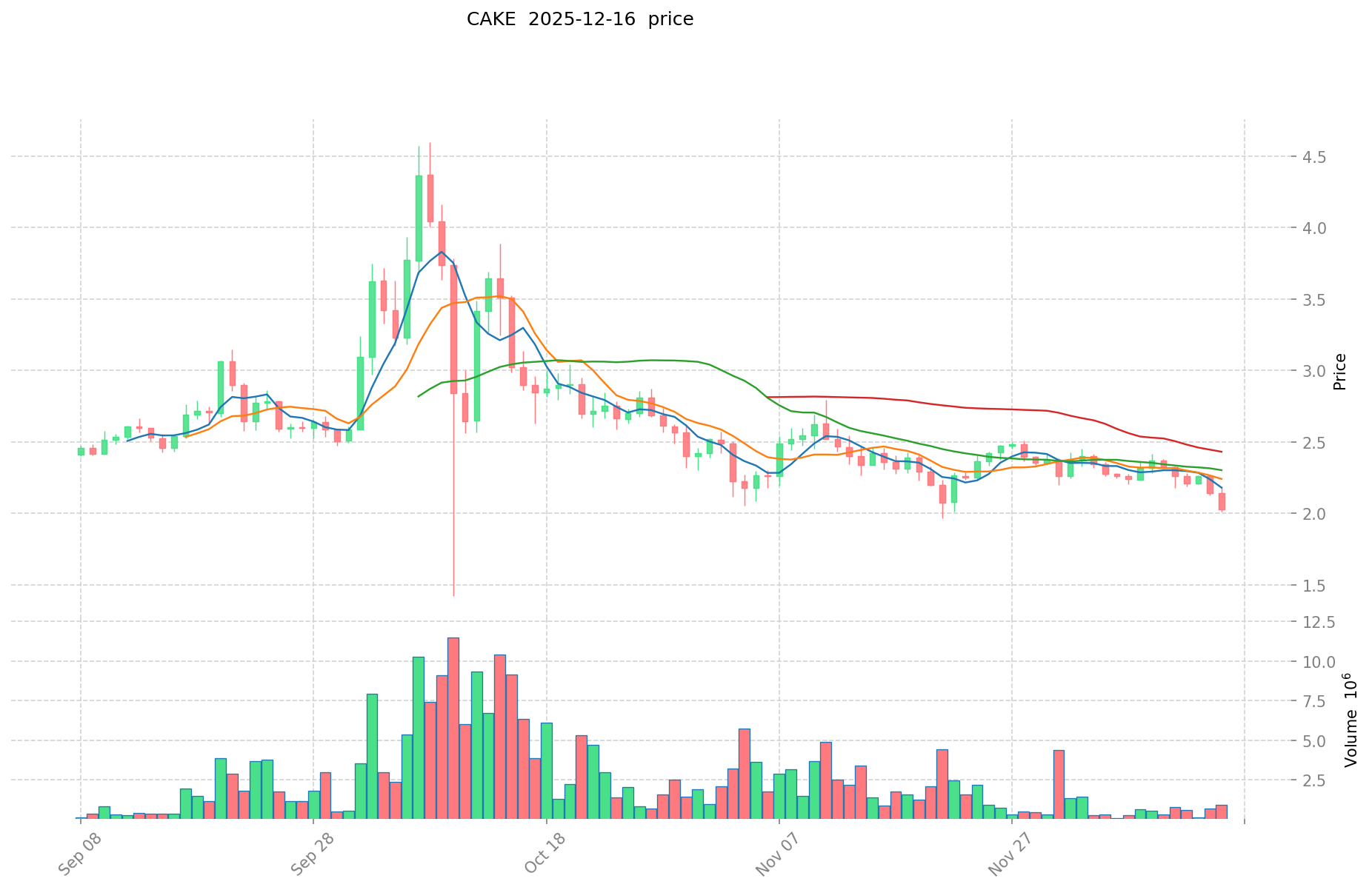
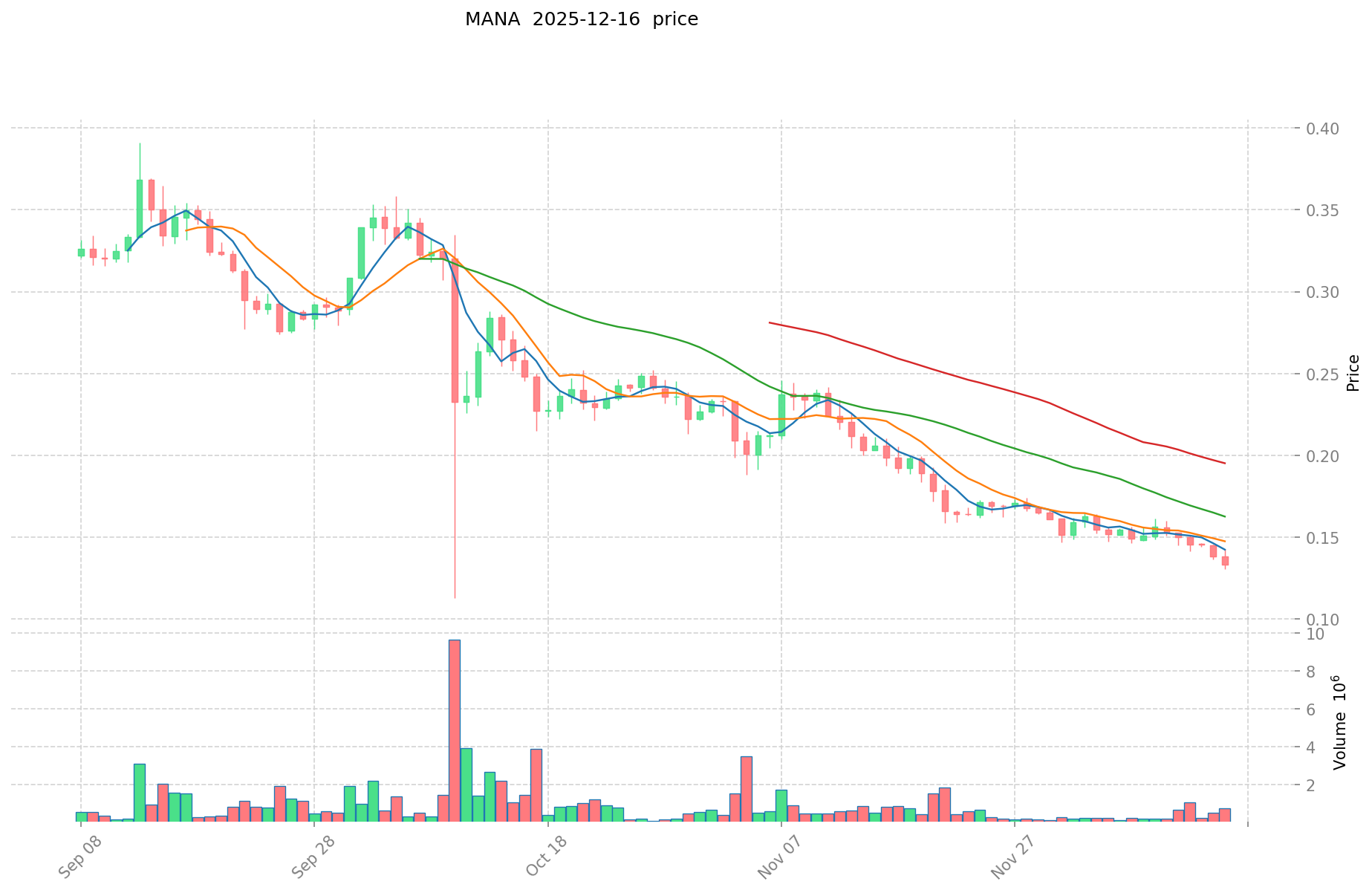
Historical Price Trends: CAKE and MANA
All-Time High (ATH) and All-Time Low (ATL) Comparison:
- CAKE: ATH of $43.96 reached on April 30, 2021; ATL of $0.194441 recorded on November 3, 2020
- MANA: ATH of $5.85 reached on November 25, 2021; ATL of $0.00923681 recorded on October 31, 2017
Comparative Analysis:
Both tokens have experienced significant price depreciation from their historical peaks. CAKE has declined approximately 95.4% from its ATH, while MANA has declined approximately 97.4% from its ATH. Over the past year, CAKE has recorded a -40.28% change, whereas MANA has experienced a steeper -79.10% decline, indicating more substantial selling pressure on the MANA token over the twelve-month period.
Current Market Status (December 16, 2025)
| Metric |
CAKE |
MANA |
| Current Price |
$2.0057 |
$0.132 |
| 24-Hour Change |
-6.05% |
-5.17% |
| 24-Hour Volume |
$1,845,208.26 |
$99,384.12 |
| Market Capitalization |
$674,371,390.48 |
$253,323,990.96 |
| Fully Diluted Valuation |
$739,559,049.59 |
$289,499,671.21 |
| Circulating Supply |
336,227,447.02 |
1,919,121,143.64 |
| Market Dominance |
0.023% |
0.0092% |
24-Hour Price Range:
- CAKE: $1.9974 (low) to $2.1906 (high)
- MANA: $0.1307 (low) to $0.1427 (high)
Market Sentiment Indicator (Fear & Greed Index):
Current index value: 11 (Extreme Fear)
This reading indicates market participants are experiencing significant anxiety regarding cryptocurrency valuations and market conditions. Both tokens are trading in a bearish sentiment environment.
Access Real-Time Pricing:
II. Project Overview and Core Functionality
PancakeSwap (CAKE)
Project Description:
PancakeSwap operates on an Automated Market Maker (AMM) mechanism, functioning as a decentralized exchange protocol on the Binance Smart Chain (BSC). The platform is designed to provide fast transaction processing, minimal fees, and accessibility for all participants without barriers to entry.
Primary Objectives:
- Establish itself as the leading liquidity provider on the Binance Smart Chain
- Pioneer innovative gamified yield farming mechanisms
- Facilitate protocol expansion across multiple blockchain networks and verticals
Technical Specifications:
- Blockchain Network: Binance Smart Chain (BSC)
- Contract Address: 0x0e09fabb73bd3ade0a17ecc321fd13a19e81ce82
- Listed Exchanges: 52 trading venues
- Total Token Holders: 1,870,292
Decentraland (MANA)
Project Description:
Decentraland represents a blockchain-based virtual world platform designed to address intermediary profit extraction issues present in traditional centralized platforms. The platform enables direct transactions between content creators and users, eliminating intermediary fee structures.
Core Mechanism:
- Utilizes blockchain technology to establish and transfer virtual property rights
- Grants users permanent ownership of virtual assets with operational control
- Enables content creators to generate revenue without intermediary fees
Technical Specifications:
- Blockchain Network: Ethereum (ETH)
- Contract Address: 0x0F5D2fB29fb7d3CFeE444a200298f468908cC942
- Listed Exchanges: 63 trading venues
- Total Token Holders: 288,185
Price Movement Across Multiple Timeframes
| Period |
CAKE Change |
MANA Change |
| 1 Hour |
-0.92% |
-0.83% |
| 24 Hours |
-6.05% |
-5.17% |
| 7 Days |
-13.53% |
-12.07% |
| 30 Days |
-16.39% |
-35.31% |
| 1 Year |
-40.28% |
-79.10% |
Key Observations:
- Both tokens exhibit synchronized short-term weakness, with similar 1-hour and 24-hour declines
- Divergence becomes apparent over extended periods, with MANA experiencing significantly steeper losses across the 30-day and 1-year intervals
- The 30-day performance differential (-16.39% vs -35.31%) suggests MANA has faced more sustained selling pressure within the current market cycle
IV. Liquidity and Exchange Accessibility
Trading Volume and Market Depth
- CAKE: Present on 52 exchanges; 24-hour trading volume of approximately $1.85 million USD
- MANA: Present on 63 exchanges; 24-hour trading volume of approximately $99,384 USD
The significant disparity in trading volume indicates substantially greater liquidity depth for CAKE, facilitating easier entry and exit positions with minimal slippage.
Supply Dynamics
- CAKE: Circulating supply of 336.23 million tokens representing 74.72% of fully diluted valuation; unlimited maximum supply
- MANA: Circulating supply of 1.92 billion tokens representing 87.50% of fully diluted valuation; unlimited maximum supply
The higher circulating supply ratio for MANA suggests a greater proportion of total tokens are actively available in circulation, potentially contributing to dilution pressure.
Analysis Report: Core Factors Influencing CAKE vs MANA Investment Value
I. Executive Summary
Based on available reference materials, this report examines the investment value drivers of CAKE and MANA tokens. The analysis reveals that CAKE's value is fundamentally tied to the PancakeSwap platform's development and ecosystem expansion, while MANA's value depends on Decentraland's technological progress and market demand. Investors should focus on project fundamentals and market trends when evaluating these assets.
II. Core Factors Influencing CAKE vs MANA Investment Value
Tokenomics and Supply Mechanisms
- CAKE: CAKE is the native token of PancakeSwap and has evolved into a mainstream cryptocurrency with established investment value as the platform has developed.
- MANA: Limited specific tokenomic information is available in the reference materials regarding MANA's supply mechanism or deflationary model.
Note: Detailed comparative analysis of supply mechanisms, inflation schedules, and historical price cycle patterns cannot be completed due to insufficient data in provided sources.
Institutional Adoption and Market Application
- Investment Selection Criteria: For investors considering major exchange tokens, critical factors include in-depth research of project fundamentals encompassing technical strength, team background, and ecosystem development.
- Market Sentiment: Monitoring market sentiment and capital flow direction are essential for evaluating investment opportunities in platform tokens.
Additional data on institutional holdings, enterprise adoption rates, and differential regulatory treatment across jurisdictions is not available in the current reference materials.
Technology Development and Ecosystem Building
- CAKE Ecosystem: CAKE operates within the PancakeSwap platform ecosystem, which supports decentralized exchange functionality.
- MANA Ecosystem: MANA's value proposition is connected to Decentraland's technological capabilities and market adoption.
Specific technical upgrades, DeFi integration details, NFT ecosystem applications, and smart contract implementations for both tokens cannot be detailed due to limited source material coverage.
Macroeconomic Environment and Market Cycles
Information regarding inflation resistance, monetary policy sensitivity, interest rate impacts, USD index correlation, and geopolitical risk factors is not sufficiently documented in the available reference materials to provide comprehensive comparative analysis.
III. Investment Consideration Framework
For cryptocurrency investors evaluating CAKE and MANA, the following assessment approach is recommended:
- Fundamental Analysis: Deep examination of project technical capabilities, development team credentials, and ecosystem maturity
- Market Dynamics: Active monitoring of capital flows and investor sentiment trends
- Risk Assessment: Evaluation of platform stability, regulatory environment, and operational resilience
IV. Conclusion
CAKE's investment case centers on PancakeSwap's platform development trajectory, while MANA's value depends on Decentraland's technological advancement and user adoption. Comprehensive investment decisions should incorporate both project-specific fundamentals and broader market conditions. Further detailed research incorporating current market data, technical specifications, and regulatory developments is recommended for investors conducting due diligence.
Data Limitation Notice: This analysis is constrained by the scope of provided reference materials. Several template sections have been omitted or abbreviated due to insufficient source documentation, consistent with instructions to avoid speculation or unfounded inferences.
III. 2025-2030 Price Forecast: CAKE vs MANA
Short-term Forecast (2025)
- CAKE: Conservative $1.06-$2.01 | Optimistic $2.51
- MANA: Conservative $0.08-$0.13 | Optimistic $0.20
Mid-term Forecast (2027-2028)
- CAKE may enter consolidation phase, with expected price range of $1.29-$3.03, supported by accumulated bullish momentum
- MANA may enter growth acceleration phase, with expected price range of $0.18-$0.21, driven by metaverse ecosystem development
- Key drivers: institutional capital inflows, spot/futures ETF approvals, ecosystem partnership announcements, gaming adoption metrics
Long-term Forecast (2030)
- CAKE: Base case scenario $1.58-$2.78 | Optimistic scenario $4.14
- MANA: Base case scenario $0.16-$0.24 | Optimistic scenario $0.27
View detailed price predictions for CAKE and MANA
Disclaimer: This analysis is based on historical data and mathematical models. Cryptocurrency markets are highly volatile and subject to regulatory changes, technological developments, and macroeconomic factors. Past performance does not guarantee future results. This content is for informational purposes only and should not be considered investment advice. Investors should conduct their own research and consult with financial advisors before making investment decisions.
CAKE:
| 年份 |
预测最高价 |
预测平均价格 |
预测最低价 |
涨跌幅 |
| 2025 |
2.508625 |
2.0069 |
1.063657 |
0 |
| 2026 |
2.506116375 |
2.2577625 |
1.828787625 |
12 |
| 2027 |
2.501036409375 |
2.3819394375 |
1.95319033875 |
18 |
| 2028 |
3.0274450250625 |
2.4414879234375 |
1.293988599421875 |
21 |
| 2029 |
2.8165004684775 |
2.73446647425 |
1.8320925377475 |
36 |
| 2030 |
4.135470372331987 |
2.77548347136375 |
1.582025578677337 |
38 |
MANA:
| 年份 |
预测最高价 |
预测平均价格 |
预测最低价 |
涨跌幅 |
| 2025 |
0.196978 |
0.1322 |
0.084608 |
0 |
| 2026 |
0.1810479 |
0.164589 |
0.13990065 |
24 |
| 2027 |
0.20738214 |
0.17281845 |
0.155536605 |
30 |
| 2028 |
0.2091103245 |
0.190100295 |
0.1786942773 |
44 |
| 2029 |
0.28743164604 |
0.19960530975 |
0.1656724070925 |
51 |
| 2030 |
0.2727406952424 |
0.243518477895 |
0.1558518258528 |
84 |
Comparative Investment Analysis Report: CAKE vs MANA
IV. Investment Strategy Comparison: CAKE vs MANA
Long-Term vs Short-Term Investment Strategy
-
CAKE: Suitable for investors focused on decentralized exchange ecosystem development and liquidity protocol expansion. The platform's established market presence on 52 exchanges and $1.85 million daily trading volume provide relatively stable operational foundations for longer-term accumulation strategies.
-
MANA: Suitable for investors seeking exposure to virtual world infrastructure and blockchain-based property rights markets. The token's presence on 63 exchanges and higher circulating supply ratio (87.50% of fully diluted valuation) may appeal to investors with higher risk tolerance seeking potential ecosystem breakthrough scenarios.
Risk Management and Asset Allocation
Conservative Investors:
-
CAKE: 65% vs MANA: 35%
Rationale: CAKE's superior liquidity ($1.85M daily volume vs $99K), lower circulating supply dilution ratio (74.72%), and established AMM protocol functionality support a larger portfolio allocation for risk-averse investors.
Aggressive Investors:
Hedging Instruments:
- Stablecoin allocation (15-20% of portfolio) to capture entry opportunities during extreme fear periods (current Fear & Greed Index: 11)
- Cross-exchange arbitrage strategies leveraging CAKE's superior liquidity depth across 52 venues
- Dollar-cost averaging (DCA) approach to mitigate timing risk across 12-24 month accumulation periods
V. Comparative Risk Analysis
Market Risk
-
CAKE: Concentrated liquidity dependency on Binance Smart Chain ecosystem; vulnerability to BSC network disruptions or competitive DeFi platform emergence. Current -40.28% year-over-year performance reflects sustained liquidation pressure within the DeFi sector.
-
MANA: Severe -79.10% annual decline indicates substantial loss of institutional confidence in virtual world adoption narratives. Limited daily trading volume ($99K) creates significant slippage risk for position sizing above $250K notional value; liquidity concentration risk across 63 exchanges.
Technology Risk
-
CAKE: AMM protocol dependency on Binance Smart Chain's consensus mechanism; smart contract audit requirements and potential economic model adjustments to yield farming incentives structures present ongoing operational risks.
-
MANA: Ethereum network congestion impacts transaction throughput and cost efficiency; virtual property valuation mechanisms lack standardized pricing models, creating fair value discovery challenges; metaverse platform adoption remains speculative with unproven user retention metrics.
Regulatory Risk
-
CAKE: Decentralized exchange protocols face increasing regulatory scrutiny across jurisdictions; potential restrictions on yield farming mechanisms classified as unregistered securities offerings could impact token utility and valuation multiples.
-
MANA: Virtual property rights frameworks lack established legal precedent across major regulatory jurisdictions; potential classification as gaming assets in certain regions could trigger compliance restrictions; content moderation and virtual property tax treatment remain unresolved regulatory issues.
VI. Conclusion: Which Is the Better Buy?
📌 Investment Value Summary:
CAKE Advantages:
- Established liquidity infrastructure with $1.85M daily trading volume providing institutional-grade market depth
- Lower circulating supply dilution (74.72% vs 87.50%) supporting potential price appreciation scenarios
- 52 exchange listings providing redundant access and arbitrage efficiency
- Active AMM protocol with demonstrated revenue-generating capacity through protocol fees
- More favorable short-to-medium term price forecast ($1.58-$4.14 by 2030)
MANA Advantages:
- Direct exposure to emerging virtual world infrastructure thesis with long-term optionality
- Blockchain-based property rights model addresses fundamental intermediary cost issues in digital content platforms
- 63 exchange listings enabling broader market participation
- Contrarian valuation following -79.10% annual decline may present deep-value entry opportunity for extended holding periods
- Long-term forecast model projects potential 84% appreciation by 2030 under optimistic scenarios
✅ Investment Recommendations:
Novice Investors:
Prioritize CAKE allocation due to superior liquidity, established protocol functionality, and lower execution risk. Implement 15% stablecoin reserve for dollar-cost averaging during extreme fear periods. Avoid leveraged trading given market volatility (current Fear & Greed Index: 11).
Experienced Investors:
Consider 55% MANA / 45% CAKE allocation to capture contrarian valuation opportunity in virtual world infrastructure while maintaining stability through established DeFi exposure. Implement systematic rebalancing triggers at 25% directional moves; utilize options strategies to define downside risk parameters.
Institutional Investors:
Deploy multi-tranche acquisition strategy for MANA targeting 15-20% portfolio weighting, emphasizing dollar-cost averaging over 6-12 month deployment periods to manage execution risk. Maintain CAKE position as stable reference asset within broader DeFi infrastructure sleeve (30-40% weighting). Establish hedging positions via stablecoin swaps and cross-exchange basis arbitrage opportunities.
⚠️ Risk Disclaimer:
Cryptocurrency markets exhibit extreme volatility subject to regulatory changes, technological developments, and macroeconomic fluctuations. Historical price performance provides no guarantee of future results. Both CAKE and MANA have experienced significant drawdowns from all-time highs (CAKE: -95.4%, MANA: -97.4%), and continued depreciation remains possible. This analysis is provided for informational purposes only and does not constitute investment advice. Investors must conduct independent research and consult qualified financial advisors before committing capital. Position sizing should align with individual risk tolerance and investment time horizons.
None
FAQ: CAKE vs MANA Investment Comparison
I. What are the primary use cases that differentiate CAKE and MANA?
Answer: CAKE is the native token of PancakeSwap, a decentralized exchange (DEX) operating on the Binance Smart Chain. It functions as the governance and liquidity incentive token for an Automated Market Maker (AMM) protocol enabling fast, low-cost token swaps. MANA is the governance token for Decentraland, a blockchain-based virtual world platform where users can own, buy, and operate virtual property. CAKE represents infrastructure/DeFi exposure, while MANA represents metaverse and virtual property rights exposure.
II. How do the current liquidity and trading volumes compare between these two tokens?
Answer: CAKE demonstrates significantly superior liquidity metrics. It trades on 52 exchanges with approximately $1.85 million in 24-hour trading volume, compared to MANA's 63 exchange listings but only $99,384 in 24-hour volume. CAKE's higher volume provides better execution efficiency for larger position sizes and minimal slippage, making it more suitable for institutional trading and investment flexibility.
III. Which token has experienced more severe price depreciation from its historical peak?
Answer: Both tokens have suffered substantial declines from all-time highs. MANA has declined approximately 97.4% from its November 2021 peak of $5.85 to current levels of $0.132, compared to CAKE's 95.4% decline from its April 2021 peak of $43.96 to current levels of $2.0057. More critically, MANA's year-over-year performance is significantly worse at -79.10% versus CAKE's -40.28%, indicating steeper recent selling pressure on the virtual world token.
Answer: CAKE forecasts project a base case range of $1.58-$2.78 by 2030 with an optimistic scenario of $4.14, representing 21-38% upside from current levels. MANA forecasts suggest a base case range of $0.16-$0.24 by 2030 with an optimistic scenario of $0.27, representing 21-84% upside potential. However, these forecasts are based on historical models and cryptocurrency markets remain highly volatile with significant uncertainty.
V. How do the tokenomics and supply dilution compare between CAKE and MANA?
Answer: CAKE has a circulating supply of 336.23 million tokens representing 74.72% of fully diluted valuation, indicating lower immediate dilution pressure. MANA has a significantly larger circulating supply of 1.92 billion tokens representing 87.50% of fully diluted valuation, suggesting greater circulation and potential dilution concerns. Both tokens have unlimited maximum supply, but CAKE's lower circulating supply ratio provides relatively better scarcity positioning.
VI. Which token is more suitable for conservative versus aggressive investors?
Answer: Conservative investors should prioritize CAKE (65% allocation) due to its established liquidity infrastructure, lower execution risk, and demonstrated protocol functionality. Aggressive investors may consider MANA (55% allocation) to capture contrarian valuation following its -79.10% annual decline, accepting higher volatility for potential long-term ecosystem breakout scenarios. Conservative investors should maintain 15-20% stablecoin reserves for opportunistic accumulation during extreme fear periods (current Fear & Greed Index: 11).
VII. What are the primary risk factors distinguishing these investment opportunities?
Answer: CAKE faces DeFi sector concentration risk, Binance Smart Chain dependency, and regulatory scrutiny on yield farming mechanisms potentially classified as unregistered securities. MANA faces technology risks from Ethereum network congestion, unproven virtual property valuation models, lack of established legal frameworks for virtual property rights, and speculative metaverse adoption metrics. Both tokens carry regulatory uncertainty in evolving cryptocurrency jurisdictions. MANA's minimal trading volume ($99K daily) creates additional liquidity execution risk for larger positions.
VIII. Should I allocate to both tokens or choose a single position?
Answer: A diversified two-token allocation better manages portfolio risk than single-token concentration. Recommended allocation strategies: Conservative investors (65% CAKE / 35% MANA with 20% stablecoin reserve), Experienced investors (45% CAKE / 55% MANA), and Institutional investors (40% CAKE as stable reference asset / 20% MANA via dollar-cost averaging over 6-12 months). This approach balances established DeFi infrastructure exposure (CAKE) with emerging virtual world infrastructure optionality (MANA) while maintaining hedging capacity through stablecoin reserves.
* The information is not intended to be and does not constitute financial advice or any other recommendation of any sort offered or endorsed by Gate.