This article provides an in-depth analysis of Cardano's recent technical incident and its implications for ADA market trends. It details how a chain split occurred due to a malformed transaction, demonstrating the network's self-healing capabilities through rapid protocol convergence. The piece examines the developer incident, leadership response, and community resilience perspectives, including technical insights from industry leaders. The ADA price analysis section identifies critical support and resistance levels at $0.39-0.40, $0.42, $0.47, and $0.50, with RSI at 43 indicating market indecision. Readers gain understanding of Cardano's blockchain security mechanisms, the incident's market impact, and technical trading levels. The comprehensive FAQ addresses investor concerns about ADA's differentiation, risks, and competitive positioning against Solana and Polkadot, making it essential reading for traders and Cardano ecosystem participants evaluating current market conditions on Gate and other trading venu
FBI Steps In As Hoskinson Quickly Escalates the Incident
In a recent incident that sent shockwaves through the Cardano community, the blockchain experienced an unprecedented technical disruption. The network ended up running two different versions simultaneously for several hours, caused by a software bug triggered by an unusual, malformed transaction. This type of incident, known as a chain split, occurs when different nodes in the network disagree on which version of the blockchain is valid.
Emergency patches were rolled out within three hours of the incident being detected, demonstrating the development team's rapid response capability. The network naturally converged back to normal operations by the following day, as the majority of nodes synchronized to the correct chain version.
Shortly after the incident, a developer using the X platform username "Homer J" came forward and admitted responsibility for causing the chain split. In his public statement, he explained that it was a careless testing mistake rather than an intentional attack. He apologized to the Cardano community and acknowledged being "dumb enough to rely on AI's instructions" while testing the damaging transaction without proper precautions.
To understand the technical details: the developer created a malformed delegation transaction and broadcast it to the network. Some Cardano nodes accepted this invalid transaction and continued building blocks on what became known as the "poisoned" chain. Meanwhile, other nodes rejected the malformed transaction and continued building the "healthy" chain. This divergence in consensus created the split that temporarily divided the network.
The developer explained on social media that his actions started as a personal technical challenge to see if he could reproduce a problematic transaction pattern. He then made the critical error of relying on AI-generated instructions to configure his Linux server's network traffic without first testing the setup on Cardano's testnet environment. In his statement, he expressed shame over the mistake and accepted full responsibility for the consequences.
However, despite the developer's public apology and explanation, Cardano founder Charles Hoskinson and the project's leadership did not treat the incident as an innocent mistake. Instead, they framed it as a deliberate attempt to exploit a known vulnerability with the intention of damaging the network's integrity.
Hoskinson circulated an internal fact sheet stating that "relevant authorities and law enforcement are being notified" about the developer's actions. This escalation to potential legal consequences marked a significant shift in how the incident was being handled, moving from a technical issue to a potential criminal matter.
The situation took another turn when an IOG (Input Output Global) developer known by the username "effectfully" resigned shortly after the incident. In his resignation statement, he expressed concern that he hadn't realized developer mistakes could lead to law enforcement risks, particularly after Hoskinson mentioned possible FBI involvement. His comments revealed dissatisfaction with how the leadership was managing the situation, suggesting that the heavy-handed response might have unintended consequences for the developer community.
Cardano Price Prediction: Can't Catch a Breath
Despite the technical and public relations challenges, many Cardano supporters are reframing the incident as a positive demonstration of the network's resilience. They argue that the chain split represents a "perfect example" of the network's ability to handle stress autonomously, with the protocol self-correcting under pressure without requiring centralized intervention.
Interestingly, this perspective gained support from an unexpected source. Solana's co-founder, Anatoly Yakovenko, publicly backed this interpretation, commenting that implementing Nakamoto-style consensus without proof of work is technically challenging. He acknowledged that Cardano's protocol actually behaved according to its design specifications during the incident, suggesting that the self-healing mechanism worked as intended.
From a technical analysis perspective, ADA appears to be forming a potential bottom in the current market conditions. The token is quietly building a small accumulation zone in the price range of 0.39 to 0.40 dollars. If this support level holds firm, a price bounce becomes increasingly probable.
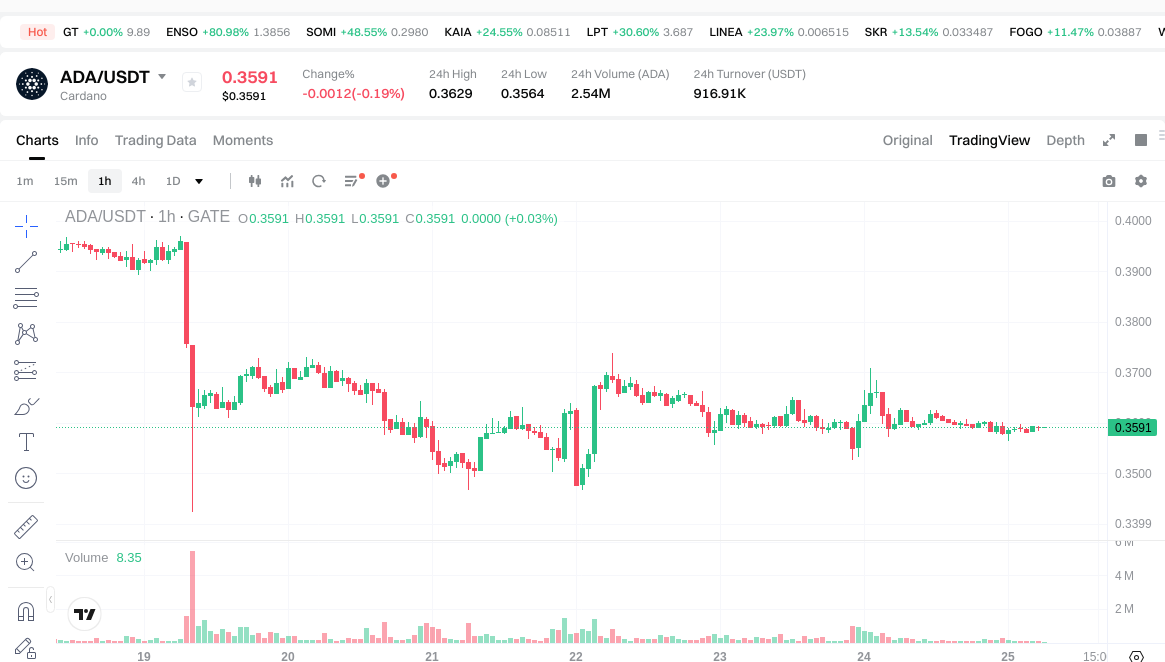 Market participants are closely watching this zone for signs of either continued accumulation or a breakdown.
A clean break above the 0.42 dollar level would serve as the first real indication of renewed strength in ADA's price action. Such a move could potentially open the door toward the 0.47 dollar resistance level, or even push toward the psychologically important 0.50 dollar area. These price targets represent key technical levels where previous selling pressure has emerged.
The Relative Strength Index (RSI) currently sits around 43, which reflects the uncertain and weak momentum characterizing ADA's recent price action. This mid-range RSI reading suggests neither oversold conditions that might trigger a bounce, nor overbought conditions that would indicate excessive bullish enthusiasm. The indicator essentially mirrors the market's indecision.
If the current accumulation zone between 0.39 and 0.40 dollars fails to hold, technical analysis suggests that ADA would likely slide toward the next major support level at 0.35 dollars. This lower support represents a critical line of defense, as a break below this level could trigger additional selling pressure and potentially lead to further downside.
The price prediction remains heavily dependent on whether the network can move past the recent technical incident and restore confidence among investors and developers. The combination of technical challenges, leadership controversies, and broader market uncertainty creates a complex environment for Cardano's near-term price trajectory.
FAQ
What is Cardano (ADA) and how does it differ from Bitcoin and Ethereum?
Cardano is a third-generation blockchain platform using proof-of-stake consensus, offering faster transactions and lower fees than Bitcoin. Unlike Ethereum's smart contracts approach, Cardano emphasizes academic research and peer-reviewed development. ADA is its native cryptocurrency, enabling network security and governance participation.
How would developer issues on the Cardano blockchain impact ADA price?
Developer issues could trigger short-term sell-offs and price pressure on ADA. However, if Cardano's community and team quickly resolve the problem, the token could recover strongly. Market sentiment and response speed are key factors determining the price impact.
What is the price prediction for Cardano (ADA) in 2024? What are the future prospects?
Cardano (ADA) shows strong potential with institutional adoption and smart contract upgrades driving growth. Analysts predict ADA could reach $1.50-$2.50 by end of 2024, supported by ecosystem expansion and network scalability improvements. Long-term prospects remain bullish as developer activity increases.
What are the main risks of buying and holding Cardano (ADA)?
Main risks include market volatility and price fluctuations, regulatory uncertainty affecting blockchain projects, technical vulnerabilities in the network, competition from other cryptocurrencies, and liquidity risks during market downturns. Additionally, smart contract bugs and adoption rate challenges could impact ADA's long-term value.
What does Charles Hoskinson's recent statement mean for the Cardano ecosystem?
Hoskinson's statement highlights security concerns within Cardano's development. This signals the project's commitment to addressing vulnerabilities and maintaining blockchain integrity. Such transparency strengthens community trust and demonstrates proactive risk management, potentially stabilizing ADA's long-term value proposition.
What are the advantages and disadvantages of ADA compared to other Layer 1 blockchain projects such as Solana and Polkadot?
ADA advantages: superior security through peer-reviewed research, strong academic foundation, and sustainability focus. Disadvantages: slower transaction throughput than Solana, smaller developer ecosystem compared to Polkadot, higher transaction costs during network congestion periods.
* The information is not intended to be and does not constitute financial advice or any other recommendation of any sort offered or endorsed by Gate.