This comprehensive analysis compares CELO and DYDX, two prominent Layer-1 governance tokens with distinct market positions. CELO focuses on mobile-first financial infrastructure and stablecoin ecosystem for financial inclusion, while DYDX specializes in decentralized derivatives trading and perpetual contracts. As of January 2026, CELO trades at $0.1413 with higher trading volume, while DYDX trades at $0.1996 with greater resilience from its all-time high. The article examines historical price trends showing CELO's 98.89% decline versus DYDX's 97.21% decline, analyzes tokenomics and institutional adoption patterns, and evaluates technological developments and ecosystem positioning. Price predictions through 2031 suggest DYDX may offer higher growth potential in optimistic scenarios, while CELO emphasizes financial inclusion applications. Investment strategies are tailored for different profiles, with comprehensive risk analysis addressing market, technical, and regulatory considerations. The comparison addres
Introduction: Investment Comparison Between CELO and DYDX
In the cryptocurrency market, the comparison between CELO vs DYDX has consistently been a topic that investors cannot overlook. The two not only exhibit notable differences in market cap ranking, application scenarios, and price performance, but also represent distinct positioning within the crypto asset landscape.
CELO (CELO): Since its launch in 2020, it has gained market recognition through its focus on financial inclusion, aiming to make financial tools accessible to anyone with a mobile phone.
DYDX (DYDX): Introduced in 2021, it has been positioned as a decentralized derivatives trading protocol, operating on L2 blockchain infrastructure and providing perpetual contract trading services.
This article will comprehensively analyze the investment value comparison of CELO vs DYDX through the dimensions of historical price trends, supply mechanisms, institutional adoption, technical ecosystem, and future forecasts, attempting to address the question that concerns investors most:
"Which is the better buy right now?"
I. Historical Price Comparison and Current Market Status
CELO and DYDX Historical Price Trends
- 2021: CELO reached its all-time high of $9.82 on August 30, 2021, during a period of broader market expansion. The token experienced significant price appreciation as the platform gained traction in the financial inclusion sector.
- 2024: DYDX reached its all-time high of $4.52 on March 8, 2024, following increased adoption of its decentralized perpetual contracts trading platform and its migration to the Cosmos ecosystem.
- Comparative Analysis: During the recent market cycle, CELO declined from its peak of $9.82 to a low of $0.109096 on January 1, 2026, representing a decline of approximately 98.89%. Meanwhile, DYDX dropped from $4.52 to $0.126201 on October 11, 2025, marking a decrease of around 97.21%.
Current Market Status (January 18, 2026)
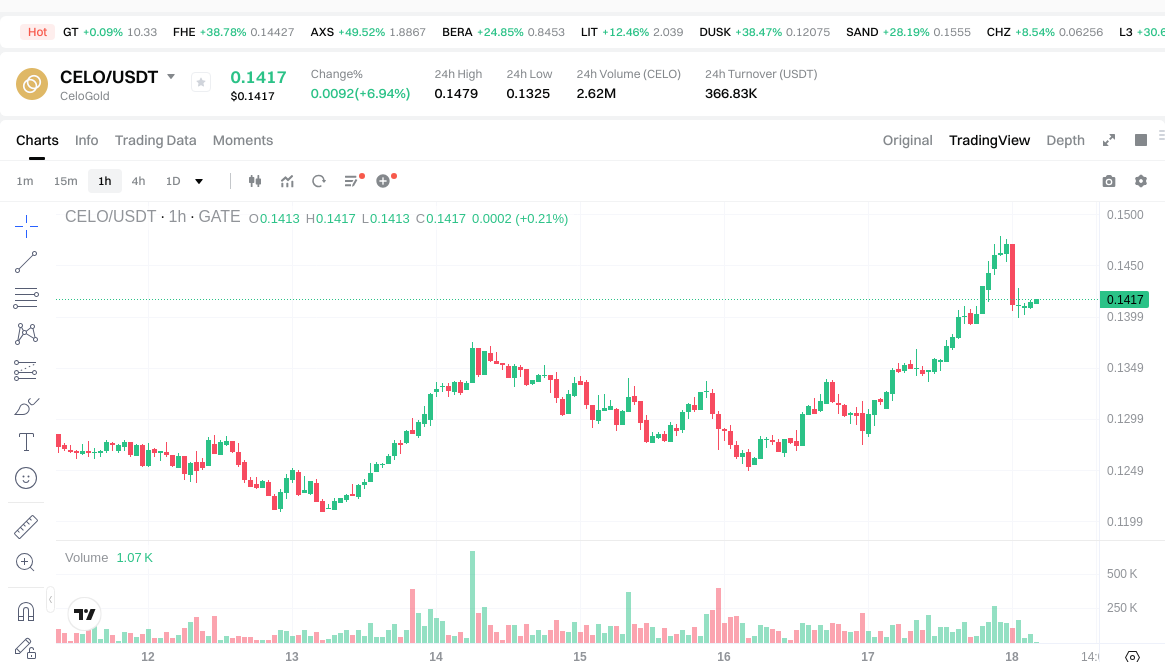
- CELO current price: $0.1413
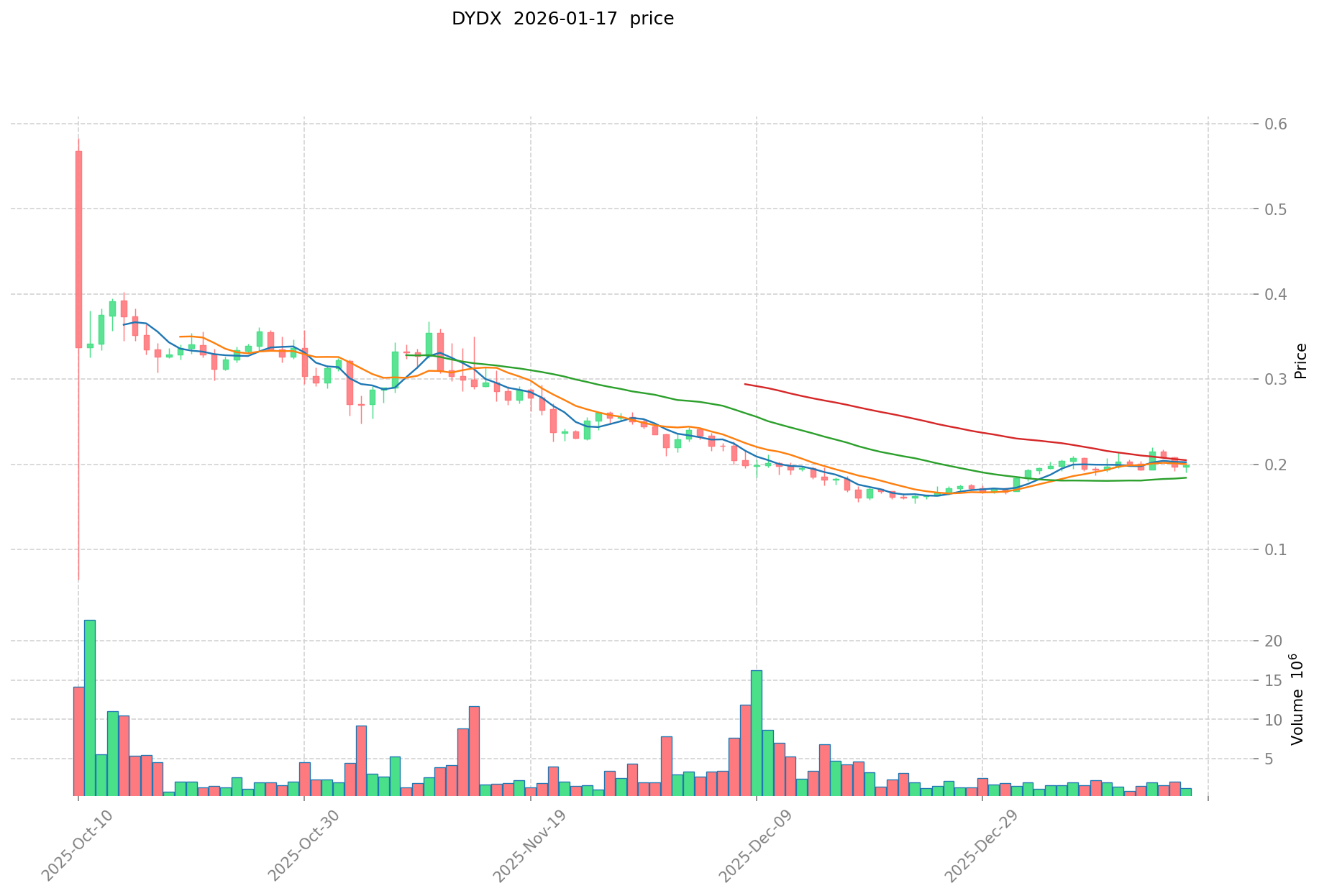
- DYDX current price: $0.1996
- 24-hour trading volume: CELO $368,715.76 vs DYDX $162,714.93
- Market Sentiment Index (Fear & Greed Index): 50 (Neutral)
View real-time prices:
II. Core Factors Influencing CELO vs DYDX Investment Value
Supply Mechanism Comparison (Tokenomics)
- CELO: Features a fixed supply structure, with its value fluctuation tied to the overall value of stablecoins circulating within the Celo ecosystem. CELO plays a role in the stability platform by adjusting the circulating supply of stablecoins.
- DYDX: As a governance and utility token for a decentralized derivatives trading platform, its tokenomics are designed to incentivize platform participation and protocol governance.
- 📌 Historical Pattern: Supply mechanisms influence price cycles through scarcity dynamics and emission schedules, though specific historical data for these tokens requires further market observation.
Institutional Adoption and Market Application
- Institutional Holdings: Available materials indicate that both projects have attracted attention from crypto venture capital firms, though specific institutional preference data between CELO and DYDX is not detailed in the reference materials.
- Enterprise Adoption: CELO focuses on mobile-first financial infrastructure and stablecoin circulation, while DYDX concentrates on decentralized derivatives trading and margin trading capabilities.
- Regulatory Landscape: Both projects operate within evolving regulatory frameworks, with their adoption influenced by jurisdiction-specific approaches to DeFi protocols and stablecoin systems.
Technology Development and Ecosystem Building
- CELO Technology Upgrades: According to reference materials, Celo announced its Baklava testnet upgrade scheduled for December 12, with L2 mainnet plans in development, potentially enhancing scalability and ecosystem expansion.
- DYDX Technology Development: Operating as a decentralized derivatives trading platform, DYDX competes with other protocols in providing enhanced interest rates and leverage opportunities within the DeFi derivatives sector.
- Ecosystem Comparison: CELO emphasizes stablecoin infrastructure and mobile accessibility, while DYDX focuses on derivatives trading, margin capabilities, and synthetic asset markets. Both ecosystems face competition from established DeFi protocols in their respective sectors.
Macroeconomic Environment and Market Cycles
- Performance in Inflationary Environments: CELO's connection to stablecoin mechanisms may provide different characteristics compared to DYDX's trading platform utility, though specific anti-inflation properties require case-by-case analysis based on market conditions.
- Macroeconomic Monetary Policy: Interest rate changes and dollar index movements can affect both tokens differently - CELO through stablecoin demand dynamics, and DYDX through derivatives trading volumes and platform activity.
- Geopolitical Factors: Cross-border transaction needs and international developments may influence adoption patterns for both platforms, with CELO potentially benefiting from mobile payment infrastructure demand and DYDX from increased derivatives trading activity during market volatility.
III. 2026-2031 Price Prediction: CELO vs DYDX
Short-term Prediction (2026)
- CELO: Conservative $0.106-$0.142 | Optimistic $0.142-$0.200
- DYDX: Conservative $0.112-$0.200 | Optimistic $0.200-$0.277
Mid-term Prediction (2028-2029)
- CELO may enter a gradual growth phase, with estimated price range of $0.108-$0.206
- DYDX may enter an expansion phase, with estimated price range of $0.248-$0.432
- Key drivers: institutional capital inflows, ETF developments, ecosystem expansion
Long-term Prediction (2030-2031)
- CELO: Baseline scenario $0.123-$0.232 | Optimistic scenario $0.174-$0.318
- DYDX: Baseline scenario $0.268-$0.477 | Optimistic scenario $0.406-$0.572
View detailed price predictions for CELO and DYDX
Disclaimer
CELO:
| Year |
Predicted High Price |
Predicted Average Price |
Predicted Low Price |
Price Change |
| 2026 |
0.199797 |
0.1417 |
0.106275 |
0 |
| 2027 |
0.189530835 |
0.1707485 |
0.1365988 |
20 |
| 2028 |
0.2017564276 |
0.1801396675 |
0.1080838005 |
27 |
| 2029 |
0.206223891354 |
0.19094804755 |
0.1202972699565 |
35 |
| 2030 |
0.26610519906568 |
0.198585969452 |
0.12312330106024 |
40 |
| 2031 |
0.31831345043461 |
0.23234558425884 |
0.17425918819413 |
64 |
DYDX:
| Year |
Predicted High Price |
Predicted Average Price |
Predicted Low Price |
Price Change |
| 2026 |
0.277444 |
0.1996 |
0.111776 |
0 |
| 2027 |
0.32916036 |
0.238522 |
0.15742452 |
19 |
| 2028 |
0.3860240048 |
0.28384118 |
0.2639722974 |
42 |
| 2029 |
0.432063044196 |
0.3349325924 |
0.247850118376 |
67 |
| 2030 |
0.57141174926402 |
0.383497818298 |
0.2684484728086 |
91 |
| 2031 |
0.49655297513225 |
0.47745478378101 |
0.405836566213858 |
138 |
IV. Investment Strategy Comparison: CELO vs DYDX
Long-term vs Short-term Investment Strategies
- CELO: May be suitable for investors interested in mobile-first financial infrastructure and stablecoin ecosystem development, particularly those focused on financial inclusion applications and emerging market adoption patterns.
- DYDX: May appeal to investors seeking exposure to decentralized derivatives trading infrastructure and DeFi protocol governance, particularly those monitoring perpetual contract platform developments and margin trading ecosystem growth.
Risk Management and Asset Allocation
- Conservative Investors: CELO 40% vs DYDX 30% (with 30% allocated to stablecoins or other defensive positions)
- Aggressive Investors: CELO 50% vs DYDX 50% (with potential for concentrated positions based on market conditions)
- Hedging Tools: Stablecoin allocation for liquidity management, options strategies where available, cross-asset diversification across different DeFi sectors
V. Potential Risk Comparison
Market Risks
- CELO: Price volatility influenced by stablecoin demand cycles, mobile payment adoption rates, and competition from other financial inclusion platforms. Market sentiment shifts may impact ecosystem development momentum.
- DYDX: Trading volume fluctuations affecting platform utility value, competition from centralized and decentralized derivatives exchanges, and sensitivity to overall DeFi sector performance trends.
Technical Risks
- CELO: Scalability considerations during L2 transition phases, network stability requirements for mobile-first infrastructure, and technical execution risks associated with testnet and mainnet upgrades.
- DYDX: Platform security considerations for derivatives trading infrastructure, smart contract vulnerability concerns, and technical complexity associated with perpetual contract mechanisms.
Regulatory Risks
- Global regulatory frameworks continue to evolve for both DeFi protocols and stablecoin platforms, with different jurisdictions potentially applying varying compliance requirements. CELO's stablecoin infrastructure and DYDX's derivatives trading services may face distinct regulatory considerations depending on regional approaches to digital asset classification and DeFi protocol oversight.
VI. Conclusion: Which Is the Better Buy?
📌 Investment Value Summary:
- CELO Characteristics: Focus on mobile-first financial infrastructure and stablecoin ecosystem, with ongoing L2 development initiatives. Price predictions suggest potential gradual growth trajectory from current levels, with estimated ranges of $0.106-$0.200 in 2026 and $0.174-$0.318 by 2031 under optimistic scenarios.
- DYDX Characteristics: Positioning in decentralized derivatives trading sector with perpetual contract capabilities. Price predictions indicate potential expansion phases, with estimated ranges of $0.112-$0.277 in 2026 and $0.406-$0.572 by 2031 under optimistic scenarios.
✅ Investment Considerations:
- New Investors: Consider starting with smaller position sizes to understand market dynamics, prioritize risk management through diversification, and maintain stablecoin reserves for volatility management. Research both ecosystems thoroughly before making allocation decisions.
- Experienced Investors: Evaluate technical development roadmaps, monitor ecosystem adoption metrics, and consider portfolio allocation based on individual risk tolerance and investment thesis. Track institutional developments and regulatory landscape changes affecting both sectors.
- Institutional Investors: Assess liquidity profiles, trading volume sustainability, regulatory compliance frameworks, and ecosystem maturity indicators. Consider broader DeFi sector positioning and correlation patterns with overall crypto market cycles.
⚠️ Risk Disclaimer: Cryptocurrency markets exhibit high volatility characteristics. This content does not constitute investment advice. Historical price performance does not guarantee future results. Investors should conduct independent research and consider their individual financial circumstances before making investment decisions.
VII. FAQ
Q1: What are the main differences between CELO and DYDX in terms of their use cases?
CELO focuses on mobile-first financial infrastructure and stablecoin circulation for financial inclusion, while DYDX specializes in decentralized derivatives trading and perpetual contracts. CELO aims to make financial tools accessible to anyone with a mobile phone, particularly targeting emerging markets and underbanked populations. DYDX operates as a trading platform providing leverage and margin trading capabilities within the DeFi derivatives sector, primarily serving traders seeking decentralized alternatives to centralized exchanges for perpetual contract trading.
Q2: How do the tokenomics of CELO and DYDX differ?
CELO features a fixed supply structure with value fluctuation tied to stablecoin circulation within its ecosystem, while DYDX operates as a governance and utility token for its derivatives trading platform. CELO plays a role in the stability platform by adjusting stablecoin supply, making its economics connected to the broader Celo stablecoin infrastructure. DYDX tokenomics are designed to incentivize platform participation, protocol governance, and trading activity, with value derived from platform utility and governance rights rather than stablecoin mechanism dynamics.
Q3: Which token has shown better price resilience during recent market downturns?
DYDX has demonstrated relatively better price resilience with a decline of approximately 97.21% from its all-time high, compared to CELO's decline of approximately 98.89%. As of January 18, 2026, DYDX trades at $0.1996 while CELO trades at $0.1413. However, it's important to note that CELO reached its all-time high earlier (August 2021) during a different market cycle, while DYDX peaked more recently (March 2024), making direct comparisons subject to different market condition contexts.
Q4: What are the key technical developments investors should monitor for both projects?
For CELO, investors should track the Baklava testnet upgrade and L2 mainnet development plans, which aim to enhance scalability and ecosystem expansion capabilities. For DYDX, key developments include platform security enhancements, competition positioning against other derivatives protocols, and improvements in perpetual contract mechanisms. Both projects face ecosystem-building challenges, with CELO competing in the stablecoin infrastructure space and DYDX competing in the derivatives trading sector against both centralized and decentralized alternatives.
Q5: How do price predictions compare for CELO vs DYDX through 2031?
Price predictions suggest DYDX may have higher growth potential in optimistic scenarios. By 2031, DYDX's optimistic prediction ranges from $0.406-$0.572, while CELO's optimistic range is $0.174-$0.318. In conservative baseline scenarios for 2031, DYDX ranges from $0.268-$0.477 compared to CELO's $0.123-$0.232. However, these predictions depend on numerous factors including ecosystem adoption, institutional capital inflows, regulatory developments, and broader market cycle dynamics. Investors should treat these predictions as reference points rather than guaranteed outcomes.
Q6: What risk factors should investors consider when choosing between CELO and DYDX?
CELO faces risks related to stablecoin demand cycles, mobile payment adoption rates, L2 transition execution, and competition from other financial inclusion platforms. DYDX faces risks including trading volume fluctuations, platform security considerations, competition from derivatives exchanges, and smart contract vulnerabilities. Both projects face regulatory uncertainty as global frameworks for DeFi protocols and stablecoins continue to evolve. Additionally, both tokens exhibit high volatility characteristics inherent to cryptocurrency markets, requiring appropriate risk management strategies regardless of choice.
Q7: Which token is more suitable for different investor profiles?
CELO may appeal to investors interested in mobile-first financial infrastructure, stablecoin ecosystem development, and financial inclusion themes, particularly those with longer time horizons focused on emerging market adoption. DYDX may suit investors seeking exposure to decentralized derivatives trading infrastructure, DeFi protocol governance, and perpetual contract platform developments. Conservative investors might consider a balanced allocation (40% CELO, 30% DYDX, 30% stablecoins), while aggressive investors could pursue concentrated positions based on their conviction in specific ecosystem development trajectories. New investors should prioritize smaller position sizes and thorough ecosystem research before making allocation decisions.
Q8: How do current trading volumes compare and what does this indicate?
As of January 18, 2026, CELO shows higher 24-hour trading volume at $368,715.76 compared to DYDX's $162,714.93. This suggests CELO currently experiences greater market activity and liquidity. Higher trading volume can indicate stronger market interest, better price discovery, and improved liquidity for entering and exiting positions. However, trading volume alone does not determine investment quality, as it should be evaluated alongside other factors including ecosystem development, adoption metrics, and long-term value proposition. Investors should monitor volume trends over time rather than relying on single-day snapshots.
* The information is not intended to be and does not constitute financial advice or any other recommendation of any sort offered or endorsed by Gate.