This comprehensive guide compares CELO and KAVA, two leading DeFi and blockchain platforms, analyzing their investment potential across multiple dimensions. CELO targets mobile-first financial inclusion in emerging markets since 2020, while KAVA operates as a cross-chain DeFi lending platform since 2019. The article examines historical price trends, current market status, tokenomics, institutional adoption, and technological ecosystems of both projects. It provides detailed price forecasts through 2031, with CELO potentially reaching $0.318 and KAVA $0.138 under optimistic scenarios. The guide offers tailored investment strategies for conservative and aggressive investors, compares risk factors including market, technical, and regulatory risks, and includes FAQs addressing key differences. Whether trading on Gate or long-term holding, investors gain data-driven insights to evaluate CELO versus KAVA based on their risk tolerance and investment objectives.
Introduction: Investment Comparison Between CELO and KAVA
In the cryptocurrency market, the comparison between CELO vs KAVA has consistently been a topic investors cannot avoid. Both demonstrate notable differences in market cap ranking, application scenarios, and price performance, representing distinct positioning within the crypto asset landscape.
CELO (CELO): Launched in 2020, it has gained market recognition through its focus on financial inclusion via mobile-accessible financial tools.
KAVA (KAVA): Since its launch in 2019, it has been positioned as a cross-chain DeFi platform, offering collateralized lending and stablecoin services for mainstream digital assets.
This article will comprehensively analyze the investment value comparison of CELO vs KAVA across historical price trends, supply mechanisms, institutional adoption, technical ecosystems, and future forecasts, attempting to answer the question investors care about most:
"Which is the better buy right now?"
I. Historical Price Comparison and Current Market Status
Historical Price Trends of CELO (Coin A) and KAVA (Coin B)
- 2021: CELO experienced significant price movement, reaching an all-time high of $9.82 on August 30, 2021, during the broader crypto market bull run.
- 2021: KAVA reached its historical peak of $9.12 on August 30, 2021, benefiting from similar market momentum and increased interest in DeFi platforms.
- Comparative Analysis: During the recent market cycle, CELO declined from its peak of $9.82 to a low of $0.109096 recorded on January 1, 2026, while KAVA experienced a comparable decline from $9.12 to $0.071579 on December 19, 2025.
Current Market Status (January 18, 2026)
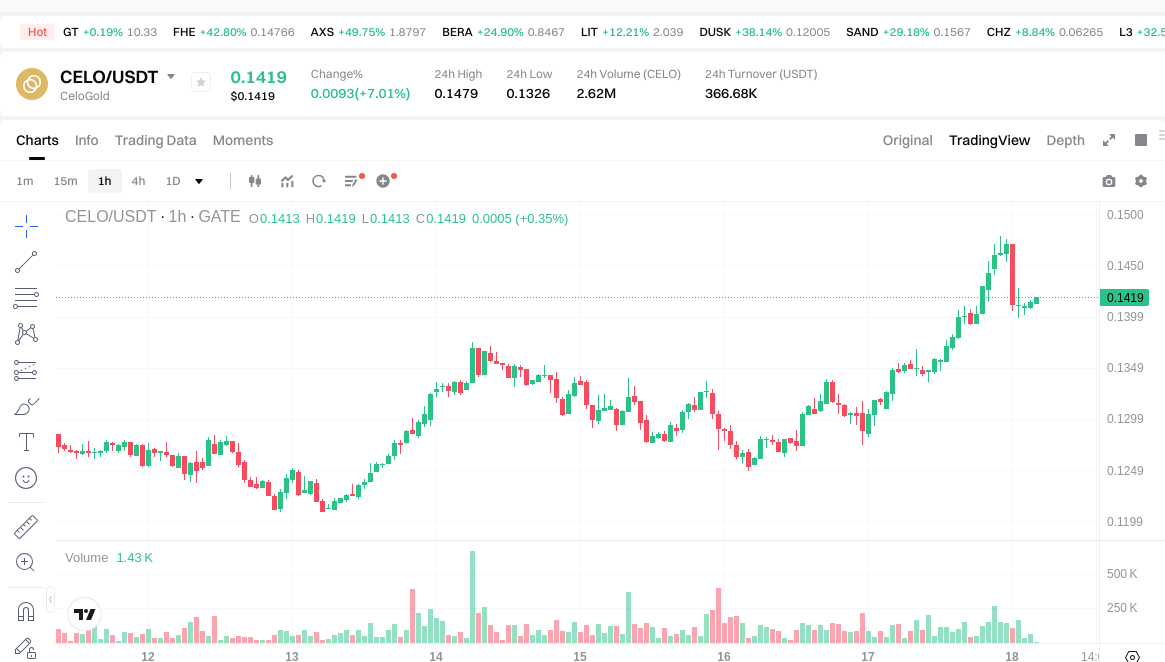
- CELO Current Price: $0.1413
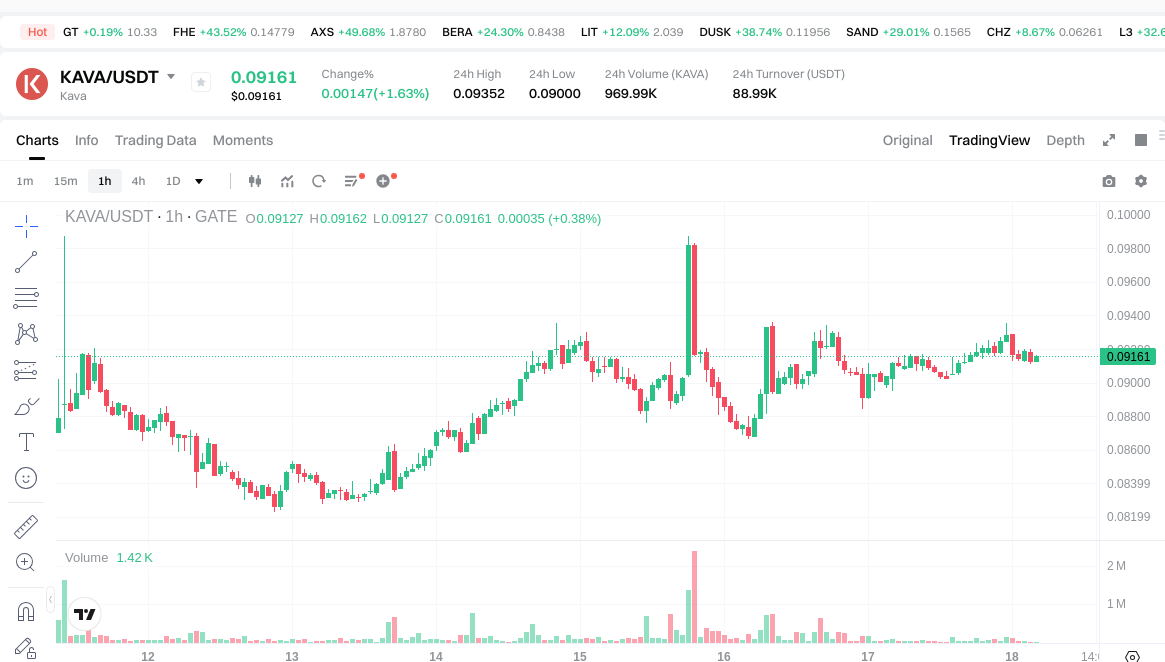
- KAVA Current Price: $0.09127
- 24-Hour Trading Volume: CELO $368,715.76 vs KAVA $89,932.75
- Market Sentiment Index (Fear & Greed Index): 50 (Neutral)
View Real-Time Prices:
II. Core Factors Influencing CELO vs KAVA Investment Value
Tokenomics Comparison
- CELO: The token serves as the native asset within the Celo ecosystem, designed to support decentralized financial applications with a focus on mobile-first accessibility and financial inclusion.
- KAVA: Functions as the governance and staking token in the Kava cross-chain DeFi platform, enabling users to participate in protocol governance and secure the network.
- 📌 Historical Pattern: Supply mechanisms and token utility models can influence price cycles through varying demand dynamics and ecosystem adoption rates.
Institutional Adoption and Market Application
- Institutional Holdings: Both projects have attracted institutional attention, with CELO receiving backing from investors including Andreessen Horowitz and Polychain Capital, which has supported ecosystem expansion efforts.
- Enterprise Adoption: CELO has been utilized in initiatives targeting financial inclusion in emerging markets, including African regions such as Nigeria and South Africa. KAVA's cross-chain DeFi capabilities position it for applications in multi-asset collateralization and decentralized lending.
- Regulatory Environment: The evolving regulatory landscape for stablecoins and DeFi protocols may impact both projects, with compliance considerations becoming increasingly relevant for sustained market participation.
Technology Development and Ecosystem Building
- CELO Technology: The platform emphasizes mobile-optimized blockchain infrastructure and has been developing applications in decentralized finance with a focus on accessibility.
- KAVA Technology: As a cross-chain DeFi project, KAVA has been working on expanding its capabilities in multi-asset collateral systems and decentralized financial services.
- Ecosystem Comparison: Both projects operate within the broader DeFi landscape, with CELO focusing on mobile-first financial applications and KAVA concentrating on cross-chain interoperability and lending protocols.
Macroeconomic and Market Cycles
- Inflation Environment Performance: The performance of both tokens may be influenced by broader macroeconomic conditions, including inflation trends and monetary policy shifts.
- Macroeconomic Monetary Policy: Interest rate changes and U.S. dollar index movements can affect risk appetite for crypto assets, potentially impacting both CELO and KAVA valuations.
- Geopolitical Factors: Cross-border transaction demands and international developments may influence adoption patterns for blockchain-based financial solutions.
III. 2026-2031 Price Forecast: CELO vs KAVA
Short-term Forecast (2026)
- CELO: Conservative $0.106-$0.142 | Optimistic $0.142-$0.200
- KAVA: Conservative $0.051-$0.092 | Optimistic $0.092-$0.100
Mid-term Forecast (2028-2029)
- CELO may enter a consolidation phase with projected prices ranging from $0.108 to $0.206
- KAVA may experience moderate growth, with estimated prices between $0.066 and $0.142
- Key drivers: institutional capital inflows, ETF developments, ecosystem expansion
Long-term Forecast (2030-2031)
- CELO: Base scenario $0.123-$0.232 | Optimistic scenario $0.232-$0.318
- KAVA: Base scenario $0.075-$0.131 | Optimistic scenario $0.131-$0.138
View detailed price forecasts for CELO and KAVA
Disclaimer
CELO:
| Year |
Predicted High Price |
Predicted Average Price |
Predicted Low Price |
Price Change |
| 2026 |
0.199797 |
0.1417 |
0.106275 |
0 |
| 2027 |
0.189530835 |
0.1707485 |
0.1365988 |
20 |
| 2028 |
0.2017564276 |
0.1801396675 |
0.1080838005 |
27 |
| 2029 |
0.206223891354 |
0.19094804755 |
0.1202972699565 |
35 |
| 2030 |
0.26610519906568 |
0.198585969452 |
0.12312330106024 |
40 |
| 2031 |
0.31831345043461 |
0.23234558425884 |
0.17425918819413 |
64 |
KAVA:
| Year |
Predicted High Price |
Predicted Average Price |
Predicted Low Price |
Price Change |
| 2026 |
0.0997895 |
0.09155 |
0.051268 |
0 |
| 2027 |
0.109063515 |
0.09566975 |
0.0507049675 |
4 |
| 2028 |
0.142289619175 |
0.1023666325 |
0.070632976425 |
12 |
| 2029 |
0.135784219679625 |
0.1223281258375 |
0.06605718795225 |
34 |
| 2030 |
0.132927857941319 |
0.129056172758562 |
0.09421100611375 |
41 |
| 2031 |
0.137541616117437 |
0.13099201534994 |
0.074665448749466 |
43 |
IV. Investment Strategy Comparison: CELO vs KAVA
Long-term vs Short-term Investment Strategies
- CELO: May be suitable for investors focusing on mobile-first financial infrastructure and emerging market adoption, particularly those interested in financial inclusion initiatives and ecosystem development in underserved regions.
- KAVA: May appeal to investors seeking exposure to cross-chain DeFi protocols and multi-asset collateralization platforms, with interest in decentralized lending and staking opportunities.
Risk Management and Asset Allocation
- Conservative Investors: CELO 40% vs KAVA 60% - This allocation reflects a higher weighting toward KAVA's established DeFi infrastructure, while maintaining exposure to CELO's mobile-focused ecosystem.
- Aggressive Investors: CELO 55% vs KAVA 45% - This strategy provides greater exposure to CELO's potential growth in emerging markets and mobile financial applications.
- Hedging Tools: Stablecoin allocation, options strategies, and cross-asset portfolio diversification can be considered to manage volatility exposure.
V. Potential Risk Comparison
Market Risk
- CELO: Price volatility may be influenced by adoption rates in target emerging markets, competition from other mobile-first blockchain solutions, and broader sentiment toward financial inclusion projects. Trading volume of $368,715.76 indicates moderate liquidity considerations.
- KAVA: Market performance may be affected by DeFi sector trends, cross-chain bridge security concerns, and competition from alternative lending protocols. Lower trading volume of $89,932.75 suggests liquidity considerations for larger position management.
Technical Risk
- CELO: Scalability challenges related to mobile optimization, network stability during periods of increased transaction activity, and ongoing development requirements for ecosystem expansion.
- KAVA: Cross-chain bridge vulnerabilities, smart contract security considerations in multi-asset collateralization systems, and potential technical challenges in maintaining interoperability across multiple blockchain networks.
Regulatory Risk
- Global regulatory developments targeting DeFi protocols may impact both projects differently, with KAVA's lending services potentially facing scrutiny in jurisdictions implementing stricter DeFi regulations.
- CELO's focus on financial inclusion in emerging markets may encounter varying regulatory approaches across different geographical regions, particularly regarding mobile payment systems and cross-border transactions.
- Evolving stablecoin regulations could affect both ecosystems, given their respective roles in facilitating decentralized financial services.
VI. Conclusion: Which Is the Better Buy?
📌 Investment Value Summary:
- CELO Advantages: Focus on mobile-first accessibility, positioning in emerging market financial inclusion initiatives, institutional backing from notable investors including Andreessen Horowitz and Polychain Capital, and development of use cases in regions with limited traditional banking infrastructure.
- KAVA Advantages: Established presence in cross-chain DeFi infrastructure, multi-asset collateralization capabilities, governance and staking functionality, and positioning within the growing decentralized lending sector.
✅ Investment Considerations:
- New Investors: May consider starting with smaller position sizes in both assets to understand their respective ecosystems and price dynamics. Focus on educational resources regarding mobile blockchain applications (CELO) and DeFi protocols (KAVA) before increasing exposure.
- Experienced Investors: May evaluate portfolio allocation based on conviction in mobile-first blockchain adoption versus cross-chain DeFi growth. Consider technical analysis of historical price patterns, ecosystem development progress, and comparative liquidity metrics when determining position sizing.
- Institutional Investors: May assess both projects based on regulatory compliance frameworks, audit histories, institutional partnership networks, and long-term ecosystem sustainability. Consider diversified exposure across both mobile financial infrastructure (CELO) and cross-chain DeFi platforms (KAVA) as part of broader crypto asset allocation strategies.
⚠️ Risk Disclaimer: The cryptocurrency market exhibits substantial volatility and carries significant investment risks. This analysis does not constitute financial advice, investment recommendations, or guarantees of future performance. Investors should conduct thorough independent research, assess their risk tolerance, and consult with qualified financial advisors before making investment decisions. Past performance is not indicative of future results.
VII. FAQ
Q1: What are the main differences between CELO and KAVA's use cases?
CELO focuses on mobile-first financial inclusion in emerging markets, while KAVA operates as a cross-chain DeFi lending platform. CELO is designed to provide accessible financial services through mobile devices, particularly targeting underbanked populations in regions like Nigeria and South Africa. Its ecosystem emphasizes user-friendly applications that can operate on smartphones with minimal technical barriers. In contrast, KAVA serves as a decentralized lending protocol that enables multi-asset collateralization across different blockchain networks, allowing users to borrow against various crypto assets and participate in governance through staking mechanisms.
Q2: Which token has shown better price resilience during the 2021-2026 market cycle?
Both tokens experienced significant declines from their 2021 peaks, with CELO declining approximately 98.6% and KAVA declining approximately 99.2%. CELO fell from its all-time high of $9.82 (August 30, 2021) to $0.109096 (January 1, 2026), while KAVA dropped from $9.12 (August 30, 2021) to $0.071579 (December 19, 2025). As of January 18, 2026, CELO trades at $0.1413 with a 24-hour volume of $368,715.76, demonstrating slightly better liquidity compared to KAVA's $0.09127 price and $89,932.75 volume, suggesting marginally stronger market support.
Q3: How do the tokenomics of CELO and KAVA differ in terms of utility?
CELO serves as the native asset within its ecosystem, enabling transaction fees, governance participation, and supporting decentralized financial applications with mobile accessibility emphasis. KAVA functions primarily as a governance and staking token within its cross-chain DeFi platform, allowing holders to participate in protocol decisions and secure the network through staking mechanisms. The key distinction lies in CELO's broader utility across mobile financial applications versus KAVA's specialized role in DeFi governance and network security. These different utility models influence demand dynamics and adoption patterns within their respective ecosystems.
Q4: What institutional backing do CELO and KAVA have?
CELO has attracted notable institutional support from prominent investors including Andreessen Horowitz and Polychain Capital, which has contributed to its ecosystem expansion efforts and market credibility. This institutional backing has supported CELO's initiatives in emerging market financial inclusion projects. While both projects have garnered institutional attention, CELO's explicitly mentioned partnerships with recognized venture capital firms provide documented institutional validation. The level and nature of institutional support can influence long-term project sustainability, ecosystem development funding, and market perception.
Q5: What are the projected price ranges for CELO and KAVA through 2031?
According to forecast models, CELO's conservative 2026 range is $0.106-$0.142, expanding to $0.123-$0.232 by 2030-2031 in base scenarios, with optimistic projections reaching $0.318 by 2031. KAVA's conservative 2026 forecast ranges from $0.051-$0.092, progressing to $0.075-$0.131 in 2030-2031 base scenarios, with optimistic estimates reaching $0.138 by 2031. These projections suggest CELO may experience higher absolute price appreciation potential, though both face substantial uncertainty. Key drivers include institutional capital inflows, ETF developments, ecosystem expansion, and broader DeFi sector adoption rates.
Q6: What are the primary risk factors differentiating CELO and KAVA investments?
CELO's primary risks include adoption rate uncertainties in target emerging markets, competition from alternative mobile blockchain solutions, scalability challenges related to mobile optimization, and varying regulatory approaches across different geographical regions regarding mobile payment systems. KAVA faces distinct risks including cross-chain bridge security vulnerabilities, smart contract risks in multi-asset collateralization systems, DeFi-specific regulatory scrutiny particularly around lending services, and lower liquidity as evidenced by its $89,932.75 trading volume compared to CELO's $368,715.76. Both face broader market volatility and cryptocurrency sector regulatory developments.
Q7: How should portfolio allocation differ between conservative and aggressive investors for CELO vs KAVA?
Conservative investors may consider a 40% CELO / 60% KAVA allocation, reflecting higher weighting toward KAVA's established DeFi infrastructure while maintaining exposure to CELO's mobile-focused ecosystem. This approach emphasizes KAVA's proven cross-chain lending mechanisms and existing governance framework. Aggressive investors might adopt a 55% CELO / 45% KAVA allocation, providing greater exposure to CELO's growth potential in emerging markets and mobile financial applications. The rationale assumes higher risk tolerance for CELO's less mature but potentially high-growth market segments, while maintaining diversified exposure to KAVA's established DeFi positioning.
Q8: What technological advantages differentiate CELO and KAVA ecosystems?
CELO's technological focus centers on mobile-optimized blockchain infrastructure designed for accessibility in regions with limited traditional banking services, emphasizing lightweight client implementations and user-friendly interfaces for smartphone users. KAVA's technological emphasis lies in cross-chain interoperability capabilities, enabling multi-asset collateralization across different blockchain networks and facilitating decentralized lending protocols with diverse collateral types. While CELO prioritizes mobile accessibility and financial inclusion through simplified user experiences, KAVA emphasizes technical sophistication in cross-chain DeFi operations and complex collateral management systems. These distinct technological approaches serve different market segments within the broader blockchain ecosystem.
* The information is not intended to be and does not constitute financial advice or any other recommendation of any sort offered or endorsed by Gate.