This comprehensive analysis examines CESS versus ETH investment comparison, addressing two distinct blockchain assets with different market positioning. CESS, a 2024 Layer1 decentralized storage infrastructure project, positions at $0.002269 with focus on data sovereignty and AI optimization, while ETH, the established 2015 smart contract platform, trades at $3,006.52 with extensive DeFi and enterprise ecosystems. The article covers historical price trends showing CESS volatility (declined from $0.02004 peak) versus ETH's relative stability, tokenomics differences where ETH operates under Proof-of-Stake with deflationary mechanisms while CESS incentivizes network participation, and institutional adoption patterns favoring ETH's proven track record over CESS's emerging infrastructure status. Technical ecosystem analysis reveals ETH's mature application layer supporting thousands of protocols against CESS's specialized storage focus. Price forecasts through 2031 project CESS ranging $0.00211-$0.00439 and ETH be
Introduction: Investment Comparison Between CESS and ETH
In the cryptocurrency market, the comparison between CESS vs ETH has become a topic of interest for investors. The two differ significantly in market cap ranking, application scenarios, and price performance, representing distinct positioning within the crypto asset landscape.
CESS (CESS): Launched in 2024, it positions itself as a Layer1 decentralized infrastructure for data value, gaining recognition for empowering AI and RWA applications while ensuring data sovereignty and user privacy.
ETH (ETH): Since its launch in 2015, Ethereum has been recognized as a foundational platform for smart contracts and decentralized applications, ranking among the cryptocurrencies with the highest global trading volume and market capitalization.
This article provides a comprehensive analysis of the investment value comparison between CESS vs ETH, covering historical price trends, supply mechanisms, institutional adoption, technical ecosystems, and future forecasts, attempting to address investors' most pressing question:
"Which is the better buy right now?"
I. Historical Price Comparison and Current Market Status
CESS and ETH Historical Price Trends
-
2025: CESS experienced significant price volatility following its mainnet launch, with the token reaching a peak of $0.02004 in June 2025 before declining. The price demonstrated substantial fluctuations as the project established its market presence in the decentralized data infrastructure sector.
-
2015-2025: ETH has undergone multiple market cycles since its inception. The token experienced major milestones including the transition to Proof of Stake through the Merge upgrade and subsequent protocol enhancements such as the Dencun upgrade in March 2024, which introduced EIP-4844 to reduce Layer 2 transaction costs. ETH reached a notable price point of $4,946.05 in August 2025.
-
Comparative Analysis: During recent market cycles, CESS has shown higher volatility as an emerging infrastructure project, declining from its June 2025 high of $0.02004 to current levels around $0.002269, representing substantial price compression. In contrast, ETH has demonstrated relatively more stable price action, trading around $3,006.52 after declining from its August 2025 peak, reflecting its established market position.
Current Market Status (2026-01-28)
- CESS Current Price: $0.002269
- ETH Current Price: $3,006.52
- 24-Hour Trading Volume: CESS $111,668.22 vs ETH $537,846,243.28
- Market Sentiment Index (Fear & Greed Index): 29 (Fear)
View real-time prices:
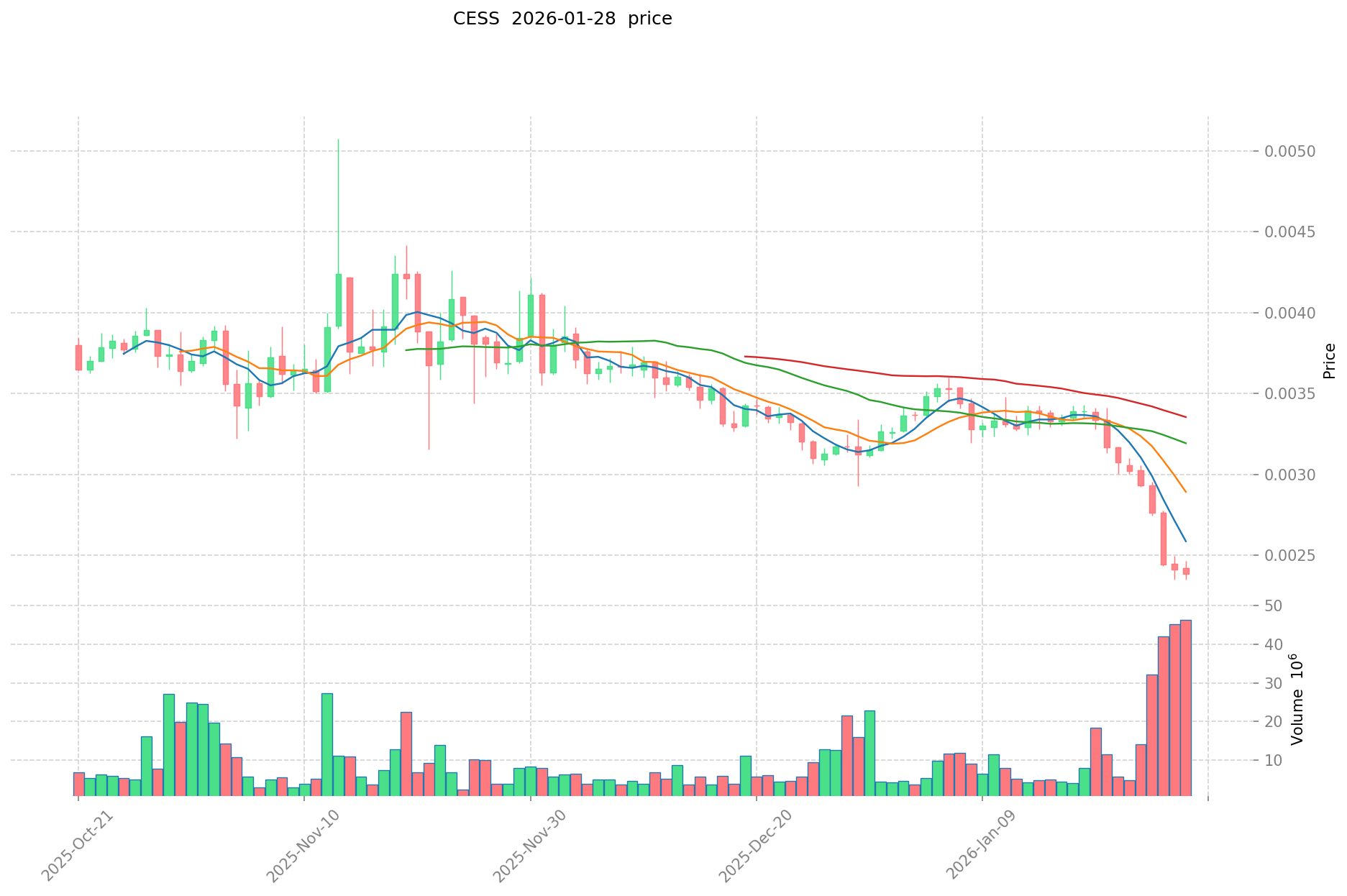
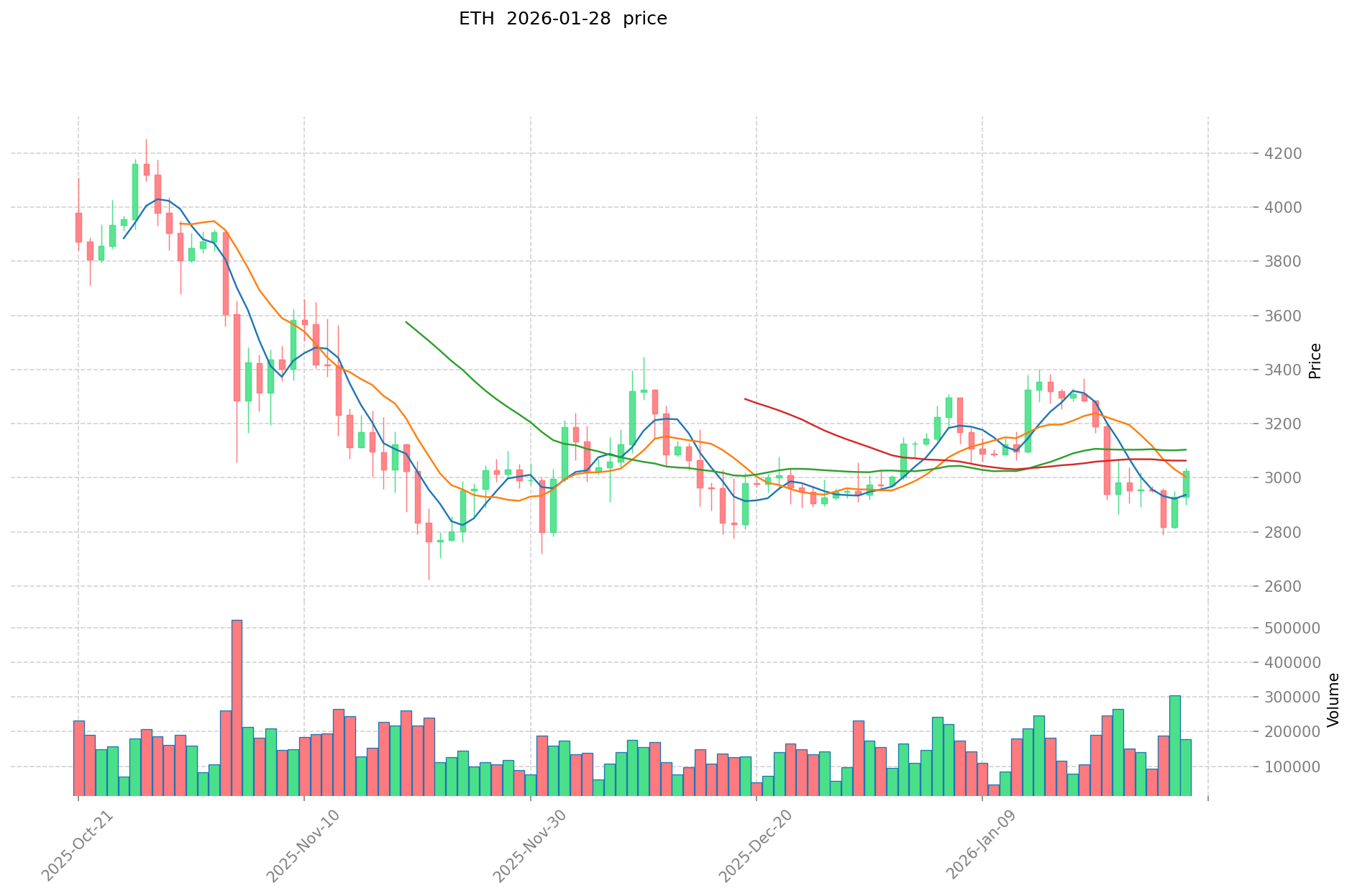
II. Core Factors Influencing CESS vs ETH Investment Value
Supply Mechanism Comparison (Tokenomics)
-
CESS: The token serves multiple functions including network security through staking, storage incentives, governance participation, and transaction fees. CESS operates within both EVM and WebAssembly ecosystems, facilitating cross-platform value exchange. The tokenomics design supports decentralized cloud storage infrastructure with incentive mechanisms tied to network participation.
-
ETH: Ethereum operates under a Proof-of-Stake (PoS) consensus mechanism following The Merge upgrade, which significantly reduced energy consumption and introduced staking rewards. Protocol upgrades such as EIP-1559 altered the supply dynamics by introducing a burn mechanism, creating deflationary pressure during periods of high network activity. Users can earn yields through staking participation.
-
📌 Historical Pattern: Supply mechanisms drive price cycles through scarcity dynamics and emission schedules. Protocol-level changes in token supply models have historically influenced market valuation and investor sentiment.
Institutional Adoption and Market Application
-
Institutional Holdings: ETH has demonstrated broader institutional acceptance, with significant holdings by investment funds and integration into traditional finance products. CESS remains in earlier adoption phases with focus on decentralized storage applications.
-
Enterprise Adoption: ETH powers extensive decentralized applications including DeFi protocols, smart contract platforms, and enterprise blockchain solutions. Its application spans settlement layers, cross-border transactions, and tokenization frameworks. CESS focuses on decentralized cloud storage solutions with applications in data sovereignty and AI-optimized storage networks.
-
Regulatory Environment: Different jurisdictions maintain varying regulatory stances toward blockchain assets. ETH benefits from clearer regulatory frameworks in multiple markets, while emerging projects like CESS navigate evolving storage and data management regulations.
Technology Development and Ecosystem Building
-
CESS Technical Evolution: The network emphasizes decentralized storage infrastructure with AI optimization capabilities and data sovereignty features. Technical innovations focus on storage layer improvements and cross-chain compatibility through EVM and WebAssembly support.
-
ETH Technical Development: Ethereum continues protocol upgrades aimed at scalability, security, and sustainability. The transition to PoS through The Merge represents a foundational shift, with ongoing developments in Layer 2 solutions and sharding technology to enhance throughput and reduce transaction costs.
-
Ecosystem Comparison: ETH maintains a mature ecosystem with extensive DeFi protocols, NFT marketplaces, and smart contract applications across various sectors. CESS develops specialized applications in decentralized storage, positioning within niche infrastructure segments rather than broad-based application layers.
Macroeconomic Environment and Market Cycles
-
Performance Under Inflation: Digital assets demonstrate varied responses to inflationary environments. ETH's established market position and utility in decentralized finance may provide certain hedging characteristics, though correlation with broader risk assets remains significant.
-
Monetary Policy Impact: Interest rate adjustments and monetary policy shifts influence liquidity conditions across digital asset markets. Changes in the U.S. dollar index and global monetary conditions affect capital flows into both established and emerging blockchain projects.
-
Geopolitical Factors: Cross-border transaction demand and international regulatory developments shape adoption trajectories. Market demand for decentralized infrastructure responds to evolving data sovereignty requirements and digital asset integration into global financial systems.
III. 2026-2031 Price Forecast: CESS vs ETH
Short-term Forecast (2026)
- CESS: Conservative $0.00211 - $0.00227 | Optimistic $0.00227 - $0.00338
- ETH: Conservative $2,762 - $3,002 | Optimistic $3,002 - $3,932
Mid-term Forecast (2028-2029)
- CESS may enter a gradual growth phase, with estimated prices ranging from $0.00298 to $0.00416
- ETH may enter a steady expansion phase, with estimated prices ranging from $2,977 to $5,616
- Key drivers: institutional capital inflows, ETF developments, ecosystem expansion
Long-term Forecast (2030-2031)
- CESS: Baseline scenario $0.00211 - $0.00383 | Optimistic scenario $0.00383 - $0.00439
- ETH: Baseline scenario $2,951 - $5,652 | Optimistic scenario $5,652 - $6,557
View detailed price predictions for CESS and ETH
Disclaimer
CESS:
| Year |
Predicted High Price |
Predicted Average Price |
Predicted Low Price |
Price Change |
| 2026 |
0.00338379 |
0.002271 |
0.00211203 |
0 |
| 2027 |
0.00364733955 |
0.002827395 |
0.00155506725 |
24 |
| 2028 |
0.003755346039 |
0.003237367275 |
0.002978377893 |
42 |
| 2029 |
0.00416066442183 |
0.003496356657 |
0.00181810546164 |
54 |
| 2030 |
0.003943365855597 |
0.003828510539415 |
0.002105680796678 |
68 |
| 2031 |
0.004391110163182 |
0.003885938197506 |
0.003108750558004 |
71 |
ETH:
| Year |
Predicted High Price |
Predicted Average Price |
Predicted Low Price |
Price Change |
| 2026 |
3932.4104 |
3001.84 |
2761.6928 |
0 |
| 2027 |
4264.563996 |
3467.1252 |
2218.960128 |
15 |
| 2028 |
4909.62263946 |
3865.844598 |
2976.70034046 |
28 |
| 2029 |
5616.2990319744 |
4387.73361873 |
4036.7149292316 |
45 |
| 2030 |
6302.540569943772 |
5002.0163253522 |
2951.189631957798 |
66 |
| 2031 |
6556.64299927166376 |
5652.278447647986 |
3843.54934440063048 |
88 |
IV. Investment Strategy Comparison: CESS vs ETH
Long-term vs Short-term Investment Strategies
-
CESS: May appeal to investors focusing on emerging decentralized storage infrastructure and data sovereignty applications. The project targets niche segments within blockchain infrastructure, particularly AI-optimized storage networks and cross-platform data management solutions. Investors considering CESS should evaluate their risk tolerance for early-stage infrastructure projects with limited market history and higher volatility patterns.
-
ETH: May suit investors seeking exposure to established smart contract platforms with demonstrated network effects and broader institutional adoption. The asset provides access to extensive decentralized application ecosystems spanning DeFi, NFTs, and enterprise blockchain solutions. ETH's relatively longer market presence and clearer regulatory positioning in multiple jurisdictions may align with investors prioritizing established market infrastructure.
Risk Management and Asset Allocation
-
Conservative Investors: Asset allocation strategies might consider heavier weighting toward established assets with longer track records and greater liquidity depth. Portfolio construction could incorporate stablecoin positions to manage volatility exposure and maintain capital preservation objectives during market uncertainty periods.
-
Aggressive Investors: Higher risk tolerance profiles might allocate portions toward emerging infrastructure projects alongside established platform assets. Diversification across different blockchain application layers and infrastructure segments could provide exposure to various growth trajectories within the digital asset landscape.
-
Hedging Instruments: Risk management approaches may include stablecoin allocations for liquidity maintenance, diversification across multiple digital assets with varying correlation patterns, and position sizing aligned with individual risk parameters. Market participants should consider their specific investment horizons and capital requirements when structuring allocation strategies.
V. Potential Risk Comparison
Market Risks
-
CESS: The token exhibits substantial price volatility, having declined from its June 2025 peak of $0.02004 to current levels around $0.002269. Limited trading volume of $111,668.22 over 24-hour periods indicates constrained liquidity conditions that may amplify price movements during market stress. As an emerging infrastructure project launched in 2024, CESS faces execution risks related to network adoption, competitive positioning within decentralized storage markets, and ability to achieve sustainable user growth.
-
ETH: While demonstrating relatively more stable price patterns compared to emerging projects, ETH remains subject to broader cryptocurrency market cycles and sentiment shifts. The current Fear & Greed Index reading of 29 indicates cautious market conditions. Price movements show correlation with macroeconomic factors including monetary policy changes, regulatory developments, and institutional capital flows. Network competition from alternative Layer 1 platforms and scalability challenges during high-demand periods represent ongoing considerations.
Technical Risks
-
CESS: The network's focus on decentralized storage infrastructure requires successful technical implementation of AI optimization features and data sovereignty mechanisms. Cross-platform compatibility through EVM and WebAssembly support introduces integration complexity. Network stability and security during scaling phases remain critical factors for long-term viability. Limited operational history constrains assessment of technical resilience under various network conditions.
-
ETH: Protocol upgrades carry implementation risks, though Ethereum's extensive developer community and testing processes provide mitigation mechanisms. Scalability improvements through Layer 2 solutions and future sharding implementations face technical complexity and coordination challenges. Network security depends on validator participation and staking distribution patterns. Gas fee volatility during network congestion periods affects user experience and application economics.
Regulatory Risks
- Regulatory frameworks for digital assets continue evolving across jurisdictions, creating uncertainty for market participants. ETH benefits from relatively clearer regulatory treatment in multiple markets, though classification debates and compliance requirements remain ongoing considerations. CESS, as an emerging project, navigates developing regulatory frameworks for decentralized storage and data management applications. Regulatory changes affecting staking mechanisms, securities classifications, and cross-border transactions could impact both assets differently based on their respective use cases and market positioning.
VI. Conclusion: Which Is the Better Buy?
📌 Investment Value Summary:
-
CESS Characteristics: The project positions within specialized decentralized storage infrastructure with focus on data sovereignty and AI optimization capabilities. Cross-platform compatibility through EVM and WebAssembly support provides technical flexibility. The token demonstrates higher volatility patterns and limited liquidity conditions characteristic of emerging infrastructure projects. Price performance shows substantial compression from recent peaks, reflecting early-stage market positioning and adoption phases.
-
ETH Characteristics: Ethereum maintains established market presence as a foundational smart contract platform with extensive ecosystem development across DeFi, NFTs, and enterprise applications. The network demonstrates broader institutional adoption and clearer regulatory frameworks in multiple jurisdictions. Protocol upgrades including the transition to Proof-of-Stake and ongoing scalability improvements support long-term infrastructure development. Relative price stability compared to emerging projects reflects mature market positioning, though significant volatility remains present across market cycles.
✅ Investment Considerations:
-
Entry-level Market Participants: Individuals new to digital asset markets should prioritize understanding fundamental concepts including wallet security, transaction mechanics, and market dynamics before capital allocation. Starting with established assets having longer operational histories and greater liquidity may facilitate learning processes. Education regarding market volatility, security practices, and risk management principles forms essential groundwork for informed participation.
-
Experienced Market Participants: Investors with established digital asset exposure might evaluate allocation adjustments based on portfolio objectives, risk tolerance parameters, and market cycle positioning. Diversification across different infrastructure layers and application segments could provide exposure to various growth trajectories. Regular portfolio rebalancing aligned with changing market conditions and individual circumstances supports disciplined investment approaches.
-
Institutional Participants: Organizations considering digital asset allocation should implement comprehensive due diligence frameworks covering technical architecture, governance structures, regulatory compliance, and custody solutions. Infrastructure maturity, liquidity depth, and operational track records represent key evaluation criteria. Institutional strategies typically incorporate rigorous risk management protocols, compliance procedures, and governance oversight aligned with fiduciary responsibilities.
⚠️ Risk Disclosure: Cryptocurrency markets demonstrate significant volatility with potential for substantial capital loss. This analysis does not constitute investment advice, financial recommendations, or solicitation for any transaction. Market participants should conduct independent research, consult qualified financial advisors, and carefully evaluate their financial circumstances, investment objectives, and risk tolerance before making allocation decisions. Past performance does not indicate future results. Regulatory environments continue evolving with potential impacts on digital asset markets and specific projects.
VII. FAQ
Q1: What are the fundamental differences between CESS and ETH as investment assets?
CESS is an emerging Layer1 decentralized storage infrastructure project launched in 2024, focusing on data sovereignty and AI-optimized storage solutions, while ETH is an established smart contract platform operating since 2015 with extensive DeFi and enterprise application ecosystems. The fundamental difference lies in their market maturity, application scope, and infrastructure positioning—CESS targets specialized storage infrastructure with limited operational history and higher volatility ($0.002269 current price, declined from $0.02004 peak), whereas ETH represents foundational blockchain infrastructure with broader institutional adoption, clearer regulatory frameworks, and relatively more stable price patterns ($3,006.52 current price with $537.8M daily trading volume compared to CESS's $111,668).
Q2: How do the supply mechanisms of CESS and ETH affect their investment value?
ETH operates under a Proof-of-Stake consensus mechanism with deflationary pressure through EIP-1559's burn mechanism during high network activity periods, creating scarcity dynamics that historically influence valuation cycles. CESS employs tokenomics supporting decentralized cloud storage infrastructure with incentive mechanisms tied to network participation, staking for security, and cross-platform value exchange through EVM and WebAssembly compatibility. ETH's established staking ecosystem and protocol-level supply adjustments provide more predictable tokenomics compared to CESS's emerging incentive structures, though both mechanisms directly impact long-term value propositions through scarcity creation and network participation rewards.
Q3: What are the price forecasts for CESS and ETH through 2031?
Short-term forecasts for 2026 project CESS ranging from $0.00211-$0.00338 (conservative to optimistic scenarios) and ETH between $2,762-$3,932. Mid-term 2028-2029 estimates suggest CESS may reach $0.00298-$0.00416 while ETH could trade between $2,977-$5,616, driven by institutional capital inflows and ecosystem expansion. Long-term 2030-2031 projections indicate CESS baseline scenarios of $0.00211-$0.00439 and ETH ranging from $2,951-$6,557. These forecasts reflect different growth trajectories—CESS showing gradual expansion as an emerging infrastructure project with higher percentage gains from lower base prices, while ETH demonstrates steady appreciation from an established market position with significant absolute value increases.
Q4: What risks should investors consider when comparing CESS vs ETH?
CESS presents higher market risks including substantial volatility (88% decline from recent peaks), limited liquidity ($111,668 daily volume), execution risks related to network adoption, and competitive positioning within decentralized storage markets with only two years of operational history. ETH faces market cycle correlation with macroeconomic factors, network competition from alternative Layer1 platforms, gas fee volatility during congestion, and protocol upgrade implementation complexities, though mitigated by extensive developer community and longer track record. Both assets face evolving regulatory frameworks, with ETH benefiting from clearer treatment in multiple jurisdictions while CESS navigates developing regulations for decentralized storage applications. Technical risks for CESS include unproven network stability during scaling phases, whereas ETH manages scalability challenges through Layer2 solutions and future sharding implementations.
Q5: Which investor profiles align with CESS versus ETH investment strategies?
Conservative investors might favor ETH due to its established market infrastructure, greater liquidity depth ($537.8M daily volume), longer operational track record since 2015, and clearer regulatory positioning across multiple jurisdictions, though significant volatility remains present. Aggressive investors with higher risk tolerance may allocate portions toward CESS to gain exposure to emerging decentralized storage infrastructure and potential higher percentage returns, accepting substantial volatility and execution risks associated with early-stage projects. Entry-level participants should prioritize established assets like ETH for learning market dynamics and security practices before exploring emerging projects. Experienced participants might diversify across both assets based on portfolio objectives—ETH for core smart contract platform exposure and CESS for specialized storage infrastructure positioning—while implementing rigorous position sizing aligned with individual risk parameters.
Q6: How do institutional adoption patterns differ between CESS and ETH?
ETH demonstrates significantly broader institutional acceptance with substantial holdings by investment funds, integration into traditional finance products including spot ETFs, and enterprise blockchain adoption across settlement layers, cross-border transactions, and tokenization frameworks. CESS remains in early adoption phases with focus on decentralized storage applications, lacking comparable institutional recognition or traditional finance integration. The institutional adoption gap reflects ETH's nine-year operational history, regulatory clarity in multiple markets, and proven use cases across DeFi protocols, NFT marketplaces, and smart contract applications. CESS must demonstrate sustained network growth, technical reliability, and competitive advantages within decentralized storage markets to attract institutional capital, representing a fundamental difference in current market positioning and future adoption trajectories.
Q7: What role do macroeconomic factors play in CESS and ETH price performance?
Both assets demonstrate sensitivity to macroeconomic conditions including monetary policy shifts, inflation dynamics, and interest rate adjustments affecting liquidity conditions across digital asset markets. ETH's established market position and utility in decentralized finance may provide certain characteristics during inflationary environments, though significant correlation with broader risk assets persists, as evidenced by the current Fear & Greed Index reading of 29 indicating cautious market sentiment. CESS, as an emerging project with limited price history, exhibits amplified responses to macroeconomic shifts due to lower liquidity and higher volatility patterns. Changes in the U.S. dollar index, global monetary conditions, and geopolitical factors shape capital flows differently—ETH receiving institutional flows during risk-on periods while CESS faces more pronounced capital constraints during market stress. Cross-border transaction demand and data sovereignty requirements driven by geopolitical developments may influence adoption trajectories for both assets through different mechanisms.
* The information is not intended to be and does not constitute financial advice or any other recommendation of any sort offered or endorsed by Gate.