This comprehensive analysis compares CHEQ and XRP, two distinct cryptocurrency projects with fundamentally different value propositions. CHEQ focuses on decentralized identity and verifiable credentials through the CHEQD Network, while XRP serves as a digital asset for cross-border payments via Ripple's infrastructure. The comparison evaluates historical price trends, tokenomics, institutional adoption, technological ecosystems, and regulatory environments. XRP demonstrates significantly higher trading volume ($61M daily vs $15K for CHEQ) and established market presence since 2011, though faces ongoing securities law scrutiny. CHEQ presents emerging ecosystem opportunities in trusted data economy but carries higher liquidity and execution risks. Investment suitability depends on risk tolerance, investment horizon, and regulatory considerations. View real-time pricing on Gate for both assets.
Introduction: Investment Comparison Between CHEQ and XRP
In the cryptocurrency market, the comparison between CHEQ vs XRP has become a topic of interest for investors. These two assets differ significantly in market cap ranking, application scenarios, and price performance, representing distinct positions within the crypto asset landscape.
CHEQ (CHEQ): Launched as part of the CHEQD NETWORK, this project focuses on building a trusted data economy. It aims to enable new business models where verifiable credentials are exchanged in a reliable, reusable, secure, and cost-effective manner through customizable governance structures on a public permissionless network.
XRP (XRP): Since its launch in 2011, XRP has gained recognition as a digital asset designed for cross-border payments. Built on the XRP Ledger, it is known for its speed (approximately 3 seconds per transaction), low cost ($0.0002 per transaction), scalability (1,500+ tps), and carbon-neutral design. XRP ranks among the top cryptocurrencies globally by trading volume and market capitalization.
This article will provide a comprehensive analysis of CHEQ vs XRP investment value comparison, covering historical price trends, supply mechanisms, institutional adoption, technological ecosystems, and future predictions. We aim to address the question that concerns investors most:
"Which is the better buy right now?"
I. Price History Comparison and Current Market Status
CHEQ (Coin A) and XRP (Coin B) Historical Price Trends
- 2021: CHEQ reached a notable price level during November, reflecting initial market interest in its decentralized identity ecosystem.
- 2025: XRP experienced significant movement in July, with price activity reflecting ongoing developments in its payment network infrastructure.
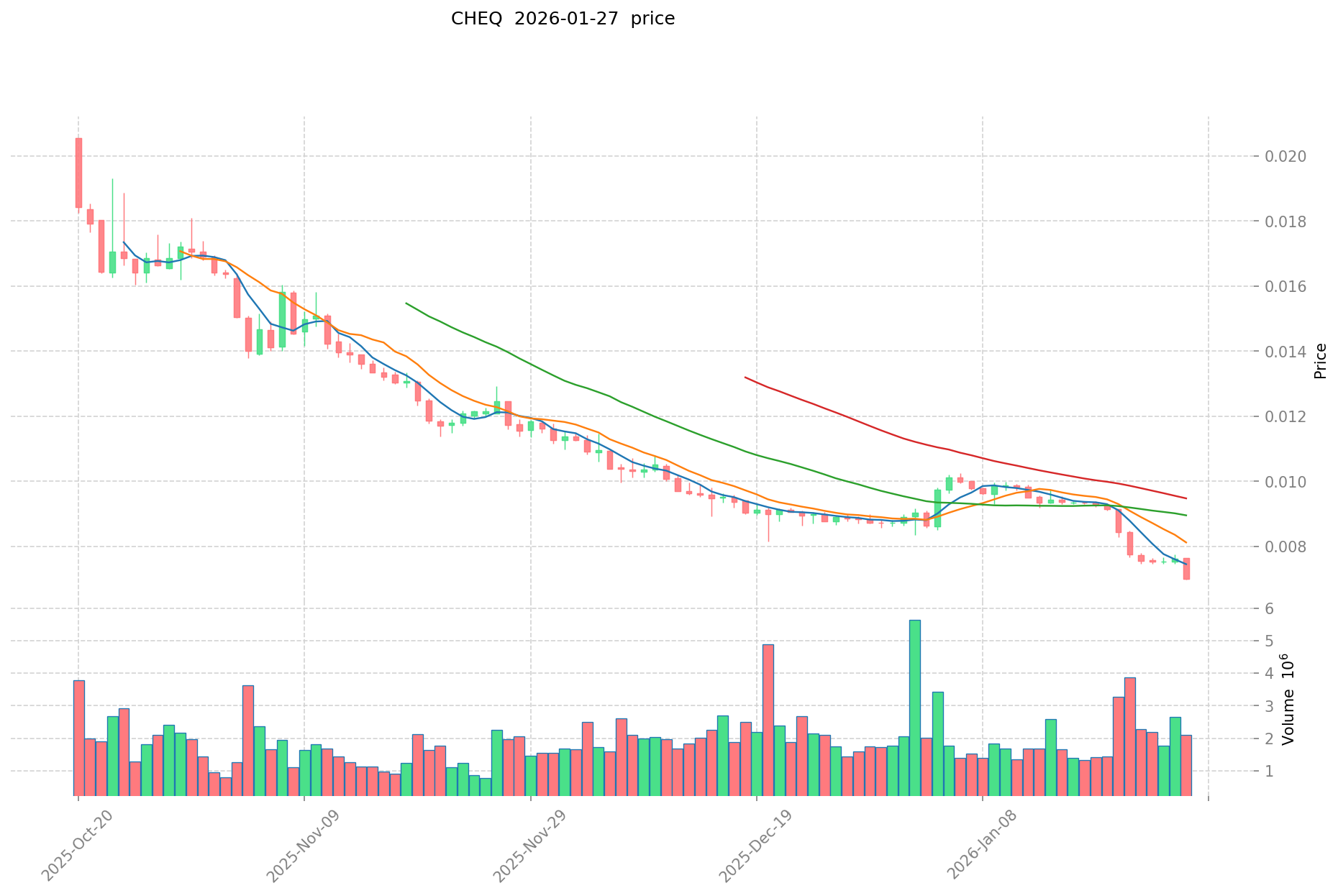
- Comparative Analysis: Throughout the 2021-2026 market cycle, CHEQ moved from $0.71551 to $0.00686065, while XRP fluctuated between $3.65 and $0.00268621, demonstrating distinct volatility patterns across different market phases.
Current Market Status (2026-01-28)
- CHEQ Current Price: $0.006875
- XRP Current Price: $1.912
- 24-Hour Trading Volume: $15,865.10 (CHEQ) vs $61,034,730.90 (XRP)
- Market Sentiment Index (Fear & Greed Index): 29 (Fear)
View real-time prices:

II. Core Factors Influencing Investment Value: CHEQ vs XRP
Tokenomics Comparison
-
XRP: Operates with a pre-mined supply model where 100 billion tokens were created at launch. Ripple Labs holds a significant portion of tokens in escrow, releasing them periodically into circulation. This controlled distribution mechanism aims to prevent sudden supply shocks while maintaining network liquidity.
-
CHEQ: Specific tokenomics details are not available in the reference materials.
-
📌 Historical Pattern: Supply mechanisms can influence price cycles through inflation rates and token release schedules, though actual market performance depends on multiple variables including demand dynamics and broader market sentiment.
Institutional Adoption and Market Application
-
Institutional Holdings: Reference materials indicate that XRP has attracted attention from institutional investors, particularly in the context of cross-border payment solutions. Ripple's business model focuses on providing blockchain-based payment networks for financial institutions.
-
Enterprise Adoption: XRP is positioned within Ripple's payment network infrastructure, which targets banks and financial institutions for international settlements. However, the materials note that financial institutions can utilize the Ripple network without necessarily adopting XRP tokens, as the system also supports fiat currencies. This means widespread adoption of Ripple's payment solutions may not directly correlate with increased XRP value.
-
Regulatory Environment: XRP has faced regulatory scrutiny, particularly regarding securities law compliance. Court decisions have indicated that sales of XRP to sophisticated investors may meet certain investment contract tests under securities regulations. The regulatory landscape continues to evolve, creating uncertainty around XRP's classification and future regulatory treatment.
Technology Development and Ecosystem Building
-
XRP Technology: XRP functions as part of Ripple's payment network infrastructure, designed to facilitate rapid cross-border transactions. The network aims to enhance transaction speeds for financial institutions through blockchain technology.
-
CHEQ Technology: The reference materials emphasize that CHEQ's investment value depends on its technological innovation and market application prospects, though specific technical developments are not detailed.
-
Ecosystem Comparison: XRP's primary use case centers on payment and settlement solutions within the financial services sector. Ripple's revenue model includes XRP sales, payment fees, investment returns, and loan interest income.
Macroeconomic Factors and Market Cycles
-
Inflation Environment: The reference materials do not provide specific analysis comparing inflation-hedging characteristics between CHEQ and XRP.
-
Monetary Policy Impact: Market liquidity conditions appear to constrain institutional demand in the cryptocurrency sector. Reference materials suggest that liquidity constraints, rather than volatility concerns, may limit institutional participation in crypto markets.
-
Geopolitical Considerations: Cross-border transaction demand represents a potential driver for payment-focused cryptocurrencies. XRP's positioning within international settlement infrastructure may provide exposure to global payment flows, though adoption remains dependent on regulatory clarity and institutional preferences.
Note: Both XRP and CHEQ exhibit considerable volatility characteristics. Investment decisions should account for regulatory uncertainties, technological development trajectories, and evolving market conditions. The materials emphasize the need for careful consideration when evaluating these assets.
III. 2026-2031 Price Prediction: CHEQ vs XRP
Short-term Prediction (2026)
- CHEQ: Conservative $0.00405 - $0.00686 | Optimistic $0.00686 - $0.00961
- XRP: Conservative $1.25 - $1.92 | Optimistic $1.92 - $2.68
Mid-term Prediction (2028-2029)
- CHEQ may enter a consolidation phase with estimated price range of $0.00717 - $0.01165 in 2028, potentially reaching $0.00864 - $0.01306 by 2029
- XRP may enter an expansion phase with estimated price range of $2.13 - $3.11 in 2028, maintaining levels around $2.48 - $3.10 in 2029
- Key drivers: institutional capital inflows, ETF developments, ecosystem expansion
Long-term Prediction (2030-2031)
- CHEQ: Baseline scenario $0.01086 - $0.01155 | Optimistic scenario $0.01155 - $0.01398 by 2030, with potential growth to $0.01097 - $0.01621 by 2031
- XRP: Baseline scenario $1.90 - $2.96 | Optimistic scenario $2.96 - $3.53 by 2030, potentially reaching $2.56 - $3.47 by 2031
View detailed price predictions for CHEQ and XRP
Disclaimer: Price predictions are subject to market volatility and various external factors. Historical performance does not guarantee future results.
CHEQ:
| Year |
Predicted High Price |
Predicted Average Price |
Predicted Low Price |
Price Change |
| 2026 |
0.0096054 |
0.006861 |
0.00404799 |
0 |
| 2027 |
0.00864486 |
0.0082332 |
0.007903872 |
19 |
| 2028 |
0.0116458614 |
0.00843903 |
0.0071731755 |
22 |
| 2029 |
0.01305517941 |
0.0100424457 |
0.008636503302 |
46 |
| 2030 |
0.01397406319155 |
0.011548812555 |
0.0108558838017 |
67 |
| 2031 |
0.016207026099059 |
0.012761437873275 |
0.010974836571016 |
85 |
XRP:
| Year |
Predicted High Price |
Predicted Average Price |
Predicted Low Price |
Price Change |
| 2026 |
2.6838 |
1.917 |
1.24605 |
0 |
| 2027 |
2.76048 |
2.3004 |
1.679292 |
20 |
| 2028 |
3.1124412 |
2.53044 |
2.1255696 |
32 |
| 2029 |
3.10358466 |
2.8214406 |
2.482867728 |
47 |
| 2030 |
3.5253900297 |
2.96251263 |
1.8960080832 |
54 |
| 2031 |
3.4710279229395 |
3.24395132985 |
2.5627215505815 |
69 |
IV. Investment Strategy Comparison: CHEQ vs XRP
Long-term vs Short-term Investment Strategies
-
XRP: May appeal to investors focused on payment infrastructure and institutional adoption scenarios. The asset's positioning within cross-border settlement networks suggests alignment with investors interested in financial technology applications, though regulatory uncertainties remain a consideration.
-
CHEQ: The reference materials emphasize evaluation based on technological innovation and market application prospects, though specific strategic positioning details are not available for direct comparison.
Risk Management and Asset Allocation
-
Conservative Investors: Asset allocation strategies should account for volatility profiles and regulatory exposure. Given XRP's established market presence versus CHEQ's emerging status, conservative portfolios might consider limiting exposure to emerging assets while maintaining diversification across established digital assets.
-
Aggressive Investors: Higher risk tolerance portfolios may explore emerging ecosystem opportunities, though position sizing should reflect the inherent uncertainties in nascent projects and regulatory environments.
-
Hedging Tools: Risk management approaches may include stablecoin allocation for liquidity management, diversification across multiple digital assets, and careful monitoring of regulatory developments that could impact specific tokens.
V. Potential Risk Comparison
Market Risk
-
XRP: Exhibits price volatility influenced by regulatory developments, institutional adoption pace, and broader cryptocurrency market cycles. The 24-hour trading volume of $61,034,730.90 indicates active market participation, though liquidity can vary across different market conditions.
-
CHEQ: Shows lower trading volumes ($15,865.10 in 24 hours), which may present liquidity considerations during market stress periods. Price movements reflect both project-specific developments and broader market sentiment, with the current Fear & Greed Index at 29 indicating cautious market conditions.
Technology Risk
-
XRP: Technical infrastructure supports transaction processing within Ripple's payment network. Considerations include network maintenance requirements and ongoing system development to maintain competitive positioning against evolving payment technologies.
-
CHEQ: Technology risk assessment depends on the project's ability to execute its decentralized identity and trusted data economy vision, though specific technical implementation details are not provided in the reference materials.
Regulatory Risk
-
Global Regulatory Impact: XRP faces ongoing regulatory scrutiny regarding securities law compliance, particularly concerning token sales to sophisticated investors. Court decisions have established precedents that continue to influence the regulatory treatment of XRP, creating uncertainty around future classification and compliance requirements.
-
Differential Impact: Regulatory developments may affect payment-focused tokens differently than infrastructure or identity-focused projects. The evolving regulatory landscape presents considerations for both assets, though the specific nature and timing of regulatory actions remain uncertain.
VI. Conclusion: Which Is the Better Buy?
📌 Investment Value Summary:
-
XRP Characteristics: Established presence in cross-border payment infrastructure, institutional awareness within financial services sector, defined use case in international settlement scenarios. Considerations include regulatory uncertainties and the distinction between Ripple network adoption and XRP token utilization.
-
CHEQ Characteristics: Positioning within decentralized identity and trusted data economy sectors. Evaluation depends on technological development execution and market application realization, though specific implementation details require further assessment.
✅ Investment Considerations:
-
Beginning Investors: Should prioritize understanding fundamental differences between payment infrastructure tokens and emerging ecosystem projects. Careful evaluation of risk tolerance, regulatory considerations, and market volatility patterns is recommended before position establishment.
-
Experienced Investors: May evaluate these assets within broader portfolio contexts, considering correlation patterns with traditional markets, regulatory development timelines, and technological adoption trajectories. Position sizing should reflect individual risk parameters and market outlook assessments.
-
Institutional Investors: Assessment should incorporate regulatory compliance frameworks, liquidity requirements, custody solutions, and alignment with institutional investment mandates. Regulatory clarity developments may influence institutional allocation decisions for both assets.
⚠️ Risk Disclosure: Cryptocurrency markets demonstrate considerable volatility characteristics. This analysis does not constitute investment advice. Market participants should conduct independent research, consult qualified advisors, and carefully assess their risk tolerance and investment objectives before making allocation decisions.
VII. FAQ
Q1: What are the primary differences between CHEQ and XRP in terms of their core use cases?
XRP is designed for cross-border payment infrastructure, focusing on facilitating rapid international transactions within financial institutions' settlement networks. CHEQ, in contrast, targets the decentralized identity and trusted data economy sector, aiming to enable verifiable credential exchanges through customizable governance structures. The fundamental distinction lies in XRP's payment-focused application versus CHEQ's identity and data infrastructure positioning, representing different segments within the digital asset ecosystem.
Q2: How does the regulatory environment differently impact XRP and CHEQ?
XRP faces significant regulatory scrutiny, particularly regarding securities law compliance, with court decisions establishing precedents that create ongoing uncertainty around its classification and future regulatory treatment. CHEQ's regulatory considerations primarily relate to data privacy and identity management frameworks rather than securities regulations. The differential regulatory exposure means XRP's value proposition remains more directly tied to evolving securities law interpretations, while CHEQ's regulatory risks center on compliance with data protection and digital identity standards.
Q3: What explains the substantial difference in trading volumes between CHEQ ($15,865.10) and XRP ($61,034,730.90)?
The trading volume disparity reflects XRP's established market presence since 2011 versus CHEQ's emerging status within the cryptocurrency ecosystem. XRP's integration into institutional payment infrastructure, higher market capitalization ranking, and broader exchange listings contribute to significantly deeper liquidity. CHEQ's lower trading volume indicates limited market participation and potentially higher liquidity risk during periods of market stress, which investors should consider when evaluating position sizing and exit strategy planning.
Q4: Can institutional adoption of Ripple's payment network directly translate to increased XRP value?
Not necessarily. The reference materials specifically note that financial institutions can utilize the Ripple network without adopting XRP tokens, as the system supports fiat currency transactions. This architectural design means widespread adoption of Ripple's payment solutions may not directly correlate with increased XRP demand or value appreciation. Investors should distinguish between Ripple's network adoption metrics and actual XRP token utilization when evaluating investment potential.
Q5: How should investors interpret the current Fear & Greed Index of 29 in relation to CHEQ and XRP positioning?
The Fear & Greed Index reading of 29 indicates prevailing market caution, suggesting reduced risk appetite among market participants. In this environment, established assets like XRP with defined use cases and institutional awareness may experience relatively more stable demand compared to emerging projects like CHEQ. However, fear-dominated markets can also present accumulation opportunities for investors with longer time horizons, provided they maintain appropriate risk management and position sizing relative to their portfolio objectives.
Q6: What role does tokenomics play in differentiating CHEQ and XRP investment characteristics?
XRP operates with a pre-mined supply model of 100 billion tokens, with Ripple Labs controlling periodic releases through escrow mechanisms to prevent supply shocks. This controlled distribution creates predictable supply dynamics that investors can model into valuation frameworks. CHEQ's tokenomics details remain unspecified in available materials, creating uncertainty around inflation rates, token release schedules, and supply-side pressures. Understanding supply mechanics is essential for evaluating long-term price sustainability and dilution risks in both assets.
Q7: How should conservative versus aggressive investors approach allocation between CHEQ and XRP?
Conservative investors should prioritize XRP's established market presence, defined payment infrastructure use case, and higher liquidity profile, while limiting exposure given regulatory uncertainties. Aggressive investors might explore CHEQ's emerging ecosystem opportunities within decentralized identity sectors, though position sizing should reflect heightened project execution risks and lower liquidity conditions. Both investor profiles should maintain diversification across multiple digital assets and align allocations with individual risk tolerance parameters rather than pursuing concentrated positions in either asset.
Q8: What technological considerations distinguish investment risk profiles between CHEQ and XRP?
XRP's technology risk centers on maintaining competitive positioning within evolving payment infrastructure, requiring ongoing system development and network maintenance to compete against alternative blockchain-based settlement solutions. CHEQ's technology risk relates to execution capability in building decentralized identity infrastructure and achieving market adoption within trusted data economy applications. The differing technological foundations mean XRP investors should monitor payment technology evolution, while CHEQ investors must assess identity management protocol development and enterprise integration progress.
* The information is not intended to be and does not constitute financial advice or any other recommendation of any sort offered or endorsed by Gate.