This comprehensive analysis compares CHZ and XTZ, two blockchain assets with distinct market positioning and use cases. CHZ focuses on sports fan engagement through the Socios.com platform, currently trading at $0.05475 with strong 30-day momentum of 68.45%, while XTZ operates as a self-amending blockchain infrastructure platform at $0.5813. The article examines historical price trends, supply mechanisms, institutional adoption patterns, and technological ecosystems to help investors evaluate investment value. Both assets show significant volatility and recovery potential, with CHZ appealing to growth-focused traders and XTZ attracting infrastructure-oriented investors. Detailed price forecasts for 2026-2031, risk management strategies tailored to investor profiles, and actionable recommendations guide decision-making in the current neutral market sentiment.
Introduction: Comparative Investment Analysis of CHZ and XTZ
In the cryptocurrency market, the comparison between CHZ and XTZ remains a topic of significant interest among investors. These two assets exhibit notable differences in market capitalization ranking, application scenarios, and price performance, representing distinct positioning within the crypto asset landscape.
Chiliz (CHZ): Launched in 2019, this token has gained market recognition through its positioning in fan engagement and sports entertainment, serving as the utility token for the Socios.com platform that enables fans to participate in team management decisions.
Tezos (XTZ): Introduced in 2017, this project has established itself as a self-amending blockchain platform with formal verification capabilities, designed to absorb innovations from various blockchain-based ledgers through its modular architecture.
This article will provide a comprehensive analysis of CHZ vs XTZ investment value comparison, examining historical price trends, supply mechanisms, institutional adoption patterns, technological ecosystems, and future outlook. The analysis aims to address the key question investors frequently consider:
"Which asset presents a more compelling investment case at the current market juncture?"
As of January 14, 2026, CHZ ranks 121st with a market capitalization of approximately 559 million USD and a current price of 0.05475 USD, while XTZ holds the 117th position with a market capitalization of around 623 million USD and trades at 0.5813 USD. Both tokens have demonstrated notable volatility, with CHZ showing a 30-day gain of 68.45% and XTZ recording a 20.75% increase over the same period.
I. Historical Price Comparison and Current Market Status
Historical Price Trends of CHZ (Coin A) and XTZ (Coin B)
- 2021: CHZ experienced significant price movement, reaching an all-time high of $0.878633 on March 13, 2021, driven by growing adoption in the sports fan engagement sector.
- 2021: XTZ reached its all-time high of $9.12 on October 4, 2021, reflecting strong momentum during the broader crypto market rally.
- Comparative Analysis: During the 2021-2022 market cycle, CHZ declined from its peak of $0.878633 to a low of $0.00410887 (recorded on September 28, 2019, representing its historical lowest point), while XTZ experienced a similar downturn, falling from $9.12 to $0.350476 (its historical low on December 7, 2018).
Current Market Status (January 14, 2026)
- CHZ Current Price: $0.05475
- XTZ Current Price: $0.5813
- 24-Hour Trading Volume: CHZ recorded $2,488,135.29 vs XTZ with $490,198.06
- Market Sentiment Index (Fear & Greed Index): 48 (Neutral)
Check real-time prices:
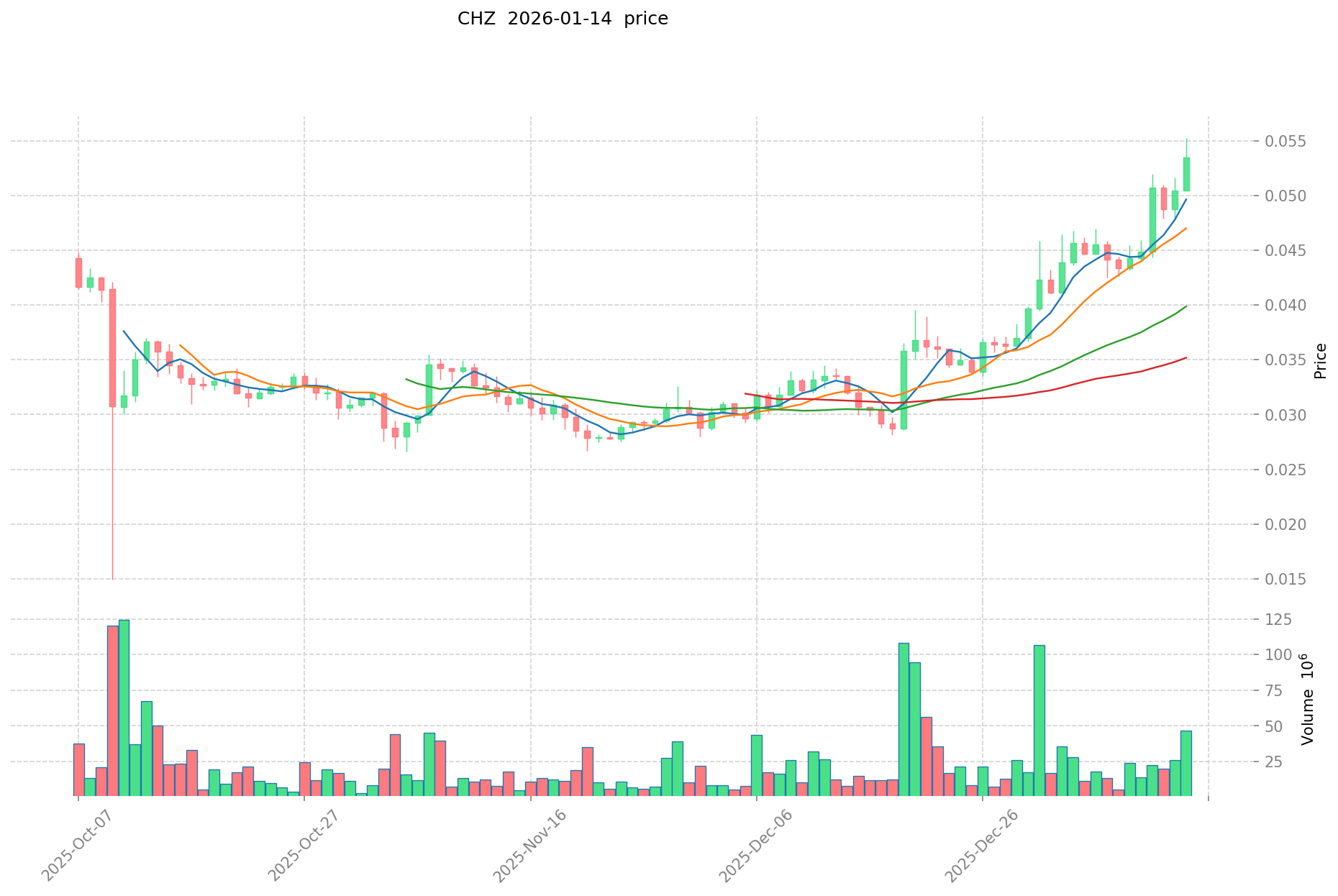
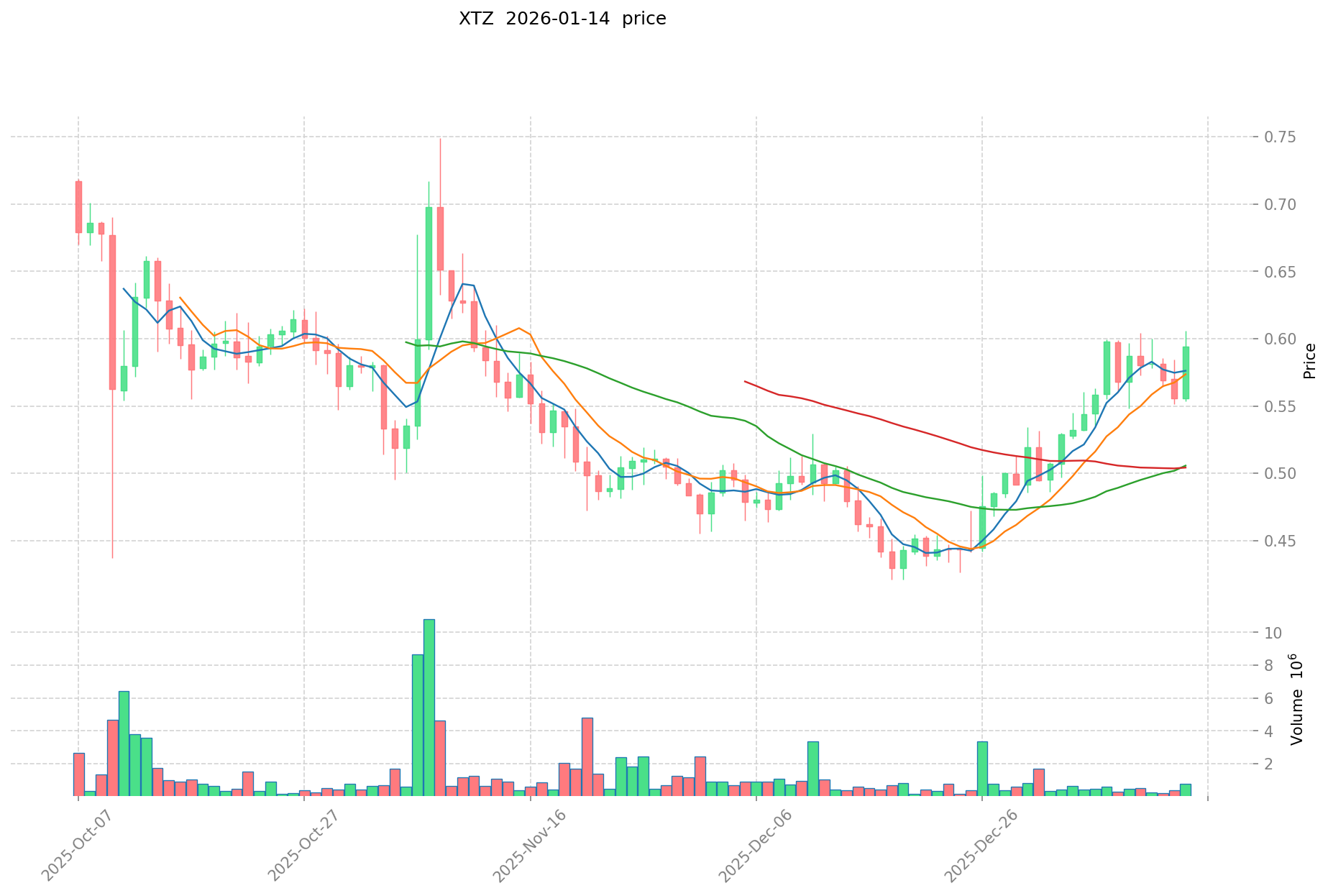
II. Core Factors Influencing CHZ vs XTZ Investment Value
Supply Mechanism Comparison (Tokenomics)
- CHZ: The token supply mechanism may be influenced by issuance policies, where monitoring the specific pace of token issuance—monthly issuance volume and allocation distribution—becomes relevant for assessing potential value dilution.
- XTZ: The supply dynamics are shaped by the protocol's staking and inflation mechanisms, which affect token circulation and holder incentives.
- 📌 Historical patterns: Supply mechanisms can contribute to price cycle variations, with issuance policies and staking models potentially influencing market dynamics over time.
Institutional Adoption and Market Application
- Institutional holdings: Market data suggests varying levels of institutional interest in both assets, influenced by factors such as ecosystem maturity and regulatory clarity.
- Enterprise adoption: CHZ focuses on sports industry digitalization and fan engagement platforms, while XTZ has seen exploration in areas including institutional blockchain applications.
- National policies: Regulatory approaches toward both tokens differ across jurisdictions, affecting their adoption potential in various markets.
Technology Development and Ecosystem Building
- CHZ technology development: The value proposition is tied to the progress of sports industry digitalization and the expansion of fan token platforms.
- XTZ technology evolution: Technical innovation and protocol upgrades represent key factors in the ecosystem's development trajectory.
- Ecosystem comparison: CHZ emphasizes sports-related applications and fan engagement mechanisms, while XTZ has explored DeFi and institutional blockchain use cases.
Macroeconomic Environment and Market Cycles
- Inflation environment performance: Market sentiment and macroeconomic trends influence both assets, with investor confidence playing a role in price movements.
- Macroeconomic monetary policy: Interest rate trends and broader market conditions can affect both CHZ and XTZ valuations.
- Geopolitical factors: Market developments and regulatory shifts across different regions may influence the adoption and trading patterns of both tokens.
III. 2026-2031 Price Forecast: CHZ vs XTZ
Short-term Forecast (2026)
- CHZ: Conservative $0.043-0.055 | Optimistic $0.055-0.070
- XTZ: Conservative $0.468-0.585 | Optimistic $0.585-0.620
Mid-term Forecast (2028-2029)
- CHZ may enter a consolidation phase with projected price range of $0.049-0.093
- XTZ may enter an expansion phase with projected price range of $0.600-0.986
- Key drivers: institutional capital inflows, ETF developments, ecosystem growth
Long-term Forecast (2030-2031)
- CHZ: Base scenario $0.058-0.082 | Optimistic scenario $0.104-0.108
- XTZ: Base scenario $0.745-1.069 | Optimistic scenario $1.251-1.283
View detailed price predictions for CHZ and XTZ
Disclaimer
CHZ:
| Year |
Predicted High Price |
Predicted Average Price |
Predicted Low Price |
Price Change |
| 2026 |
0.0700151 |
0.05513 |
0.0430014 |
0 |
| 2027 |
0.068829805 |
0.06257255 |
0.0581924715 |
14 |
| 2028 |
0.07752738945 |
0.0657011775 |
0.04861887135 |
20 |
| 2029 |
0.0930985685175 |
0.071614283475 |
0.04941385559775 |
30 |
| 2030 |
0.107886918055087 |
0.08235642599625 |
0.057649498197375 |
50 |
| 2031 |
0.103682622507978 |
0.095121672025668 |
0.058975436655914 |
73 |
XTZ:
| Year |
Predicted High Price |
Predicted Average Price |
Predicted Low Price |
Price Change |
| 2026 |
0.619676 |
0.5846 |
0.46768 |
0 |
| 2027 |
0.87912148 |
0.602138 |
0.38536832 |
3 |
| 2028 |
0.8369116062 |
0.74062974 |
0.5999100894 |
27 |
| 2029 |
0.985963341375 |
0.7887706731 |
0.646791951942 |
35 |
| 2030 |
1.251187480204875 |
0.8873670072375 |
0.7453882860795 |
52 |
| 2031 |
1.283132692465425 |
1.069277243721187 |
0.983735064223492 |
83 |
IV. Investment Strategy Comparison: CHZ vs XTZ
Long-term vs Short-term Investment Strategies
- CHZ: May appeal to investors focused on sports industry digitalization and fan engagement platform growth, with consideration of the token's utility within the Socios.com ecosystem and potential expansion of sports-related applications.
- XTZ: May attract investors interested in blockchain infrastructure developments and self-amending protocol capabilities, with attention to institutional blockchain applications and the evolving DeFi ecosystem.
Risk Management and Asset Allocation
- Conservative investors: CHZ 30% vs XTZ 70% - This allocation reflects a greater emphasis on the more established blockchain infrastructure of XTZ while maintaining exposure to CHZ's sports sector positioning.
- Aggressive investors: CHZ 55% vs XTZ 45% - This strategy accounts for CHZ's recent 30-day performance of 68.45% and its lower price point, balanced against XTZ's broader ecosystem applications.
- Hedging tools: Stablecoin allocation for liquidity management, consideration of derivatives instruments where available, and cross-asset portfolio diversification.
V. Potential Risk Comparison
Market Risk
- CHZ: Market dynamics are influenced by the adoption pace of fan tokens and sports industry digitalization trends, with price movements showing correlation to developments in the sports entertainment sector. The 24-hour trading volume of $2,488,135.29 suggests active trading activity, though market depth may vary during periods of volatility.
- XTZ: Market performance is affected by broader blockchain infrastructure adoption trends and institutional interest patterns. The 24-hour trading volume of $490,198.06 indicates varying liquidity conditions, with price movements potentially influenced by protocol developments and ecosystem expansion.
Technical Risk
- CHZ: Network scalability considerations relate to the expansion of fan token platforms and the ability to support growing user engagement across multiple sports organizations.
- XTZ: Technical considerations include the ongoing evolution of the self-amending protocol mechanism and the network's capacity to absorb innovations while maintaining security through formal verification processes.
Regulatory Risk
- Global regulatory frameworks may affect both assets differently based on their distinct use cases. CHZ's focus on fan engagement and sports applications may face regulatory considerations specific to digital asset utility and consumer protection. XTZ's positioning as a blockchain infrastructure platform may be subject to regulatory approaches governing smart contract platforms and institutional blockchain applications. Regulatory clarity varies across jurisdictions, potentially influencing adoption patterns in different markets.
VI. Conclusion: Which Is the Better Buy?
📌 Investment Value Summary:
- CHZ advantages: Positioned within the sports industry digitalization trend with a specific utility focus on fan engagement platforms; demonstrated recent price momentum with a 30-day gain of 68.45%; lower price point at $0.05475 may appeal to certain investment strategies; active trading volume of $2,488,135.29 suggests market interest.
- XTZ advantages: Established blockchain infrastructure with self-amending protocol capabilities; longer operational history since 2017; higher market capitalization ranking at 117th position; formal verification features may attract institutional consideration; price of $0.5813 reflects different market positioning.
✅ Investment Recommendations:
- Novice investors: Consider starting with smaller position sizes and focusing on understanding the distinct use cases of each asset. Prioritize risk management through portfolio diversification and avoid concentration in single assets. Monitor market conditions and current sentiment indicators (Fear & Greed Index: 48 - Neutral) before making allocation decisions.
- Experienced investors: Evaluate both assets within the context of broader portfolio strategy, considering the correlation between sports industry trends (CHZ) and blockchain infrastructure developments (XTZ). Monitor ecosystem growth metrics, technological developments, and institutional adoption patterns for informed decision-making.
- Institutional investors: Assess both assets based on specific investment mandates and risk frameworks. Consider factors including liquidity profiles, regulatory compliance requirements across jurisdictions, and alignment with institutional investment criteria. Evaluate the maturity of each ecosystem and the sustainability of their respective value propositions.
⚠️ Risk Warning: The cryptocurrency market exhibits high volatility. This analysis does not constitute investment advice. Market conditions can change rapidly, and past performance does not guarantee future results. Investors should conduct thorough due diligence, consider their risk tolerance, and consult with qualified financial advisors before making investment decisions.
VII. FAQ
Q1: What are the primary differences between CHZ and XTZ in terms of their core use cases?
CHZ is primarily a utility token focused on sports fan engagement through the Socios.com platform, enabling fans to participate in team management decisions and access exclusive content. XTZ, in contrast, operates as a blockchain infrastructure platform with self-amending protocol capabilities and formal verification features, designed for institutional applications and DeFi ecosystems. The fundamental distinction lies in CHZ's sports entertainment specialization versus XTZ's broader blockchain infrastructure positioning.
Q2: How do the supply mechanisms of CHZ and XTZ differ, and what implications does this have for investors?
CHZ's supply mechanism is influenced by issuance policies tied to the expansion of fan token platforms and partnership agreements with sports organizations, where monitoring monthly issuance volume becomes relevant for assessing potential value dilution. XTZ employs a staking-based inflation model where network participants can earn rewards through delegation, with the protocol's self-amending nature allowing governance-driven adjustments to inflation parameters. These distinct mechanisms mean CHZ holders should monitor platform expansion rates, while XTZ holders should focus on staking participation and protocol governance decisions.
Q3: Which asset demonstrates stronger institutional adoption potential based on current market data?
Based on the reference materials, XTZ shows characteristics more aligned with institutional adoption considerations, including longer operational history since 2017, formal verification capabilities for security-critical applications, and exploration in institutional blockchain use cases. CHZ's institutional appeal stems from partnerships within the sports industry and fan engagement sector. However, the 24-hour trading volume comparison ($2,488,135.29 for CHZ vs $490,198.06 for XTZ) suggests varying levels of market liquidity, with institutional preference potentially influenced by specific use case requirements and regulatory compliance frameworks across jurisdictions.
Q4: How have CHZ and XTZ performed during recent market cycles, and what does this indicate about their volatility profiles?
CHZ reached its all-time high of $0.878633 in March 2021 and subsequently declined to its historical low of $0.00410887, demonstrating high volatility with a price range exceeding 200x between extremes. XTZ peaked at $9.12 in October 2021 and fell to $0.350476 at its lowest point, showing a volatility range of approximately 26x. The current 30-day performance shows CHZ gaining 68.45% compared to XTZ's 20.75%, suggesting CHZ exhibits greater short-term price momentum but also potentially higher risk. This volatility differential indicates that CHZ may appeal to traders seeking higher risk-reward profiles, while XTZ presents relatively more stable price movements.
Q5: What key factors should investors monitor when deciding between CHZ and XTZ allocations?
For CHZ, critical monitoring factors include: expansion of sports partnerships and fan token adoption rates, platform user growth metrics, developments in sports industry digitalization trends, and regulatory clarity regarding fan engagement tokens. For XTZ, key indicators include: protocol upgrade implementations, institutional blockchain adoption progress, DeFi ecosystem growth metrics, staking participation rates, and governance proposal outcomes. Additionally, both assets warrant monitoring of broader market conditions reflected in the Fear & Greed Index (currently 48 - Neutral), macroeconomic trends affecting crypto markets, and regulatory developments across major jurisdictions.
Q6: How do the price predictions for 2026-2031 differ between CHZ and XTZ, and what assumptions underlie these forecasts?
The price forecasts project CHZ reaching $0.043-0.070 in 2026 and $0.058-0.108 by 2031 under various scenarios, representing potential growth of 7-97% from current levels. XTZ forecasts range from $0.468-0.620 in 2026 to $0.745-1.283 by 2031, indicating potential growth of -19% to 121%. These predictions assume continued ecosystem development, with CHZ dependent on sports industry digitalization acceleration and XTZ relying on institutional blockchain adoption expansion. Key assumptions include sustained crypto market growth cycles, technological innovation progress, favorable regulatory environments, and macroeconomic stability. Investors should note that these are model-based projections subject to significant uncertainty and actual outcomes may vary substantially.
Q7: What risk management approach should different investor types adopt when considering CHZ versus XTZ?
Conservative investors are recommended a 30% CHZ / 70% XTZ allocation, reflecting greater emphasis on XTZ's established blockchain infrastructure while maintaining exposure to CHZ's sports sector positioning. This approach prioritizes capital preservation and lower volatility through XTZ's relatively stable ecosystem. Aggressive investors may consider 55% CHZ / 45% XTZ, accounting for CHZ's recent 68.45% 30-day performance and growth potential in sports tokenization, balanced against XTZ's broader applications. Both strategies should incorporate stablecoin allocations for liquidity management, implement stop-loss mechanisms appropriate to individual risk tolerance, and maintain portfolio diversification beyond these two assets. Institutional investors require additional considerations including compliance frameworks, liquidity depth assessment, and alignment with investment mandate restrictions.
Q8: Given current market conditions and the Fear & Greed Index at 48 (Neutral), which asset presents a more compelling entry point?
At the current neutral market sentiment (Fear & Greed Index: 48), neither asset presents obvious overvaluation or undervaluation extremes, suggesting a balanced entry environment. CHZ at $0.05475 (93.8% below its all-time high) may appeal to investors seeking exposure to sports industry digitalization with substantial recovery potential, particularly given its recent 68.45% 30-day gain indicating momentum. XTZ at $0.5813 (93.6% below its peak) offers entry into established blockchain infrastructure with institutional application potential. The decision should consider individual investment timeframes: short-term traders might favor CHZ's current momentum and higher volatility, while long-term investors may prefer XTZ's established ecosystem and relatively lower volatility profile. Both assets warrant position-sizing appropriate to overall portfolio risk tolerance and should be evaluated within broader crypto market cycle positioning.
* The information is not intended to be and does not constitute financial advice or any other recommendation of any sort offered or endorsed by Gate.