This comprehensive guide compares COMP and FIL, two leading blockchain assets representing distinct market segments. COMP functions as a governance token for decentralized lending protocols on Ethereum, while FIL powers a decentralized storage network rewarding miners for capacity contributions. The article analyzes historical price trends, tokenomics differences, institutional adoption patterns, and current market positioning, providing detailed investment analysis for diverse investor profiles. Real-time pricing data via Gate exchange shows COMP at $26.95 and FIL at $1.564, with respective 24-hour volumes of $104,538.16 and $4,400,666.99. The guide presents tiered investment strategies across conservative, aggressive, and institutional allocations, alongside risk assessments covering market, technical, and regulatory factors. Price forecasts through 2031, risk management frameworks, and specific recommendations for novice, experienced, and institutional investors enable readers to evaluate which asset align
Introduction: Investment Comparison Between COMP and FIL
In the cryptocurrency market, the comparison between COMP vs FIL has always been a topic that investors cannot avoid. The two not only have obvious differences in market cap ranking, application scenarios, and price performance, but also represent different positioning in the crypto asset space.
COMP (Compound): Launched in 2020, it has gained market recognition as a decentralized money market protocol built on the Ethereum blockchain.
FIL (Filecoin): Since its launch in 2020, it has been recognized as a decentralized storage solution, rewarding miners for contributing idle hard disk capacity through a unique proof-of-work algorithm.
This article will comprehensively analyze the investment value comparison between COMP vs FIL, focusing on historical price trends, supply mechanisms, institutional adoption, technical ecosystems, and future predictions, attempting to answer the question investors care about most:
"Which is the better buy right now?"
I. Historical Price Comparison and Current Market Status
COMP and FIL Historical Price Trends
- 2021: COMP reached its all-time high of $910.54 in May 2021, reflecting strong market interest during the DeFi summer period.
- 2021: FIL achieved its historical peak of $236.84 in April 2021, demonstrating significant momentum during the broader cryptocurrency bull market.
- Comparative Analysis: During the market correction cycle, COMP declined from its peak of $910.54 to a low of $22.89 (recorded in October 2025), representing a substantial drawdown. FIL experienced a similar trajectory, falling from $236.84 to $0.848008 (also in October 2025), showing comparable volatility patterns across both assets.
Current Market Position (2026-01-15)
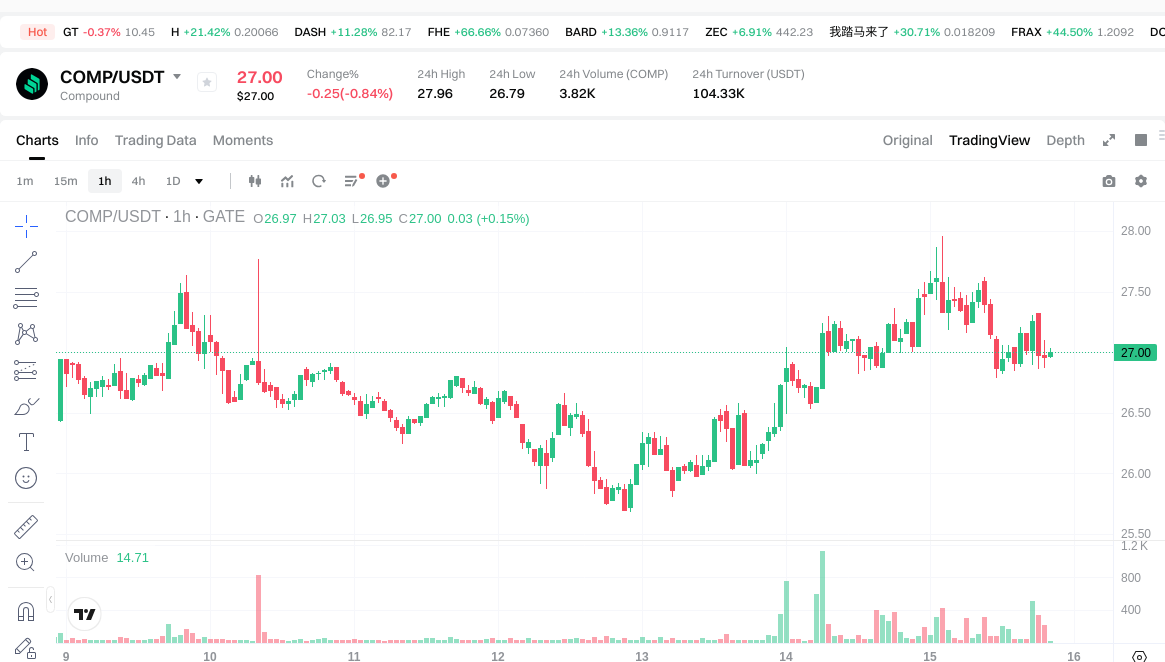
- COMP Current Price: $26.95
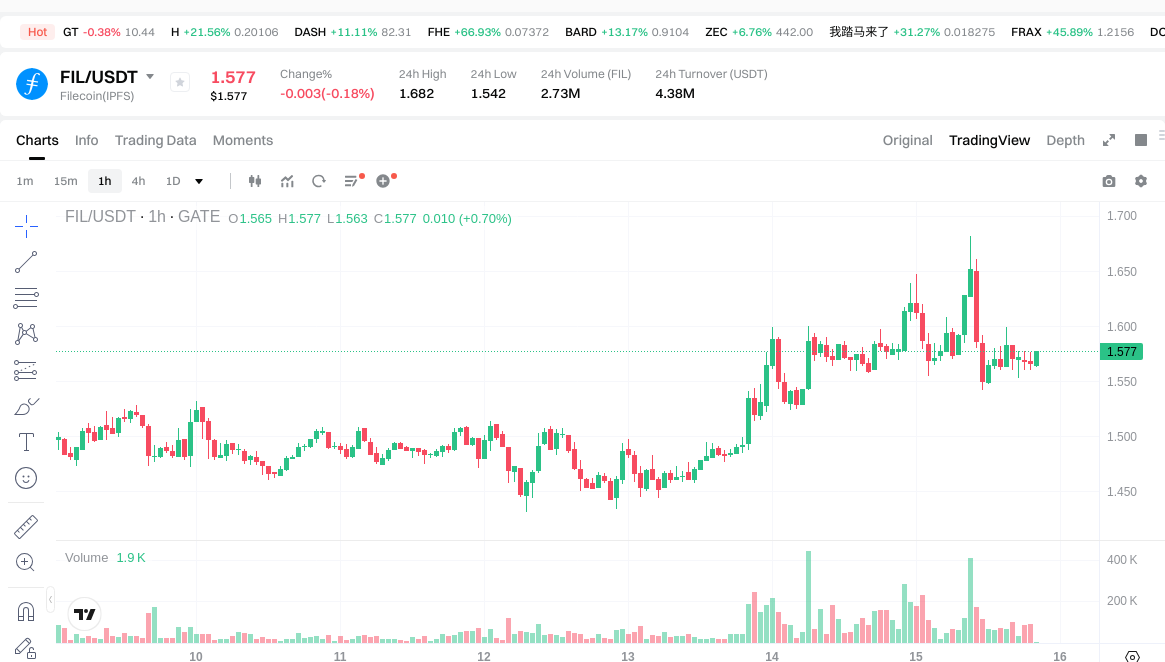
- FIL Current Price: $1.564
- 24-Hour Trading Volume: COMP at $104,538.16 vs FIL at $4,400,666.99
- Market Sentiment Index (Fear & Greed Index): 61 (Greed)
View real-time prices:
II. Core Factors Influencing COMP vs FIL Investment Value
Supply Mechanism Comparison (Tokenomics)
- COMP: COMP employs a distribution model where tokens are allocated to protocol users through liquidity mining and governance participation, creating ongoing supply dynamics tied to platform activity.
- FIL: FIL features a block reward mechanism where tokens are minted and distributed to storage miners who provide network capacity, with rewards decreasing over time according to a predefined schedule.
- 📌 Historical Pattern: Supply mechanisms have demonstrated influence on price cycles, with distribution models affecting token availability and market liquidity over different timeframes.
Institutional Adoption and Market Application
- Institutional Holdings: Both assets have attracted varying levels of institutional interest, though adoption patterns differ based on use case alignment and regulatory clarity.
- Enterprise Adoption: COMP serves primarily in decentralized lending protocols within DeFi ecosystems, while FIL targets decentralized storage solutions for data management and archival needs.
- Regulatory Landscape: Different jurisdictions have taken varied approaches to crypto asset regulation, affecting market access and institutional participation for both tokens.
Technology Development and Ecosystem Building
- COMP Technology Evolution: The Compound protocol continues to develop governance mechanisms and lending market functionalities that may influence token utility and demand.
- FIL Technology Development: Filecoin network focuses on storage capacity expansion, retrieval performance improvements, and integration capabilities that shape its competitive positioning.
- Ecosystem Comparison: COMP operates within DeFi lending markets and governance frameworks, while FIL participates in decentralized storage and data preservation applications, representing distinct value propositions.
Macroeconomic Environment and Market Cycles
- Performance During Inflationary Periods: Asset correlation with inflation varies based on market perception, adoption trajectory, and fundamental utility during different economic conditions.
- Monetary Policy Impact: Interest rate adjustments and currency strength fluctuations can influence risk appetite and capital allocation across digital asset categories.
- Geopolitical Considerations: Cross-border transaction demands and international developments may affect adoption rates and market sentiment for blockchain-based financial and storage solutions.
III. 2026-2031 Price Forecast: COMP vs FIL
Short-term Forecast (2026)
- COMP: Conservative $21.57-$26.96 | Optimistic $26.96-$33.97
- FIL: Conservative $0.99-$1.58 | Optimistic $1.58-$2.19
Mid-term Forecast (2028-2029)
- COMP may enter a consolidation phase, with projected price range of $19.97-$41.24
- FIL may enter a growth phase, with projected price range of $1.22-$2.54
- Key drivers: institutional capital inflows, ETF developments, ecosystem expansion
Long-term Forecast (2030-2031)
- COMP: Baseline scenario $26.09-$40.13 | Optimistic scenario $40.13-$58.59
- FIL: Baseline scenario $1.39-$2.78 | Optimistic scenario $2.78-$3.28
View detailed price predictions for COMP and FIL
Disclaimer
COMP:
| Year |
Predicted High Price |
Predicted Average Price |
Predicted Low Price |
Price Change |
| 2026 |
33.9696 |
26.96 |
21.568 |
0 |
| 2027 |
39.60424 |
30.4648 |
28.027616 |
13 |
| 2028 |
40.6400432 |
35.03452 |
19.9696764 |
29 |
| 2029 |
41.242636944 |
37.8372816 |
31.404943728 |
40 |
| 2030 |
40.72615805016 |
39.539959272 |
35.5859633448 |
46 |
| 2031 |
58.5942656451768 |
40.13305866108 |
26.086488129702 |
48 |
FIL:
| Year |
Predicted High Price |
Predicted Average Price |
Predicted Low Price |
Price Change |
| 2026 |
2.19203 |
1.577 |
0.99351 |
0 |
| 2027 |
1.94105045 |
1.884515 |
1.5829926 |
20 |
| 2028 |
2.31446709725 |
1.912782725 |
1.224180944 |
22 |
| 2029 |
2.53634989335 |
2.113624911125 |
1.96567116734625 |
35 |
| 2030 |
3.231732489110125 |
2.3249874022375 |
1.3949924413425 |
48 |
| 2031 |
3.278464735895098 |
2.778359945673812 |
2.472740351649693 |
77 |
IV. Investment Strategy Comparison: COMP vs FIL
Long-term vs Short-term Investment Strategies
- COMP: Suitable for investors focused on DeFi lending protocol participation and governance utility, with interest in decentralized financial infrastructure development over extended timeframes.
- FIL: Suitable for investors interested in decentralized storage infrastructure and data preservation applications, with focus on storage network adoption and capacity expansion trends.
Risk Management and Asset Allocation
- Conservative Investors: COMP 30% vs FIL 70% - Conservative allocation may favor FIL's infrastructure positioning while maintaining COMP exposure for DeFi sector participation.
- Aggressive Investors: COMP 60% vs FIL 40% - Aggressive allocation may emphasize COMP's governance token dynamics and DeFi market positioning alongside FIL storage network growth potential.
- Hedging Instruments: Stablecoin allocation, options strategies, cross-asset portfolio diversification
V. Potential Risk Comparison
Market Risk
- COMP: Exposure to DeFi lending market dynamics, protocol competition, and governance mechanism evolution affecting token demand and liquidity patterns.
- FIL: Exposure to decentralized storage market adoption rates, miner participation economics, and competition from alternative storage solutions affecting network value.
Technical Risk
- COMP: Scalability considerations related to Ethereum network capacity, protocol security mechanisms, and smart contract functionality dependencies.
- FIL: Storage network capacity expansion challenges, proof mechanism complexity, and miner infrastructure concentration affecting network resilience.
Regulatory Risk
- Global regulatory frameworks may affect both assets differently based on classification approaches, with lending protocols and storage networks facing distinct compliance considerations across jurisdictions.
VI. Conclusion: Which Is the Better Buy?
📌 Investment Value Summary:
- COMP Advantages: Participation in established DeFi lending protocol with governance utility, integration within Ethereum ecosystem, and exposure to decentralized finance market segment.
- FIL Advantages: Positioning in decentralized storage infrastructure market, potential alignment with data preservation needs, and participation in storage capacity network economics.
✅ Investment Recommendations:
- Novice Investors: Consider starting with diversified exposure across both assets while understanding distinct use cases, beginning with smaller position sizes to gain familiarity with DeFi and storage network dynamics.
- Experienced Investors: Evaluate allocation based on sector preference between DeFi lending protocols and decentralized storage infrastructure, considering technical developments and adoption trajectories for strategic positioning.
- Institutional Investors: Assess alignment with portfolio mandates regarding DeFi infrastructure versus storage network exposure, considering regulatory clarity, liquidity requirements, and sector allocation strategies.
⚠️ Risk Disclosure: Cryptocurrency markets exhibit substantial volatility. This content does not constitute investment advice.
VII. FAQ
Q1: What are the main differences between COMP and FIL in terms of their use cases?
COMP serves as a governance token for decentralized lending protocols within the DeFi ecosystem, while FIL functions as the utility token for a decentralized storage network. COMP allows holders to participate in protocol governance and earn rewards through liquidity provision in money markets built on Ethereum. In contrast, FIL incentivizes miners to provide storage capacity and enables users to pay for decentralized data storage and retrieval services. These fundamental differences mean COMP targets the financial services sector of blockchain applications, whereas FIL addresses data storage and preservation needs.
Q2: How do the supply mechanisms of COMP and FIL differ, and what impact does this have on price dynamics?
COMP utilizes a distribution model tied to protocol activity, allocating tokens to users through liquidity mining and governance participation, creating supply dynamics linked to platform usage. FIL employs a block reward mechanism with decreasing emissions over time, distributing tokens to storage miners who contribute network capacity. These different tokenomics affect price behavior: COMP's supply responds to DeFi market activity and lending demand, while FIL's supply follows a predetermined schedule tied to mining economics and storage capacity expansion. Both mechanisms influence token availability and market liquidity differently across various market cycles.
Q3: Which asset has better short-term growth potential in 2026?
Based on conservative forecasts for 2026, COMP shows a projected price range of $21.57-$26.96 (conservative) to $26.96-$33.97 (optimistic), while FIL projects $0.99-$1.58 (conservative) to $1.58-$2.19 (optimistic). From a percentage growth perspective relative to current prices, both assets present similar upside potential in their optimistic scenarios. However, short-term performance will depend heavily on sector-specific developments: DeFi lending market dynamics and governance participation for COMP, versus decentralized storage adoption rates and miner economics for FIL. Market sentiment (currently at 61 on the Fear & Greed Index) and broader cryptocurrency market conditions will also significantly influence short-term price action for both assets.
Q4: What are the primary risks investors should consider when comparing COMP vs FIL?
For COMP, key risks include exposure to DeFi lending market volatility, competition from alternative lending protocols, Ethereum network scalability limitations, smart contract vulnerabilities, and regulatory uncertainty surrounding decentralized financial services. For FIL, primary risks encompass decentralized storage market adoption challenges, miner participation economics and potential centralization, storage network capacity constraints, proof mechanism complexity, and competition from both centralized cloud storage providers and alternative decentralized storage solutions. Both assets face general cryptocurrency market risks including regulatory developments across different jurisdictions, macroeconomic conditions affecting risk appetite, and technological evolution within their respective sectors.
Q5: How should different investor profiles allocate between COMP and FIL?
Conservative investors might consider a 30% COMP / 70% FIL allocation, favoring FIL's infrastructure positioning in the growing data storage market while maintaining COMP exposure for DeFi sector participation. Aggressive investors could adopt a 60% COMP / 40% FIL allocation, emphasizing COMP's governance dynamics and established position in DeFi lending markets alongside FIL's storage network growth potential. Novice investors should start with smaller, diversified positions in both assets to gain familiarity with DeFi and storage network dynamics before increasing exposure. Institutional investors should evaluate allocation based on portfolio mandates, regulatory clarity in their jurisdictions, liquidity requirements, and strategic sector preferences between decentralized finance infrastructure and storage networks.
Q6: What institutional adoption trends differentiate COMP from FIL?
COMP benefits from integration within established DeFi protocols and financial applications, attracting institutions interested in decentralized lending and yield generation strategies. Its position within the Ethereum ecosystem provides exposure to smart contract-based financial services that some institutions are exploring for treasury management and liquidity provision. FIL targets institutional use cases focused on decentralized data storage, archival solutions, and content delivery networks, appealing to organizations seeking alternatives to centralized cloud storage providers. The regulatory landscape affects both differently: COMP faces scrutiny related to securities classification and DeFi lending activities, while FIL encounters considerations around data storage regulations and cross-border data transfer compliance. Enterprise adoption patterns reflect these distinctions, with COMP seeing usage in financial protocol integrations and FIL in storage infrastructure deployments.
Q7: How do macroeconomic conditions affect COMP and FIL differently?
Macroeconomic factors impact both assets through distinct channels. COMP's performance correlates with broader DeFi market activity, which tends to respond to interest rate environments, inflation expectations, and risk appetite for yield-seeking strategies. During periods of monetary tightening and rising interest rates, traditional fixed-income alternatives may compete with DeFi lending yields, potentially affecting COMP demand. FIL's performance relates more directly to data storage demand trends, enterprise digitization rates, and infrastructure investment cycles. Inflationary periods may influence both through cryptocurrency market sentiment and adoption trajectories. Geopolitical developments can affect COMP through cross-border DeFi usage and regulatory responses, while FIL may see impact from data sovereignty concerns and decentralized storage demand in regions with internet infrastructure challenges or censorship concerns.
Q8: What technical developments could significantly impact the relative value of COMP vs FIL by 2031?
For COMP, critical technical developments include Ethereum scaling solutions (Layer 2 implementations, sharding), DeFi protocol innovations in lending mechanisms, governance framework evolution, cross-chain interoperability improvements, and integration with institutional financial infrastructure. These could enhance COMP's utility and demand within expanding DeFi ecosystems. For FIL, key technical factors include storage capacity scaling capabilities, retrieval performance improvements, proof mechanism optimizations reducing miner costs, integration with Web3 applications and content delivery networks, and competitive positioning against both centralized cloud providers and alternative decentralized storage solutions. Long-term forecasts through 2031 project COMP at $26.09-$58.59 and FIL at $1.39-$3.28, with actual outcomes heavily dependent on successful execution of technical roadmaps, ecosystem adoption rates, and ability to capture value within their respective market segments.
* The information is not intended to be and does not constitute financial advice or any other recommendation of any sort offered or endorsed by Gate.