This comprehensive analysis compares CTK (Shentu) and TRX (TRON), two leading blockchain networks with distinct market positioning. CTK, launched in October 2020, focuses on blockchain security infrastructure following its 2021 rebranding from CertiK, while TRX, established in June 2017, serves as a major blockchain infrastructure platform with broader ecosystem applications. The comparison examines critical investment factors including historical price performance, current market status, supply mechanisms, institutional adoption, and technology development. CTK ranks 619th with $38.33 million market capitalization and limited liquidity, while TRX ranks 8th globally with $29.06 billion market cap and significantly higher trading volume. Price predictions through 2031 suggest both assets show growth potential, though TRX demonstrates greater stability and market resilience. Investment recommendations distinguish between conservative investors favoring TRX's established position and aggressive investors willing
Introduction: Investment Comparison Between CTK and TRX
In the cryptocurrency market, the comparison between CTK vs TRX has consistently been a topic investors cannot avoid. The two differ significantly in market cap ranking, application scenarios, and price performance, representing distinct positioning within the crypto asset landscape.
Shentu (CTK): Launched in October 2020, it has gained market recognition through its security-oriented positioning. Originally known as CertiK, it was upgraded and rebranded as Shentu Chain Token in September 2021.
TRON (TRX): Since its launch in June 2017, it has been recognized as a major blockchain infrastructure platform and ranks among the cryptocurrencies with substantial global trading volume and market capitalization.
This article will comprehensively analyze the investment value comparison of CTK vs TRX around historical price trends, supply mechanisms, institutional adoption, technical ecosystems, and future forecasts, attempting to answer the question most investors care about:
"Which is the better buy right now?"
I. Historical Price Comparison and Current Market Status
Historical Price Trends of CTK (Coin A) and TRX (Coin B)
-
2020: CTK launched in October with an initial price of 0.77 USD, marking its entry into the blockchain security infrastructure market.
-
2021: CTK experienced significant growth during the broader cryptocurrency bull market, reaching an all-time high of 3.94 USD on April 7, 2021, driven by increased demand for blockchain security solutions.
-
2021: In September, CertiK underwent a rebranding to Shentu Chain, maintaining the CTK token designation while expanding its cross-chain compatibility features.
-
2017-2018: TRX launched in July 2017 at 0.0015 USD and experienced substantial growth during the 2017-2018 cryptocurrency market expansion.
-
2022: TRX entered the decentralized stablecoin era in May with the launch of USDD, supported by the TRON DAO Reserve, representing a strategic expansion into the stablecoin ecosystem.
-
2022: In October, Dominica designated TRON as its official national blockchain infrastructure, establishing TRX as a public chain collaborating with a sovereign nation.
-
2024: TRX reached its all-time high of 0.431288 USD on December 4, 2024, reflecting growing adoption and ecosystem development.
-
2025: CTK recorded its all-time low of 0.211993 USD on June 23, 2025, representing a significant decline from its 2021 peak.
-
Comparative Analysis: During market cycles, CTK declined from its high of 3.94 USD to a low of 0.211993 USD, representing a substantial decrease. In contrast, TRX demonstrated resilience with a relatively smaller drawdown percentage from its all-time high, maintaining stronger price stability across market cycles.
Current Market Status (January 20, 2026)
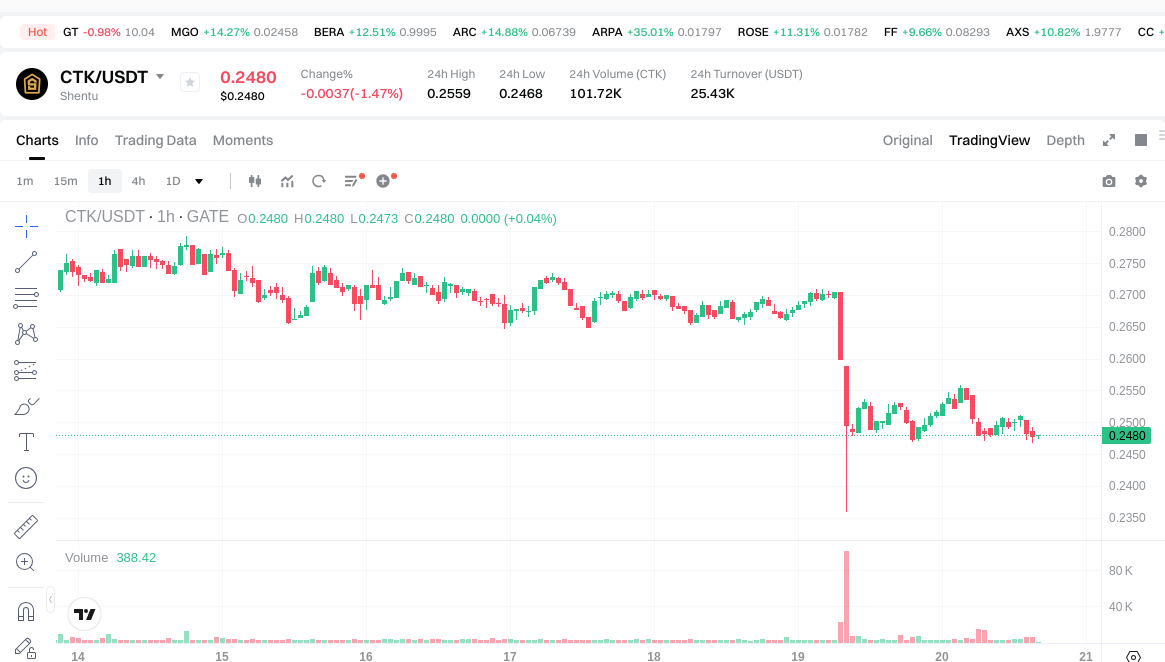
- CTK current price: 0.2479 USD
- TRX current price: 0.30679 USD
- 24-hour trading volume: CTK recorded 25,461.13 USD compared to TRX's 4,121,007.28 USD, indicating significantly higher liquidity for TRX.
- Market capitalization: CTK's circulating market cap stands at 38.33 million USD (ranking 619), while TRX maintains a substantially larger market cap of 29.06 billion USD (ranking 8).
- 24-hour price changes: CTK decreased by 1.82%, while TRX declined by 3.05%.
- Market Sentiment Index (Fear & Greed Index): 32 (Fear)
View real-time prices:
- View CTK current price Market Price
- View TRX current price Market Price

II. Core Factors Influencing CTK vs TRX Investment Value
Supply Mechanism Comparison (Tokenomics)
Due to insufficient reference materials regarding the supply mechanisms of CTK and TRX, this section cannot provide detailed tokenomics analysis at this time.
Institutional Adoption and Market Applications
Without sufficient data on institutional holdings, enterprise adoption patterns, or regulatory stances toward CTK and TRX across different jurisdictions, a comparative analysis of their market applications cannot be established based on available materials.
Technology Development and Ecosystem Construction
The reference materials do not contain information regarding recent technical upgrades, development roadmaps, or ecosystem activities for either CTK or TRX. Consequently, comparisons related to DeFi integration, NFT infrastructure, payment solutions, or smart contract implementations cannot be substantiated.
Macroeconomic Factors and Market Cycles
Analysis of how CTK and TRX perform under varying macroeconomic conditions—including inflationary environments, monetary policy shifts, interest rate fluctuations, and geopolitical developments—cannot be conducted due to the absence of relevant historical performance data in the provided materials.
III. 2026-2031 Price Prediction: CTK vs TRX
Short-term Prediction (2026)
- CTK: Conservative $0.225225 - $0.2475 | Optimistic $0.2475 - $0.264825
- TRX: Conservative $0.2240589 - $0.30693 | Optimistic $0.30693 - $0.3591081
Mid-term Prediction (2028-2029)
- CTK may enter a growth phase with estimated price range of $0.169541150625 - $0.37243465875 in 2028, potentially reaching $0.195111291375 - $0.34144475990625 in 2029
- TRX may enter an expansion phase with estimated price range of $0.213098890095 - $0.5485323282075 in 2028, potentially reaching $0.334821765372412 - $0.674359330257112 in 2029
- Key drivers: institutional capital inflows, ETF developments, ecosystem expansion
Long-term Prediction (2030-2031)
- CTK: Baseline scenario $0.290050819830646 - $0.38164581556664 | Optimistic scenario $0.333315122765625 - $0.511405392859298
- TRX: Baseline scenario $0.621557466277931 - $0.647455694039512 | Optimistic scenario $0.572969640742931 - $0.82226873143018
View detailed price predictions for CTK and TRX
Disclaimer
CTK:
| Year |
Predicted High Price |
Predicted Average Price |
Predicted Low Price |
Price Change |
| 2026 |
0.264825 |
0.2475 |
0.225225 |
0 |
| 2027 |
0.299710125 |
0.2561625 |
0.17931375 |
3 |
| 2028 |
0.37243465875 |
0.2779363125 |
0.169541150625 |
12 |
| 2029 |
0.34144475990625 |
0.325185485625 |
0.195111291375 |
31 |
| 2030 |
0.429976508367656 |
0.333315122765625 |
0.309983064172031 |
34 |
| 2031 |
0.511405392859298 |
0.38164581556664 |
0.290050819830646 |
53 |
TRX:
| Year |
Predicted High Price |
Predicted Average Price |
Predicted Low Price |
Price Change |
| 2026 |
0.3591081 |
0.30693 |
0.2240589 |
0 |
| 2027 |
0.4562360985 |
0.33301905 |
0.306377526 |
8 |
| 2028 |
0.5485323282075 |
0.39462757425 |
0.213098890095 |
28 |
| 2029 |
0.674359330257112 |
0.47157995122875 |
0.334821765372412 |
53 |
| 2030 |
0.721941747336093 |
0.572969640742931 |
0.423997534149769 |
86 |
| 2031 |
0.82226873143018 |
0.647455694039512 |
0.621557466277931 |
111 |
IV. Investment Strategy Comparison: CTK vs TRX
Long-term vs Short-term Investment Strategies
- CTK: More suitable for investors focused on blockchain security infrastructure and willing to accept higher volatility. Given its smaller market capitalization of 38.33 million USD and ranking at 619, CTK presents characteristics of a smaller-cap asset with potential growth opportunities but accompanied by elevated risk levels.
- TRX: More appropriate for investors seeking established blockchain infrastructure with demonstrated market resilience. With a market capitalization of 29.06 billion USD and ranking 8th globally, TRX offers relatively greater liquidity and market stability compared to CTK.
Risk Management and Asset Allocation
- Conservative investors: CTK 15-20% vs TRX 80-85% allocation may be considered, prioritizing the more established asset with higher liquidity
- Aggressive investors: CTK 40-50% vs TRX 50-60% allocation could provide exposure to both established infrastructure and emerging security-focused blockchain projects
- Hedging instruments: Stablecoin allocation, options strategies, and cross-asset portfolio diversification
V. Potential Risk Comparison
Market Risk
- CTK: Exhibits higher price volatility, having declined from an all-time high of 3.94 USD to a low of 0.211993 USD. The current 24-hour trading volume of 25,461.13 USD indicates limited liquidity, which may result in increased price slippage during larger transactions.
- TRX: Demonstrates relatively lower volatility compared to CTK, with a 24-hour trading volume of 4,121,007.28 USD providing substantially greater market liquidity. However, TRX remains subject to broader cryptocurrency market cycles and sentiment fluctuations, as evidenced by the current Fear & Greed Index reading of 32.
Technical Risk
- CTK: As a security-focused blockchain infrastructure, CTK's value proposition depends on continued adoption of its security solutions and successful cross-chain compatibility implementation following the 2021 Shentu Chain rebranding.
- TRX: Technical risks include network scalability challenges and maintaining decentralization while supporting growing transaction volumes across its ecosystem.
Regulatory Risk
- Global regulatory developments may impact both assets differently based on their positioning and use cases. CTK's focus on blockchain security infrastructure and TRX's establishment as national blockchain infrastructure in Dominica present distinct regulatory profiles that investors should monitor across different jurisdictions.
VI. Conclusion: Which Is the Better Buy?
📌 Investment Value Summary:
- CTK advantages: Positioned in the blockchain security infrastructure sector, which addresses growing demand for security solutions. Following the 2021 rebranding to Shentu Chain, CTK offers cross-chain compatibility features.
- TRX advantages: Established market position with ranking of 8th by market capitalization, significantly higher liquidity with 24-hour trading volume exceeding 4 million USD, and demonstrated ecosystem development including stablecoin infrastructure and national blockchain infrastructure adoption.
✅ Investment Recommendations:
- Novice investors: May consider TRX as an entry point due to its established market position, higher liquidity, and relatively lower volatility compared to CTK. The larger market capitalization provides greater price stability during market fluctuations.
- Experienced investors: Could explore portfolio diversification by allocating between both assets based on risk tolerance, with TRX serving as a core holding and CTK as a smaller allocation for exposure to blockchain security infrastructure.
- Institutional investors: May evaluate TRX for its established ecosystem, substantial trading volume, and proven market resilience across multiple market cycles since 2017.
⚠️ Risk Warning: The cryptocurrency market exhibits extreme volatility. This content does not constitute investment advice. Investors should conduct thorough research and assess their risk tolerance before making investment decisions.
VII. FAQ
Q1: What is the main difference between CTK and TRX in terms of market positioning?
CTK (Shentu) is primarily positioned as a blockchain security infrastructure platform, while TRX (TRON) functions as a comprehensive blockchain infrastructure platform with broader ecosystem applications. CTK focuses specifically on security solutions and cross-chain compatibility following its 2021 rebranding from CertiK, targeting the growing demand for blockchain security services. In contrast, TRX has established itself as a major public blockchain with diverse use cases including decentralized applications, stablecoin infrastructure (USDD), and even national blockchain infrastructure adoption in Dominica. The market capitalization difference is substantial: CTK ranks 619th with $38.33 million market cap, while TRX ranks 8th globally with $29.06 billion market cap, reflecting their different scales of adoption and market recognition.
Q2: Which cryptocurrency has better liquidity: CTK or TRX?
TRX demonstrates significantly superior liquidity compared to CTK. As of January 20, 2026, TRX's 24-hour trading volume stands at $4,121,007.28 USD, while CTK's 24-hour trading volume is only $25,461.13 USD—approximately 162 times lower. This substantial liquidity difference means TRX offers better price stability, reduced slippage during transactions, and easier entry/exit positions for investors. The higher liquidity of TRX also indicates broader market participation and exchange support, making it more accessible for both retail and institutional investors. For investors prioritizing trade execution efficiency and minimal market impact, TRX presents a clear advantage over CTK.
Q3: How have CTK and TRX performed historically in terms of price stability?
TRX has demonstrated stronger price stability and resilience across market cycles compared to CTK. CTK experienced a dramatic decline from its all-time high of $3.94 USD (April 2021) to a low of $0.211993 USD (June 2025), representing a decrease of approximately 94.6%. In contrast, while TRX also experiences market volatility, it has shown relatively smaller drawdown percentages from its all-time high of $0.431288 USD (December 2024). TRX's longer market presence since June 2017, larger market capitalization, and established ecosystem have contributed to its comparative price stability. CTK's smaller market cap and lower liquidity expose it to greater volatility, making it a higher-risk asset particularly during broader cryptocurrency market downturns.
Q4: What are the price predictions for CTK and TRX through 2031?
For 2026, CTK's conservative prediction ranges from $0.225225 to $0.2475, while optimistic scenarios suggest $0.2475 to $0.264825. TRX's 2026 conservative range is $0.2240589 to $0.30693, with optimistic predictions of $0.30693 to $0.3591081. Looking toward 2031, CTK's baseline scenario estimates $0.290050819830646 to $0.38164581556664, with optimistic scenarios reaching $0.333315122765625 to $0.511405392859298. TRX's 2031 baseline prediction ranges from $0.621557466277931 to $0.647455694039512, with optimistic scenarios of $0.572969640742931 to $0.82226873143018. These predictions suggest TRX may maintain higher absolute price levels through 2031, though both assets show potential for growth. However, these predictions are subject to market conditions, technological developments, and adoption rates.
Q5: Which asset is more suitable for conservative versus aggressive investors?
For conservative investors, TRX represents the more suitable choice due to its established market position (rank 8), substantially higher liquidity ($4.1 million daily volume), and demonstrated resilience across multiple market cycles since 2017. A suggested allocation might be 80-85% TRX with only 15-20% CTK for limited exposure to blockchain security infrastructure. For aggressive investors willing to accept higher volatility and risk, a more balanced allocation of 50-60% TRX and 40-50% CTK could provide exposure to both established blockchain infrastructure and emerging security-focused projects. CTK's smaller market capitalization presents higher growth potential but carries elevated risk due to limited liquidity and greater price volatility. Investment decisions should align with individual risk tolerance and investment timeframes.
Q6: What are the key risk factors investors should consider when choosing between CTK and TRX?
Market risk differs significantly between the two assets. CTK exhibits higher price volatility and limited liquidity ($25,461 daily volume), resulting in increased potential for price slippage and difficulty executing larger transactions. TRX, while also subject to cryptocurrency market cycles, offers substantially greater liquidity and lower volatility. Technical risks include CTK's dependence on continued adoption of blockchain security solutions and successful implementation of cross-chain features, while TRX faces challenges related to network scalability and maintaining decentralization. Regulatory risk affects both assets differently: CTK's security infrastructure positioning and TRX's role as national blockchain infrastructure in Dominica present distinct regulatory profiles. The current market sentiment (Fear & Greed Index: 32) indicates a fearful market environment, suggesting heightened caution for both assets.
Q7: How do institutional adoption patterns differ between CTK and TRX?
While comprehensive institutional adoption data is limited in available materials, market indicators suggest different institutional positioning. TRX's significantly larger market capitalization ($29.06 billion) and daily trading volume ($4.1 million) indicate broader institutional participation compared to CTK. TRX's establishment as national blockchain infrastructure in Dominica (October 2022) and its development of decentralized stablecoin infrastructure (USDD in May 2022) demonstrate institutional-grade use cases. CTK's focus on blockchain security infrastructure appeals to a more specialized institutional segment concerned with security auditing and cross-chain security solutions. The substantial difference in market capitalization and liquidity suggests TRX has achieved greater institutional recognition and adoption, making it potentially more suitable for institutional portfolios seeking established blockchain infrastructure exposure.
Q8: What investment strategy should beginners adopt when considering CTK versus TRX?
Novice investors should consider TRX as a more appropriate entry point into cryptocurrency investment compared to CTK. TRX's established market position (rank 8), higher liquidity, and relatively lower volatility provide a more stable foundation for beginners learning cryptocurrency markets. The substantial daily trading volume of $4.1 million ensures easier transaction execution and better price discovery. For beginners interested in portfolio diversification, a conservative approach might involve allocating 80-90% to TRX and only 10-20% to CTK, allowing limited exposure to blockchain security infrastructure while maintaining stability through the more established asset. Beginners should prioritize understanding market cycles, risk management, and their personal risk tolerance before investing. Both assets remain subject to cryptocurrency market volatility, and investors should only commit capital they can afford to lose while conducting thorough research before making investment decisions.
* The information is not intended to be and does not constitute financial advice or any other recommendation of any sort offered or endorsed by Gate.