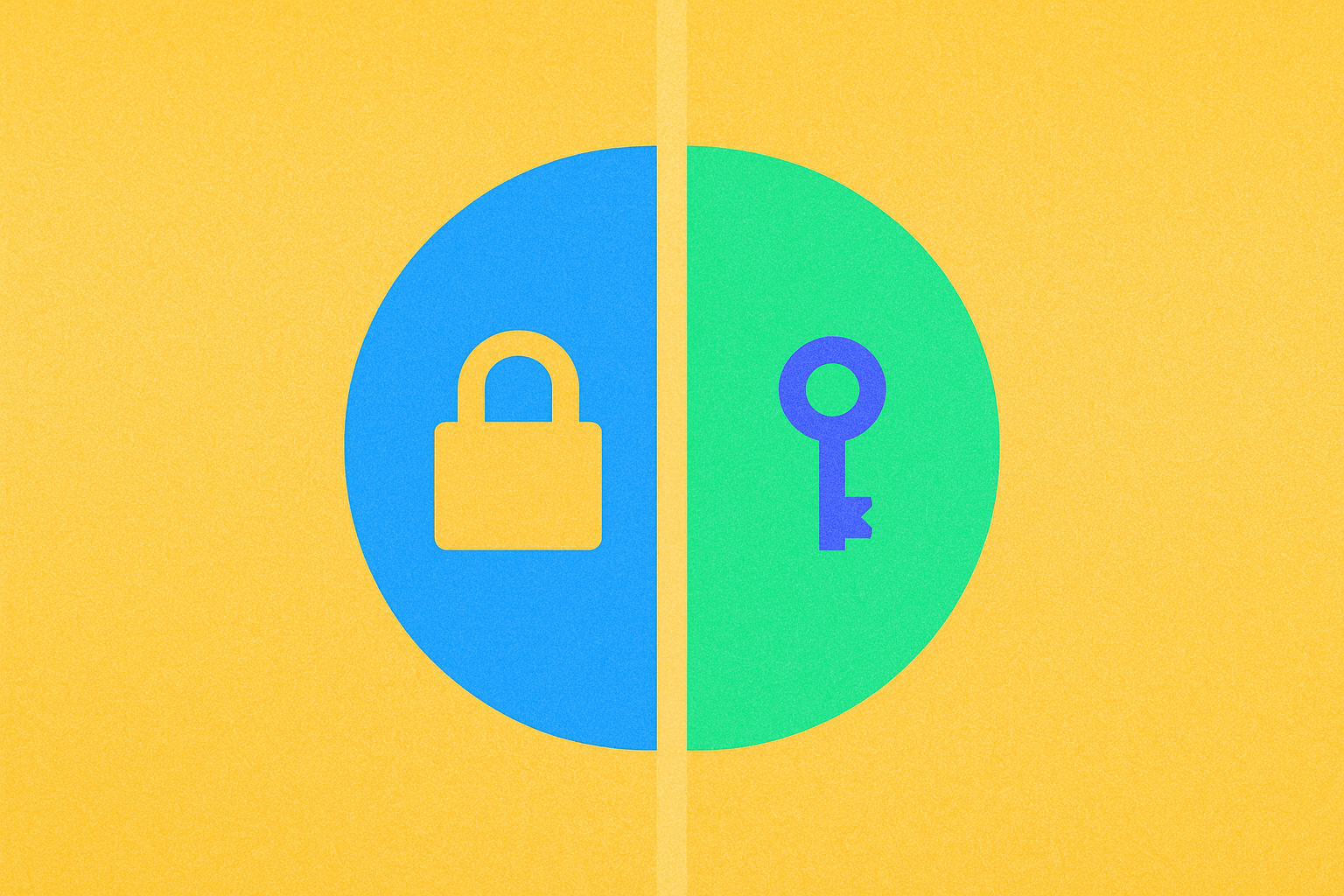
Explore the distinctions between custodial and non-custodial wallets. Assess security, control, and user experience to select the optimal solution for your crypto assets. This complete guide serves both beginners and Web3 investors.
Crypto Wallet Fundamentals
A cryptocurrency wallet does not physically hold your digital coins. Your Bitcoin or Ethereum remain recorded on the blockchain—a decentralized and immutable network. The wallet actually stores your cryptographic keys, which are digital credentials proving ownership of your assets.
There are two fundamental types of keys:
- Public Key: Functions as your wallet address, which you can freely share to receive funds—similar to a bank account number.
- Private Key: Serves as your secret password, proving that you are the true owner of the funds. Whoever holds the private key controls all coins tied to that address.
Wallets are classified by their internet connectivity:
Hot Wallets: Remain online, such as mobile apps or browser extensions. Examples include popular mobile wallet apps and browser extensions. They provide convenient, instant access but face higher cyberattack risks due to constant internet exposure.
Cold Wallets: Kept offline for maximum security:
- Paper Wallets: Physical printouts containing your public and private keys
- Hardware Wallets: Dedicated devices from crypto security specialists that store keys offline, even if briefly connected to a computer
What Is a Custodial Wallet?
A custodial wallet is one in which a third party (the custodian) holds and manages your private keys. You deposit your crypto with an intermediary—typically a crypto exchange or fintech firm—which assumes responsibility for safeguarding both your coins and your keys.
This model mirrors traditional banking: you entrust assets to an institution that manages them for you. The key difference is that, instead of fiat currency, you’re entrusting digital assets.
How Custody Works
-
Registration and Deposit: You open an account on the platform, often submitting identification for KYC (Know Your Customer) verification. When you buy or deposit crypto, your funds are transferred to pooled wallets managed by the provider—not directly to a personal wallet.
-
Fund Usage: To send crypto off-platform, you use the exchange or service interface. The provider signs the transaction using its controlled private keys and broadcasts it to the blockchain.
-
Access and Features: Logging in feels like accessing email or online banking. You view your balances through a dashboard and can use integrated services like trading, staking, or lending.
Advantages of Custodial Wallets
- Easy Recovery and Support: Forgot your password? Customer support can help restore access via identity verification
- Beginner-Friendly Interface: Intuitive design similar to traditional banking apps, with no need to manage complex keys
- Simplified Fiat On-Ramps: Buy crypto directly using credit card, bank transfer, or other standard payment methods
- Professional Security Measures: Providers employ cold storage, insurance, security audits, and dedicated teams
- Trading Convenience: Instant, fee-free transactions within the same platform—no waiting for blockchain confirmation
- Integrated Services: Easy access to staking, lending, crypto cards, and other financial products
Disadvantages of Custodial Wallets
- You Don’t Control Private Keys: Violates Bitcoin’s core principle: not your keys, not your coins
- Counterparty Risk: The provider may go bankrupt, be hacked, or face liquidity issues—your funds could be at risk
- Limited Control: The platform can freeze your account, limit withdrawals, or restrict access without warning
- Reduced Privacy: Your transactions and balances are visible to the provider and potentially regulators
- Platform Restrictions: Limits on which assets you can hold or where you can send funds
- Withdrawal Fees and Limits: Transaction costs, withdrawal fees, and daily/monthly limits may apply
Popular Custodial Wallet Examples
- Major Global Exchanges: US-based platforms known for beginner-friendliness and streamlined fiat purchases
- High-Volume Exchanges: The world’s largest exchange by trading volume, offering a broad range of assets
- Security-Focused Platforms: Well-known exchanges with robust security and regulatory compliance
- Other Platforms: Multiple established services offering custodial wallets with varied features and regional focuses
- Hybrid Custody: Services using Multi-Party Computation (MPC) to split your private key between several parties, reducing single points of failure
What Is a Non-Custodial Wallet?
A non-custodial wallet is one where you alone hold your private keys. You have direct, on-chain ownership of your assets, with no intermediaries. This model embodies the true spirit of crypto decentralization: individual financial sovereignty.
With non-custodial wallets, you’re solely responsible for your funds’ security and management. No company can freeze, seize, or restrict access to your assets. You interact directly with the blockchain, signing transactions with your own private keys.
Can a Non-Custodial Wallet Be Traced?
Non-custodial wallets do not guarantee anonymity. All transactions are permanently visible on public blockchains like Bitcoin and Ethereum. Anyone can view addresses, transferred amounts, and complete transaction history.
The main privacy weakness is linking your wallet to your real identity. The critical point is when you interact with a regulated exchange requiring KYC—then, the exchange knows which wallet belongs to you, creating a permanent link between your identity and blockchain addresses.
You can enhance privacy using tools such as:
- Mixers/Tumblers: Services that mix your coins with others (CoinJoin for Bitcoin, mixing protocols for Ethereum)
- Privacy Coins: Cryptocurrencies focused on anonymity, like Monero or Zcash, which obfuscate senders, recipients, and amounts
Important: Using mixers may mark your funds as suspicious on regulated exchanges, possibly resulting in frozen accounts or denied deposits.
Custodial vs Non-Custodial Wallets: Key Differences
| Feature |
Custodial Wallet |
Non-Custodial Wallet |
| Private Key Control |
Held by third parties |
Held exclusively by the user |
| Access and Recovery |
Password recovery available |
Recovery only via seed phrase |
| Security Responsibility |
Managed by provider |
Completely user-dependent |
| Ease of Use |
Beginner-friendly |
Steeper learning curve |
| KYC and Regulation |
Requires identity verification |
Often anonymous |
| DeFi/Web3 Access |
Limited or restricted |
Full access |
| Risk Profile |
Platform hacks, freezes, insolvency |
User error, seed phrase loss |
| Asset Control |
Provider can freeze funds |
User controls fund movement |
| Examples |
Major centralized exchanges |
Popular software and hardware wallets |
Private Key Ownership and Control
True crypto ownership hinges on who holds your private keys. This is the principle that sets crypto apart from traditional financial systems.
With custodial wallets, you don’t hold the keys—the provider does. Technically, you have a claim or IOU for your crypto balance, not direct control. It’s like money in a bank: you trust the institution to honor your claim but don’t physically own the cash.
Non-custodial wallets offer true ownership. Only the holder of the private key can move the funds. No central authority can freeze, seize, or deny access to your assets. You are truly your own bank.
Security and Risk Trade-Offs
Custodial wallets require trust in a company to secure your crypto. They provide professional security, but become a single point of failure. Even major exchanges have been hacked—millions lost to security breaches over the years.
Custodial risks include:
- Platform hacks: Attackers may compromise exchange systems
- Insolvency risk: The company may fail, freezing withdrawals
- Regulatory action: Governments may order account freezes
- Internal fraud: Employees may abuse privileged access
Non-custodial wallets give you total control, but all security risk falls on you:
- Seed phrase loss: No backup means permanent loss of funds
- Malware and phishing: You may be tricked into revealing keys
- User error: Sending funds to the wrong address is irreversible
- Physical attacks: Devices may be stolen or you may be coerced to transfer funds
Ease of Use and Integration
Custodial wallets are much easier to set up. Registration is familiar: email, password, identity verification. The interface resembles traditional banking apps.
Non-custodial wallets require managing a 12–24 word recovery phrase and understanding blockchain concepts like gas fees, network confirmations, and contract addresses. For newcomers, this can be intimidating.
However, new solutions are closing this usability gap. Modern wallets use facial recognition instead of seed phrases, and some offer social recovery—trusted contacts can help restore access.
Recovery, Backup, and Inheritance
Custodial wallets provide familiar recovery options via customer support. Forgot your password? Answer security questions, verify by email or phone, and regain access. Convenient and reassuring for non-technical users.
Non-custodial wallets do not offer password resets. Losing your seed phrase means permanent, irreversible loss of all funds. No support team can help—this design ensures only you can access your assets.
Inheritance is complex for self-custody. Without careful planning to pass seed phrases safely to heirs, your crypto could be lost after death. Emerging solutions offer "time vaults" that release funds automatically if you’re inactive for a set period.
Regulated custodial wallets require KYC and may restrict service by location. You must prove identity, residence, and sometimes the source of funds. This creates a permanent record tying your identity to your crypto.
Compliance advantages:
- Greater legal protection and regulatory recourse
- Access to regulated financial products
- Higher institutional trust
Disadvantages:
- Reduced privacy
- Possible location-based service denial
- Government transaction surveillance
Non-custodial wallets don’t require identification and allow global access. You can create a wallet instantly, anywhere, with no personal data. However, you are responsible for tax reporting and regulatory compliance.
DeFi, dApps, and Asset Accessibility
Custodial wallets severely restrict what you can do with your crypto. Most exchanges do not permit:
- Joining DeFi protocols (lending, yield farming, liquidity pools)
- Buying/selling NFTs on decentralized marketplaces
- Using Web3 apps and smart contracts
- Participating in decentralized governance
- Receiving token launches or airdrops requiring personal wallets
Non-custodial wallets offer full access to blockchain:
- Connect directly to any DeFi protocol
- Participate in NFT and metaverse marketplaces
- Vote in DAO governance
- Receive airdrops and network rewards
- Try new blockchain apps at launch
Fees, Transaction Speed, and Costs
Custodial wallets often allow instant, free transfers within the platform. If you and a friend use the same exchange, transfers are instant and costless—the exchange only updates internal records, not the blockchain.
But they charge:
- Trading fees: Typically 0.1%–1% per trade
- Withdrawal fees: Fixed or percentage cost to send crypto out
- Spreads: Difference between buy and sell prices
- Fiat conversion fees: Fees for depositing/withdrawing traditional currency
Non-custodial wallets charge network fees for each on-chain transaction. You pay miners or validators to process and confirm your transactions. Fees vary widely:
- Bitcoin: Fees range from cents to tens of dollars based on congestion
- Ethereum: Gas fees can spike during high demand
- Layer 2/alternatives: Much lower fees
Advantage: you pay only network fees, with no intermediaries. Disadvantage: on-chain transactions are never instant—you wait for blockchain confirmations.
How to Choose: Custodial or Non-Custodial?
Risk Tolerance and Asset Size
For large holdings (over $50,000), self-custody with hardware wallets is strongly recommended. The risk of storing substantial amounts on exchanges outweighs the convenience—you become a target for hacks and regulatory action.
For smaller, actively traded amounts, custodial solutions offer greater convenience. If you’re day trading or frequently moving funds, transferring in and out of personal wallets may be impractical.
Many use a hybrid approach:
- Active trading funds: Keep on custodial exchanges for speed
- Significant long-term holdings: Store in cold storage (hardware wallet)
- Daily spending funds: Use a non-custodial mobile wallet
Technical Comfort and Learning Curve
Custodial wallets offer setup similar to banks. If you can use email and online banking, you can use a custodial wallet—no need to understand cryptography or manage complex keys.
Non-custodial wallets require security management and blockchain knowledge:
- Knowing what a seed phrase is and how to protect it
- Verifying contract addresses to avoid scams
- Understanding gas fees and how to adjust them
- Recognizing phishing and malicious sites
Beginner-friendly non-custodial options are closing the gap:
- Mobile wallets with intuitive interfaces
- Social or biometric recovery features
- Integrated anti-phishing protection
Active Trading: Use custodial wallets. The speed and convenience of centralized exchanges outweigh the risks for frequently moved funds.
DeFi Protocols: Use non-custodial wallets. Direct control is required for smart contracts, liquidity, and yield farming.
NFTs: Use non-custodial wallets. NFT marketplaces require connecting your personal wallet to buy, sell, and display tokens.
Long-Term Holding: Use hardware or secure non-custodial wallets. For assets held long-term, cold storage provides maximum security.
Peer-to-Peer Payments: Use non-custodial mobile wallets. For crypto payments to friends or merchants, you need direct control.
Hybrid Approach: The Best of Both Worlds
Divide your holdings by intended use:
-
Custodial Exchange (10–20% of funds): For active trading and quick access to platform services like staking or lending
-
Non-Custodial Mobile Wallet (5–10% of funds): For daily spending, dApps, and Web3 participation
-
Hardware Wallet (70–85% of funds): For long-term holdings and significant savings, stored offline on a dedicated device
Essential security practices:
- Use strong, unique passwords on custodial exchanges
- Enable two-factor authentication (2FA) everywhere
- Protect your seed phrase—write it down and store it securely offline
- Never share your seed phrase digitally or photograph it
- Consider splitting backups across multiple secure locations
Recent Trends and Emerging Models
Regulators are tightening controls with stricter policies. Governments worldwide are introducing frameworks for crypto exchanges, requiring licensing, proof of reserves, and stronger consumer protections.
Technology is blurring traditional lines through:
Multi-Party Computation (MPC) Custody: Splits your private key into fragments held by multiple parties. No one entity can access your funds, but transactions can be authorized collaboratively. This offers non-custodial-level security with custodial convenience.
Ethereum Account Abstraction: Enables smart contracts to act as wallets, unlocking features like:
- Social recovery without seed phrases
- Spending limits and parental controls
- Batch transactions and automation
- Paying gas fees with any token
Mainstream Adoption and Embedded Wallets: Apps and platforms now integrate wallet functionality directly, letting users interact with blockchain without the underlying complexity. Games, social networks, and e-commerce apps automatically create wallets for users.
The future points toward more accessible self-custody with built-in recovery, bridging usability gaps while preserving crypto ownership principles.
Final Thoughts: Non-Custodial vs Custodial Wallets
Custodial wallets offer convenience and easy recovery, but require trust in a third-party platform. You trade control for ease of use—much like traditional banks. They’re ideal for beginners, active traders, and anyone who values convenience over absolute sovereignty.
Non-custodial wallets give you full control with no third-party risk, but demand complete responsibility for security. You’re truly your own bank, with all the freedom and responsibility that entails. They are essential for long-term holdings, DeFi participation, and those who value crypto’s core decentralization principles.
Choose based on your goals:
- Trading convenience: Custodial recommended
- Security and total control: Non-custodial recommended
- DeFi/Web3 access: Requires non-custodial
- Beginner ease of use: Custodial is more accessible
Many experienced users use both—active trading funds on exchanges, savings in personal wallets. This hybrid approach balances convenience and security.
Immediate Action Steps:
- Start small and learn gradually—don’t move everything at once.
- Secure your keys immediately. For non-custodial wallets, write your seed phrase on paper and store securely offline.
- For custodial wallets, use strong, unique passwords and enable two-factor authentication.
- Continuously educate yourself about crypto security and best practices.
- Test small transactions before moving larger amounts.
Remember: in crypto, you are ultimately responsible for your assets. Choose the wallet model that fits your needs, skills, and risk tolerance.
FAQ
What’s the difference between a Custodial Wallet and a Non-Custodial Wallet?
Custodial Wallet: third parties manage your private keys, offering greater security but less control. Non-Custodial Wallet: you have total control over your private keys, with full autonomy over your assets.
Custodial vs Non-Custodial Wallet: Which Is Safer? What Are the Risks?
Non-custodial wallets are safer since you control the private keys; risk: complex management. Custodial wallets are convenient, but risk arises from third-party key management.
Should I choose a custodial or non-custodial wallet for storing crypto assets?
Choose custodial for convenience and daily transactions; go non-custodial for maximum security and large asset storage.
If I lose the private key or recovery phrase for a non-custodial wallet, can I recover my funds?
No. Without your private key or recovery phrase, funds are irretrievable. You bear full responsibility for custody; secure backup is essential and loss is permanent.
What are the advantages of custodial wallets? Why do some people prefer them?
Custodial wallets are easy to use and quick to set up. Many users prefer them for simplified crypto management, password recovery, and a smoother experience for beginners.
Are non-custodial wallets beginner-friendly? What are common operational issues?
Non-custodial wallets require more technical know-how, as you manage your own private keys. Common problems include lost passwords, poor backups, and transfer errors. Learning basic operations first is recommended.
Is an exchange wallet a custodial wallet? Is it safe to store funds on an exchange long-term?
Yes, exchange wallets are custodial. Long-term storage on exchanges is not safe. Use self-custody wallets and keep only trading funds on exchanges.
* The information is not intended to be and does not constitute financial advice or any other recommendation of any sort offered or endorsed by Gate.