This comprehensive analysis compares Convex Finance (CVX) and VeChain (VET) across multiple investment dimensions. CVX operates as a DeFi yield optimization protocol integrated with Curve Finance, featuring a capped supply of 100 million tokens and fee-earning mechanisms through cvxCRV staking. VET functions as an enterprise blockchain token within VeChain's dual-token model, supporting supply chain management and logistics applications with VTHO handling transaction costs. The article examines historical price trends, tokenomics differences, institutional adoption prospects, and technical risk profiles specific to each asset. Key investment considerations include CVX's DeFi infrastructure positioning versus VET's enterprise blockchain focus, regulatory uncertainties in both sectors, and macroeconomic factors affecting different user bases. Detailed price forecasts through 2031 and risk management strategies assist investors in evaluating which asset aligns with their investment objectives and risk tolerance,
Introduction: CVX Investment Value, Price Prediction, and Risk Analysis
In the cryptocurrency market, Convex Finance (CVX) has drawn attention as a DeFi protocol token focused on optimizing yields for Curve Finance users. Since its launch in May 2021, CVX has positioned itself as a key infrastructure component within the Curve ecosystem, enabling users to enhance their CRV rewards through streamlined staking and liquidity provision mechanisms.
CVX serves as the native platform token of Convex Finance. By staking CVX, users can earn platform fees distributed in the form of cvxCRV (tokenized veCRV). The token rewards CRV stakers and Curve.fi liquidity pool participants proportionally based on the CRV generated by the platform. As of January 16, 2026, CVX is ranked 250th by market capitalization, with a circulating supply of approximately 91.26 million tokens out of a maximum supply of 100 million.
This article will provide a comprehensive analysis covering historical price trends, tokenomics, utility within the Convex and Curve ecosystems, and potential risk factors. We aim to address key questions investors often ask:
"What factors influence CVX's value, and what are the associated risks?"
By examining market performance, supply dynamics, and the evolving DeFi landscape, this analysis seeks to offer a balanced perspective on CVX as an investment consideration.
I. Historical Price Comparison and Current Market Status
CVX (Coin A) and VET (Coin B) Historical Price Trends
- 2022: CVX experienced notable price movements following its platform's early growth phase, with prices fluctuating in response to broader DeFi market dynamics.
- 2021: VET saw price variations influenced by enterprise partnerships and blockchain adoption milestones within supply chain management sectors.
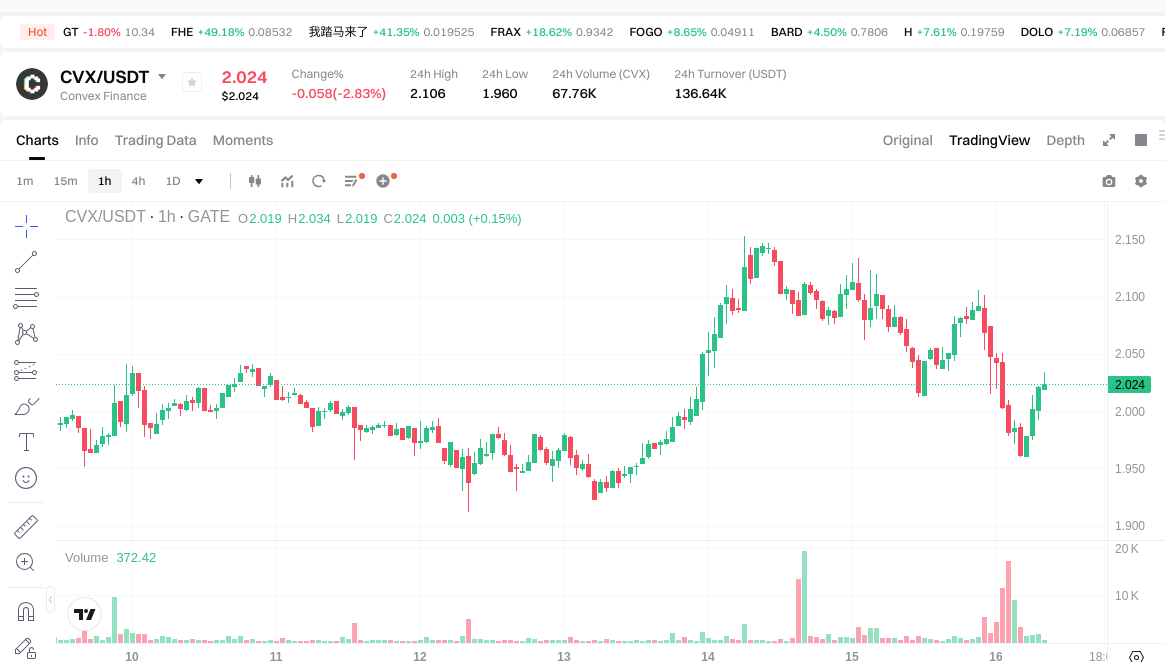
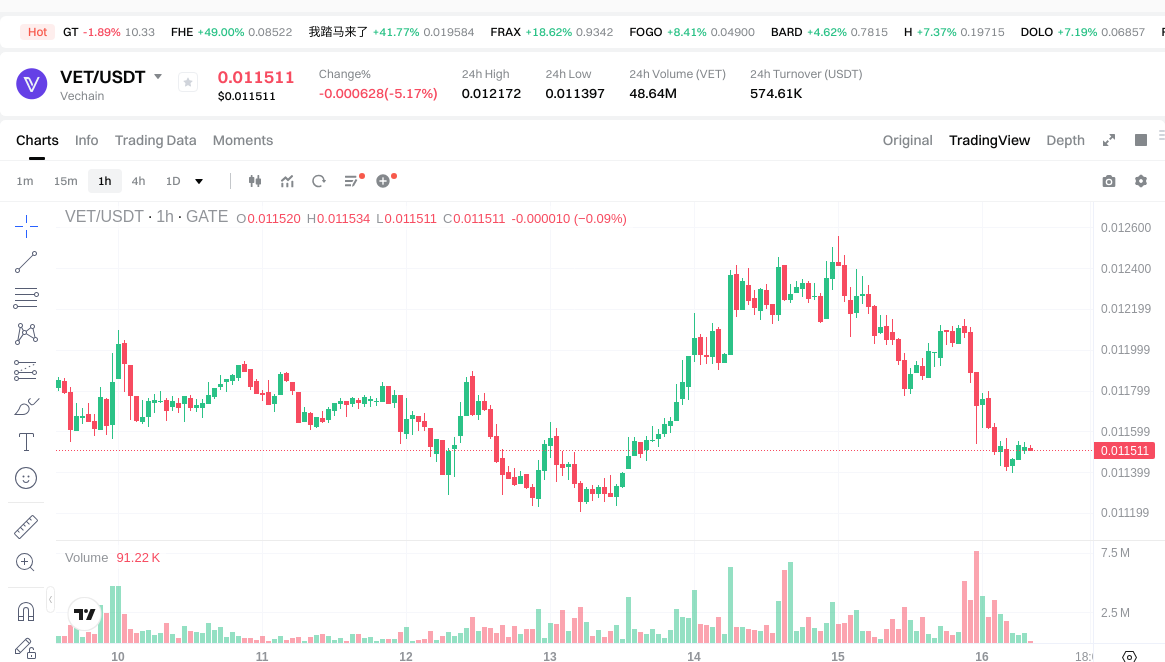
- Comparative analysis: During recent market cycles, CVX has moved from its previous price levels toward its current position around $2.021, while VET has shown movement patterns related to its enterprise blockchain development trajectory.
Current Market Conditions (2026-01-16)
- CVX current price: $2.021
- VET current price: $0.011521
- 24-hour trading volume: CVX $136,156.19 vs VET $574,152.34
- Market Sentiment Index (Fear & Greed Index): 61 (Greed)
Click to view real-time prices:
II. Core Factors Influencing CVX vs VET Investment Value
Supply Mechanism Comparison (Tokenomics)
- CVX: CVX represents stock shares in Chevron Corporation with a traditional equity structure. The company maintains a disciplined capital allocation approach, with 38 consecutive years of dividend growth, reflecting a shareholder-friendly value distribution model.
- VET: VET operates within VeChain's dual-token model, where VET serves as the value token while VTHO functions as the transaction fuel. This model separates value storage from operational costs, creating a unique economic structure for blockchain operations.
- 📌 Historical Pattern: CVX's consistent dividend policy has provided stable returns for long-term shareholders, while VET's tokenomics are designed to support continuous network operations through VTHO generation.
Institutional Adoption and Market Application
- Institutional Holdings: CVX, as a major energy sector entity, enjoys substantial institutional investment due to its industry position and consistent performance. VET's institutional adoption centers on enterprises seeking blockchain-based supply chain solutions.
- Enterprise Application: CVX operates across the energy value chain from upstream exploration to downstream refining. VET's applications focus on supply chain management, logistics tracking, and smart contract implementations in enterprise blockchain solutions.
- Regulatory Environment: CVX operates under established securities regulations as a publicly traded energy company. VET exists within evolving cryptocurrency regulatory frameworks that vary significantly across jurisdictions.
Technology Development and Ecosystem Building
- CVX Technology Progress: Chevron focuses on energy sector innovations, including major project deployments such as the TCO facility in Kazakhstan and the Ballymore project in the Gulf of Mexico. The company targets structural cost savings of 2-3 billion dollars by next year through operational efficiency improvements.
- VET Technology Development: VET forms part of the VeChainThor blockchain infrastructure, with VTHO serving as the functional token for transaction fees, smart contracts, and on-chain operations. This architecture supports the network's operational requirements.
- Ecosystem Comparison: CVX operates within traditional energy markets with established infrastructure. VET's ecosystem includes blockchain applications in supply chain verification, with VTHO playing an essential role in network functionality.
Macroeconomic Factors and Market Cycles
- Performance in Inflationary Environments: CVX, as an energy sector participant, may show correlation with commodity price movements during certain economic conditions. VET's relationship with macroeconomic factors remains tied to broader cryptocurrency market dynamics.
- Macroeconomic Monetary Policy: Interest rate changes and currency movements may influence both assets through different transmission mechanisms - CVX through traditional financial channels and VET through cryptocurrency market flows.
- Geopolitical Considerations: CVX's operations span global energy markets and may be influenced by international energy dynamics. VET's cross-border applications in supply chain management operate within the context of blockchain technology adoption patterns.
III. 2026-2031 Price Forecast: CVX vs VET
Short-term Forecast (2026)
- CVX: Conservative $1.56 - $2.02 | Optimistic $2.02 - $2.33
- VET: Conservative $0.011 - $0.012 | Optimistic $0.012 - $0.016
Mid-term Forecast (2028-2029)
- CVX may enter a growth phase with estimated price range of $1.74 - $3.11
- VET may experience gradual appreciation with estimated price range of $0.010 - $0.020
- Key drivers: institutional capital inflows, ETF developments, ecosystem expansion
Long-term Forecast (2030-2031)
- CVX: Baseline scenario $2.44 - $2.84 | Optimistic scenario $3.59 - $3.69
- VET: Baseline scenario $0.012 - $0.019 | Optimistic scenario $0.019 - $0.024
View detailed price predictions for CVX and VET
Disclaimer
CVX:
| Year |
Predicted High Price |
Predicted Average Price |
Predicted Low Price |
Price Change |
| 2026 |
2.3253 |
2.022 |
1.55694 |
0 |
| 2027 |
2.4562245 |
2.17365 |
1.5432915 |
7 |
| 2028 |
2.824223445 |
2.31493725 |
1.7362029375 |
14 |
| 2029 |
3.109192220475 |
2.5695803475 |
2.20983909885 |
27 |
| 2030 |
3.69120216918375 |
2.8393862839875 |
2.44187220422925 |
40 |
| 2031 |
3.591823649244187 |
3.265294226585625 |
2.775500092597781 |
61 |
VET:
| Year |
Predicted High Price |
Predicted Average Price |
Predicted Low Price |
Price Change |
| 2026 |
0.01565496 |
0.011511 |
0.01116567 |
0 |
| 2027 |
0.0167070654 |
0.01358298 |
0.0123605118 |
17 |
| 2028 |
0.018628377921 |
0.0151450227 |
0.014539221792 |
31 |
| 2029 |
0.020432907375705 |
0.0168867003105 |
0.010300887189405 |
46 |
| 2030 |
0.019406195996826 |
0.018659803843102 |
0.011569078382723 |
61 |
| 2031 |
0.024171909898355 |
0.019032999919964 |
0.013513429943174 |
65 |
IV. Investment Strategy Comparison: CVX vs VET
Long-term vs Short-term Investment Strategies
- CVX: May be suitable for investors seeking exposure to DeFi yield optimization mechanisms and the Curve Finance ecosystem. The token's utility in earning platform fees and governance participation presents characteristics that align with investors evaluating protocol-level infrastructure investments within decentralized finance.
- VET: May be suitable for investors interested in enterprise blockchain applications and supply chain management solutions. The dual-token model and focus on real-world business implementations present characteristics that align with investors evaluating blockchain technology adoption in traditional industries.
Risk Management and Asset Allocation
- Conservative investors: CVX 20-30% vs VET 20-30%, with remaining allocation to established cryptocurrencies and stablecoins
- Aggressive investors: CVX 40-50% vs VET 30-40%, with selective exposure to emerging DeFi protocols
- Hedging instruments: stablecoin allocation for liquidity management, options strategies where available, cross-asset portfolio diversification across different blockchain sectors
V. Potential Risk Comparison
Market Risks
- CVX: Token value may be influenced by overall DeFi market conditions, Curve Finance protocol performance, competitive dynamics within yield optimization platforms, and broader cryptocurrency market sentiment. The relatively concentrated focus on Curve ecosystem creates dependency on that protocol's continued adoption and functionality.
- VET: Token value may be influenced by enterprise blockchain adoption rates, competition from alternative supply chain solutions, broader cryptocurrency market conditions, and the pace of real-world business integration. The dual-token model introduces complexity in understanding value accrual mechanisms.
Technical Risks
- CVX: Protocol dependency on Curve Finance infrastructure, smart contract vulnerabilities in staking mechanisms, potential changes to tokenomics or fee distribution models, and scalability considerations as the platform grows.
- VET: Network performance requirements for enterprise applications, VTHO generation and consumption dynamics, potential technical limitations in scaling blockchain operations, and smart contract execution reliability across diverse use cases.
Regulatory Risks
Global regulatory developments may affect both assets differently. CVX operates within DeFi protocols that face evolving regulatory frameworks around decentralized financial services, token classifications, and yield-generating mechanisms. VET's enterprise-focused applications may encounter regulations related to supply chain data management, cross-border blockchain operations, and compliance requirements in traditional industries. Regulatory clarity remains uncertain across multiple jurisdictions for both cryptocurrency categories.
VI. Conclusion: Which Is the Better Buy?
📌 Investment Value Summary:
- CVX advantages: Integration within the Curve Finance ecosystem, fee-earning mechanisms through cvxCRV, defined tokenomics with capped supply at 100 million tokens, and positioning within DeFi yield optimization infrastructure.
- VET advantages: Enterprise blockchain applications in supply chain management, dual-token economic model separating value storage from operational costs, established partnerships in logistics and verification sectors, and real-world business use case focus.
✅ Investment Considerations:
- Beginning investors: Consider starting with smaller position sizes in either asset, focus on understanding the underlying protocols and ecosystems, maintain diversification across different cryptocurrency sectors, and prioritize risk management through stablecoin allocations.
- Experienced investors: May evaluate protocol fundamentals, tokenomics sustainability, competitive positioning within respective sectors, and correlation with broader market cycles when determining allocation strategies between DeFi infrastructure and enterprise blockchain applications.
- Institutional investors: Assessment may include protocol governance structures, liquidity depth for position management, regulatory risk profiles across jurisdictions, and alignment with portfolio mandates regarding DeFi versus enterprise blockchain exposure.
⚠️ Risk Disclosure: Cryptocurrency markets exhibit significant volatility. This analysis does not constitute investment advice. Market conditions, technical developments, and regulatory environments may change materially. Individuals should conduct independent research and consider personal risk tolerance before making investment decisions.
VII. FAQ
Q1: What is the primary difference between CVX and VET in terms of their core utility?
CVX serves as a DeFi protocol token focused on yield optimization within the Curve Finance ecosystem, while VET functions as an enterprise blockchain token designed for supply chain management solutions. CVX enables users to enhance CRV rewards through streamlined staking mechanisms and earn platform fees distributed as cvxCRV. By staking CVX, holders receive a proportional share of fees generated from the Convex platform's operations. In contrast, VET operates within VeChain's dual-token model where VET stores value while VTHO handles transaction costs, separating economic value from operational functionality. This fundamental difference means CVX targets DeFi yield seekers, while VET serves enterprises implementing blockchain-based logistics and verification systems.
Q2: How do the tokenomics of CVX and VET differ in terms of supply mechanisms?
CVX has a fixed maximum supply of 100 million tokens with approximately 91.26 million currently in circulation as of January 16, 2026, creating a deflationary supply model with clear scarcity. VET utilizes a dual-token economic structure where VET generates VTHO for network operations, effectively separating value storage from transaction fuel. CVX's capped supply means no additional tokens will be created beyond the 100 million limit, potentially creating upward price pressure as demand increases. VET's model continuously produces VTHO tokens, which are consumed during network operations including smart contracts and transaction processing, creating a self-sustaining operational economy designed to support ongoing enterprise blockchain activities.
Q3: Which asset faces greater regulatory uncertainty?
Both CVX and VET face regulatory uncertainty, but through different channels. CVX operates within the DeFi sector, which faces evolving regulatory frameworks around decentralized financial services, token classifications, yield-generating mechanisms, and potential securities law implications across multiple jurisdictions. Regulatory bodies worldwide are actively developing policies for DeFi protocols, creating ongoing uncertainty. VET encounters regulations related to enterprise blockchain applications, supply chain data management, cross-border operations, and compliance requirements when integrating with traditional industries. While VET's enterprise focus may provide some regulatory clarity through established business frameworks, both assets operate in jurisdictions with varying cryptocurrency policies. Neither asset has achieved comprehensive global regulatory clarity, making this a shared risk factor requiring ongoing monitoring.
Q4: What are the key technical risks associated with each token?
CVX faces technical risks centered on its dependency on Curve Finance infrastructure, including smart contract vulnerabilities in staking mechanisms, potential changes to fee distribution models, and scalability challenges as the platform expands. Since CVX's value proposition relies heavily on the Curve ecosystem's continued functionality and adoption, any technical failures or exploits within Curve could materially impact CVX. VET's technical risks involve network performance requirements for enterprise applications, the complexity of VTHO generation and consumption dynamics, potential limitations in scaling blockchain operations for high-volume enterprise use cases, and smart contract execution reliability across diverse industrial implementations. VET must maintain consistent performance standards to meet enterprise-grade requirements, as supply chain applications demand high reliability and minimal downtime.
Q5: How might macroeconomic conditions differently affect CVX and VET?
CVX's performance correlates primarily with DeFi market dynamics, cryptocurrency adoption cycles, and investor appetite for yield-generating protocols, making it more sensitive to broader crypto market sentiment and liquidity conditions. During risk-off periods in cryptocurrency markets, DeFi tokens like CVX typically experience heightened volatility. VET's price movements relate to enterprise blockchain adoption rates, traditional business investment cycles, and corporate technology spending patterns, which may follow different timing compared to pure cryptocurrency market cycles. VET could potentially show relative resilience during crypto market downturns if enterprise adoption continues, while CVX may benefit more strongly during DeFi expansion phases. Both assets remain influenced by overall cryptocurrency market conditions, but through different transmission mechanisms reflecting their distinct use cases and target user bases.
Q6: What are the institutional adoption prospects for CVX versus VET?
CVX's institutional adoption centers on DeFi-focused funds, cryptocurrency hedge funds, and investment vehicles seeking exposure to yield optimization infrastructure within the Curve ecosystem. Institutional interest depends on regulatory clarity around DeFi protocols, smart contract security assurances, and the maturation of decentralized finance as an asset class. VET's institutional pathway involves enterprises implementing blockchain solutions for supply chain verification, logistics tracking, and business process optimization. Corporate adoption requires meeting enterprise-grade standards for reliability, compliance, and integration capabilities. VET may attract institutional capital through traditional business channels as companies allocate budgets toward digital transformation initiatives, while CVX appeals to institutions specifically targeting cryptocurrency and DeFi exposure. The adoption timelines and drivers differ significantly between these institutional pathways.
Q7: Which token presents better liquidity characteristics for portfolio management?
As of January 16, 2026, CVX shows 24-hour trading volume of $136,156.19 compared to VET's $574,152.34, indicating VET currently demonstrates higher trading activity. However, liquidity assessment requires examining multiple factors including exchange availability, order book depth, bid-ask spreads, and market impact for larger transactions. CVX's ranking at 250th by market capitalization with approximately 91.26 million tokens in circulation may present liquidity constraints for substantial position adjustments. VET's higher trading volume suggests more active market participation, potentially offering better execution for portfolio rebalancing. Institutional investors managing larger positions should evaluate liquidity across multiple exchanges and time periods, as single-day volume metrics may not reflect consistent trading conditions. Both tokens may experience liquidity variations during volatile market periods.
Q8: What investment timeframe best suits each asset based on their development trajectories?
CVX may be more suitable for medium to long-term investment horizons (2-5 years) as DeFi infrastructure matures and the Curve ecosystem potentially expands. The token's utility in fee generation and governance participation represents value that may accrue over time as platform usage grows. Short-term price movements may reflect broader DeFi market volatility rather than fundamental protocol developments. VET's enterprise blockchain applications suggest a longer-term investment perspective (3-7 years) aligned with typical enterprise technology adoption cycles, which progress gradually as businesses implement, test, and scale blockchain solutions. VET's value realization may correlate with sustained enterprise integration rather than rapid price appreciation. Both tokens face near-term volatility from cryptocurrency market cycles, but their underlying value propositions operate on different timescales reflecting their distinct target markets and adoption pathways.
* The information is not intended to be and does not constitute financial advice or any other recommendation of any sort offered or endorsed by Gate.