This comprehensive comparison analyzes CYS and GRT as leading blockchain infrastructure platforms for investors. CYS, launched in December 2025, positions itself as ComputeFi infrastructure leveraging hardware acceleration and ZK proof systems, currently trading at $0.5286. The Graph (GRT), operating since 2020 as a decentralized data indexing protocol for Ethereum, trades at $0.04341. The article examines historical price trends, tokenomics, institutional adoption, technical ecosystems, and 2026-2031 price forecasts. CYS demonstrates early-stage momentum with volatility potential, while GRT offers established infrastructure with proven operational history. The analysis addresses investment strategies for different investor profiles, risk management approaches, and regulatory considerations, providing investors with detailed insights to evaluate both blockchain assets within diversified portfolio frameworks.
Introduction: Investment Comparison Between CYS and GRT
In the cryptocurrency market, the comparison between CYS vs GRT has become an increasingly relevant topic for investors. These two assets differ significantly in market cap ranking, application scenarios, and price performance, representing distinct positioning within the crypto asset landscape.
Cysic (CYS): Launched in 2025, it has gained market recognition by positioning itself as ComputeFi infrastructure that transforms global computing resources into verifiable, tokenized on-chain assets through hardware acceleration and ZK proof systems.
The Graph (GRT): Since its launch in 2020, it has been recognized as a decentralized protocol for indexing and querying blockchain data, primarily applied to Ethereum, making data queries simple and accessible through open APIs.
This article will comprehensively analyze the investment value comparison between CYS vs GRT around historical price trends, supply mechanisms, institutional adoption, technical ecosystems, and future predictions, attempting to answer the question investors care about most:
"Which is the better buy right now?"
I. Historical Price Comparison and Current Market Status
Historical Price Trends of CYS (Coin A) and GRT (Coin B)
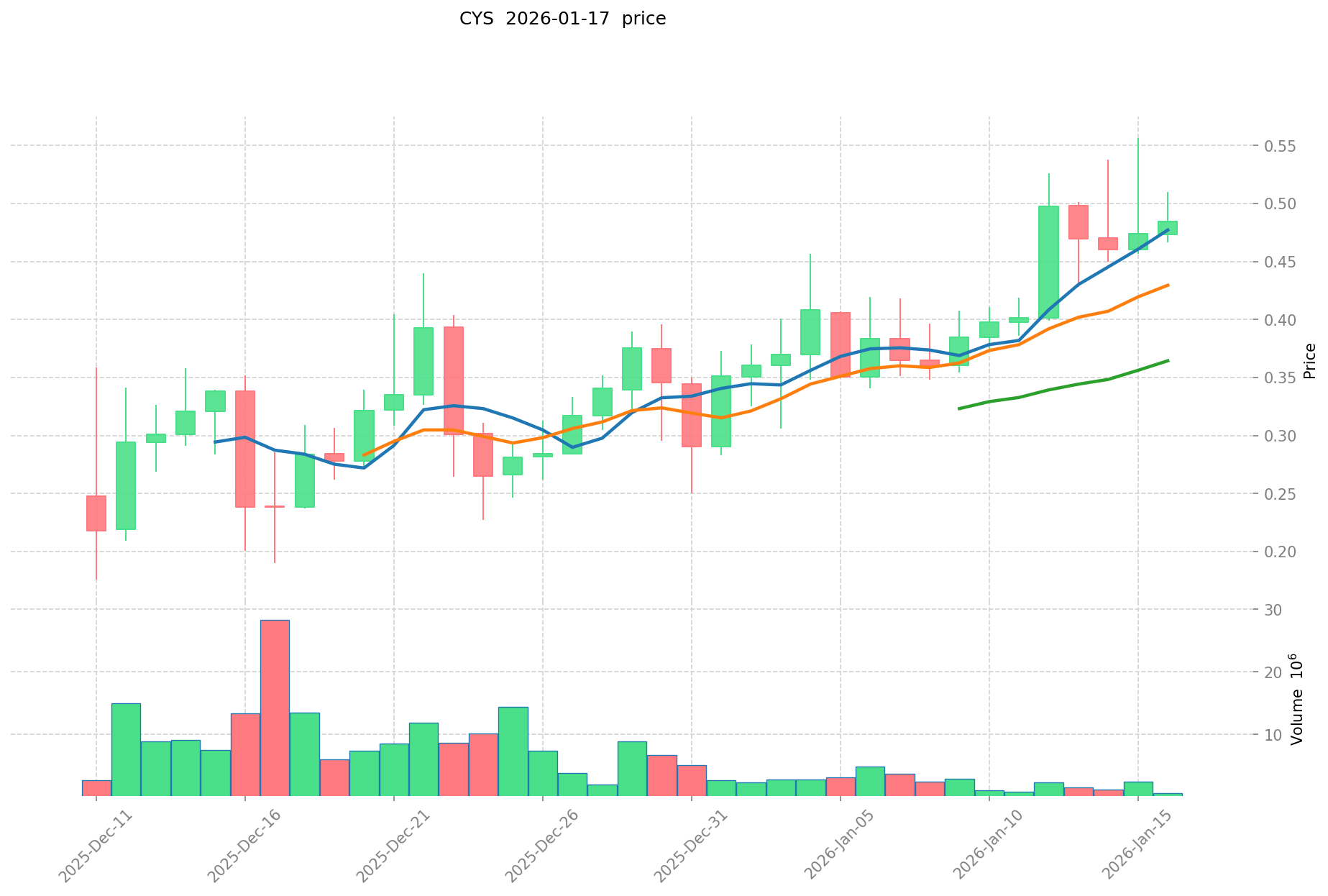
- 2025: CYS launched in December 2025 at a price around $0.26, experiencing significant volatility in its early trading period.
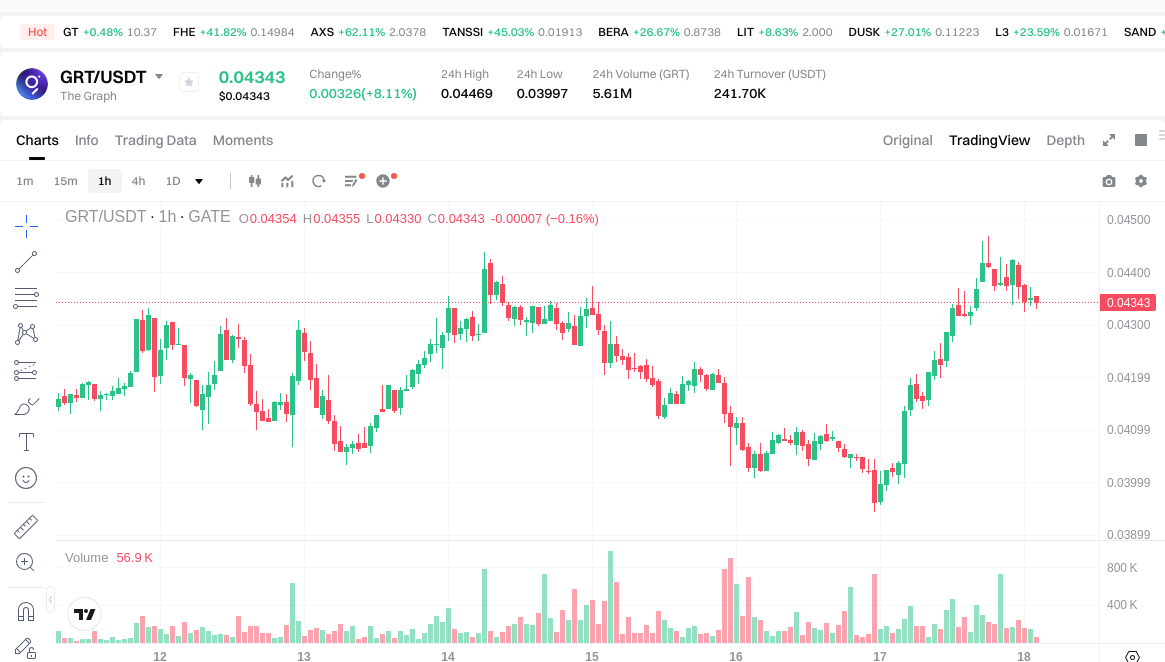
- 2021: GRT reached its all-time high of $2.84 in February 2021 during a broader market uptrend, followed by a prolonged decline.
- Comparative Analysis: During the recent market cycle, CYS moved from its historical low of $0.1758 (December 2025) to a peak of $0.5561 (January 2026), demonstrating strong initial momentum. In contrast, GRT has experienced a substantial decline from its 2021 peak of $2.84 to current levels around $0.043, representing a decline of over 98% from its historical high.
Current Market Status (January 18, 2026)
- CYS Current Price: $0.5286
- GRT Current Price: $0.04341
- 24-Hour Trading Volume: CYS $431,613.99 vs GRT $240,588.66
- Market Sentiment Index (Fear & Greed Index): 50 (Neutral)
View real-time prices:
II. Core Factors Influencing CYS vs GRT Investment Value
Tokenomics Comparison
- CYS: Supply mechanism details are not available in current materials.
- GRT: Supply mechanism details are not available in current materials.
Institutional Adoption and Market Application
- Institutional Holdings: Comparative data on institutional preference between CYS and GRT is not available in current materials.
- Enterprise Adoption: Information regarding CYS and GRT applications in cross-border payments, settlements, or investment portfolios is not available in current materials.
- National Policies: Regulatory attitudes toward CYS and GRT across different jurisdictions are not available in current materials.
Technical Development and Ecosystem Building
- CYS Technical Upgrades: Information on technical developments and potential impacts is not available in current materials.
- GRT Technical Development: Information on technical developments and potential impacts is not available in current materials.
- Ecosystem Comparison: Data on DeFi, NFT, payment systems, and smart contract implementations for both assets is not available in current materials.
Macroeconomic Environment and Market Cycles
- Performance in Inflationary Environments: Comparative analysis of inflation-hedging properties between CYS and GRT is not available in current materials.
- Macroeconomic Monetary Policy: Impact assessment of interest rates and dollar index movements on both assets is not available in current materials.
- Geopolitical Factors: Information on cross-border transaction demand and international situation impacts is not available in current materials.
III. 2026-2031 Price Forecast: CYS vs GRT
Short-term Forecast (2026)
- CYS: Conservative $0.37-$0.52 | Optimistic $0.52-$0.60
- GRT: Conservative $0.042-$0.043 | Optimistic $0.043-$0.046
Mid-term Forecast (2028-2029)
- CYS may enter a consolidation phase, with projected price range of $0.34-$0.71 in 2028, potentially reaching $0.43-$0.72 in 2029
- GRT may enter a growth phase, with projected price range of $0.026-$0.067 in 2028, potentially expanding to $0.046-$0.084 in 2029
- Key drivers: institutional capital flows, ETF developments, ecosystem expansion
Long-term Forecast (2030-2031)
- CYS: Base scenario $0.37-$0.70 | Optimistic scenario $0.70-$0.86 by 2030, extending to $0.48-$0.94 by 2031
- GRT: Base scenario $0.044-$0.070 | Optimistic scenario $0.070-$0.086 by 2030, extending to $0.040-$0.104 by 2031
View detailed price predictions for CYS and GRT
Disclaimer: Price predictions are subject to market volatility and should not be considered as investment advice. Actual results may vary significantly from forecasts.
CYS:
| Year |
Predicted High Price |
Predicted Average Price |
Predicted Low Price |
Price Change |
| 2026 |
0.598386 |
0.5249 |
0.372679 |
0 |
| 2027 |
0.75260162 |
0.561643 |
0.5054787 |
6 |
| 2028 |
0.7096920948 |
0.65712231 |
0.3351323781 |
24 |
| 2029 |
0.724411634544 |
0.6834072024 |
0.430546537512 |
29 |
| 2030 |
0.85876949053584 |
0.703909418472 |
0.36603289760544 |
33 |
| 2031 |
0.937607345404704 |
0.78133945450392 |
0.476617067247391 |
47 |
GRT:
| Year |
Predicted High Price |
Predicted Average Price |
Predicted Low Price |
Price Change |
| 2026 |
0.0464701 |
0.04343 |
0.0416928 |
0 |
| 2027 |
0.0471975525 |
0.04495005 |
0.0364095405 |
3 |
| 2028 |
0.0668070118125 |
0.04607380125 |
0.0258013287 |
6 |
| 2029 |
0.08353180166625 |
0.05644040653125 |
0.045716729290312 |
30 |
| 2030 |
0.086082908041462 |
0.06998610409875 |
0.044091245582212 |
61 |
| 2031 |
0.103785893073241 |
0.078034506070106 |
0.039797598095754 |
79 |
IV. Investment Strategy Comparison: CYS vs GRT
Long-term vs Short-term Investment Strategies
-
CYS: May be suitable for investors focusing on emerging infrastructure narratives and early-stage growth potential, particularly those interested in ComputeFi and ZK proof technology developments. The asset's recent launch in December 2025 suggests it is in an early price discovery phase.
-
GRT: May appeal to investors seeking established blockchain data infrastructure with a longer operational history since 2020, particularly those interested in decentralized data indexing protocols serving Ethereum and other blockchain ecosystems.
Risk Management and Asset Allocation
-
Conservative Investors: Consider limited exposure with diversification across multiple assets. A balanced approach might involve smaller allocations to higher-volatility newer assets like CYS alongside more established protocols.
-
Aggressive Investors: May allocate higher proportions to assets with greater volatility and growth potential, while maintaining risk management through position sizing and stop-loss strategies.
-
Hedging Tools: Stablecoin reserves, options strategies where available, and cross-asset portfolio diversification can help manage downside risk.
V. Potential Risk Comparison
Market Risks
-
CYS: As a newly launched asset in December 2025, CYS faces heightened volatility and liquidity risks typical of early-stage tokens. Price movements from $0.1758 to $0.5561 within approximately one month demonstrate significant volatility potential. Limited trading history makes price pattern analysis challenging.
-
GRT: Despite a longer market presence since 2020, GRT has experienced substantial decline from its 2021 peak of $2.84 to current levels around $0.043. Historical performance indicates vulnerability to broader market cycles and sustained downward pressure.
Technical Risks
-
CYS: As infrastructure focused on ComputeFi and ZK proof systems, technical implementation risks include network scalability challenges, hardware acceleration adoption rates, and competition from alternative proof systems.
-
GRT: As a data indexing protocol, technical considerations include maintaining indexing efficiency, network decentralization, subgraph quality, and adaptation to evolving blockchain architectures.
Regulatory Risks
- Global regulatory frameworks continue evolving for crypto assets. Both CYS and GRT face potential impacts from securities classifications, data privacy regulations, and infrastructure compliance requirements across different jurisdictions. Regulatory clarity remains limited for emerging infrastructure tokens.
VI. Conclusion: Which Is the Better Buy?
📌 Investment Value Summary:
-
CYS Characteristics: Represents emerging ComputeFi infrastructure narrative with ZK proof technology focus. Recent launch provides early-stage exposure but carries elevated volatility and uncertainty. Price movement from $0.1758 to current $0.5286 demonstrates significant short-term momentum.
-
GRT Characteristics: Established blockchain data indexing protocol with operational history since 2020. Serves Ethereum ecosystem with decentralized query infrastructure. Current price of $0.04341 represents substantial decline from historical levels, potentially offering value considerations for those believing in data infrastructure fundamentals.
✅ Investment Considerations:
-
Beginner Investors: Consider starting with comprehensive research and risk assessment before engaging with either asset. Both carry significant volatility and risk profiles. Education on underlying technologies and market dynamics is essential.
-
Experienced Investors: May evaluate both assets within diversified portfolio frameworks, considering risk tolerance, time horizons, and thesis alignment with ComputeFi infrastructure (CYS) versus data indexing protocols (GRT). Position sizing relative to portfolio risk parameters remains critical.
-
Institutional Investors: Should conduct thorough due diligence on technical architectures, tokenomics structures, regulatory compliance, and ecosystem adoption metrics. Consider liquidity profiles and custody solutions appropriate for each asset.
⚠️ Risk Disclosure: Cryptocurrency markets exhibit extreme volatility and carry substantial loss potential. This analysis does not constitute investment advice. Price predictions are speculative and subject to significant uncertainty. Investors should conduct independent research and consult qualified financial advisors before making investment decisions. Past performance does not indicate future results.
VII. FAQ
Q1: What is the fundamental difference between CYS and GRT in terms of their use cases?
CYS focuses on ComputeFi infrastructure that transforms computing resources into verifiable, tokenized on-chain assets through hardware acceleration and ZK proof systems, while GRT operates as a decentralized protocol for indexing and querying blockchain data, primarily serving the Ethereum ecosystem. CYS targets the emerging narrative of computational resource tokenization launched in December 2025, whereas GRT has been providing data infrastructure services since 2020, enabling developers to access blockchain data through open APIs and subgraphs.
Q2: Which asset has demonstrated better price stability historically?
Neither asset demonstrates strong price stability characteristics. GRT has experienced a dramatic decline of over 98% from its February 2021 all-time high of $2.84 to current levels around $0.043, reflecting sustained downward pressure over multiple years. CYS, launched in December 2025, exhibited extreme volatility within its first month, moving from $0.1758 to $0.5561 before settling at current levels around $0.5286. The limited trading history for CYS makes comprehensive stability assessment challenging, while GRT's extended decline suggests vulnerability to prolonged bear market conditions.
Q3: What are the key risk factors investors should consider for each asset?
For CYS, primary risks include early-stage volatility typical of newly launched tokens, limited trading history for pattern analysis, technical implementation challenges related to hardware acceleration adoption, and competition from alternative ComputeFi solutions. For GRT, significant risks encompass the substantial decline from historical peaks indicating potential fundamental challenges, dependence on Ethereum ecosystem growth, competition from alternative data indexing solutions, and the need to maintain network decentralization while scaling. Both assets face regulatory uncertainty as global frameworks for crypto infrastructure continue evolving.
Q4: How do the 2026-2031 price forecasts compare between CYS and GRT?
CYS forecasts suggest a conservative 2026 range of $0.37-$0.52 with potential long-term growth to $0.48-$0.94 by 2031 in optimistic scenarios, representing possible gains from current levels. GRT forecasts indicate a conservative 2026 range of $0.042-$0.043 with potential expansion to $0.040-$0.104 by 2031, suggesting modest growth potential from current positions. However, these predictions carry substantial uncertainty and should not be considered investment advice, as cryptocurrency markets exhibit extreme volatility and actual outcomes may differ significantly from forecasts.
Q5: Which asset is more suitable for different investor profiles?
For beginner investors, comprehensive research and risk education are essential before engaging with either asset due to their significant volatility profiles. Experienced investors with higher risk tolerance might consider CYS for exposure to emerging ComputeFi narratives and early-stage growth potential, while those seeking established blockchain infrastructure might evaluate GRT for its operational history since 2020. Conservative investors should consider limited exposure with diversification across multiple assets, while aggressive investors may allocate higher proportions while maintaining strict risk management through position sizing. Institutional investors require thorough due diligence on technical architectures, tokenomics, regulatory compliance, and liquidity profiles for either asset.
Q6: What current market indicators should investors monitor for both assets?
Key indicators include 24-hour trading volumes (CYS: $431,613.99 vs GRT: $240,588.66 as of January 18, 2026), price volatility patterns, and the current market sentiment index at 50 (Neutral). Investors should monitor CYS's price discovery dynamics given its recent December 2025 launch, tracking whether momentum from $0.1758 to $0.5561 sustains. For GRT, attention should focus on whether the asset can establish support above current levels around $0.043 or faces further downward pressure from its historical decline. Real-time price tracking and volume analysis provide essential context for both assets' market dynamics.
Q7: What are the ecosystem development differences between CYS and GRT?
CYS positions itself within the emerging ComputeFi infrastructure narrative, focusing on hardware acceleration and ZK proof system implementations to enable verifiable computational resource tokenization. This represents a newer technological approach with limited deployment history. GRT operates within the established data infrastructure category, providing indexing and querying services primarily for Ethereum through a decentralized network of indexers, curators, and delegators. GRT's longer operational history since 2020 provides more extensive ecosystem data, though current materials lack detailed information on specific DeFi integrations, NFT applications, and smart contract implementations for both assets.
* The information is not intended to be and does not constitute financial advice or any other recommendation of any sort offered or endorsed by Gate.