The article delves into the fundamental differences between Decentralized Autonomous Organizations (DAO) and Ethereum (ETH), focusing on investment value, price history, supply mechanisms, and market adoption. It addresses the critical question of which asset offers better buying opportunities, offering insights into both short-term and long-term investment strategies. Suitable for investors seeking a deeper understanding of crypto assets, the article provides detailed price predictions and compares risk factors. With a structured analysis of market trends, technological growth, and regulatory impacts, it guides decision-making for both new and experienced crypto investors.
Introduction: DAO vs ETH Investment Comparison
In the cryptocurrency market, DAO vs ETH comparison has always been an unavoidable topic for investors. The two not only differ significantly in market cap ranking, application scenarios, and price performance, but also represent different positioning in crypto assets.
DAO Maker (DAO): Launched in 2021, it has gained market recognition for its role in providing a technology platform and financing framework for startups.
Ethereum (ETH): Since its inception in 2015, it has been hailed as the foundation for decentralized applications and smart contracts, and is one of the cryptocurrencies with the highest global trading volume and market capitalization.
This article will comprehensively analyze the investment value comparison between DAO and ETH, focusing on historical price trends, supply mechanisms, institutional adoption, technological ecosystems, and future predictions, and attempt to answer the question investors care most about:
"Which is the better buy right now?"
I. Price History Comparison and Current Market Status
DAO (Coin A) and ETH (Coin B) Historical Price Trends
- 2021: DAO reached its all-time high of $8.71 due to the crypto bull market.
- 2022: ETH completed "The Merge" upgrade, transitioning to Proof-of-Stake consensus.
- Comparative analysis: In the recent market cycle, DAO dropped from its high of $8.71 to a low of $0.10392, while ETH has shown more resilience and maintained its position as the second-largest cryptocurrency by market cap.
Current Market Situation (2025-10-03)
- DAO current price: $0.1166
- ETH current price: $4478.15
- 24-hour trading volume: $30,682,600 (DAO) vs $1,528,018,515 (ETH)
- Market Sentiment Index (Fear & Greed Index): 64 (Greed)
Click to view real-time prices:
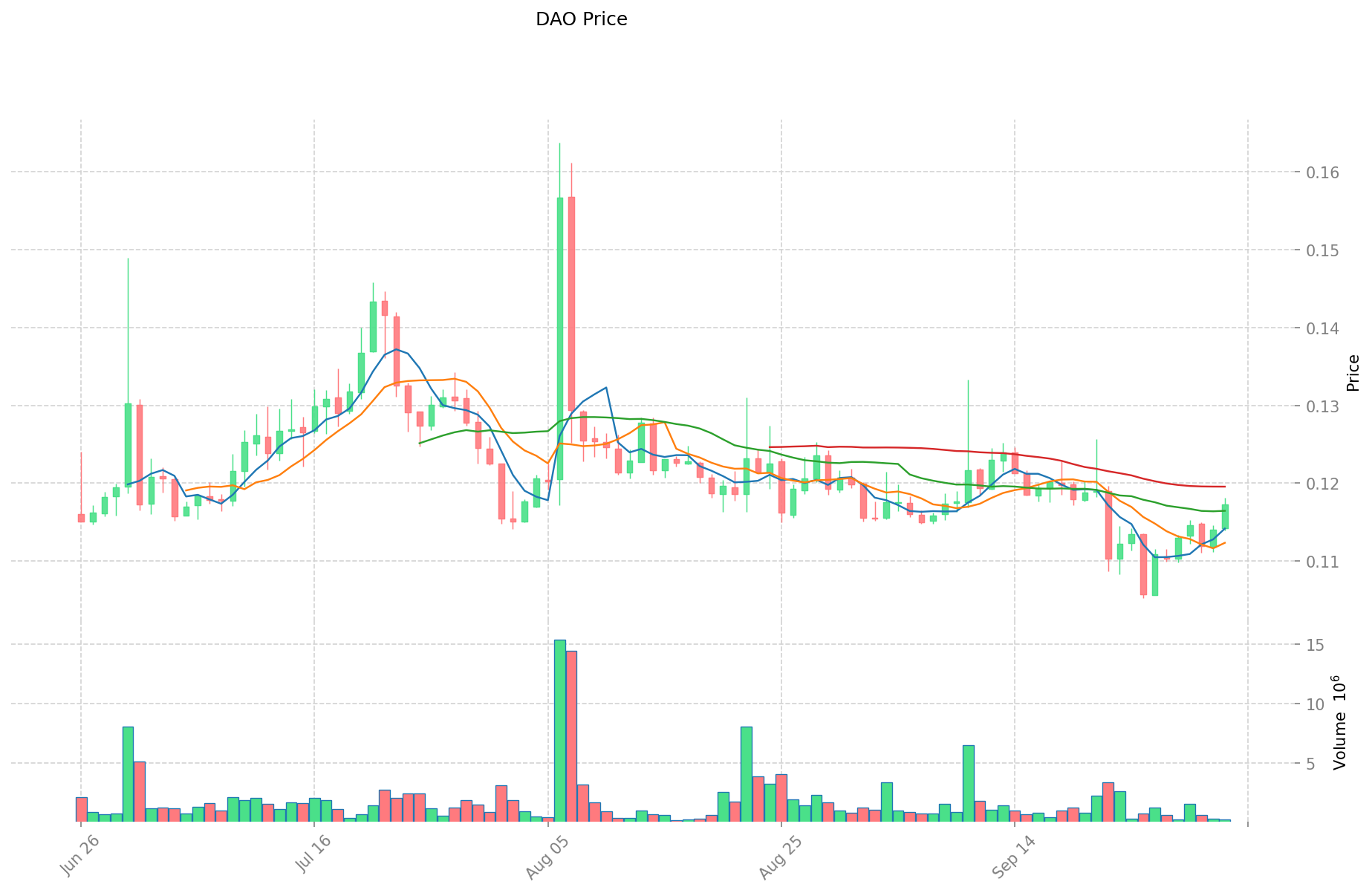
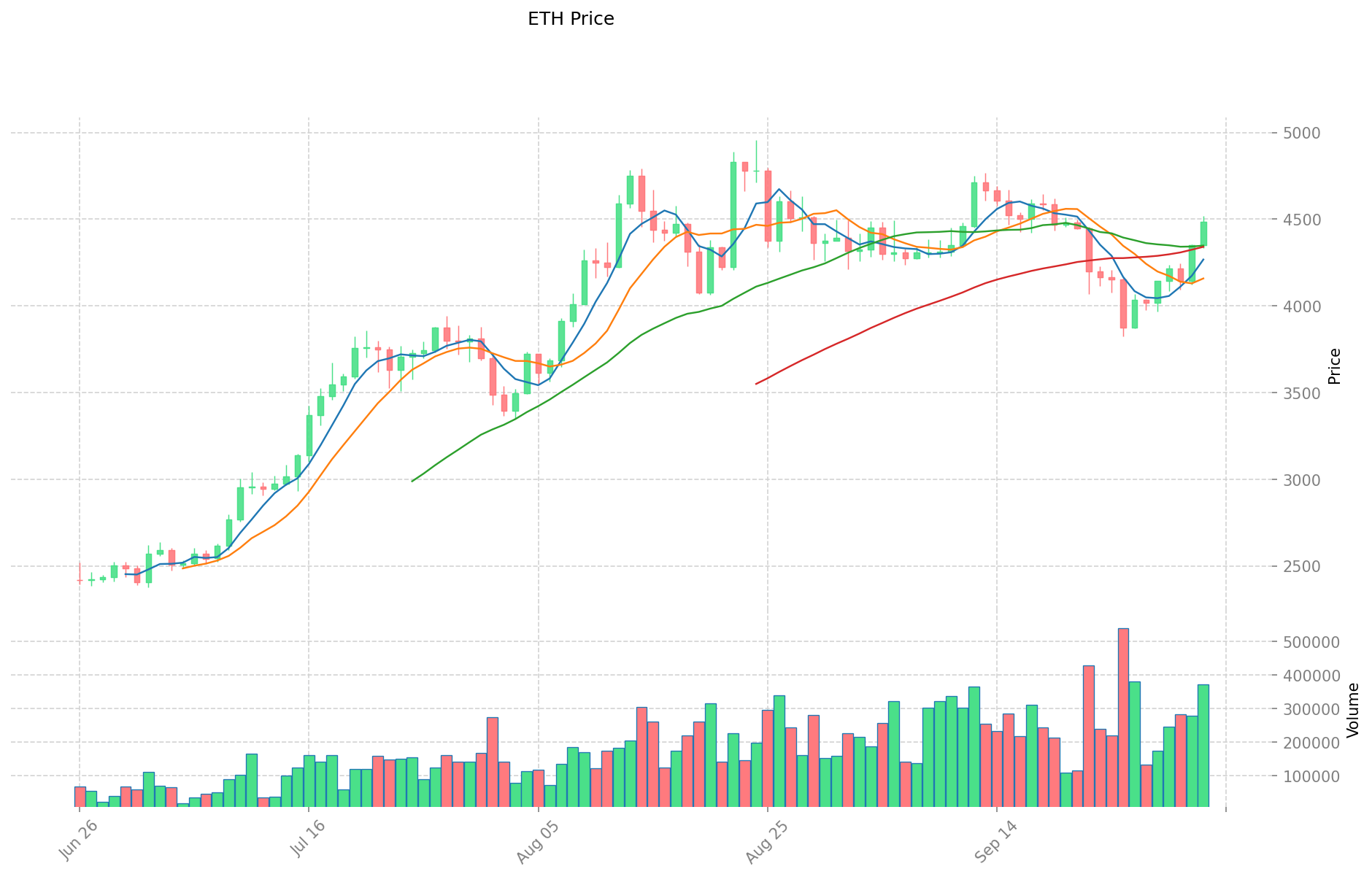
Factors Influencing DAO vs ETH Investment Value
Supply Mechanism Comparison (Tokenomics)
- ETH: Dynamic supply model with EIP-1559 burn mechanism creating deflationary pressure during high network activity
- DAO tokens: Typically governed by each organization's specific economic model and governance parameters
- 📌 Historical pattern: ETH's value tends to increase with network usage due to fee burning, while DAO tokens correlate with their governance utility and treasury growth.
Institutional Adoption and Market Applications
- Institutional holdings: ETH has attracted significant institutional capital with ETF inflows exceeding $2.1B, including $1.79B into BlackRock's iShares Ethereum Trust
- Enterprise adoption: ETH serves as infrastructure for thousands of decentralized applications, while DAOs primarily function as governance mechanisms
- Regulatory stance: Regulatory clarity is emerging for ETH through frameworks like the GENIUS Act for stablecoins, while DAO regulation varies significantly by jurisdiction
Technological Development and Ecosystem Building
- ETH technical upgrades: Dual strategy of "expanding L1 + expanding Blob" with Verkle trees implementation and execution layer parallelization
- DAO innovation: Evolution toward more sophisticated governance models and treasury management systems
- Ecosystem comparison: ETH supports the entire Web3 infrastructure including DeFi, NFTs, and L2 solutions, while DAOs focus on community governance and capital coordination
Macroeconomic Environment and Market Cycles
- Inflation hedge properties: ETH shows deflationary characteristics during high network usage through EIP-1559 fee burning
- Monetary policy impact: Both assets remain highly correlated with risk assets and sensitive to interest rate changes
- Geopolitical factors: ETH benefits from global settlement needs and censorship resistance, while DAOs face varying regulatory treatment across jurisdictions
III. 2025-2030 Price Prediction: DAO vs ETH
Short-term Prediction (2025)
- DAO: Conservative $0.067 - $0.116 | Optimistic $0.116 - $0.142
- ETH: Conservative $3,942 - $4,480 | Optimistic $4,480 - $5,689
Mid-term Prediction (2027)
- DAO may enter a growth phase, with estimated prices of $0.089 - $0.181
- ETH may enter a bullish market, with estimated prices of $3,708 - $7,192
- Key drivers: Institutional capital inflow, ETF, ecosystem development
Long-term Prediction (2030)
- DAO: Base scenario $0.188 - $0.207 | Optimistic scenario $0.207+
- ETH: Base scenario $9,062 - $12,959 | Optimistic scenario $12,959+
View detailed price predictions for DAO and ETH
Disclaimer
DAO:
| 年份 |
预测最高价 |
预测平均价格 |
预测最低价 |
涨跌幅 |
| 2025 |
0.141886 |
0.1163 |
0.067454 |
0 |
| 2026 |
0.15362067 |
0.129093 |
0.11231091 |
10 |
| 2027 |
0.1809367488 |
0.141356835 |
0.08905480605 |
21 |
| 2028 |
0.206267893632 |
0.1611467919 |
0.135363305196 |
38 |
| 2029 |
0.1928927099043 |
0.183707342766 |
0.14329172735748 |
57 |
| 2030 |
0.207130028968665 |
0.18830002633515 |
0.178885025018392 |
61 |
ETH:
| 年份 |
预测最高价 |
预测平均价格 |
预测最低价 |
涨跌幅 |
| 2025 |
5689.2825 |
4479.75 |
3942.18 |
0 |
| 2026 |
6152.2646625 |
5084.51625 |
4270.99365 |
13 |
| 2027 |
7191.539784 |
5618.39045625 |
3708.137701125 |
25 |
| 2028 |
8390.50430736375 |
6404.965120125 |
5380.170700905 |
43 |
| 2029 |
10726.71533492934375 |
7397.734713744375 |
3920.79939828451875 |
65 |
| 2030 |
12958.981784801708906 |
9062.225024336859375 |
7249.7800194694875 |
102 |
IV. Investment Strategy Comparison: DAO vs ETH
Long-term vs Short-term Investment Strategies
- DAO: Suitable for investors focused on governance participation and early-stage project potential
- ETH: Suitable for investors seeking ecosystem exposure and potential deflationary properties
Risk Management and Asset Allocation
- Conservative investors: DAO: 5% vs ETH: 20%
- Aggressive investors: DAO: 15% vs ETH: 40%
- Hedging tools: Stablecoin allocation, options, cross-currency portfolios
V. Potential Risk Comparison
Market Risk
- DAO: Higher volatility, lower liquidity compared to major cryptocurrencies
- ETH: Correlation with broader crypto market, susceptible to macro-economic factors
Technical Risk
- DAO: Platform scalability, network stability
- ETH: Centralization concerns, potential security vulnerabilities in smart contracts
Regulatory Risk
- Global regulatory policies may have different impacts on both assets, with ETH potentially facing more scrutiny due to its larger market presence
VI. Conclusion: Which Is the Better Buy?
📌 Investment Value Summary:
- DAO advantages: Governance utility, potential for high growth in emerging DAO ecosystems
- ETH advantages: Established ecosystem, deflationary mechanism, institutional adoption
✅ Investment Advice:
- New investors: Consider allocating a larger portion to ETH for its established market position
- Experienced investors: Diversify between ETH and DAO based on risk tolerance and governance interests
- Institutional investors: Focus on ETH for liquidity and regulatory clarity, with potential small allocations to DAO for exposure to governance trends
⚠️ Risk Warning: The cryptocurrency market is highly volatile. This article does not constitute investment advice.
None
VII. FAQ
Q1: What are the main differences between DAO and ETH?
A: DAO is a governance token for decentralized autonomous organizations, while ETH is the native cryptocurrency of the Ethereum blockchain. ETH has a larger market cap, higher liquidity, and serves as the foundation for many decentralized applications. DAO tokens are typically used for specific project governance and have a smaller market presence.
Q2: Which has shown better price performance historically?
A: Ethereum (ETH) has shown better historical price performance and stability compared to DAO. While DAO reached an all-time high of $8.71 in 2021, it has since dropped significantly. ETH, on the other hand, has maintained its position as the second-largest cryptocurrency by market cap and has shown more resilience in price fluctuations.
Q3: How do the supply mechanisms of DAO and ETH differ?
A: ETH has a dynamic supply model with a deflationary mechanism (EIP-1559) that burns fees during high network activity. DAO tokens typically have a fixed supply governed by each organization's specific economic model and governance parameters.
Q4: Which asset has attracted more institutional adoption?
A: Ethereum (ETH) has attracted significantly more institutional adoption. It has seen substantial ETF inflows, with over $2.1 billion invested, including $1.79 billion into BlackRock's iShares Ethereum Trust. DAO tokens have less institutional presence due to their focus on specific project governance.
Q5: What are the key factors influencing the future value of DAO and ETH?
A: For ETH, key factors include technological upgrades like "expanding L1 + expanding Blob," institutional adoption, and regulatory developments. For DAO, important factors are the evolution of governance models, treasury management systems, and the overall growth of the DAO ecosystem.
Q6: How do the long-term price predictions for DAO and ETH compare?
A: By 2030, the base scenario for DAO predicts a price range of $0.188 - $0.207, with an optimistic scenario above $0.207. For ETH, the base scenario predicts $9,062 - $12,959, with an optimistic scenario above $12,959. ETH is generally expected to see higher growth potential.
Q7: What are the recommended investment strategies for DAO and ETH?
A: For conservative investors, a suggested allocation is 5% DAO and 20% ETH. For aggressive investors, 15% DAO and 40% ETH is recommended. New investors might consider allocating more to ETH for its established market position, while experienced investors could diversify between both based on their risk tolerance and interest in governance participation.
* The information is not intended to be and does not constitute financial advice or any other recommendation of any sort offered or endorsed by Gate.














