This comprehensive guide provides investors with a detailed comparison between DASH and SOL, two leading cryptocurrency networks with distinct market positioning. DASH operates as a payment-focused digital cash solution emphasizing transaction speed and optional privacy features, while SOL functions as a high-performance blockchain platform supporting DeFi and decentralized applications. The analysis covers historical price trends, tokenomics differences, institutional adoption patterns, and technical ecosystem development. Current market data shows DASH trading at $64.57 with SOL at $144.85, reflecting their different market capitalizations and trading volumes. Investment strategies vary by risk profile—conservative investors might allocate 30% DASH/70% SOL, while aggressive investors favor 20% DASH/80% SOL. The guide addresses regulatory considerations, technical risks, and projected price ranges through 2031, equipping investors with essential information for informed decision-making within cryptocurrency
Introduction: Investment Comparison Between DASH and SOL
In the cryptocurrency market, the comparison between DASH vs SOL has consistently been a focal point for investors. These two assets differ significantly in market capitalization ranking, application scenarios, and price performance, representing distinct positioning within the crypto asset landscape.
DASH: Launched in 2014, it has gained market recognition through its positioning as a digital cash solution designed for daily transactions and international remittances, with emphasis on low transaction fees and fast transaction speeds.
SOL (Solana): Since its launch in 2018, it has been regarded as a high-performance blockchain protocol, focusing on scalability without compromising decentralization or security, becoming one of the widely traded cryptocurrencies in the market.
This article will comprehensively analyze the investment value comparison between DASH vs SOL, covering historical price trends, supply mechanisms, institutional adoption, technical ecosystems, and future projections, attempting to address investors' most pressing question:
"Which is the better buy right now?"
I. Historical Price Comparison and Current Market Status
DASH and SOL Historical Price Trends
- 2017: DASH reached a notable price level of $1,493.59 on December 20, 2017, marking a significant peak during the cryptocurrency market expansion of that period.
- 2020: SOL launched in March 2020 at an initial price of approximately $0.22, establishing its entry point in the blockchain ecosystem.
- 2025: SOL experienced substantial price movement, reaching $293.31 on January 19, 2025, representing a considerable appreciation from its launch price.
- Comparative Analysis: During the 2017-2018 market cycle, DASH declined from its peak of $1,493.59 to lower levels, while SOL, having launched later in 2020, demonstrated different market dynamics with its price evolving from $0.50 (May 2020 low) to higher valuations in subsequent years.
Current Market Status (January 14, 2026)
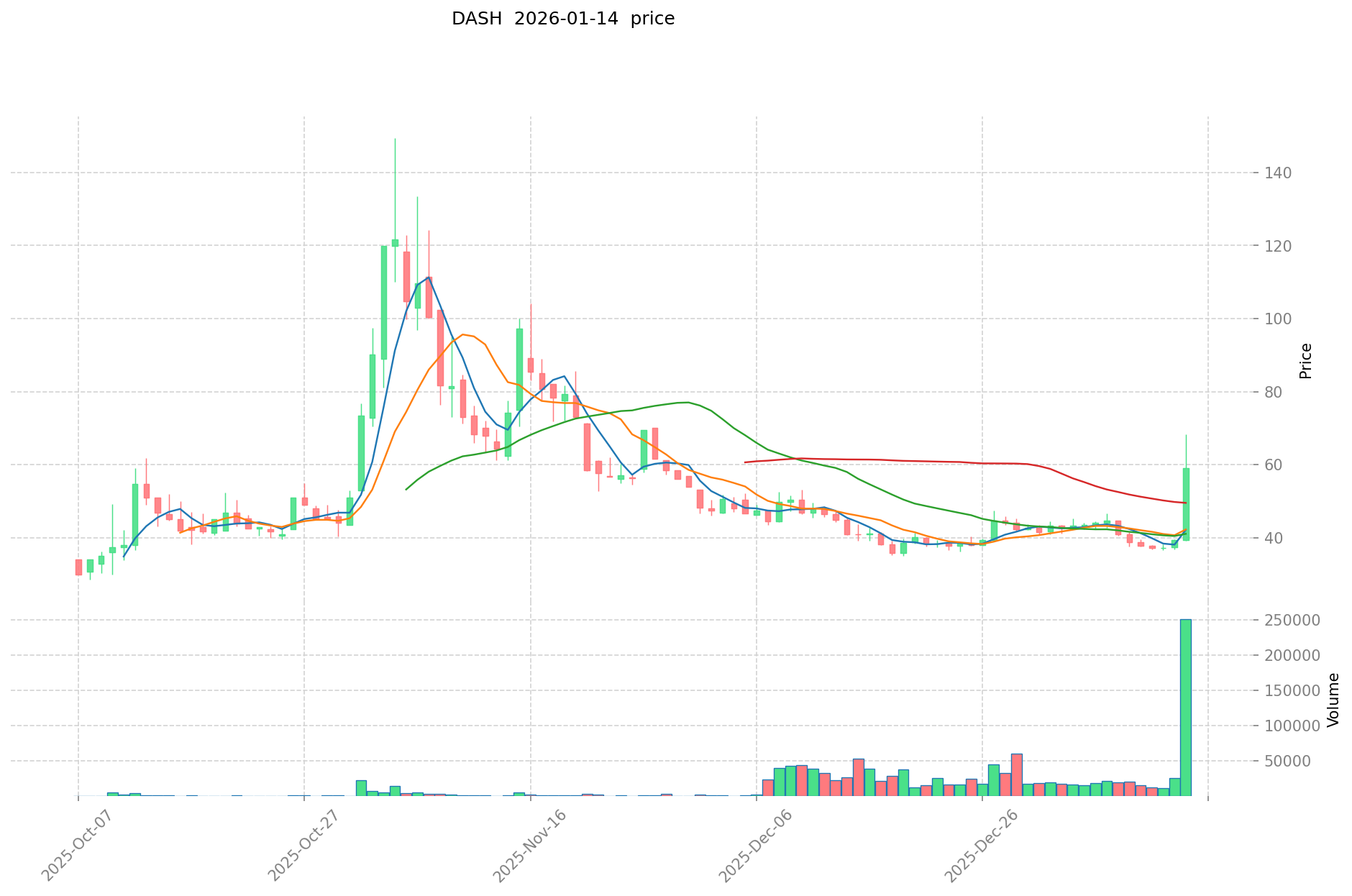
- DASH current price: $64.57
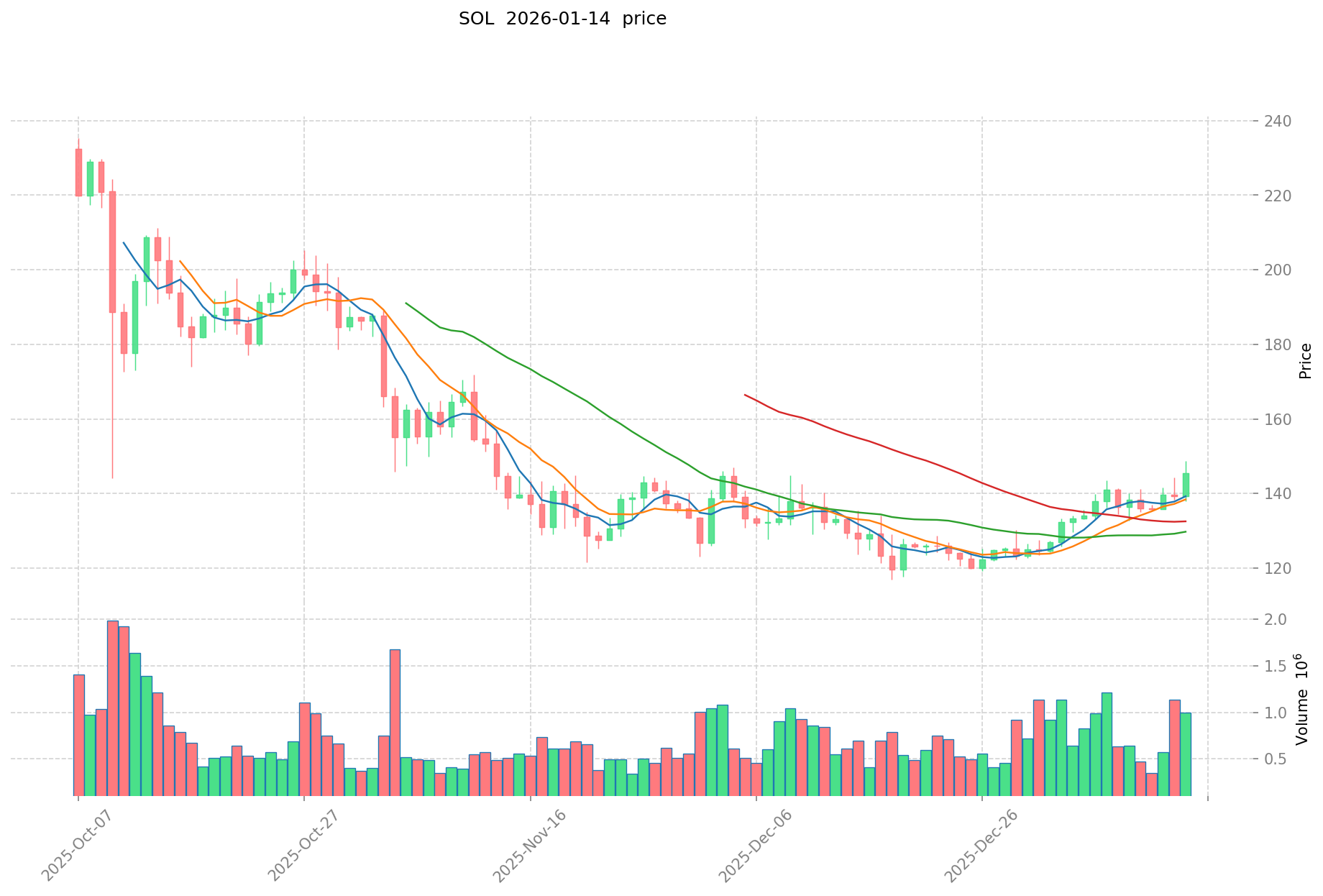
- SOL current price: $144.85
- 24-hour trading volume: DASH $17.23 million vs SOL $132.76 million
- Market capitalization: DASH $810.48 million vs SOL $81.87 billion
- Market sentiment index (Fear & Greed Index): 48 (Neutral)
- Recent price performance:
- DASH: +38.4% (24H), +47.33% (7D)
- SOL: +3.42% (24H), +4.00% (7D)
View real-time prices:
II. Core Factors Influencing DASH vs SOL Investment Value
Supply Mechanism Comparison (Tokenomics)
-
DASH: Implements a deflationary supply model with a halving mechanism similar to Bitcoin. Block rewards gradually decrease over time, reducing the rate at which new DASH tokens enter circulation. The network allocates rewards across miners, masternodes (which require 1,000 DASH as collateral), and a treasury system for governance proposals.
-
SOL: Features a different supply structure with initial inflationary characteristics that gradually decrease over time. SOL's tokenomics support network security through staking rewards while maintaining operational efficiency for the Solana blockchain ecosystem.
-
📌 Historical Pattern: Supply mechanisms drive price cycle variations through scheduled reduction events and staking dynamics, with reduced new token issuance potentially creating upward price pressure during periods of sustained demand.
Institutional Adoption and Market Application
-
Institutional Holdings: Both assets attract different institutional profiles, with considerations varying based on use case requirements and regulatory compliance frameworks.
-
Enterprise Adoption: DASH positions itself as a digital cash alternative with emphasis on instant transactions (InstantSend) and optional privacy features (PrivateSend), finding application in certain payment scenarios. SOL supports decentralized applications (dApps) and has gained traction in DeFi and Web3 infrastructure deployment.
-
National Policy: Regulatory attitudes differ across jurisdictions. Privacy-enhanced features in DASH face scrutiny in some regions under anti-money laundering frameworks, while SOL's transparent architecture may align more readily with certain compliance requirements.
Technology Development and Ecosystem Construction
-
DASH Technical Upgrades: The network has implemented various platform versions (Dash Core and Dash Platform releases) focusing on scalability, storage optimization, and efficiency improvements. The masternode network with over 2,500 nodes provides governance capabilities and enhanced network services.
-
SOL Technical Development: Solana emphasizes high-speed transaction processing and scalability through its unique consensus mechanism, supporting growing ecosystem requirements for dApp deployment and network expansion.
-
Ecosystem Comparison: SOL demonstrates stronger presence in DeFi protocols, NFT platforms, and smart contract applications. DASH maintains focus on payment functionality and transaction efficiency, with varying degrees of adoption in each sector.
Macroeconomic Environment and Market Cycles
-
Performance Under Inflation: Both assets exhibit characteristics influenced by broader cryptocurrency market sentiment and macroeconomic conditions, though neither functions as traditional inflation hedges in the same manner as physical commodities.
-
Macro Monetary Policy: Interest rate adjustments and dollar index movements affect cryptocurrency market liquidity and risk appetite, influencing both DASH and SOL valuations through capital flow dynamics.
-
Geopolitical Factors: Cross-border transaction demand and international developments may create varying opportunities for payment-focused versus application-platform cryptocurrencies, depending on regional adoption patterns and regulatory evolution.
III. 2026-2031 Price Prediction: DASH vs SOL
Short-term Prediction (2026)
- DASH: Conservative $38.83-$63.65 | Optimistic $63.65-$77.65
- SOL: Conservative $110.23-$145.04 | Optimistic $145.04-$178.40
Mid-term Prediction (2028-2029)
- DASH may enter a growth phase, with estimated price range of $48.73-$150.31
- SOL may enter a consolidation phase, with estimated price range of $134.46-$219.89
- Key drivers: institutional capital inflows, ETF developments, ecosystem expansion
Long-term Prediction (2031)
- DASH: Base scenario $82.89-$138.15 | Optimistic scenario $138.15-$167.16
- SOL: Base scenario $196.74-$221.06 | Optimistic scenario $221.06-$258.64
View detailed price predictions for DASH and SOL
Disclaimer
DASH:
| Year |
Predicted High Price |
Predicted Average Price |
Predicted Low Price |
Price Change |
| 2026 |
77.653 |
63.65 |
38.8265 |
-1 |
| 2027 |
100.32513 |
70.6515 |
42.3909 |
9 |
| 2028 |
116.2641084 |
85.488315 |
48.72833955 |
32 |
| 2029 |
150.305555433 |
100.8762117 |
86.753542062 |
56 |
| 2030 |
150.7090602798 |
125.5908835665 |
119.311339388175 |
94 |
| 2031 |
167.1614660270115 |
138.14997192315 |
82.88998315389 |
113 |
SOL:
| Year |
Predicted High Price |
Predicted Average Price |
Predicted Low Price |
Price Change |
| 2026 |
178.3992 |
145.04 |
110.2304 |
0 |
| 2027 |
228.024636 |
161.7196 |
121.2897 |
11 |
| 2028 |
228.00037806 |
194.872118 |
134.46176142 |
34 |
| 2029 |
219.8936979512 |
211.43624803 |
158.5771860225 |
45 |
| 2030 |
226.44822164013 |
215.6649729906 |
125.085684334548 |
48 |
| 2031 |
258.63621885897705 |
221.056597315365 |
196.74037161067485 |
52 |
IV. Investment Strategy Comparison: DASH vs SOL
Long-term vs Short-term Investment Strategies
-
DASH: May suit investors focusing on payment infrastructure and transaction efficiency use cases, particularly those interested in digital cash applications with emphasis on speed and optional privacy features.
-
SOL: May appeal to investors seeking exposure to smart contract platforms and decentralized application ecosystems, with focus on DeFi, NFT, and Web3 infrastructure development.
Risk Management and Asset Allocation
-
Conservative Investors: Consider diversified allocation such as DASH 30% vs SOL 70%, balancing established payment infrastructure with platform ecosystem growth potential.
-
Aggressive Investors: May explore allocation such as DASH 20% vs SOL 80%, with higher weighting toward ecosystem expansion and application layer development.
-
Hedging Instruments: Incorporate stablecoin positions for liquidity management, utilize options strategies where available, and maintain cross-asset diversification to manage cryptocurrency market volatility.
V. Potential Risk Comparison
Market Risk
-
DASH: Price volatility influenced by payment adoption rates, competition from other digital cash alternatives, and shifting preferences in transaction privacy features across different regulatory jurisdictions.
-
SOL: Price fluctuations tied to DeFi sector performance, smart contract platform competition, and network usage metrics including transaction volumes and active addresses.
Technical Risk
-
DASH: Network scalability considerations related to masternode infrastructure requirements and governance system efficiency as transaction volumes evolve.
-
SOL: Network stability considerations including historical outage events, validator concentration patterns, and ongoing development requirements for maintaining high-throughput performance.
Regulatory Risk
- Global regulatory frameworks may affect both assets differently based on their primary use cases. Privacy-enhanced features in DASH face varying scrutiny under anti-money laundering regulations across jurisdictions. Smart contract platforms like SOL encounter evolving securities law interpretations and DeFi regulatory developments that differ by region.
VI. Conclusion: Which Is the Better Buy?
📌 Investment Value Summary:
-
DASH Characteristics: Established payment infrastructure with masternode network governance, focus on transaction speed and optional privacy features, positioning in digital cash segment with cross-border remittance applications.
-
SOL Characteristics: High-performance blockchain infrastructure supporting diverse application ecosystem, significant presence in DeFi and NFT sectors, technical architecture emphasizing scalability and processing capacity.
✅ Investment Considerations:
-
Beginning Investors: Consider starting with smaller position sizes, focus on understanding fundamental differences between payment-focused and platform-focused cryptocurrencies, maintain diversification across multiple assets.
-
Experienced Investors: Evaluate allocation based on specific exposure goals—payment infrastructure versus application platform ecosystems, monitor technical developments and adoption metrics, adjust positions according to market cycle phases.
-
Institutional Investors: Assess regulatory compliance requirements for each asset class, evaluate custody solutions and liquidity profiles, consider portfolio role within broader digital asset allocation framework.
⚠️ Risk Disclosure: Cryptocurrency markets exhibit substantial volatility. This content does not constitute investment advice. Conduct thorough due diligence and consult qualified financial advisors before making investment decisions.
VII. FAQ
Q1: What are the main differences between DASH and SOL in terms of their core functions?
DASH focuses on payment infrastructure while SOL emphasizes smart contract platform capabilities. DASH positions itself as digital cash with features like InstantSend for fast transactions and PrivateSend for optional privacy, targeting payment scenarios and cross-border remittances. SOL, conversely, operates as a high-performance blockchain protocol designed to support decentralized applications (dApps), DeFi protocols, and NFT platforms through its scalability-focused architecture.
Q2: How do the supply mechanisms of DASH and SOL differ?
DASH implements a deflationary model with Bitcoin-like halving events, while SOL features an initially inflationary structure that gradually decreases. DASH's block rewards decrease over time through scheduled halvings, distributing tokens among miners, masternodes (requiring 1,000 DASH collateral), and a treasury system. SOL's tokenomics support network security through staking rewards with a decreasing inflation rate, creating different long-term supply dynamics between the two assets.
Q3: Which asset has stronger institutional adoption?
SOL demonstrates broader institutional adoption in the blockchain application space, particularly within DeFi and Web3 infrastructure. Its transparent architecture and smart contract capabilities align with institutional requirements for deploying decentralized applications. DASH maintains institutional interest primarily in payment processing and remittance sectors, though its privacy-enhanced features face varying regulatory scrutiny across different jurisdictions.
Q4: What are the primary technical risks associated with each cryptocurrency?
DASH faces scalability considerations related to its masternode infrastructure and governance efficiency as transaction volumes evolve. SOL encounters network stability concerns, including historical outage events and validator concentration patterns, alongside ongoing development requirements to maintain high-throughput performance. Both assets carry technical risks inherent to their respective architectural approaches.
Q5: How should investors approach allocation between DASH and SOL?
Conservative investors might consider allocations such as DASH 30% vs SOL 70%, balancing established payment infrastructure with platform ecosystem growth potential. Aggressive investors may explore DASH 20% vs SOL 80%, weighting toward ecosystem expansion. Allocation decisions should reflect individual risk tolerance, investment timeframe, and exposure goals—whether prioritizing payment infrastructure or application platform ecosystems.
Q6: What regulatory considerations affect DASH and SOL differently?
DASH's privacy-enhanced features face scrutiny under anti-money laundering (AML) frameworks in certain jurisdictions, affecting adoption in regulated payment channels. SOL's transparent architecture may align more readily with compliance requirements but encounters evolving securities law interpretations regarding DeFi applications and smart contract functionality. Regulatory approaches differ by region, creating varying adoption dynamics for each asset.
Q7: What price ranges are projected for DASH and SOL through 2031?
For 2026, DASH projects a conservative range of $38.83-$63.65 and optimistic range of $63.65-$77.65, while SOL estimates $110.23-$145.04 (conservative) and $145.04-$178.40 (optimistic). By 2031, DASH forecasts a base scenario of $82.89-$138.15 and optimistic scenario of $138.15-$167.16, compared to SOL's base scenario of $196.74-$221.06 and optimistic scenario of $221.06-$258.64. These projections reflect different growth trajectories based on respective market positioning.
Q8: Which cryptocurrency is more suitable for beginning investors?
Beginning investors should start with smaller position sizes and focus on understanding fundamental differences between the two assets. SOL may appeal to those interested in broader blockchain ecosystem development and application platforms, while DASH suits investors focusing on payment infrastructure use cases. Both require thorough due diligence regarding technical architecture, market dynamics, and regulatory considerations. Diversification across multiple assets remains essential for managing cryptocurrency market volatility.
* The information is not intended to be and does not constitute financial advice or any other recommendation of any sort offered or endorsed by Gate.