This comprehensive analysis compares DATA (Streamr) and QNT (Quant Network) as investment opportunities in the cryptocurrency market, examining historical price trends, tokenomics, institutional adoption, and technology ecosystems. QNT demonstrates stronger institutional engagement through participation in the UK Regulated Liability Network and ISO 20022 compliance, with fixed supply deflationary mechanics supporting long-term scarcity dynamics. DATA offers earlier-stage technology exposure but lacks transparent development information. The article evaluates investment strategies tailored to conservative, aggressive, and institutional investors, presents price predictions through 2031, and identifies key risks including market liquidity, technology execution, and regulatory uncertainty. Investors should prioritize due diligence on adoption metrics and risk management through diversification and hedging strategies on Gate.
Introduction: Investment Comparison Between DATA and QNT
In the cryptocurrency market, the comparison between DATA vs QNT has been a topic that investors cannot avoid. The two not only show notable differences in market cap ranking, application scenarios, and price performance, but also represent different crypto asset positioning.
Streamr (DATA): Since its launch in 2017, it has gained market recognition with its positioning as a decentralized P2P network for real-time data streaming and trading.
Quant Network (QNT): Since its inception in 2018, it has been recognized as a blockchain interoperability solution provider, currently among the leading projects enabling enterprise innovation and blockchain adoption through its Overledger operating system.
This article will comprehensively analyze the investment value comparison of DATA vs QNT, focusing on historical price trends, supply mechanisms, institutional adoption, technical ecosystems, and future predictions, attempting to answer the question that investors care about most:
"Which is the better buy right now?"
I. Historical Price Comparison and Current Market Status
Historical Price Trends of DATA (Coin A) and QNT (Coin B)
- 2021: DATA experienced significant price movement, with its all-time high recorded at $0.209972 on December 3, 2021.
- 2021: QNT reached its all-time high at $427.42 on September 11, 2021, representing a notable milestone in its trading history.
- Comparative analysis: During recent market cycles, DATA declined from its peak of $0.209972 to a low of $0.00359195 (recorded on January 30, 2026), while QNT decreased from $427.42 to $0.215773 (recorded on August 23, 2018).
Current Market Status (January 31, 2026)
- DATA current price: $0.003703
- QNT current price: $69.7
- 24-hour trading volume: DATA $42,457.996297 vs QNT $501,874.27114
- Market sentiment index (Fear & Greed Index): 20 (Extreme Fear)
View real-time prices:
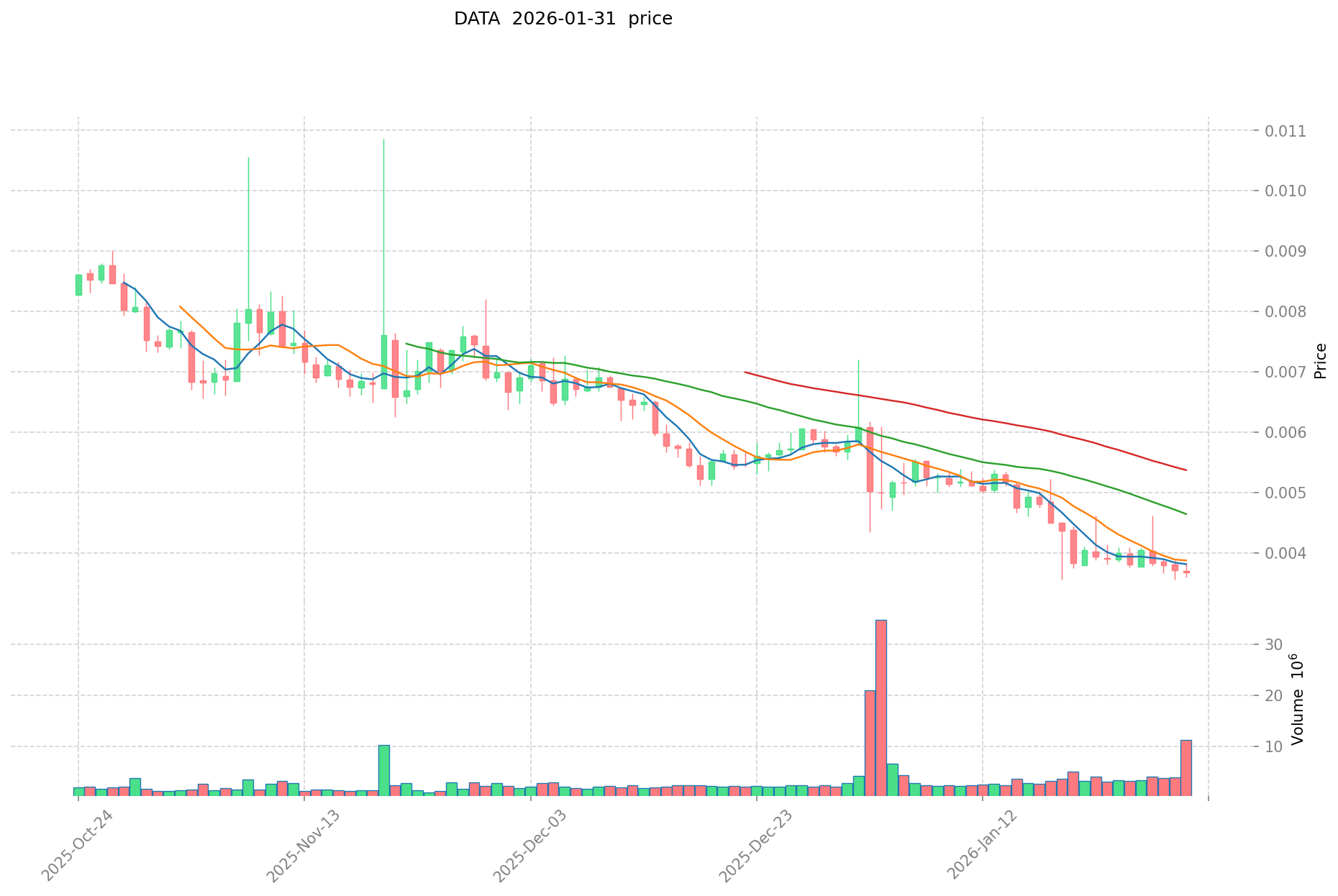
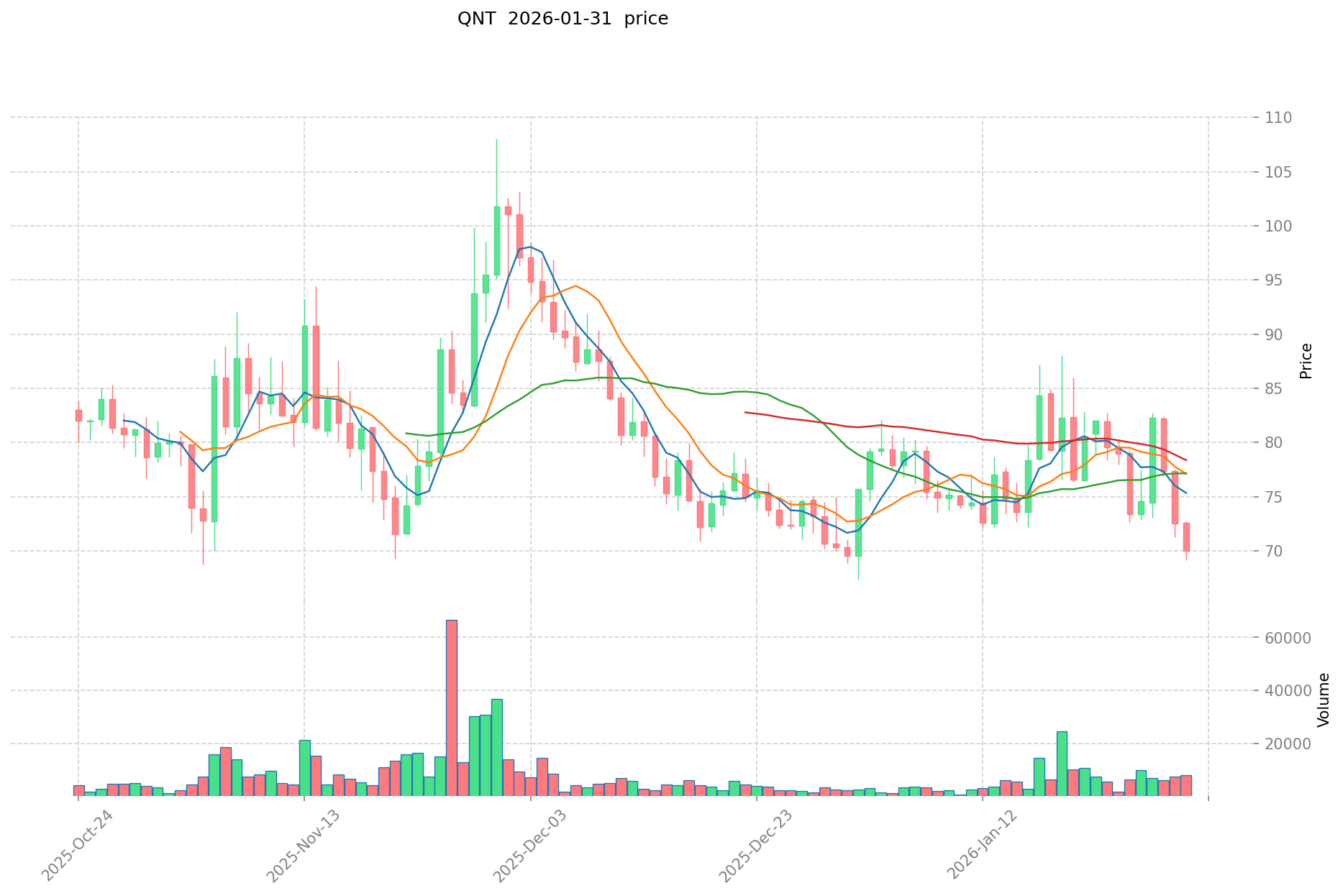
II. Core Factors Influencing DATA vs QNT Investment Value
Supply Mechanism Comparison (Tokenomics)
- QNT: Fixed supply capped at 14,612,493 tokens with a deflationary model. The token allocation includes approximately 9.96 million tokens distributed during the ICO, 2.65 million reserved for company operations (R&D, infrastructure, legal, marketing, exchanges), and the remainder burned post-fundraising—over 9.5 million QNT tokens were permanently removed from circulation.
- DATA: Reference materials do not provide specific supply mechanism information for DATA tokens.
- 📌 Historical Pattern: Fixed supply models with token burn mechanisms may create scarcity dynamics that support price appreciation during adoption growth phases, while reducing inflationary pressure on long-term holders.
Institutional Adoption and Market Applications
- Institutional Holdings: QNT demonstrates notable institutional engagement through participation in the UK Regulated Liability Network (RLN) experimentation phase coordinated by UK Finance in September 2024. The project serves as core infrastructure provider for the UK's tokenized Great British Pound Deposit (GBTD) pilot program, involving major financial institutions including Barclays.
- Enterprise Adoption: QNT's Overledger platform enables blockchain interoperability for enterprise use cases spanning insurance optimization, trade and supply chain efficiency improvements, and cross-network payment tracking. The May 2025 release of Overledger Fusion introduced institutional-grade features including asset issuance, cross-chain transaction processing, and regulatory compliance mechanisms designed to bridge institutional and decentralized finance infrastructure.
- Regulatory Environment: QNT's compliance with ISO 20022 standards positions it for potential integration with traditional financial systems. ISO 20022 represents an international messaging protocol for secure financial communication, with implementation across European markets by end-2022 and U.S. markets in 2023. Compliance enhances the potential for central bank consideration and inclusion in centralized payment systems.
Technology Development and Ecosystem Building
- QNT Technology Upgrades: The Overledger operating system provides the technical foundation for multi-chain interoperability, enabling cross-chain transactions, data sharing, and development of decentralized applications (dApps) that operate across multiple blockchains. Despite QNT being an ERC-20 token on Ethereum, the Quant Network maintains blockchain-agnostic architecture adaptable to any distributed ledger technology. Overledger Fusion (launched May 2025) expanded capabilities to support institutional and DeFi infrastructure interaction as an additional layer complementing existing Overledger systems.
- DATA Technology Development: Reference materials do not contain specific information regarding DATA's technological development or upgrade roadmap.
- Ecosystem Comparison: QNT demonstrates application across insurance, trade finance, supply chain management, and cross-border payment sectors. The project's participation in central bank digital currency (CBDC) experimentation and tokenized deposit initiatives indicates progress in real-world implementation. Reference materials lack comparable ecosystem development information for DATA.
Macroeconomic Environment and Market Cycles
- Performance Under Inflationary Conditions: QNT's fixed supply model with deflationary characteristics (through token burns) may provide structural support during inflationary periods, as scarcity dynamics can help preserve value relative to assets with expanding supplies.
- Macroeconomic Monetary Policy: Interest rate adjustments and U.S. dollar index movements influence cryptocurrency valuations through capital flow patterns and risk appetite shifts. Regulatory clarity and institutional adoption may moderate sensitivity to macroeconomic volatility for projects with established enterprise partnerships.
- Geopolitical Factors: Cross-border transaction demand and international payment infrastructure modernization present growth opportunities for blockchain interoperability solutions. QNT's ISO 20022 compliance and participation in regulated financial infrastructure projects position it to potentially benefit from institutional demand for standards-compliant digital asset solutions in cross-border settlement applications.
III. 2026-2031 Price Prediction: DATA vs QNT
Short-term Prediction (2026)
- DATA: Conservative $0.00274 - $0.00370 | Optimistic $0.00370 - $0.00396
- QNT: Conservative $38.89 - $69.45 | Optimistic $69.45 - $88.20
Medium-term Prediction (2028-2029)
- DATA may enter a gradual growth phase, with estimated price range of $0.00312 - $0.00467
- QNT may enter an expansion phase, with estimated price range of $87.40 - $148.89
- Key drivers: institutional capital inflows, ETF developments, ecosystem expansion
Long-term Prediction (2030-2031)
- DATA: Baseline scenario $0.00270 - $0.00510 | Optimistic scenario $0.00510 - $0.00628
- QNT: Baseline scenario $84.83 - $155.31 | Optimistic scenario $155.31 - $181.71
View detailed price predictions for DATA and QNT
Disclaimer
DATA:
| Year |
Predicted High Price |
Predicted Average Price |
Predicted Low Price |
Price Change |
| 2026 |
0.00395793 |
0.003699 |
0.00273726 |
0 |
| 2027 |
0.0042878808 |
0.003828465 |
0.003062772 |
3 |
| 2028 |
0.004585735377 |
0.0040581729 |
0.003124793133 |
9 |
| 2029 |
0.00466771046958 |
0.0043219541385 |
0.004192295514345 |
16 |
| 2030 |
0.00570843702613 |
0.00449483230404 |
0.002696899382424 |
21 |
| 2031 |
0.006275010638055 |
0.005101634665085 |
0.002907931759098 |
37 |
QNT:
| Year |
Predicted High Price |
Predicted Average Price |
Predicted Low Price |
Price Change |
| 2026 |
88.2015 |
69.45 |
38.892 |
0 |
| 2027 |
103.2617325 |
78.82575 |
74.8844625 |
13 |
| 2028 |
110.1629269125 |
91.04374125 |
87.4019916 |
30 |
| 2029 |
148.89293444025 |
100.60333408125 |
94.567134036375 |
44 |
| 2030 |
185.8747200485175 |
124.74813426075 |
84.82873129731 |
78 |
| 2031 |
181.714369770921487 |
155.31142715463375 |
133.567827352985025 |
122 |
IV. Investment Strategy Comparison: DATA vs QNT
Long-term vs Short-term Investment Strategies
-
DATA: May appeal to investors focused on data infrastructure themes and early-stage technology projects with higher risk tolerance. The token's current low price point and historical volatility suggest suitability for speculative positioning with limited capital allocation.
-
QNT: May suit investors seeking exposure to institutional blockchain adoption, enterprise interoperability solutions, and regulatory-compliant infrastructure. The fixed supply model with deflationary characteristics, combined with participation in regulated financial initiatives, positions QNT for consideration in portfolios emphasizing established use cases and institutional validation.
Risk Management and Asset Allocation
-
Conservative Investors: DATA 10-15% allocation vs QNT 20-30% allocation within a diversified cryptocurrency portfolio, with remaining exposure distributed across established assets and stablecoins to manage volatility.
-
Aggressive Investors: DATA 25-35% allocation vs QNT 35-45% allocation, accepting higher concentration risk in exchange for potential appreciation linked to technology adoption and market expansion cycles.
-
Hedging Tools: Stablecoin reserves (20-40% of crypto portfolio) for opportunistic rebalancing, options contracts for downside protection during periods of elevated volatility, and cross-asset correlation analysis to reduce portfolio concentration risk across similar market segments.
V. Potential Risk Comparison
Market Risk
-
DATA: Limited reference material regarding current adoption metrics, ecosystem development, and trading volume patterns may indicate reduced market liquidity and increased price volatility exposure. The significant decline from historical peaks suggests sensitivity to broader market sentiment shifts and potential concentration of holdings.
-
QNT: While institutional participation and regulatory compliance provide differentiation, market capitalization dynamics and trading volume relative to total supply may influence price discovery mechanisms. Participation in early-stage regulatory initiatives carries implementation timeline uncertainty and potential for pilot program outcomes to affect market perception.
Technology Risk
-
DATA: Reference materials lack detailed information regarding current technology development status, network performance metrics, scalability roadmap, and competitive positioning within the decentralized data infrastructure segment. This information gap presents uncertainty regarding technical differentiation and long-term viability.
-
QNT: As an ERC-20 token on Ethereum, QNT inherits underlying network dependencies including transaction cost fluctuations and network congestion risks. The Overledger system's blockchain-agnostic architecture requires ongoing maintenance of multi-chain compatibility as underlying protocols evolve. Enterprise adoption timelines depend on institutional integration complexity and regulatory approval processes that may extend beyond current projections.
Regulatory Risk
-
Global regulatory frameworks for digital assets continue to evolve, with differing approaches across jurisdictions affecting market access, compliance requirements, and institutional participation pathways.
-
QNT's involvement in regulated financial infrastructure experiments and ISO 20022 compliance may provide advantages in jurisdictions emphasizing standards-based frameworks, while potentially creating dependencies on specific regulatory outcomes.
-
DATA's regulatory positioning remains unclear from available materials, presenting uncertainty regarding compliance status and potential impacts from evolving data privacy, cross-border data transfer, and digital asset classification regulations.
-
Changes in tax treatment, securities classification determinations, and cross-border transaction reporting requirements may affect both projects differently based on their respective use cases, token distribution models, and jurisdictional exposure.
VI. Conclusion: Which Is the Better Buy?
📌 Investment Value Summary
-
DATA Characteristics: Limited available information regarding current development activity, ecosystem partnerships, and adoption metrics presents challenges for comprehensive valuation assessment. The token's price performance and market positioning suggest early-stage or transitional project status requiring significant due diligence.
-
QNT Characteristics: Demonstrated institutional engagement through participation in regulated financial infrastructure initiatives, compliance with international messaging standards (ISO 20022), and deployment of enterprise-focused interoperability technology. The fixed supply model with token burn history provides structural scarcity dynamics, while Overledger platform development indicates ongoing technical evolution.
✅ Investment Considerations
-
New Investors: Consider prioritizing established projects with transparent development roadmaps, measurable adoption metrics, and documented use cases. Begin with limited allocation to higher-risk assets while building understanding of market dynamics, technology fundamentals, and risk management approaches. Prioritize education regarding wallet security, exchange selection, and portfolio diversification principles.
-
Experienced Investors: Evaluate alignment between project fundamentals and portfolio objectives, considering factors including technology differentiation, competitive positioning, team execution history, and adoption trajectory evidence. Apply position sizing discipline based on conviction level, risk-adjusted return expectations, and correlation with existing holdings. Monitor developments in regulatory frameworks, institutional adoption patterns, and macroeconomic conditions affecting digital asset valuations.
-
Institutional Investors: Assess regulatory compliance status, custody solution availability, liquidity depth for position scaling, and alignment with investment mandate requirements. QNT's participation in regulated initiatives and standards compliance may facilitate consideration within frameworks emphasizing institutional-grade infrastructure and regulatory clarity. Conduct enhanced due diligence regarding counterparty risks, technical architecture security, and governance mechanisms.
⚠️ Risk Disclosure: Cryptocurrency markets exhibit significant price volatility and technical complexity. This analysis does not constitute investment advice, financial recommendation, or solicitation to purchase or sell any digital asset. Investors should conduct independent research, consult qualified financial advisors, and only allocate capital they can afford to lose. Past performance does not guarantee future results, and price predictions involve substantial uncertainty regarding market conditions, technology adoption, regulatory developments, and macroeconomic factors.
VII. FAQ
Q1: What are the main differences between DATA and QNT in terms of market positioning and use cases?
DATA focuses on decentralized P2P networks for real-time data streaming and trading, while QNT specializes in blockchain interoperability solutions for enterprise adoption. QNT demonstrates clearer institutional validation through participation in UK's Regulated Liability Network and tokenized deposit programs involving major financial institutions like Barclays. The Overledger operating system enables cross-chain transactions and enterprise applications across insurance, trade finance, and payment sectors. In contrast, available reference materials provide limited information regarding DATA's current ecosystem development, adoption metrics, and competitive positioning within the decentralized data infrastructure segment.
Q2: How do the supply mechanisms of DATA and QNT differ, and what implications does this have for investment value?
QNT implements a fixed supply cap of 14,612,493 tokens with a deflationary model—over 9.5 million tokens were permanently burned post-fundraising, creating structural scarcity dynamics. This fixed supply mechanism may support price appreciation during adoption growth phases while reducing inflationary pressure on long-term holders. Available reference materials do not provide specific supply mechanism information for DATA tokens, creating uncertainty regarding tokenomics structure, inflation dynamics, and long-term supply predictability. The absence of transparent supply information presents challenges for fundamental valuation analysis and comparative assessment of scarcity characteristics.
Q3: What are the current price levels and trading volumes for DATA vs QNT?
As of January 31, 2026, DATA trades at $0.003703 with 24-hour trading volume of $42,457.996297, while QNT trades at $69.7 with 24-hour volume of $501,874.27114. QNT demonstrates significantly higher trading volume, suggesting greater market liquidity and potentially lower slippage for position entry and exit. DATA has declined from its all-time high of $0.209972 (December 3, 2021) to current levels, while QNT decreased from $427.42 (September 11, 2021) to present pricing. The substantial volume differential may indicate differing levels of market participant engagement, institutional interest, and overall liquidity depth between the two assets.
Q4: What institutional adoption and regulatory compliance advantages does QNT possess?
QNT participates in the UK Regulated Liability Network experimentation coordinated by UK Finance, serving as core infrastructure provider for tokenized Great British Pound Deposit pilot programs involving major financial institutions. The project demonstrates compliance with ISO 20022 standards—an international messaging protocol for secure financial communication implemented across European markets by end-2022 and U.S. markets in 2023. This standards compliance positions QNT for potential integration with traditional financial systems and central bank consideration in payment infrastructure. The May 2025 release of Overledger Fusion introduced institutional-grade features including regulatory compliance mechanisms designed to bridge institutional and decentralized finance infrastructure.
Q5: What are the price predictions for DATA and QNT through 2031?
For 2026, DATA conservative estimates range from $0.00274-$0.00370, with optimistic scenarios reaching $0.00370-$0.00396. QNT conservative projections span $38.89-$69.45, with optimistic scenarios at $69.45-$88.20. Long-term predictions (2030-2031) place DATA baseline scenarios at $0.00270-$0.00510 and optimistic scenarios at $0.00510-$0.00628, while QNT baseline scenarios range from $84.83-$155.31 and optimistic scenarios reach $155.31-$181.71. These projections incorporate assumptions regarding institutional capital inflows, ETF developments, ecosystem expansion, and macroeconomic conditions. However, cryptocurrency price predictions involve substantial uncertainty, and actual outcomes may differ significantly based on market dynamics, regulatory developments, and technology adoption trajectories.
Q6: What are the primary risks associated with investing in DATA vs QNT?
DATA faces information transparency challenges, with limited reference materials regarding current development activity, ecosystem partnerships, adoption metrics, and trading liquidity patterns. This information gap presents uncertainty regarding technical differentiation, competitive positioning, and long-term viability. QNT inherits Ethereum network dependencies including transaction cost fluctuations and congestion risks, while requiring ongoing maintenance of multi-chain compatibility as underlying protocols evolve. Both projects face evolving global regulatory frameworks affecting market access, compliance requirements, and institutional participation pathways. Enterprise adoption timelines depend on integration complexity and regulatory approval processes that may extend beyond projections. Market volatility, technology execution risks, and macroeconomic conditions present additional considerations for both assets.
Q7: How should investors approach portfolio allocation between DATA and QNT?
Conservative investors might consider DATA allocation of 10-15% versus QNT allocation of 20-30% within a diversified cryptocurrency portfolio, with remaining exposure distributed across established assets and stablecoins to manage volatility. Aggressive investors may allocate DATA 25-35% versus QNT 35-45%, accepting higher concentration risk for potential appreciation linked to technology adoption cycles. Investment decisions should align with individual risk tolerance, investment timeframes, and portfolio objectives. QNT's institutional engagement and regulatory compliance may suit investors emphasizing established use cases and validation, while DATA may appeal to those focused on early-stage technology projects with higher risk tolerance. Position sizing should incorporate conviction level, risk-adjusted return expectations, and correlation with existing holdings.
Q8: What hedging strategies can investors employ when holding DATA and QNT?
Investors can implement stablecoin reserves (20-40% of crypto portfolio) for opportunistic rebalancing during market corrections, providing liquidity for tactical position adjustments. Options contracts offer downside protection during periods of elevated volatility, allowing investors to define maximum loss thresholds while maintaining upside participation. Cross-asset correlation analysis helps reduce portfolio concentration risk across similar market segments, identifying diversification opportunities beyond individual token selection. Dollar-cost averaging strategies may smooth entry price volatility for long-term accumulation positions. Setting predetermined stop-loss levels and profit-taking targets establishes disciplined risk management frameworks, while regular portfolio rebalancing maintains target allocations as individual asset values fluctuate relative to overall portfolio composition.
* The information is not intended to be and does not constitute financial advice or any other recommendation of any sort offered or endorsed by Gate.