This comprehensive analysis compares DCR (Decred) and CHZ (Chiliz), two distinct blockchain tokens serving different market segments. DCR, established in 2016, focuses on decentralized governance through hybrid consensus mechanisms, currently trading at $22.164 with community-driven decision-making emphasis. CHZ, introduced in 2019, powers sports fan engagement via Socios.com platform, currently at $0.05572. The article examines historical price trends, tokenomics, institutional adoption, technical development, and ecosystem building for both assets. Price forecasts through 2031 indicate DCR ranging $12.14-$43.15 and CHZ $0.04-$0.10. Investment strategies vary by risk profile, while regulatory and technical risks differ significantly between governance-focused DCR and application-specific CHZ. Real-time market data available on Gate exchange.
Introduction: Investment Comparison Between DCR and CHZ
In the cryptocurrency market, the comparison between DCR vs CHZ has consistently been a topic investors cannot overlook. Both exhibit notable differences in market cap ranking, application scenarios, and price performance, representing distinct crypto asset positioning.
Decred (DCR): Since its launch in 2016, it has gained market recognition through its positioning in community governance and hybrid consensus mechanism, emphasizing decentralized decision-making and miner-holder balance.
Chiliz (CHZ): Introduced in 2019, it has been positioned as a fan engagement token for sports and esports, enabling fans to participate in team management and strategic decisions.
This article will comprehensively analyze the investment value comparison of DCR vs CHZ around historical price trends, supply mechanisms, ecosystem development, and future outlook, attempting to answer the question investors care about most:
"Which represents a more suitable investment consideration based on current market conditions?"
I. Historical Price Comparison and Current Market Status
Historical Price Trends of DCR (Coin A) and CHZ (Coin B)
-
2016: DCR launched in February with a focus on decentralized governance combining PoW and PoS consensus mechanisms. The token started at approximately $0.95 and experienced early volatility as the project established its community-driven framework.
-
2018: CHZ was created in February by Alexandre Dreyfus, targeting sports and entertainment fan engagement through blockchain technology. The project raised $66 million through private placement during Q2 2018, with initial tokens distributed to early investors before listing on exchanges.
-
2019: CHZ launched the Socios.com fan engagement platform in December, enabling fans to purchase branded fan tokens and participate in team voting decisions through the platform's blockchain infrastructure.
-
2021: DCR reached its all-time high of $247.35 on April 17, 2021, during the broader cryptocurrency bull market. CHZ achieved its historical peak of $0.878633 on March 13, 2021, driven by increased adoption of fan tokens among major sports clubs including Barcelona, Paris Saint-Germain, and Juventus.
-
Comparative Analysis: During the 2021-2022 market cycle, DCR declined from its peak of $247.35 to significantly lower levels, while CHZ experienced a similar downward trajectory from $0.88, reflecting broader market conditions affecting both projects.
Current Market Status (2026-01-15)
- DCR current price: $22.164
- CHZ current price: $0.05572
- 24-hour trading volume: DCR $764,417.20 vs CHZ $2,772,886.38
- Market Sentiment Index (Fear & Greed Index): 61 (Greed)
Click to view real-time prices:
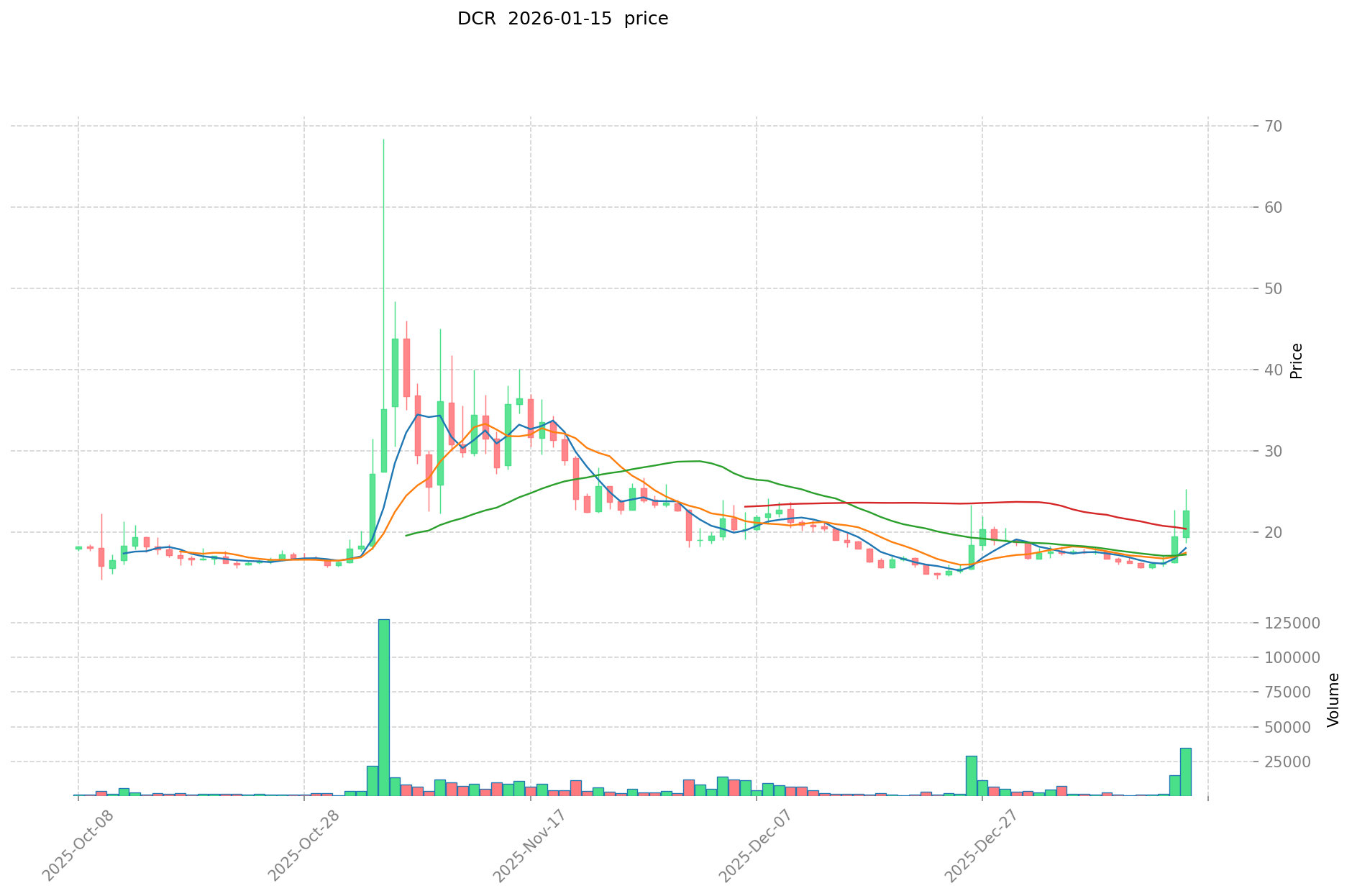
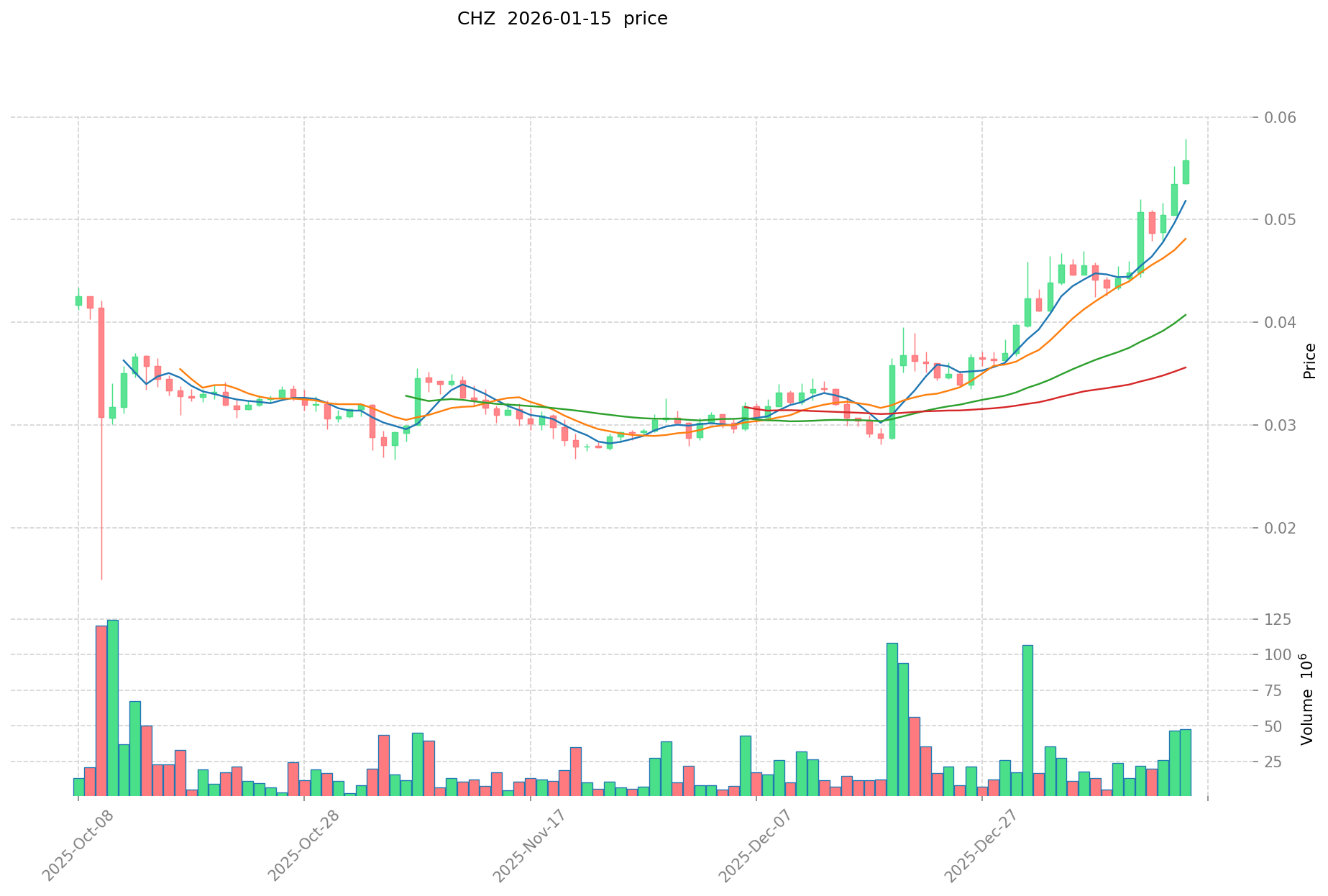
II. Core Factors Influencing DCR vs CHZ Investment Value
Supply Mechanism Comparison (Tokenomics)
-
DCR: According to available materials, DCR's tokenomics describes its economic model, including supply volume and distribution methods within the ecosystem. Factors such as total supply, circulating supply, and allocation ratios to teams, investors, or communities may influence its valuation, though specific supply mechanism details are not provided in the materials.
-
CHZ: The reference materials do not contain specific information regarding CHZ's supply mechanism, distribution model, or deflationary features.
-
📌 Historical Pattern: Supply mechanisms can drive price cycle changes through scarcity effects and distribution dynamics, though specific historical data for DCR and CHZ cycles is not available in the provided sources.
Institutional Adoption and Market Application
-
Institutional Holdings: The materials do not provide comparative data on institutional preference between DCR and CHZ.
-
Enterprise Adoption: Specific applications of DCR or CHZ in cross-border payments, settlement systems, or investment portfolios are not detailed in the reference materials.
-
National Policies: Regulatory attitudes from different jurisdictions toward DCR and CHZ are not covered in the provided sources.
Technical Development and Ecosystem Building
-
DCR Technical Upgrades: The materials mention DCR's use within its ecosystem but do not specify recent technical upgrades or their potential impacts.
-
CHZ Technical Development: No information regarding CHZ's technical roadmap or development milestones is available in the reference materials.
-
Ecosystem Comparison: The materials do not provide details on DeFi integration, NFT applications, payment systems, or smart contract implementations for either DCR or CHZ.
Macroeconomic and Market Cycles
-
Performance in Inflationary Environments: The materials note that both DCR and CHZ investment values are influenced by market trends and regulatory changes, but specific anti-inflation properties are not compared.
-
Macroeconomic Monetary Policy: The reference materials indicate that market trends affect both cryptocurrencies' values, though specific impacts from interest rates or dollar index movements are not detailed.
-
Geopolitical Factors: While the materials acknowledge that regulatory changes influence both tokens' investment value, specific geopolitical impacts on cross-border transaction demand are not elaborated.
III. 2026-2031 Price Forecast: DCR vs CHZ
Short-term Forecast (2026)
- DCR: Conservative $12.14-$22.07 | Optimistic $22.07-$31.56
- CHZ: Conservative $0.04-$0.06 | Optimistic $0.06-$0.08
Mid-term Forecast (2028-2029)
- DCR may enter a consolidation phase with projected price range of $25.68-$35.68
- CHZ may enter a growth phase with projected price range of $0.05-$0.09
- Key drivers: institutional capital inflows, ETF developments, ecosystem expansion
Long-term Forecast (2030-2031)
- DCR: Baseline scenario $22.09-$38.83 | Optimistic scenario $38.83-$43.15
- CHZ: Baseline scenario $0.05-$0.09 | Optimistic scenario $0.09-$0.10
View detailed price predictions for DCR and CHZ
Disclaimer
DCR:
| Year |
Predicted High Price |
Predicted Average Price |
Predicted Low Price |
Price Change |
| 2026 |
31.56296 |
22.072 |
12.1396 |
0 |
| 2027 |
37.0081224 |
26.81748 |
19.0404108 |
20 |
| 2028 |
34.784953308 |
31.9128012 |
26.806753008 |
43 |
| 2029 |
35.68329866178 |
33.348877254 |
25.67863548558 |
50 |
| 2030 |
43.1451099473625 |
34.51608795789 |
22.0902962930496 |
55 |
| 2031 |
40.3838229107313 |
38.83059895262625 |
31.841091141153525 |
75 |
CHZ:
| Year |
Predicted High Price |
Predicted Average Price |
Predicted Low Price |
Price Change |
| 2026 |
0.07533 |
0.0558 |
0.038502 |
0 |
| 2027 |
0.09375795 |
0.065565 |
0.0406503 |
17 |
| 2028 |
0.0844411635 |
0.079661475 |
0.05655964725 |
43 |
| 2029 |
0.0877949115975 |
0.08205131925 |
0.0467692519725 |
47 |
| 2030 |
0.092566195811887 |
0.08492311542375 |
0.052652331562725 |
52 |
| 2031 |
0.099394014291957 |
0.088744655617818 |
0.053246793370691 |
59 |
IV. Investment Strategy Comparison: DCR vs CHZ
Long-term vs Short-term Investment Strategies
-
DCR: May appeal to investors interested in decentralized governance models and hybrid consensus mechanisms. The token's community-driven framework and focus on balanced decision-making between miners and holders could attract those seeking projects with established governance structures.
-
CHZ: May suit investors exploring fan engagement and sports-related blockchain applications. The token's positioning within the sports and entertainment sectors through platforms like Socios.com could interest those evaluating niche market opportunities in digital fan experiences.
Risk Management and Asset Allocation
-
Conservative Investors: Consider diversified exposure with careful position sizing, such as DCR 40% vs CHZ 60%, balancing between established governance projects and sector-specific applications. Individual risk tolerance and market conditions should guide allocation decisions.
-
Aggressive Investors: May evaluate higher concentration strategies, such as DCR 60% vs CHZ 40%, based on conviction in specific technological or market developments. Higher allocations carry increased volatility exposure.
-
Hedging Tools: Portfolio management may incorporate stablecoin allocations for liquidity management, options strategies for downside protection, and cross-asset diversification to mitigate single-token concentration risks.
V. Potential Risk Comparison
Market Risks
-
DCR: The token faces market volatility common to mid-cap cryptocurrencies. Price movements may be influenced by broader market sentiment, trading volume fluctuations (currently $764,417.20 in 24-hour volume), and shifts in investor interest toward governance-focused projects.
-
CHZ: Market risks include sensitivity to sports industry trends and fan engagement adoption rates. The token's 24-hour trading volume of $2,772,886.38 reflects current market activity levels, while price performance may correlate with sports seasonality and partnership developments.
Technical Risks
-
DCR: Technical considerations include ongoing maintenance of its hybrid consensus mechanism, network participation rates from both miners and stakeholders, and the scalability of its governance infrastructure as the ecosystem evolves.
-
CHZ: Technical aspects involve platform reliability for fan voting systems, blockchain infrastructure supporting multiple fan tokens, and integration challenges with traditional sports organizations' existing technology frameworks.
Regulatory Risks
- Global regulatory developments may affect both projects differently based on their functional classifications. Governance tokens like DCR could face scrutiny regarding voting rights and decentralization claims, while fan engagement tokens like CHZ may encounter regulations specific to consumer protection, sports betting associations, or securities classifications in various jurisdictions. Evolving regulatory frameworks across regions could impact listing availability, trading access, and operational compliance requirements for both assets.
VI. Conclusion: Which Is the Better Buy?
📌 Investment Value Summary
-
DCR Characteristics: Established presence since 2016 with focus on community governance and hybrid consensus mechanisms. Current price of $22.164 reflects positioning within the mid-cap cryptocurrency segment, with projected price ranges suggesting potential consolidation and growth scenarios through 2031.
-
CHZ Characteristics: Sector-specific positioning in sports and entertainment fan engagement since 2019. Current price of $0.05572 represents a different market segment, with forecasts indicating potential growth aligned with fan token adoption and sports partnership expansion.
✅ Investment Considerations
-
Novice Investors: Consider starting with smaller position sizes in either asset while developing understanding of cryptocurrency market dynamics, volatility patterns, and project fundamentals. Educational resources and gradual exposure may help build familiarity with both governance-focused and application-specific tokens.
-
Experienced Investors: May evaluate portfolio inclusion based on existing holdings, sector exposure preferences, and risk-adjusted return expectations. Technical analysis, on-chain metrics, and ecosystem development tracking could inform positioning decisions between governance infrastructure and fan engagement applications.
-
Institutional Investors: Assessment may incorporate liquidity analysis, regulatory compliance frameworks, custody solutions, and alignment with investment mandates. Considerations might include governance token implications for portfolio construction and sector-specific exposure through sports-related digital assets.
⚠️ Risk Disclosure: Cryptocurrency markets exhibit high volatility and substantial risk of capital loss. This content does not constitute investment advice, financial guidance, or recommendations to buy, sell, or hold any digital assets. Individual circumstances, risk tolerance, and independent research should guide all investment decisions.
VII. FAQ
Q1: What are the fundamental differences between DCR and CHZ in terms of project purpose?
DCR (Decred) focuses on decentralized governance through a hybrid PoW/PoS consensus mechanism, while CHZ (Chiliz) targets sports and entertainment fan engagement. DCR, launched in 2016, emphasizes community-driven decision-making and balancing power between miners and token holders. CHZ, introduced in 2019, enables fans to participate in team management through the Socios.com platform, allowing voting rights on club decisions. These represent fundamentally different use cases—DCR as governance infrastructure versus CHZ as sector-specific consumer application.
Q2: How do the current trading volumes of DCR and CHZ compare, and what does this indicate?
CHZ demonstrates higher liquidity with $2,772,886.38 in 24-hour trading volume compared to DCR's $764,417.20. This approximately 3.6x volume difference suggests greater market activity and potentially easier entry/exit positions for CHZ. However, higher volume doesn't automatically indicate superior investment quality—it reflects CHZ's broader retail appeal through sports partnerships and fan engagement, while DCR's lower volume may indicate a more concentrated holder base focused on governance participation rather than active trading.
Q3: What are the price volatility patterns between DCR and CHZ based on their historical peaks?
DCR experienced more dramatic volatility, declining from its April 2021 peak of $247.35 to the current $22.164 (approximately 91% decline). CHZ fell from $0.878633 in March 2021 to $0.05572 (approximately 94% decline). Both tokens demonstrated similar percentage drawdowns from their all-time highs, reflecting broader cryptocurrency market cycles. This parallel performance suggests that despite different use cases, both remain highly correlated with general market sentiment and macroeconomic conditions affecting the entire crypto sector.
Q4: How do the 2026-2031 price forecasts differ between DCR and CHZ?
DCR's forecast range extends from $12.14-$43.15 (2026-2031), while CHZ projects $0.04-$0.10 over the same period. In percentage terms, DCR shows potential upside of approximately 95% to its optimistic 2031 target, while CHZ indicates roughly 79% potential appreciation. DCR's projections suggest consolidation followed by gradual growth, whereas CHZ forecasts assume steady expansion aligned with sports industry adoption. These trajectories reflect different growth drivers—DCR dependent on governance adoption and institutional interest, CHZ on fan token ecosystem expansion.
Q5: What risk profiles should investors consider when comparing DCR and CHZ?
DCR carries technical risks related to maintaining its hybrid consensus mechanism and sustaining network participation from both miners and stakeholders. CHZ faces platform reliability concerns for fan voting systems and dependency on sports partnership renewals. Regulatory risks differ significantly—DCR may encounter scrutiny regarding governance token classifications and voting rights, while CHZ could face regulations related to consumer protection, sports betting associations, or securities laws. Both face market volatility risks, but CHZ shows additional sensitivity to sports industry trends and seasonal factors affecting fan engagement.
Q6: Which token suits different investor profiles based on current market conditions?
Conservative investors might favor diversified exposure (DCR 40% / CHZ 60%) to balance established governance projects with sector-specific applications. Aggressive investors could consider DCR 60% / CHZ 40% if conviction exists regarding governance infrastructure adoption. Novice investors should start with smaller positions in either asset while learning market dynamics, whereas experienced investors may base selections on existing portfolio composition and sector exposure preferences. Institutional investors require additional evaluation of liquidity depth, custody solutions, and regulatory compliance frameworks—DCR offering governance infrastructure exposure, CHZ providing sports-digital asset sector access.
Q7: What are the key catalysts that could drive price performance for DCR versus CHZ through 2026?
DCR's potential catalysts include institutional adoption of governance-focused cryptocurrencies, technical upgrades enhancing its hybrid consensus mechanism, and broader market acceptance of decentralized decision-making models. CHZ's growth drivers center on expansion of sports partnerships beyond current clubs, successful integration of fan tokens into team operations, increased adoption of the Socios.com platform, and potential partnerships with major sports leagues. The current Fear & Greed Index of 61 (Greed) suggests moderate positive sentiment, which could benefit both tokens if sustained, though DCR may respond more to institutional capital flows while CHZ remains sensitive to consumer adoption metrics.
Q8: How do supply mechanisms and tokenomics affect the long-term investment thesis for DCR and CHZ?
While specific supply mechanism details are limited in available materials, tokenomics fundamentally impact long-term value propositions. DCR's economic model involves distribution between miners, stakeholders, and the development treasury, creating balanced incentives for network participation. CHZ's supply dynamics relate to fan token creation and platform utility. Investors should evaluate circulating versus total supply ratios, inflation or deflationary mechanisms, and token unlock schedules. The absence of detailed tokenomics data in current materials highlights the importance of independent research into allocation transparency, vesting periods, and whether supply mechanisms support sustainable price appreciation versus dilution risks.
* The information is not intended to be and does not constitute financial advice or any other recommendation of any sort offered or endorsed by Gate.