This comprehensive analysis compares DENT and QNT, two distinct blockchain utility tokens with different market positioning. DENT operates as a mobile data trading platform launched in 2017, while QNT serves as a blockchain interoperability solution introduced in 2018. The comparison examines historical price performance, current market status, tokenomics, institutional adoption, technology ecosystems, and investment strategies across conservative and aggressive profiles. QNT demonstrates stronger market presence with $1.16 billion capitalization versus DENT's $18.18 million, coupled with significantly higher trading volumes on Gate. The article provides detailed price forecasts through 2031, risk assessments including market and regulatory considerations, and tailored investment recommendations for novice, experienced, and institutional investors, concluding with comprehensive FAQ addressing key investment decision factors.
Introduction: Investment Comparison Between DENT and QNT
In the cryptocurrency market, the comparison between DENT vs QNT has been a topic of interest among investors. The two differ significantly in market cap ranking, application scenarios, and price performance, representing distinct positioning within the crypto asset landscape.
DENT (DENT): Launched in 2017, it has gained market recognition through its mobile data trading platform positioning.
QNT (QNT): Since its introduction in 2018, it has been positioned as a blockchain interoperability solution provider, ranking among cryptocurrencies with substantial market presence.
This article will provide a comprehensive analysis of the investment value comparison between DENT vs QNT, covering historical price trends, supply mechanisms, institutional adoption, technological ecosystems, and future forecasts, attempting to address investors' most pressing question:
"Which is the better buy right now?"
I. Historical Price Comparison and Current Market Status
Price History of DENT (Coin A) and QNT (Coin B)
- 2018: DENT reached a notable price level of $0.1006 on January 9, 2018, reflecting early market interest in the mobile data trading platform concept.
- 2018: QNT was launched in August 2018 with an initial price of $1.6, marking the entry of Quant Network's blockchain interoperability solution into the market.
- 2020: DENT experienced a significant downturn, recording a low of $0.00007065 on March 13, 2020, during a period of broader market volatility.
- 2021: QNT demonstrated substantial price appreciation, reaching $427.42 on September 11, 2021, reflecting growing recognition of its Overledger operating system technology.
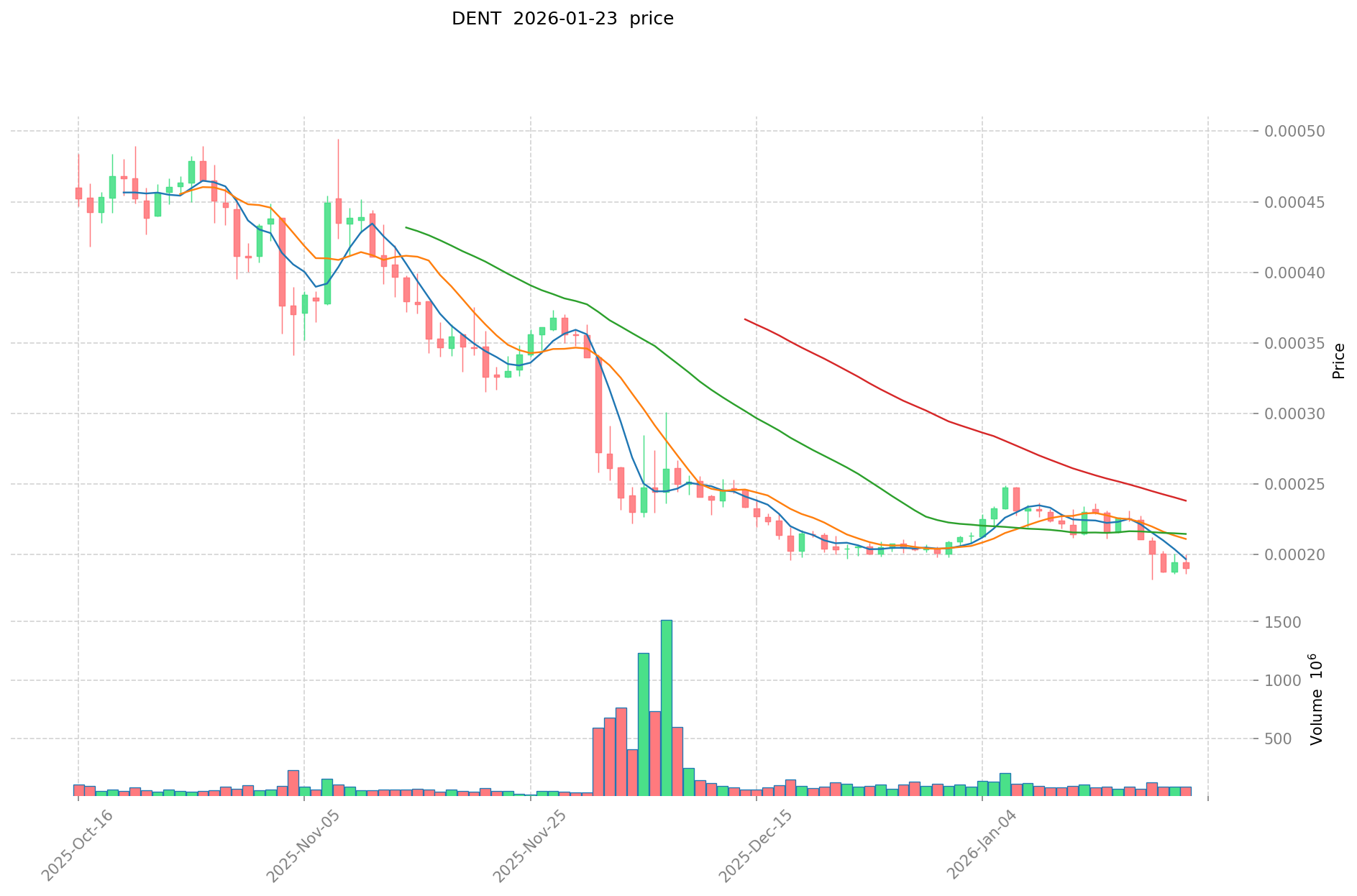
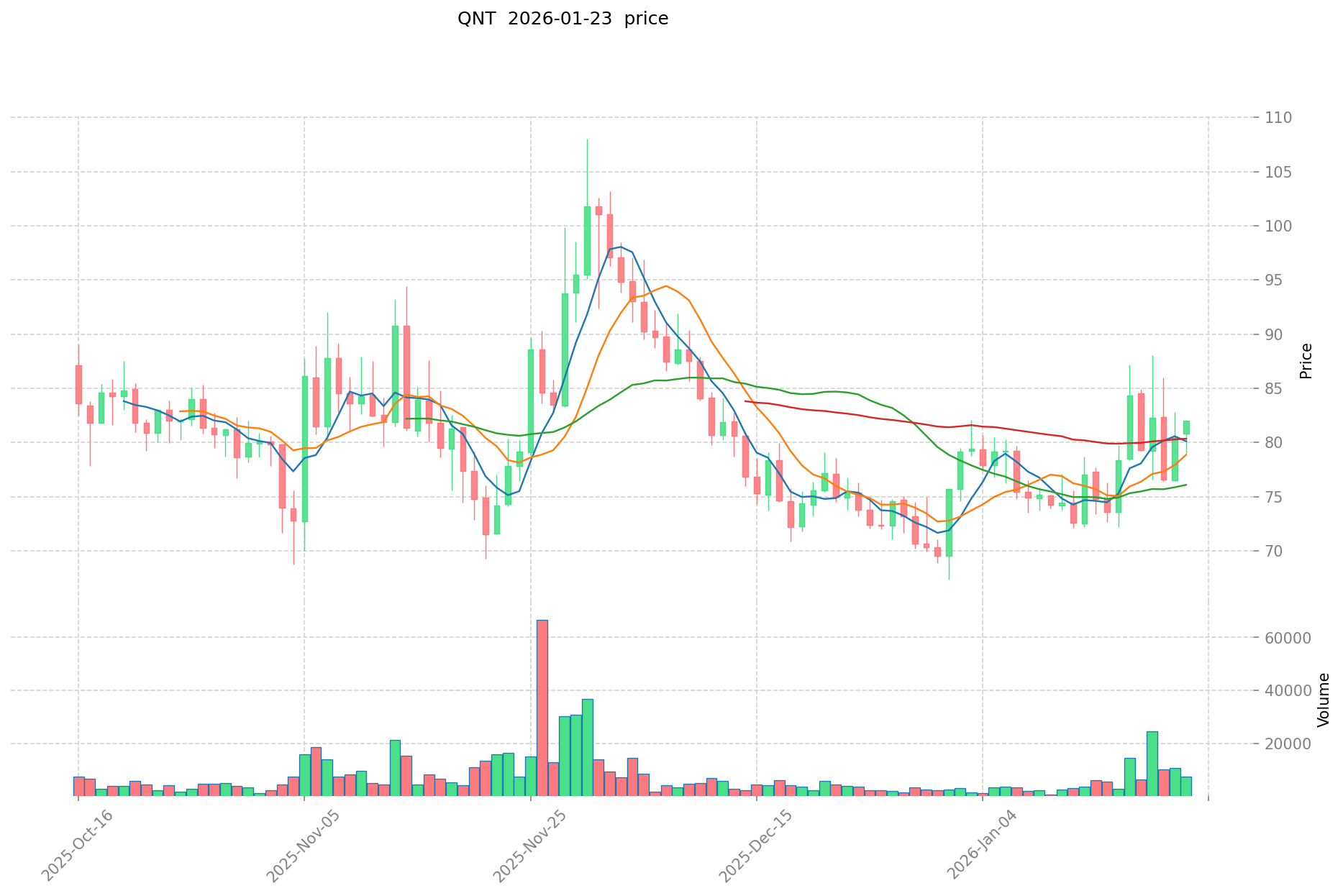
- Comparative Analysis: During the 2021-2022 market cycle, DENT declined from its historical high of $0.1006 to lower levels, while QNT exhibited more substantial price movements, ranging from its peak of $427.42 to current levels around $79.73.
Current Market Status (2026-01-23)
- DENT current price: $0.0001901
- QNT current price: $79.73
- 24-hour trading volume: DENT $15,589.11 vs QNT $561,777.69
- Market Capitalization: DENT $18,184,007.98 vs QNT $1,159,607,165.56
- Market sentiment index (Fear & Greed Index): 24 (Extreme Fear)
View real-time prices:
II. Core Factors Influencing DENT vs QNT Investment Value
Supply Mechanism Comparison (Tokenomics)
Due to limited available data on the specific supply mechanisms of DENT and QNT, a detailed comparison cannot be provided at this time. Tokenomics elements such as total supply, circulation mechanisms, and deflationary or inflationary models would typically play a significant role in long-term price dynamics.
Institutional Adoption and Market Applications
Without sufficient data on institutional holdings, enterprise adoption patterns, or specific regulatory stances across different jurisdictions for DENT and QNT, a comparative analysis of their market applications in cross-border payments, settlements, or investment portfolios cannot be established.
Technology Development and Ecosystem Building
Insufficient information is available regarding recent technical upgrades, development roadmaps, or ecosystem expansion for either DENT or QNT. A comprehensive comparison of their respective positions in DeFi, NFT markets, payment solutions, or smart contract implementations cannot be provided without additional data.
Macroeconomic Environment and Market Cycles
The relationship between macroeconomic factors and the performance of DENT and QNT requires specific historical data and correlation analysis. Without such information, assessments regarding their behavior during inflationary periods, responses to monetary policy shifts, interest rate changes, or geopolitical events remain inconclusive.
III. 2026-2031 Price Forecast: DENT vs QNT
Short-term Forecast (2026)
- DENT: Conservative $0.000119448 - $0.0001896 | Optimistic $0.000261648
- QNT: Conservative $66.2257 - $79.79 | Optimistic $116.4934
Mid-term Forecast (2028-2029)
- DENT may enter a gradual growth phase, with projected price range of $0.0002099882568 - $0.0003277865472 in 2028, potentially reaching $0.000224789868072 - $0.000376596012744 by 2029
- QNT may enter an expansion phase, with projected price range of $63.77247666 - $151.0400763 in 2028, potentially reaching $68.359619718 - $144.606887865 by 2029
- Key drivers: institutional capital inflows, ETF developments, ecosystem expansion
Long-term Forecast (2030-2031)
- DENT: Base scenario $0.000204119198979 - $0.000345964744033 | Optimistic scenario $0.000498189231407
- QNT: Base scenario $114.568093431225 - $163.5701092963875 | Optimistic scenario $194.648430062701125
View detailed price predictions for DENT and QNT
Disclaimer
DENT:
| Year |
Predicted High Price |
Predicted Average Price |
Predicted Low Price |
Price Change |
| 2026 |
0.000261648 |
0.0001896 |
0.000119448 |
0 |
| 2027 |
0.00028654248 |
0.000225624 |
0.00012860568 |
18 |
| 2028 |
0.0003277865472 |
0.00025608324 |
0.0002099882568 |
34 |
| 2029 |
0.000376596012744 |
0.0002919348936 |
0.000224789868072 |
53 |
| 2030 |
0.000357664034894 |
0.000334265453172 |
0.000207244580966 |
75 |
| 2031 |
0.000498189231407 |
0.000345964744033 |
0.000204119198979 |
81 |
QNT:
| Year |
Predicted High Price |
Predicted Average Price |
Predicted Low Price |
Price Change |
| 2026 |
116.4934 |
79.79 |
66.2257 |
0 |
| 2027 |
125.621376 |
98.1417 |
52.996518 |
23 |
| 2028 |
151.0400763 |
111.881538 |
63.77247666 |
40 |
| 2029 |
144.606887865 |
131.46080715 |
68.359619718 |
64 |
| 2030 |
189.106371085275 |
138.0338475075 |
114.568093431225 |
73 |
| 2031 |
194.648430062701125 |
163.5701092963875 |
148.848799459712625 |
105 |
IV. Investment Strategy Comparison: DENT vs QNT
Long-term vs Short-term Investment Strategies
- DENT: May be suitable for investors interested in exploring emerging mobile data marketplace concepts and seeking speculative opportunities in lower-capitalization assets with higher volatility profiles.
- QNT: May be suitable for investors focusing on blockchain interoperability infrastructure and seeking exposure to established projects with larger market capitalizations and institutional-grade positioning.
Risk Management and Asset Allocation
- Conservative Investors: DENT 10-15% vs QNT 85-90%
- Aggressive Investors: DENT 30-40% vs QNT 60-70%
- Hedging Tools: Stablecoin allocation, options strategies, cross-asset diversification
V. Potential Risk Comparison
Market Risk
- DENT: Higher volatility exposure due to smaller market capitalization ($18,184,007.98) and lower trading volumes ($15,589.11 in 24-hour period), which may result in increased price fluctuations and liquidity constraints during market stress periods.
- QNT: Market risk remains present despite larger capitalization ($1,159,607,165.56), with price movements influenced by broader cryptocurrency market cycles and sentiment shifts, as evidenced by the current Extreme Fear index reading of 24.
Technical Risk
- DENT: Network scalability considerations and platform stability factors may influence long-term viability, though specific technical infrastructure details require further evaluation.
- QNT: Technical architecture resilience and potential security considerations associated with blockchain interoperability solutions warrant ongoing assessment.
Regulatory Risk
- Global regulatory developments may affect both assets differently based on their respective use cases, with mobile data marketplace platforms and blockchain interoperability solutions potentially subject to varying jurisdictional frameworks and compliance requirements.
VI. Conclusion: Which Is the Better Buy?
📌 Investment Value Summary:
- DENT Advantages: Lower entry price point ($0.0001901) offering speculative opportunities, early positioning in mobile data trading concepts, potential for growth in niche market segments.
- QNT Advantages: Established market presence with substantial capitalization, positioning in blockchain interoperability infrastructure, demonstrated price resilience with historical peak of $427.42 in 2021.
✅ Investment Recommendations:
- Novice Investors: Consider starting with smaller allocations to both assets, prioritizing understanding of their respective use cases and risk profiles before committing significant capital. QNT may offer more established market positioning for initial exposure.
- Experienced Investors: Evaluate portfolio diversification strategies incorporating both assets based on risk tolerance, with QNT potentially serving as a core holding and DENT as a speculative position within a broader cryptocurrency allocation.
- Institutional Investors: Focus on due diligence regarding technical infrastructure, regulatory compliance frameworks, and long-term ecosystem development trajectories for both projects before making allocation decisions.
⚠️ Risk Disclosure: Cryptocurrency markets exhibit high volatility characteristics. This content does not constitute investment advice. Investors should conduct independent research and consult qualified financial advisors before making investment decisions.
VII. FAQ
Q1: What is the main difference between DENT and QNT in terms of market positioning?
DENT focuses on mobile data trading platforms while QNT specializes in blockchain interoperability solutions. DENT, launched in 2017, targets the telecommunications sector by facilitating mobile data marketplace transactions with a current market cap of $18.18 million. QNT, introduced in 2018, provides enterprise-grade blockchain interoperability through its Overledger operating system technology, commanding a significantly larger market capitalization of $1.16 billion, reflecting its positioning as infrastructure for cross-chain connectivity.
Q2: Which cryptocurrency has shown better historical price performance?
QNT has demonstrated substantially stronger historical price performance compared to DENT. QNT reached an all-time high of $427.42 on September 11, 2021, representing significant appreciation from its $1.6 launch price in August 2018. In contrast, DENT peaked at $0.1006 on January 9, 2018, and subsequently declined to a low of $0.00007065 in March 2020, maintaining price levels significantly below its historical peak through the current period at $0.0001901.
Q3: What are the projected price ranges for DENT and QNT by 2031?
According to the forecast models, DENT's projected price range for 2031 spans from a low of $0.000204119198979 to a high of $0.000498189231407, with an average projection of $0.000345964744033, representing an 81% increase from 2026 levels. QNT's 2031 projections range from $148.85 (low) to $194.65 (high), with an average of $163.57, indicating a 105% potential increase from 2026 baseline levels.
Q4: How do trading volumes compare between DENT and QNT?
QNT exhibits significantly higher trading volume compared to DENT. As of January 23, 2026, QNT's 24-hour trading volume stands at $561,777.69, approximately 36 times greater than DENT's $15,589.11. This substantial volume differential reflects QNT's greater market liquidity and institutional participation, which typically translates to tighter bid-ask spreads and reduced slippage risk for larger transactions compared to DENT's more constrained liquidity environment.
Q5: What portfolio allocation strategies are recommended for DENT vs QNT?
Portfolio allocation between DENT and QNT should align with individual risk tolerance profiles. Conservative investors might consider a 10-15% DENT allocation versus 85-90% QNT exposure, emphasizing the more established asset with larger market capitalization. Aggressive investors seeking higher growth potential could allocate 30-40% to DENT and 60-70% to QNT, accepting increased volatility risk in exchange for speculative upside potential in DENT's emerging mobile data marketplace concept.
Q6: What are the primary risk factors differentiating DENT and QNT investments?
DENT carries higher volatility risk due to its smaller market capitalization of $18.18 million and limited trading volumes, which may result in significant price fluctuations and liquidity constraints during market stress periods. QNT, despite its larger $1.16 billion market cap, faces risks related to blockchain interoperability technology adoption, enterprise implementation challenges, and broader cryptocurrency market cycle dynamics. Both assets remain subject to evolving regulatory frameworks that may affect their respective use cases differently across jurisdictions.
Q7: Which cryptocurrency is more suitable for novice investors?
QNT may present a more appropriate entry point for novice investors due to its established market presence, larger market capitalization, and relatively lower volatility compared to DENT. The substantial difference in trading volumes ($561,777.69 vs $15,589.11) indicates QNT offers better liquidity for entering and exiting positions. However, novice investors should begin with smaller allocations to either asset, prioritize understanding their distinct use cases, and consider QNT as a potential core holding within a diversified cryptocurrency portfolio while maintaining realistic expectations regarding market volatility inherent to all digital assets.
Q8: How does the current market sentiment affect DENT and QNT investment decisions?
The current Fear & Greed Index reading of 24 (Extreme Fear) suggests widespread market pessimism as of January 23, 2026. Historically, extreme fear conditions have presented accumulation opportunities for assets with strong fundamentals, though timing market bottoms remains challenging. In this environment, QNT's larger market cap and institutional positioning may provide relatively greater stability, while DENT's smaller capitalization could experience more pronounced downside volatility. Investors should consider dollar-cost averaging strategies rather than lump-sum investments during extreme fear periods to mitigate timing risk across both assets.
* The information is not intended to be and does not constitute financial advice or any other recommendation of any sort offered or endorsed by Gate.