This article thoroughly compares DERI and UNI, two prominent decentralized derivatives platforms, offering insights into their investment potential. It covers historical price trends, tokenomics, institutional adoption, technological advancements, and macroeconomic impacts. Aimed at both novice and experienced investors, it helps determine the better buy between DERI and UNI, providing strategies for different risk profiles. The article also addresses key investment questions and risks associated with these tokens. For real-time data, visit [Gate](https://www.gate.com/price/deri-protocol-deri) for DERI and [Gate](https://www.gate.com/priceuniswap-uni) for UNI.
Introduction: Investment Comparison of DERI vs UNI
In the cryptocurrency market, the comparison between DERI vs UNI has always been an unavoidable topic for investors. The two not only show significant differences in market cap ranking, application scenarios, and price performance, but also represent different positioning in crypto assets.
Deri Protocol (DERI): Since its launch in 2021, it has gained market recognition for its decentralized protocol for trading risk exposure.
Uniswap (UNI): Launched in 2020, it has been hailed as the pioneering automatic market-making protocol on Ethereum, and is one of the most widely traded and highest market cap cryptocurrencies globally.
This article will provide a comprehensive analysis of the investment value comparison between DERI vs UNI, focusing on historical price trends, supply mechanisms, institutional adoption, technological ecosystems, and future predictions, attempting to answer the question investors care most about:
"Which is the better buy right now?"
I. Price History Comparison and Current Market Status
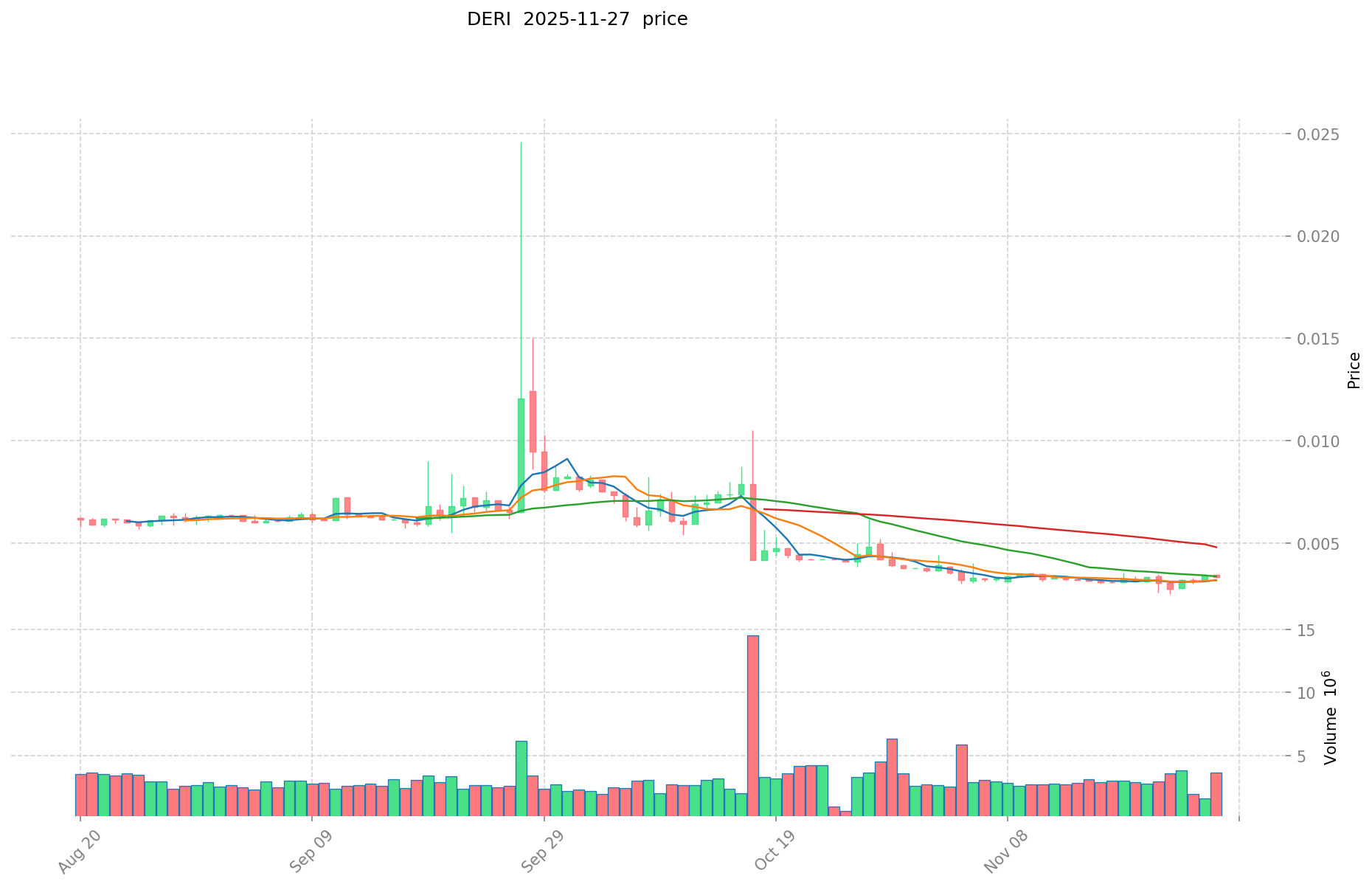
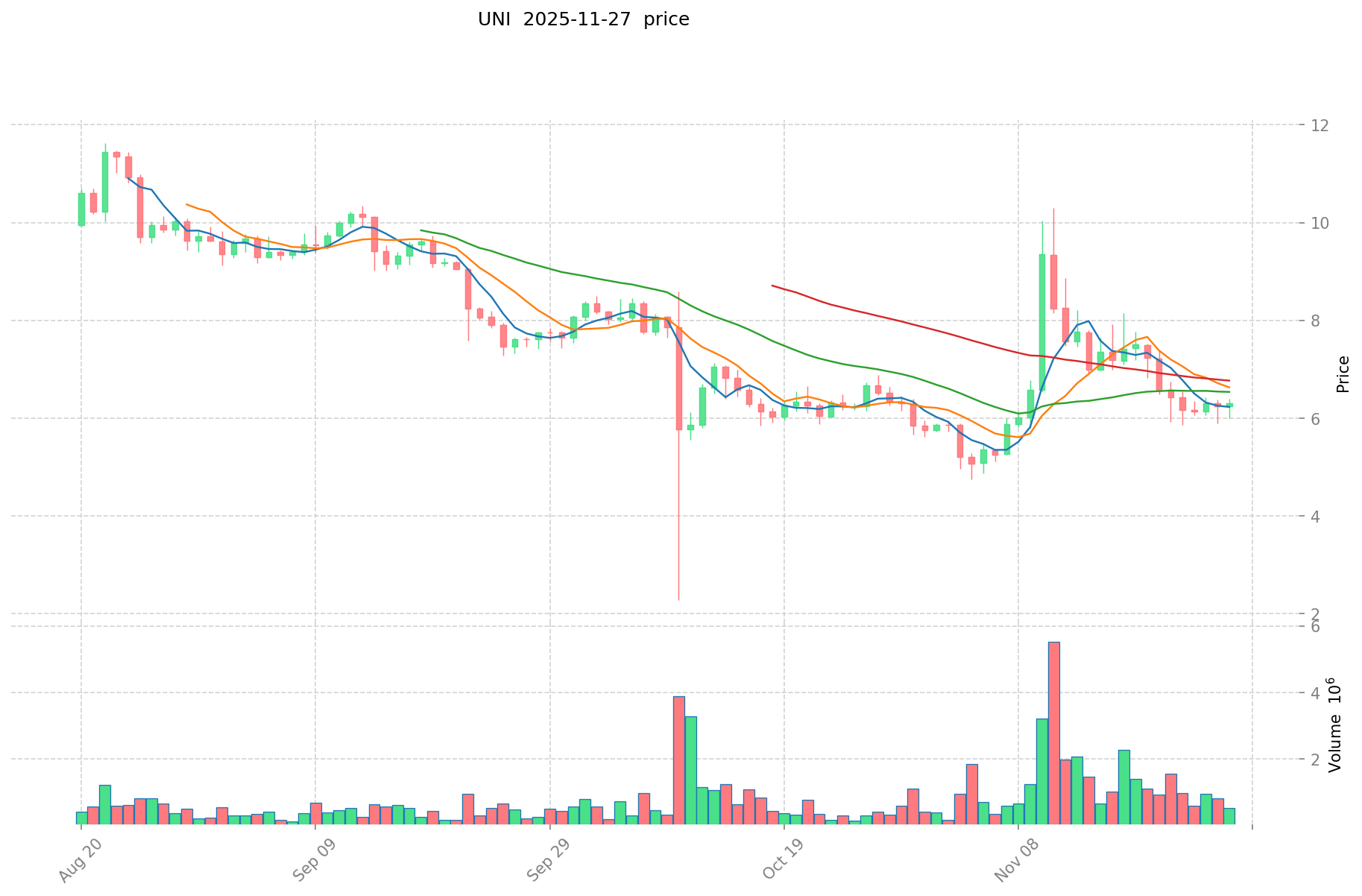
DERI (Coin A) and UNI (Coin B) Historical Price Trends
- 2021: DERI reached its all-time high of $3.77 on February 13, 2021.
- 2020: UNI was launched in September 2020, with its price starting around $1.03.
- Comparative analysis: Since their respective peaks, DERI has fallen from $3.77 to $0.003356, while UNI has declined from its all-time high of $44.92 to $6.348.
Current Market Situation (2025-11-27)
- DERI current price: $0.003356
- UNI current price: $6.348
- 24-hour trading volume: DERI $12,472.14 vs UNI $3,689,242.92
- Market Sentiment Index (Fear & Greed Index): 22 (Extreme Fear)
Click to view real-time prices:
- View DERI current price Market Price
- View UNI current price Market Price
II. Core Factors Affecting the Investment Value of DERI vs UNI
Supply Mechanisms Comparison (Tokenomics)
- DERI: Fixed supply of 1 billion tokens with emission schedule designed to distribute tokens to various stakeholders over time. DERI token has governance rights over the protocol.
- UNI: Fixed supply of 1 billion tokens with phased distribution across community, team, investors and treasury. UNI token enables governance participation in the Uniswap protocol.
- 📌 Historical pattern: Fixed supply models in both tokens create potential scarcity, but value is more strongly influenced by utility and protocol adoption than by supply mechanics alone.
Institutional Adoption and Market Applications
- Institutional holdings: UNI has significantly greater institutional adoption, with major firms like a16z, Paradigm, and traditional financial institutions including the token in their portfolios.
- Enterprise adoption: UNI has broader integration across DeFi ecosystems as the standard for decentralized exchange infrastructure, while DERI serves a more specialized derivatives market niche.
- Regulatory attitudes: Both face regulatory scrutiny in various jurisdictions, with decentralized derivatives platforms like DERI potentially facing heightened regulatory concerns in certain regions.
Technical Development and Ecosystem Building
- DERI technical upgrades: Focus on expanding derivative trading capabilities, including perpetual swaps and options across multiple blockchain networks with enhanced capital efficiency.
- UNI technical development: Progressive versions (v2, v3) have introduced concentrated liquidity, cross-chain deployments, and fee tiers, with continued development toward optimized trading and Layer 2 integrations.
- Ecosystem comparison: UNI maintains broader ecosystem adoption as foundational DeFi infrastructure with extensive integrations, while DERI serves specialized derivative trading with more limited but focused ecosystem connections.
Macroeconomic Factors and Market Cycles
- Performance during inflation: Neither has demonstrated clear anti-inflation properties, with both showing high correlation to broader crypto market cycles.
- Macroeconomic monetary policy: Both tokens demonstrate sensitivity to interest rate changes and dollar strength, with risk-off environments generally negative for both assets.
- Geopolitical factors: Regulatory developments regarding derivatives trading and decentralized exchanges across major jurisdictions represent significant risk factors for both tokens.
III. 2025-2030 Price Prediction: DERI vs UNI
Short-term Prediction (2025)
- DERI: Conservative $0.00237495 - $0.003345 | Optimistic $0.003345 - $0.00491715
- UNI: Conservative $3.831 - $6.385 | Optimistic $6.385 - $9.38595
Mid-term Prediction (2027)
- DERI may enter a growth phase, with prices estimated between $0.0046598526 - $0.0052051545
- UNI may enter a bullish market, with prices estimated between $6.3754065375 - $13.42699255625
- Key drivers: Institutional capital inflow, ETF developments, ecosystem growth
Long-term Prediction (2030)
- DERI: Base scenario $0.006373377068175 - $0.009241396748853 | Optimistic scenario $0.009241396748853+
- UNI: Base scenario $15.224523939937812 - $22.532295431107962 | Optimistic scenario $22.532295431107962+
View detailed price predictions for DERI and UNI
Disclaimer: The above predictions are based on historical data and market analysis. Cryptocurrency markets are highly volatile and subject to change. This information should not be considered as financial advice. Always conduct your own research before making investment decisions.
DERI:
| 年份 |
预测最高价 |
预测平均价格 |
预测最低价 |
涨跌幅 |
| 2025 |
0.00491715 |
0.003345 |
0.00237495 |
0 |
| 2026 |
0.005783505 |
0.004131075 |
0.00318092775 |
23 |
| 2027 |
0.0052051545 |
0.00495729 |
0.0046598526 |
47 |
| 2028 |
0.006402340035 |
0.00508122225 |
0.00386172891 |
51 |
| 2029 |
0.00700497299385 |
0.0057417811425 |
0.0039044111769 |
71 |
| 2030 |
0.009241396748853 |
0.006373377068175 |
0.004270162635677 |
89 |
UNI:
| 年份 |
预测最高价 |
预测平均价格 |
预测最低价 |
涨跌幅 |
| 2025 |
9.38595 |
6.385 |
3.831 |
0 |
| 2026 |
11.43393875 |
7.885475 |
5.59868725 |
24 |
| 2027 |
13.42699255625 |
9.659706875 |
6.3754065375 |
52 |
| 2028 |
16.3915565961875 |
11.543349715625 |
9.81184725828125 |
81 |
| 2029 |
16.481594723969375 |
13.96745315590625 |
8.659820956661875 |
120 |
| 2030 |
22.532295431107962 |
15.224523939937812 |
12.17961915195025 |
139 |
IV. Investment Strategy Comparison: DERI vs UNI
Long-term vs Short-term Investment Strategies
- DERI: Suitable for investors focused on derivative trading and niche DeFi applications
- UNI: Suitable for investors seeking broader DeFi exposure and protocol governance participation
Risk Management and Asset Allocation
- Conservative investors: DERI: 5% vs UNI: 15%
- Aggressive investors: DERI: 15% vs UNI: 30%
- Hedging tools: Stablecoin allocation, options, cross-token portfolios
V. Potential Risk Comparison
Market Risk
- DERI: Higher volatility due to smaller market cap and specialized use case
- UNI: Susceptible to broader DeFi market trends and competition from other DEX protocols
Technical Risk
- DERI: Scalability, network stability in derivative trading scenarios
- UNI: Smart contract vulnerabilities, liquidity pool imbalances
Regulatory Risk
- Global regulatory policies may have differing impacts on derivative platforms (DERI) versus decentralized exchanges (UNI)
VI. Conclusion: Which Is the Better Buy?
📌 Investment Value Summary:
- DERI advantages: Specialized in derivatives trading, potential for high growth in a niche market
- UNI advantages: Established market leader in DEX space, wider ecosystem adoption, stronger institutional backing
✅ Investment Advice:
- New investors: Consider UNI for its established position and broader market exposure
- Experienced investors: Balanced portfolio including both DERI and UNI, with emphasis on risk management
- Institutional investors: UNI for its liquidity and market cap, DERI for diversification in derivative trading exposure
⚠️ Risk Warning: Cryptocurrency markets are highly volatile. This article does not constitute investment advice.
None
VII. FAQ
Q1: What are the main differences between DERI and UNI?
A: DERI focuses on decentralized derivatives trading, while UNI is a leading decentralized exchange protocol. UNI has a larger market cap, higher trading volume, and broader institutional adoption compared to DERI.
Q2: Which token has performed better historically?
A: UNI has generally shown better historical performance. While DERI's all-time high was $3.77, UNI reached $44.92. Currently, UNI trades at $6.348, while DERI is at $0.003356.
Q3: How do the supply mechanisms of DERI and UNI compare?
A: Both DERI and UNI have a fixed supply of 1 billion tokens. However, UNI has a more established distribution across community, team, investors, and treasury, while DERI's emission schedule is designed to distribute tokens to various stakeholders over time.
Q4: Which token has greater institutional adoption?
A: UNI has significantly greater institutional adoption, with major firms like a16z, Paradigm, and traditional financial institutions including it in their portfolios. DERI has more limited institutional backing.
Q5: What are the key factors that could influence the future prices of DERI and UNI?
A: Key factors include institutional capital inflow, ETF developments, ecosystem growth, regulatory developments, and overall market conditions in the cryptocurrency and DeFi sectors.
Q6: How do the investment strategies differ for DERI and UNI?
A: DERI is more suitable for investors focused on derivative trading and niche DeFi applications, while UNI is better for those seeking broader DeFi exposure and protocol governance participation. Conservative investors might allocate 5% to DERI and 15% to UNI, while aggressive investors might allocate 15% to DERI and 30% to UNI.
Q7: What are the main risks associated with investing in DERI and UNI?
A: Both face market risks, technical risks, and regulatory risks. DERI may have higher volatility due to its smaller market cap and specialized use case. UNI is susceptible to broader DeFi market trends and competition. Both face potential regulatory challenges, with DERI possibly facing heightened scrutiny due to its focus on derivatives trading.
* The information is not intended to be and does not constitute financial advice or any other recommendation of any sort offered or endorsed by Gate.













