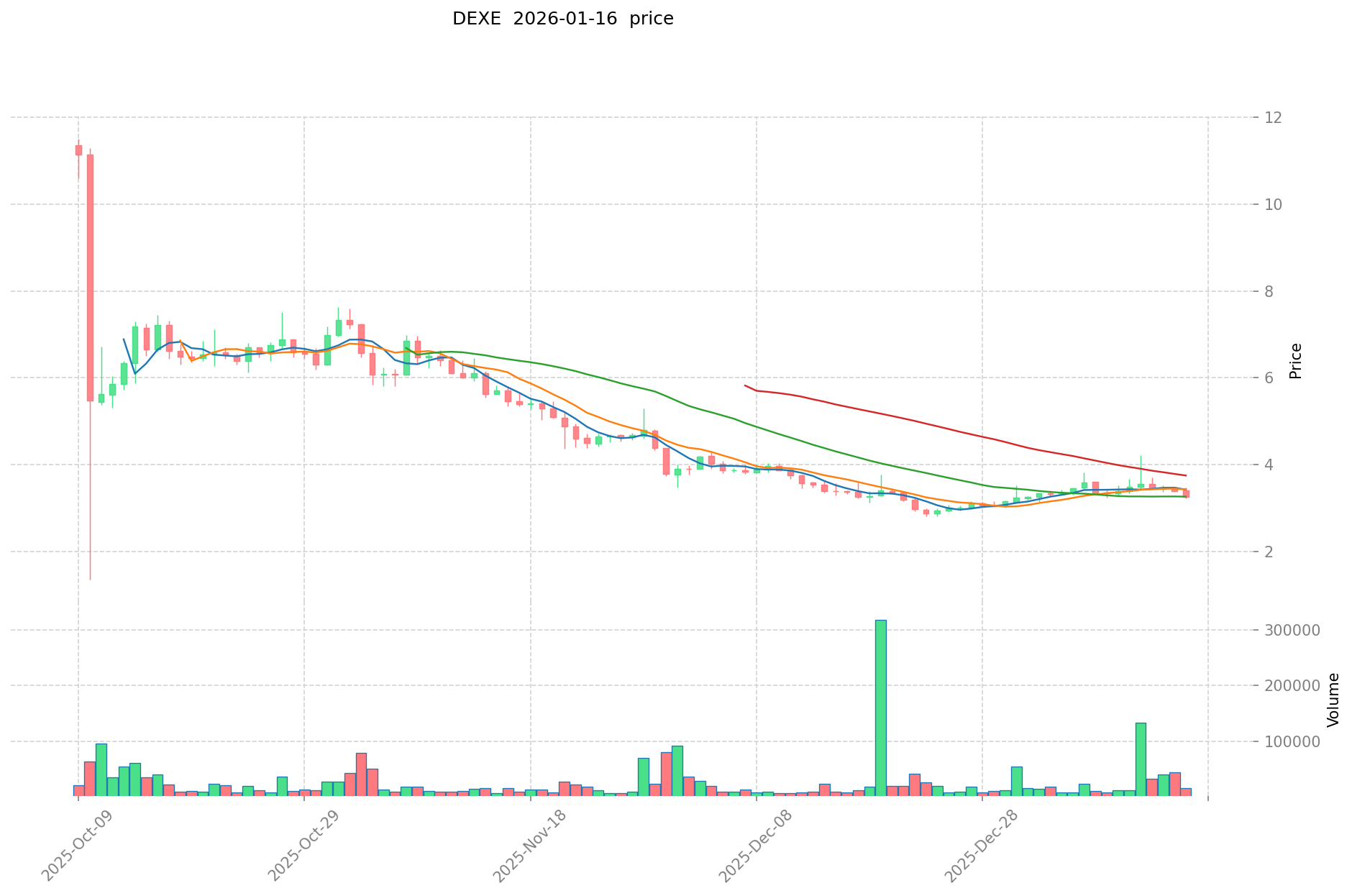
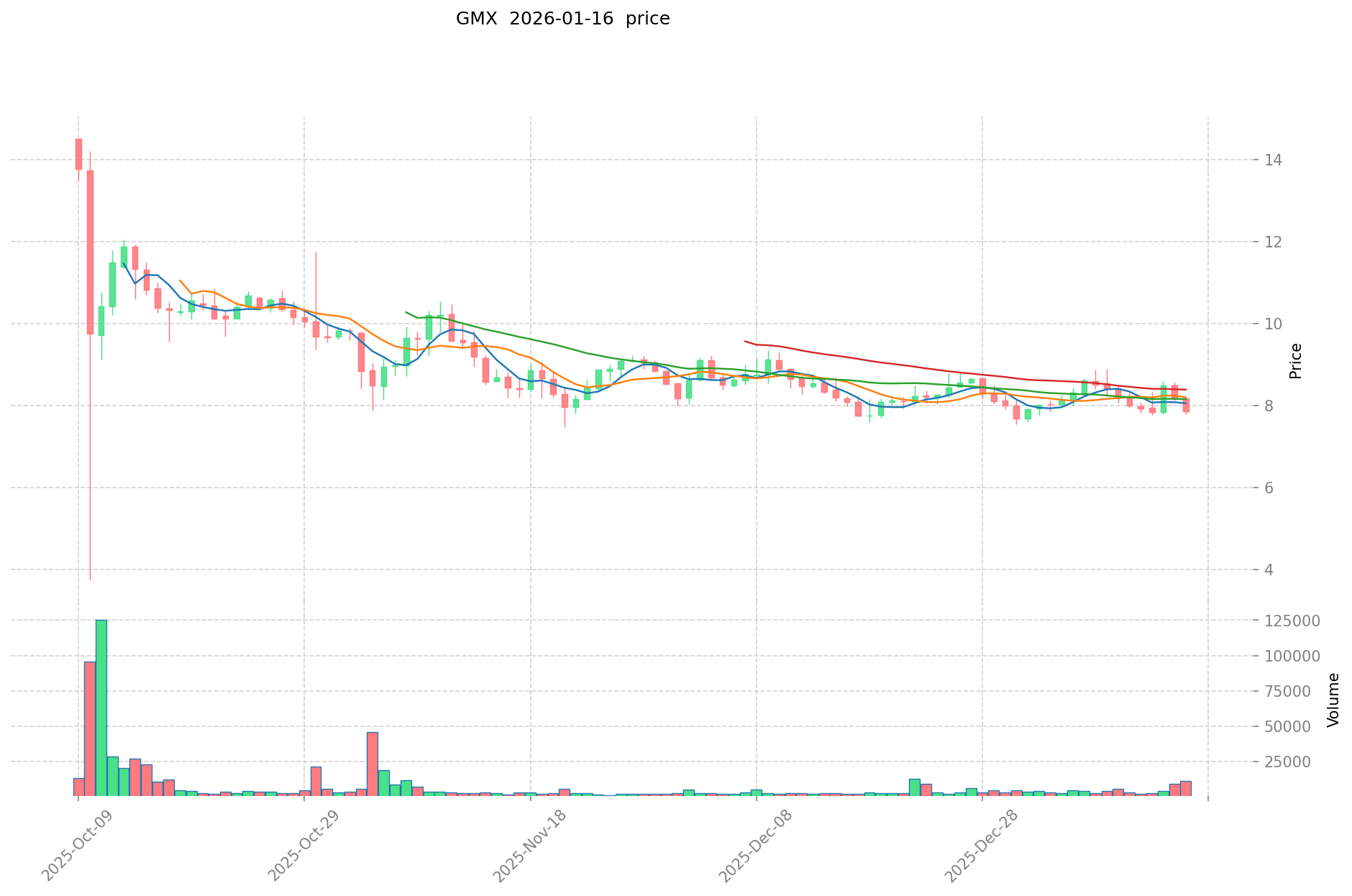
This comprehensive comparison analyzes DEXE and GMX, two leading decentralized finance protocols reshaping the DeFi landscape. DEXE, a governance token for decentralized portfolio management, currently trades at $3.229, while GMX, a perpetual exchange token, trades at $7.969 on Gate. The article examines historical price trends, tokenomics differences, and technical ecosystems of both assets. DEXE offers governance-focused staking mechanisms with deflationary buyback features, whereas GMX provides direct fee-sharing revenue distribution to token holders. Market analysis covers institutional adoption, regulatory considerations, and macroeconomic factors influencing both tokens. Long-term price forecasts (2026-2031) suggest GMX's stronger growth trajectory, though both assets face comparable volatility risks. Investment recommendations differ by investor profile: conservative portfolios favor GMX exposure (70%), while aggressive strategies increase DEXE allocation (55%). The analysis addresses trading volume, l
Introduction: Investment Comparison Between DEXE and GMX
In the cryptocurrency market, the comparison between DEXE vs GMX has been a topic that investors cannot avoid. The two differ significantly in market cap ranking, application scenarios, and price performance, representing different crypto asset positioning.
DEXE (DEXE): Launched in 2020, it has gained market recognition with its positioning as a decentralized and autonomous cryptocurrency portfolio environment. As an ERC-20 native functional token, DEXE serves governance, reward distribution, and insurance functions within the DeXe.network ecosystem.
GMX (GMX): As a decentralized perpetual exchange, GMX has established itself as both a utility and governance token. The platform allocates 30% of generated fees to GMX token holders, creating a revenue-sharing mechanism that appeals to investors seeking exposure to decentralized derivatives trading.
This article will comprehensively analyze the investment value comparison of DEXE vs GMX, covering historical price trends, supply mechanisms, technical ecosystems, and future predictions, attempting to answer the question that investors care about most:
"Which is the better buy right now?"
I. Historical Price Comparison and Current Market Status
DEXE and GMX Historical Price Trends
- 2021: DEXE reached a peak price of $32.38 on March 8, 2021, during the broader cryptocurrency bull market cycle.
- 2023: GMX recorded its historical high of $91.07 on April 18, 2023, benefiting from increased adoption of decentralized perpetual exchange platforms.
- Comparative Analysis: During the 2025 market correction, DEXE declined from its all-time high by approximately 90%, while GMX experienced a similar downward trajectory with a decline of over 91% from its peak. Both assets demonstrated significant volatility characteristic of mid-cap DeFi tokens during market downturns.
Current Market Status (January 16, 2026)
- DEXE Current Price: $3.229
- GMX Current Price: $7.969
- 24-Hour Trading Volume: DEXE recorded $60,689.61 compared to GMX's $76,927.56
- Market Sentiment Index (Fear & Greed Index): 49 (Neutral)
View real-time prices:
II. Core Factors Affecting DEXE vs GMX Investment Value
Tokenomics Comparison
- DEXE: The token serves governance, staking rewards, and insurance purposes. A portion of transaction fees (30%) is allocated to buyback mechanisms, which may contribute to deflationary pressure over time.
- GMX: The token functions within liquidity pool frameworks and is influenced by market conditions. Its design focuses on optimizing trading experiences and market efficiency through isolated pools and liquidity provision strategies.
- 📌 Historical Pattern: Supply mechanisms influence price cycles through demand-supply dynamics and utility integration within their respective ecosystems.
Institutional Adoption and Market Application
- Institutional Holdings: Information regarding institutional preference between DEXE and GMX is limited in the available materials.
- Enterprise Adoption: Both projects aim to enhance trading experiences within decentralized finance environments, though specific applications in cross-border payments or settlement systems are not detailed in the provided sources.
- National Policies: Regulatory approaches toward DEXE and GMX vary across jurisdictions, though concrete policy stances are not extensively covered in the reference materials.
Technical Development and Ecosystem Building
- DEXE Technical Progress: The token integrates governance mechanisms and insurance functions, with staking pools offering yields in certain DAO structures.
- GMX Technical Development: The platform emphasizes V2 isolated pools to optimize liquidity allocation and trading conditions, aiming to improve execution efficiency during market volatility.
- Ecosystem Comparison: Both projects operate within DeFi frameworks, though specific implementations in NFT, payment systems, or smart contract applications require further research beyond the provided materials.
Macroeconomic Factors and Market Cycles
- Performance Under Inflation: The reference materials do not provide sufficient data to assess which asset demonstrates stronger inflation-resistant characteristics.
- Macroeconomic Monetary Policy: Interest rate fluctuations and dollar index movements may impact both assets, though detailed correlations are not documented in the available sources.
- Geopolitical Factors: Cross-border transaction demand and international situations could influence market dynamics, but specific impacts on DEXE and GMX are not elaborated in the provided materials.
III. 2026-2031 Price Forecast: DEXE vs GMX
Short-term Forecast (2026)
- DEXE: Conservative $2.10-$3.24 | Optimistic $3.24-$4.37
- GMX: Conservative $6.40-$8.00 | Optimistic $8.00-$10.64
Mid-term Forecast (2028-2029)
- DEXE may enter a consolidation phase, with projected prices ranging from $2.20 to $5.82
- GMX may enter a growth phase, with projected prices ranging from $8.06 to $12.86
- Key drivers: institutional capital inflows, ETF developments, ecosystem expansion
Long-term Forecast (2030-2031)
- DEXE: Baseline scenario $3.38-$5.73 | Optimistic scenario $5.07-$7.33
- GMX: Baseline scenario $10.73-$14.91 | Optimistic scenario $12.27-$17.55
View detailed price predictions for DEXE and GMX
Disclaimer
DEXE:
| Year |
Predicted High Price |
Predicted Average Price |
Predicted Low Price |
Price Change |
| 2026 |
4.3713 |
3.238 |
2.1047 |
0 |
| 2027 |
4.489487 |
3.80465 |
3.576371 |
17 |
| 2028 |
4.47883398 |
4.1470685 |
2.197946305 |
28 |
| 2029 |
5.822484174 |
4.31295124 |
3.4934905044 |
33 |
| 2030 |
6.38532431082 |
5.067717707 |
4.15552851974 |
56 |
| 2031 |
7.3299468914048 |
5.72652100891 |
3.3786473952569 |
77 |
GMX:
| Year |
Predicted High Price |
Predicted Average Price |
Predicted Low Price |
Price Change |
| 2026 |
10.64133 |
8.001 |
6.4008 |
0 |
| 2027 |
12.02430285 |
9.321165 |
8.48226015 |
16 |
| 2028 |
12.70055337075 |
10.672733925 |
8.965096497 |
33 |
| 2029 |
12.8553080126625 |
11.686643647875 |
8.06378411703375 |
46 |
| 2030 |
17.547495437284312 |
12.27097583026875 |
11.412007522149937 |
53 |
| 2031 |
15.803789771803123 |
14.909235633776531 |
10.734649656319102 |
87 |
IV. Investment Strategy Comparison: DEXE vs GMX
Long-term vs Short-term Investment Strategies
- DEXE: Suitable for investors interested in decentralized governance ecosystems and portfolio management platforms, particularly those seeking exposure to DAO-based structures with staking yield opportunities
- GMX: Suitable for investors focused on decentralized derivatives trading infrastructure and perpetual exchange platforms, especially those attracted to fee-sharing revenue models and liquidity provision mechanisms
Risk Management and Asset Allocation
- Conservative Investors: DEXE 30% vs GMX 70%
- Aggressive Investors: DEXE 55% vs GMX 45%
- Hedging Tools: stablecoin allocation, options strategies, cross-asset portfolio diversification
V. Potential Risk Comparison
Market Risk
- DEXE: Exposure to DAO governance adoption cycles and shifts in decentralized portfolio management demand, with price volatility influenced by broader DeFi sector sentiment
- GMX: Sensitivity to perpetual exchange trading volume fluctuations and competitive pressures from alternative decentralized derivatives platforms
Technical Risk
- DEXE: Scalability considerations in governance mechanisms, network stability dependent on underlying blockchain infrastructure
- GMX: Liquidity pool optimization challenges, potential smart contract vulnerabilities in complex derivatives protocols
Regulatory Risk
- Global regulatory frameworks may impact both assets differently, with DEXE potentially facing governance-related compliance scrutiny and GMX subject to derivatives trading regulations across various jurisdictions
VI. Conclusion: Which Is the Better Buy?
📌 Investment Value Summary:
- DEXE Advantages: Governance-focused ecosystem with staking mechanisms, positioning in decentralized portfolio management sector, deflationary elements through buyback programs
- GMX Advantages: Revenue-sharing model through fee distribution, established presence in decentralized perpetual exchange market, V2 isolated pool optimizations for improved trading conditions
✅ Investment Recommendations:
- Novice Investors: Consider starting with smaller allocations to both assets while monitoring market cycles and ecosystem developments, prioritizing risk management through diversified exposure
- Experienced Investors: Evaluate portfolio positioning based on DeFi sector rotation between governance platforms and derivatives infrastructure, utilizing technical analysis alongside fundamental research
- Institutional Investors: Assess both assets within broader DeFi allocation strategies, considering liquidity profiles, regulatory exposure, and correlation with traditional financial markets
⚠️ Risk Disclaimer: The cryptocurrency market exhibits significant volatility. This article does not constitute investment advice.
VII. FAQ
Q1: Which token has shown better price resilience during market downturns - DEXE or GMX?
Both DEXE and GMX have demonstrated similar vulnerability during market corrections, with each declining over 90% from their respective all-time highs during the 2025 downturn. DEXE peaked at $32.38 in March 2021 and currently trades at $3.229, while GMX reached $91.07 in April 2023 and now sits at $7.969. This comparable downside performance suggests neither asset has established superior defensive characteristics during bear markets, reflecting the high-volatility nature of mid-cap DeFi tokens.
Q2: How do the revenue models of DEXE and GMX differ for token holders?
GMX offers a direct revenue-sharing mechanism, allocating 30% of platform-generated trading fees to GMX token holders, creating immediate yield opportunities tied to exchange volume. DEXE implements an indirect value accrual model through a buyback mechanism that uses 30% of transaction fees to repurchase tokens from the market, potentially creating deflationary pressure over time. GMX provides more transparent cash flow visibility, while DEXE's approach focuses on long-term supply reduction rather than immediate distribution.
Q3: What are the primary use cases distinguishing DEXE from GMX?
DEXE functions as a governance and infrastructure token for decentralized portfolio management and DAO ecosystems, serving investors interested in autonomous investment structures and collective decision-making frameworks. GMX operates as both a utility and governance token within a decentralized perpetual exchange platform, targeting traders seeking exposure to derivatives markets and liquidity providers attracted to fee-sharing opportunities. The fundamental distinction lies between governance-oriented portfolio management (DEXE) versus trading infrastructure (GMX).
Q4: Which token offers better long-term growth potential according to 2031 forecasts?
Based on price projections, GMX demonstrates stronger upside potential with predicted average prices reaching $14.91 by 2031 (87% increase from 2026 baseline), compared to DEXE's forecasted $5.73 average (77% increase). GMX's optimistic scenario projects highs of $17.55 versus DEXE's $7.33. However, these forecasts depend heavily on ecosystem adoption rates, regulatory developments, and overall DeFi sector growth, making actual outcomes highly uncertain and subject to numerous variables beyond current modeling assumptions.
Q5: How should portfolio allocation differ between conservative and aggressive investors for DEXE vs GMX?
Conservative investors are recommended to allocate 30% DEXE and 70% GMX, favoring GMX's established revenue-sharing model and more liquid market positioning. Aggressive investors might consider a 55% DEXE and 45% GMX split, accepting higher exposure to DEXE's governance-focused ecosystem with potentially greater volatility but corresponding upside if DAO adoption accelerates. Both strategies should incorporate stablecoin positions and hedging mechanisms to manage downside risk in volatile market conditions.
Q6: What technical developments differentiate the two platforms' competitive positioning?
GMX has prioritized V2 isolated pool architecture to optimize liquidity allocation and improve execution efficiency during volatile market conditions, addressing trader needs for better price discovery and reduced slippage. DEXE focuses on governance mechanisms and insurance functions integrated with staking pools that offer yields within DAO structures. GMX's technical roadmap emphasizes trading infrastructure refinement, while DEXE concentrates on expanding decentralized decision-making frameworks and portfolio management tools.
Q7: Which token faces greater regulatory uncertainty moving forward?
Both assets face jurisdiction-specific regulatory challenges, but GMX may encounter more immediate scrutiny due to its derivatives trading functionality, which attracts attention from financial regulators concerned with leverage, market manipulation, and investor protection in perpetual contract markets. DEXE's governance-focused model might face compliance requirements around securities classification for DAO tokens and voting rights structures. The regulatory landscape remains evolving, with neither token demonstrating clear advantages in navigating future policy frameworks across major markets.
Q8: What market indicators should investors monitor to time entry points for DEXE vs GMX?
Key metrics include 24-hour trading volume trends (currently $60,689 for DEXE vs $76,927 for GMX), which indicate liquidity depth and market interest. The Fear & Greed Index (currently 49-neutral) provides sentiment context for broader market timing. Additionally, investors should track DeFi Total Value Locked (TVL) trends, perpetual exchange volume growth for GMX, DAO treasury activity for DEXE, and correlation patterns with major assets like Bitcoin and Ethereum to identify favorable risk-reward entry opportunities during sector-specific rotations.
* The information is not intended to be and does not constitute financial advice or any other recommendation of any sort offered or endorsed by Gate.