This comprehensive analysis compares DIAM and STX, two distinct blockchain platforms serving different market positions on Gate. DIAM, launched February 2025, emphasizes democratizing the digital economy through accessible blockchain infrastructure, currently trading at $0.009242 with limited liquidity of $11,682 daily volume. STX, operational since October 2019, functions as decentralized application internet infrastructure, trading at $0.287 with significantly higher trading volume of $531,051.75. The comparison examines critical investment dimensions including historical price trajectories, tokenomics structures, institutional adoption patterns, technological ecosystems, and risk profiles. DIAM exhibits early-stage volatility characteristic of newly launched tokens, while STX demonstrates longer market cycle exposure with extended operational history. The article provides multi-year analysis, investment strategy frameworks for conservative and aggressive investors, and detailed risk assessment, enabling re
Introduction: DIAM vs STX Investment Comparison
In the cryptocurrency market, the comparison between DIAM and STX has become a topic of interest for investors. The two differ significantly in market cap ranking, application scenarios, and price performance, representing different crypto asset positioning.
DIAMANTE (DIAM): Launched in February 2025, it aims to democratize the digital economy through a secure, scalable, accessible, and inclusive blockchain ecosystem, empowering individuals and institutions.
Stacks (STX): Since its launch in October 2019, it has been recognized as a decentralized application internet infrastructure, equipped with open-source development tools to build distributed application and protocol ecosystems.
This article will comprehensively analyze the investment value comparison between DIAM and STX from the perspectives of historical price trends, supply mechanisms, institutional adoption, technological ecosystems, and future forecasts, attempting to address investors' most concerned question:
"Which is the better buy right now?"
I. Historical Price Comparison and Current Market Status
Price Trajectory of DIAM (Coin A) and STX (Coin B)
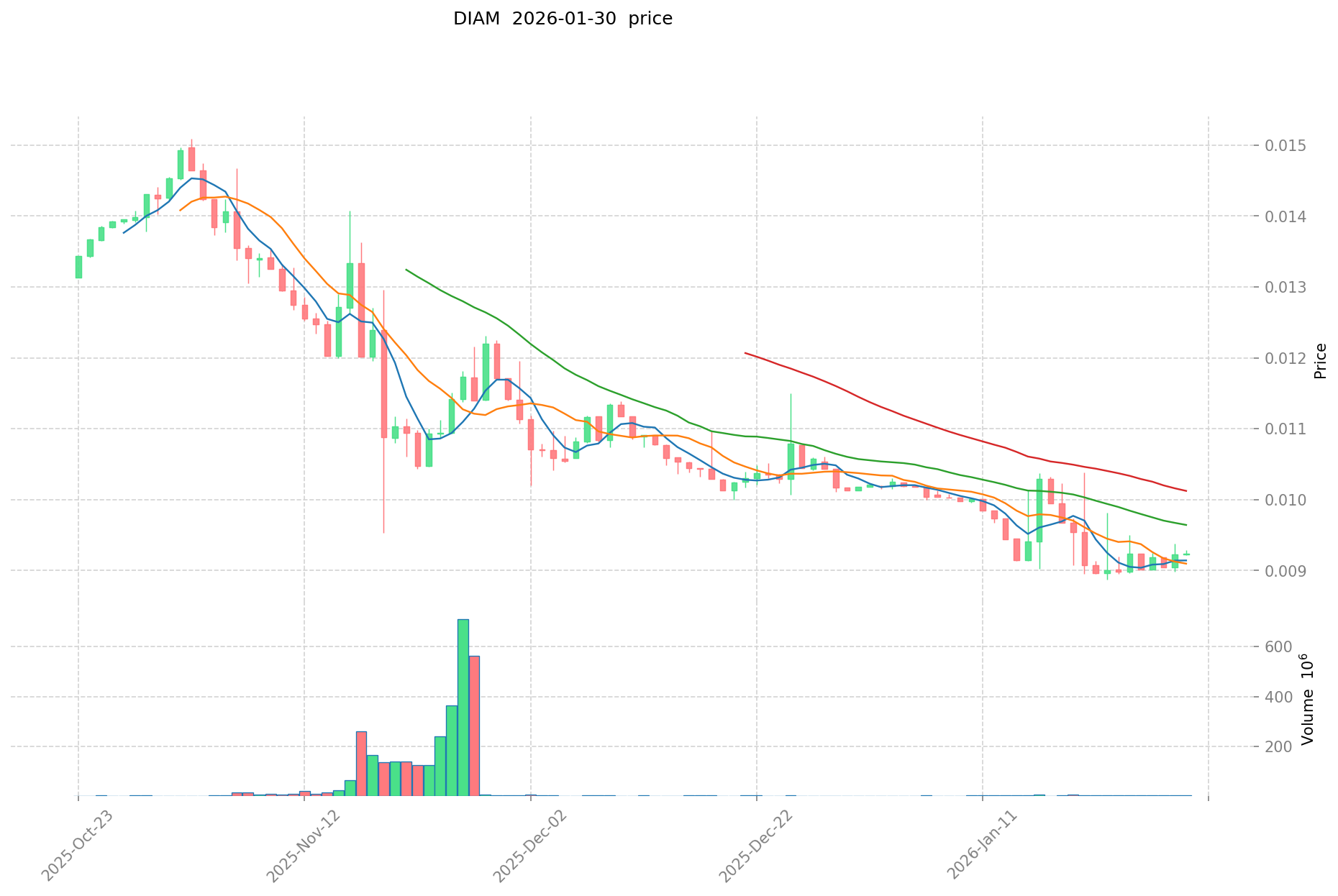
- 2025: DIAM launched on February 12, 2025, with an initial price of $0.04. The token experienced early volatility, reaching an all-time high of $0.05 on the same day of its launch, before entering a correction phase.
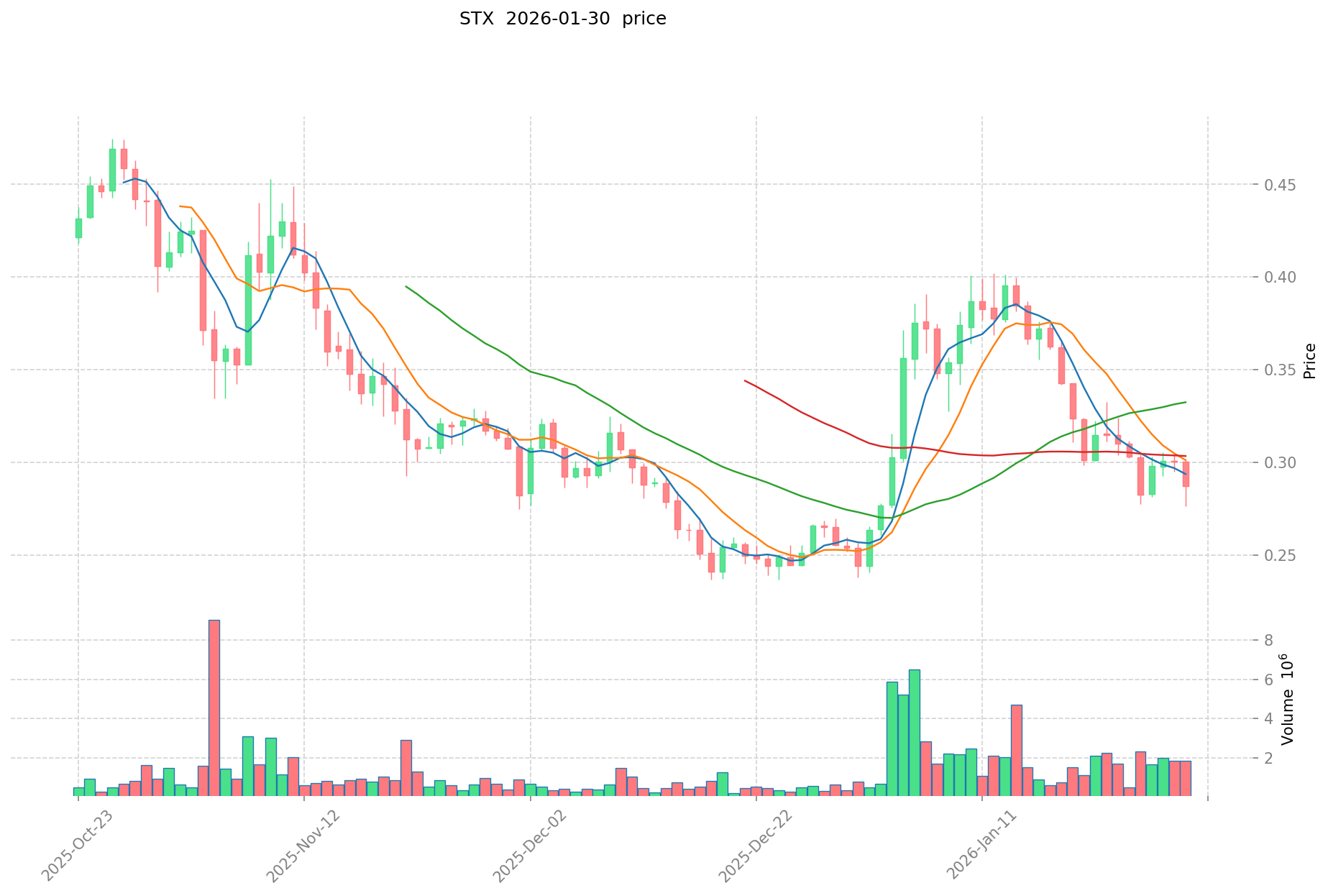
- 2025: STX, which had been operational since 2019, continued its market presence but faced significant price pressure throughout 2025, declining from higher levels as part of broader market movements.
- Comparative Analysis: During the 2025 market cycle, DIAM moved from its peak of $0.05 to a low of $0.00673 (recorded on February 18, 2025), representing substantial volatility for a newly launched token. In contrast, STX experienced a longer-term decline, moving from its historical high of $3.86 (reached on April 1, 2024) to current levels around $0.287, reflecting a more extended bearish trend.
Current Market Status (January 30, 2026)
- DIAM Current Price: $0.009242
- STX Current Price: $0.287
- 24-Hour Trading Volume: DIAM recorded $11,682.01 compared to STX's $531,051.75
- Market Sentiment Index (Fear & Greed Index): 26 (Fear)
View real-time prices:
- Check DIAM current price Market Price
- Check STX current price Market Price
II. Core Factors Influencing DIAM vs STX Investment Value
Given the limited information in the reference materials, a comprehensive comparison cannot be fully established. However, the following framework outlines key evaluation dimensions for cryptocurrency investment analysis.
Supply Mechanism Comparison (Tokenomics)
Tokenomics represents a fundamental factor in determining long-term value trajectory. The supply architecture—whether characterized by fixed caps, deflationary mechanisms, or scheduled emission reductions—shapes market dynamics and price behavior over extended periods.
📌 Historical Pattern: Supply structures have historically influenced cyclical price movements, with scarcity mechanisms potentially creating upward pressure during demand increases.
Institutional Adoption and Market Application
- Institutional Holdings: Institutional preference patterns can signal market maturity and long-term viability assessment by professional investors
- Enterprise Adoption: Cross-border payment integration, settlement infrastructure, and portfolio allocation represent practical utility indicators
- Regulatory Environment: Jurisdictional approaches toward different digital assets affect accessibility and institutional participation
Technology Development and Ecosystem Construction
Technological advancement and ecosystem expansion serve as indicators of project sustainability and competitive positioning.
- Ecosystem Comparison: Decentralized finance integration, non-fungible token infrastructure, payment channel development, and smart contract implementation demonstrate practical adoption and network effects
Macroeconomic Context and Market Cycles
- Inflation Environment Performance: Different assets may exhibit varying characteristics under inflationary conditions
- Macroeconomic Monetary Policy: Interest rate adjustments and currency index movements can influence digital asset valuations through capital flow patterns
- Geopolitical Factors: Cross-border transaction demand and international developments may affect utility and adoption patterns
III. 2026-2031 Price Prediction: DIAM vs STX
Short-term Prediction (2026)
- DIAM: Conservative $0.00813296 - $0.009242 | Optimistic $0.009242 - $0.01118282
- STX: Conservative $0.26404 - $0.287 | Optimistic $0.287 - $0.41328
Mid-term Prediction (2028-2029)
- DIAM may enter a consolidation phase with estimated price range of $0.0071328577645 - $0.0145229661369
- STX may enter an expansion phase with estimated price range of $0.326943225 - $0.5329568475
- Key drivers: institutional capital inflows, ETF developments, ecosystem growth
Long-term Prediction (2030-2031)
- DIAM: Baseline scenario $0.009452030460765 - $0.013312718958825 | Optimistic scenario $0.013312718958825 - $0.017040280267296
- STX: Baseline scenario $0.3236954576625 - $0.48312754875 | Optimistic scenario $0.48312754875 - $0.666716017275
View detailed price predictions for DIAM and STX
Disclaimer
DIAM:
| Year |
Predicted High Price |
Predicted Average Price |
Predicted Low Price |
Price Change |
| 2026 |
0.01118282 |
0.009242 |
0.00813296 |
0 |
| 2027 |
0.0131740089 |
0.01021241 |
0.0075571834 |
10 |
| 2028 |
0.0125117341115 |
0.01169320945 |
0.0071328577645 |
26 |
| 2029 |
0.0145229661369 |
0.01210247178075 |
0.00774558193968 |
30 |
| 2030 |
0.017040280267296 |
0.013312718958825 |
0.009452030460765 |
44 |
| 2031 |
0.015935324593713 |
0.01517649961306 |
0.013203554663362 |
64 |
STX:
| Year |
Predicted High Price |
Predicted Average Price |
Predicted Low Price |
Price Change |
| 2026 |
0.41328 |
0.287 |
0.26404 |
0 |
| 2027 |
0.437675 |
0.35014 |
0.1995798 |
21 |
| 2028 |
0.472689 |
0.3939075 |
0.326943225 |
37 |
| 2029 |
0.5329568475 |
0.43329825 |
0.3076417575 |
50 |
| 2030 |
0.666716017275 |
0.48312754875 |
0.3236954576625 |
68 |
| 2031 |
0.695655357445125 |
0.5749217830125 |
0.339203851977375 |
100 |
IV. Investment Strategy Comparison: DIAM vs STX
Long-term vs Short-term Investment Strategies
-
DIAM: May be considered by investors interested in emerging blockchain ecosystems with early-stage positioning. The token's recent launch (February 2025) presents characteristics typical of newer market entrants, including higher volatility patterns and developmental phase dynamics.
-
STX: May attract investors examining established infrastructure projects with longer operational history (since October 2019). The token's extended market presence reflects a different stage in project maturity and ecosystem development.
Risk Management and Asset Allocation
-
Conservative Investors: Portfolio construction emphasizing risk mitigation might consider limited exposure to highly volatile assets, with potential allocation frameworks varying based on individual risk tolerance and investment objectives.
-
Aggressive Investors: Those with higher risk appetite and longer time horizons might explore different allocation approaches, balancing potential growth opportunities against volatility considerations.
-
Hedging Instruments: Risk management tools include stablecoin allocation for liquidity preservation, derivatives for directional positioning, and cross-asset diversification strategies.
V. Potential Risk Comparison
Market Risk
-
DIAM: As a recently launched token (February 2025), DIAM exhibits price volatility characteristic of newer market entrants, with movements from $0.05 to $0.00673 within the initial days following launch. Trading volume of $11,682.01 (as of January 30, 2026) reflects limited market depth, which may amplify price fluctuations during periods of concentrated buying or selling activity.
-
STX: With a longer operational history since October 2019, STX demonstrates extended price trajectories, declining from $3.86 (April 1, 2024) to current levels around $0.287. Trading volume of $531,051.75 indicates relatively higher market activity compared to DIAM, though both tokens operate within broader market cycles influenced by macroeconomic factors and sector-wide sentiment (Fear & Greed Index: 26 - Fear).
Technology Risk
-
DIAM: The project emphasizes blockchain ecosystem development focused on accessibility and inclusivity. As with emerging infrastructure projects, execution risk relates to achieving stated objectives of scalability and security within competitive market environments.
-
STX: Positioned as decentralized application internet infrastructure with open-source development tools, the project's technology risk factors include ongoing ecosystem expansion requirements and competitive positioning within the smart contract platform landscape.
Regulatory Risk
Both digital assets operate within evolving regulatory frameworks across different jurisdictions. Regulatory developments affecting blockchain infrastructure, decentralized applications, and digital asset classification may influence adoption patterns, institutional participation, and market accessibility differently depending on project-specific characteristics and use case positioning.
VI. Conclusion: Which Is the Better Buy?
📌 Investment Value Summary:
-
DIAM Characteristics: Recent market entry (February 2025) with focus on blockchain ecosystem democratization; exhibits early-stage volatility patterns; lower trading volume reflecting developing market depth.
-
STX Characteristics: Established operational history since October 2019; positioned as decentralized application infrastructure; higher trading volume relative to DIAM; extended price trajectory reflecting longer market cycle exposure.
✅ Investment Considerations:
-
Novice Investors: Consider fundamental education on digital asset characteristics, market dynamics, and risk factors before capital allocation. Portfolio construction should align with individual financial circumstances, risk tolerance, and investment time horizons.
-
Experienced Investors: Evaluation frameworks may incorporate comparative analysis of tokenomics structures, ecosystem development progress, institutional adoption patterns, and technological differentiation within broader portfolio strategy contexts.
-
Institutional Investors: Due diligence processes typically encompass regulatory compliance assessment, liquidity analysis, custody considerations, and alignment with investment mandates and risk management frameworks.
⚠️ Risk Disclosure: Cryptocurrency markets demonstrate substantial volatility and price fluctuation characteristics. This analysis does not constitute investment advice, financial recommendation, or endorsement of any specific digital asset. Market participants should conduct independent research, consider individual circumstances, and consult qualified financial professionals before making investment decisions.
VII. FAQ
Q1: What are the main differences between DIAM and STX in terms of market maturity and trading characteristics?
DIAM represents an early-stage project launched in February 2025 with limited trading volume ($11,682.01), while STX is an established infrastructure project operational since October 2019 with significantly higher trading volume ($531,051.75). DIAM's recent market entry results in higher volatility patterns, having moved from $0.05 to $0.00673 within days of launch, whereas STX exhibits extended price trajectories reflecting longer market cycle exposure. The difference in trading volumes—STX's volume is approximately 45 times higher than DIAM's—indicates substantially different market depth levels, which may affect execution quality and price stability during trading activity.
Q2: Which token offers better price appreciation potential for long-term investors through 2031?
Based on projected price trajectories, STX demonstrates higher absolute price targets with estimated ranges from $0.287 (2026) to potential highs of $0.695 (2031), while DIAM's projections range from $0.009242 (2026) to $0.017 (2031). However, percentage-based growth potential differs: DIAM's predictions suggest potential increases from baseline levels, while STX projections reflect recovery from historical highs of $3.86. Long-term appreciation potential depends on factors including ecosystem adoption, institutional participation, and successful execution of technological roadmaps. Investors should evaluate growth potential within the context of risk tolerance, as higher potential returns typically correlate with elevated volatility characteristics.
Q3: How do tokenomics and supply mechanisms differ between DIAM and STX?
The reference materials do not provide detailed tokenomics specifications for either asset. Supply mechanism analysis—including total supply caps, emission schedules, deflationary mechanisms, and distribution frameworks—represents a fundamental evaluation dimension for digital asset investment. Tokenomics structures influence long-term value trajectories through scarcity dynamics, incentive alignment, and market circulation patterns. Investors should independently research each project's token economics documentation, including vesting schedules, allocation distributions, and any burn mechanisms or supply reduction protocols that may affect future price behavior.
Q4: What are the primary risk factors investors should consider when comparing DIAM and STX?
Both assets face distinct risk profiles: DIAM's primary risks include early-stage execution uncertainty, limited liquidity (evidenced by lower trading volume), and higher price volatility typical of recently launched tokens. STX faces risks associated with competitive positioning within the smart contract platform landscape, ecosystem expansion requirements, and recovery from significant price declines from historical highs. Common risk factors include regulatory developments affecting blockchain infrastructure across different jurisdictions, macroeconomic conditions influencing broader cryptocurrency market sentiment (current Fear & Greed Index: 26 - Fear), and technology implementation challenges. Market participants should assess risk factors within individual portfolio contexts and risk management frameworks.
Q5: Which investment strategy is more suitable for conservative versus aggressive investors?
Conservative investors typically prioritize capital preservation and risk mitigation, which may favor assets with established operational histories, higher liquidity, and lower volatility characteristics—factors more aligned with STX's market profile. However, conservative allocation frameworks generally involve limited exposure to highly volatile digital assets regardless of maturity level. Aggressive investors with higher risk tolerance and longer time horizons might explore early-stage opportunities like DIAM, accepting elevated volatility for potential growth positioning, or seek recovery opportunities in established assets like STX. Portfolio construction should incorporate diversification principles, appropriate position sizing relative to total portfolio value, and alignment with individual financial circumstances and investment objectives.
Q6: How does current market sentiment affect investment decisions for DIAM and STX?
The current Fear & Greed Index reading of 26 (Fear) indicates prevailing negative market sentiment as of January 30, 2026. During fear-dominated market conditions, both assets may experience sustained downward price pressure as risk-off behavior typically characterizes broader market participant psychology. However, contrarian investment approaches sometimes view fearful market conditions as potential accumulation opportunities, particularly for assets with strong fundamental characteristics or early-stage positioning. Market sentiment represents one analytical dimension among multiple factors—including technological development progress, ecosystem adoption metrics, and macroeconomic conditions—that inform comprehensive investment evaluation frameworks.
Q7: What role does institutional adoption play in the comparative investment thesis for DIAM versus STX?
Institutional adoption serves as an indicator of market maturity, project credibility assessment, and long-term viability evaluation by professional investors. While specific institutional holding data is not provided in the reference materials, STX's longer operational history since 2019 has allowed more time for institutional evaluation and potential participation. DIAM's recent launch (February 2025) means institutional adoption patterns remain in early development stages. Institutional participation indicators include exchange listings, custody solution availability, regulatory compliance frameworks, and integration into professional investment products. Investors should monitor institutional activity developments, regulatory approvals, and enterprise adoption announcements as signals of growing mainstream acceptance and potential catalysts for future price appreciation.
Q8: How should investors evaluate the technological ecosystems of DIAM and STX for investment purposes?
DIAM positions itself as a blockchain ecosystem focused on democratizing digital economy access through security, scalability, accessibility, and inclusivity objectives. STX functions as decentralized application internet infrastructure with open-source development tools for building distributed applications and protocols. Ecosystem evaluation should examine: developer activity metrics, decentralized application deployment numbers, total value locked in protocol ecosystems, partnership announcements with established enterprises, and technological differentiation versus competing platforms. Active development communities, regular protocol upgrades, and expanding use case implementations generally indicate healthy ecosystem trajectories. Investors should review project documentation, development roadmaps, GitHub activity (for open-source projects), and third-party ecosystem analytics to assess technological progress and competitive positioning within the broader blockchain infrastructure landscape.
* The information is not intended to be and does not constitute financial advice or any other recommendation of any sort offered or endorsed by Gate.