This comprehensive analysis compares DIMO and UNI, two distinct decentralized governance tokens with fundamentally different market positioning. DIMO focuses on decentralized physical infrastructure within the automotive sector, ranking 1546 with a $4.87 million market cap, while UNI serves as the governance token for Uniswap's leading decentralized exchange protocol, ranking 37th with a $3.03 billion market cap. The article examines historical price trends, tokenomics, institutional adoption, and technical ecosystems to help investors understand their contrasting risk-return profiles. Through detailed analysis of market risks, technical considerations, and regulatory landscapes, readers gain clarity on which asset aligns with their investment strategy—from conservative UNI-focused portfolios to aggressive diversified allocations. Price predictions spanning 2026-2031 and tailored investment strategies provide actionable insights for institutional, experienced, and newer market participants seeking exposure to
Introduction: DIMO vs UNI Investment Comparison
In the cryptocurrency market, the comparison between DIMO and UNI has become a topic of interest for investors. The two differ significantly in market cap ranking, application scenarios, and price performance, representing distinct crypto asset positioning.
DIMO (DIMO): Launched in December 2022, it has gained market attention by focusing on automotive data liberation and blockchain-based vehicle digital twins. As of January 29, 2026, DIMO ranks 1546 with a market cap of approximately $4.87 million and a circulating supply of 419.53 million tokens.
UNI (UNI): Originating in September 2020, UNI has been recognized as a leading decentralized exchange protocol token. It ranks 37th with a market cap of approximately $3.03 billion and a circulating supply of 634.54 million tokens, making it one of the widely traded cryptocurrencies in the DeFi sector.
This article will provide a comprehensive analysis of DIMO vs UNI investment value comparison, covering historical price trends, supply mechanisms, institutional adoption, technological ecosystems, and future forecasts, attempting to address investors' most pressing question:
"Which asset presents different risk-return profiles for consideration?"
I. Historical Price Comparison and Current Market Status
DIMO and UNI Historical Price Trends
- 2024: DIMO experienced significant price movement, with its price reaching $2.00 in February 2024, influenced by market dynamics in the decentralized physical infrastructure sector.
- 2021: UNI was affected by the launch of Uniswap V3, with its price reaching $44.92 in May 2021, driven by increased platform adoption and trading volume expansion.
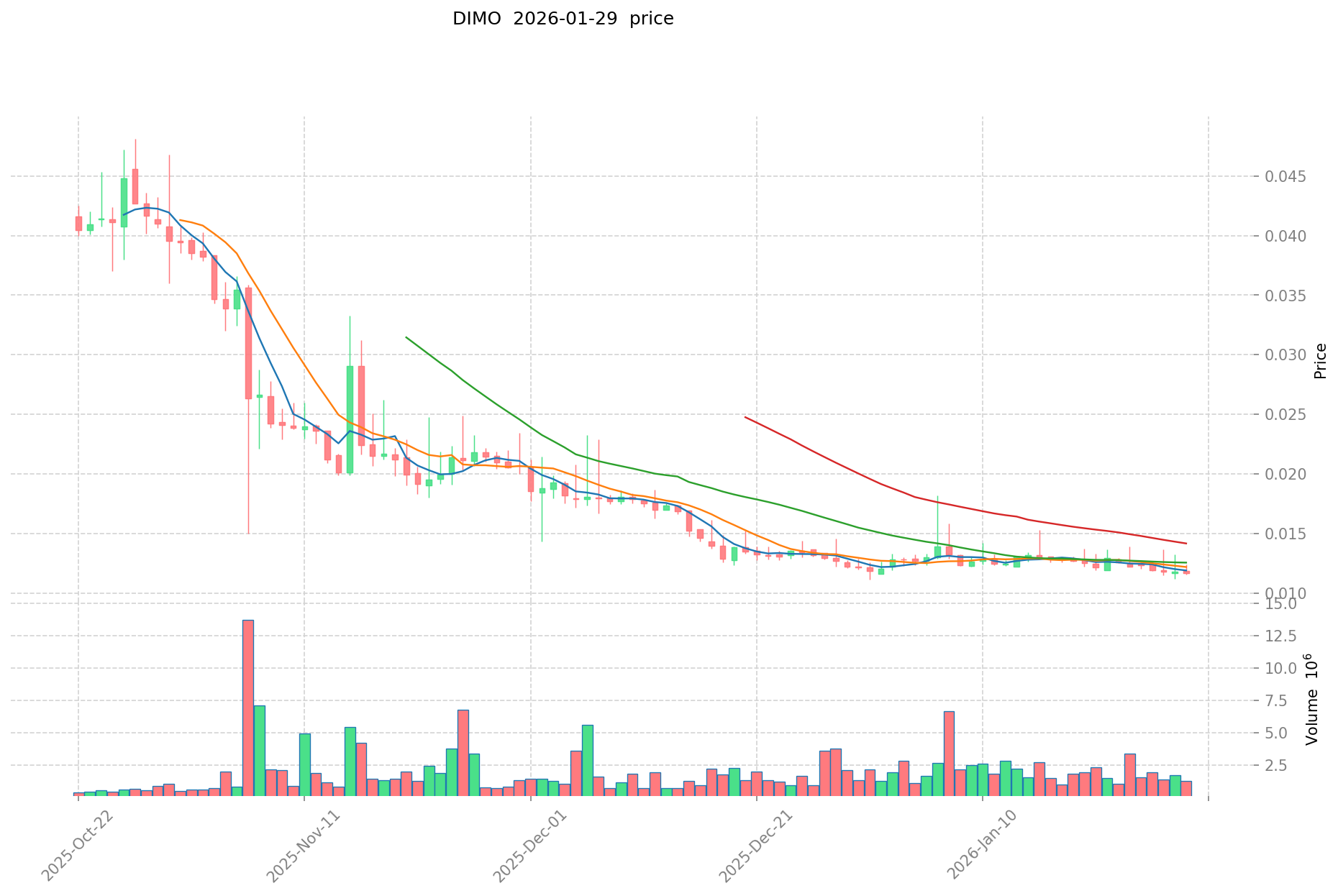
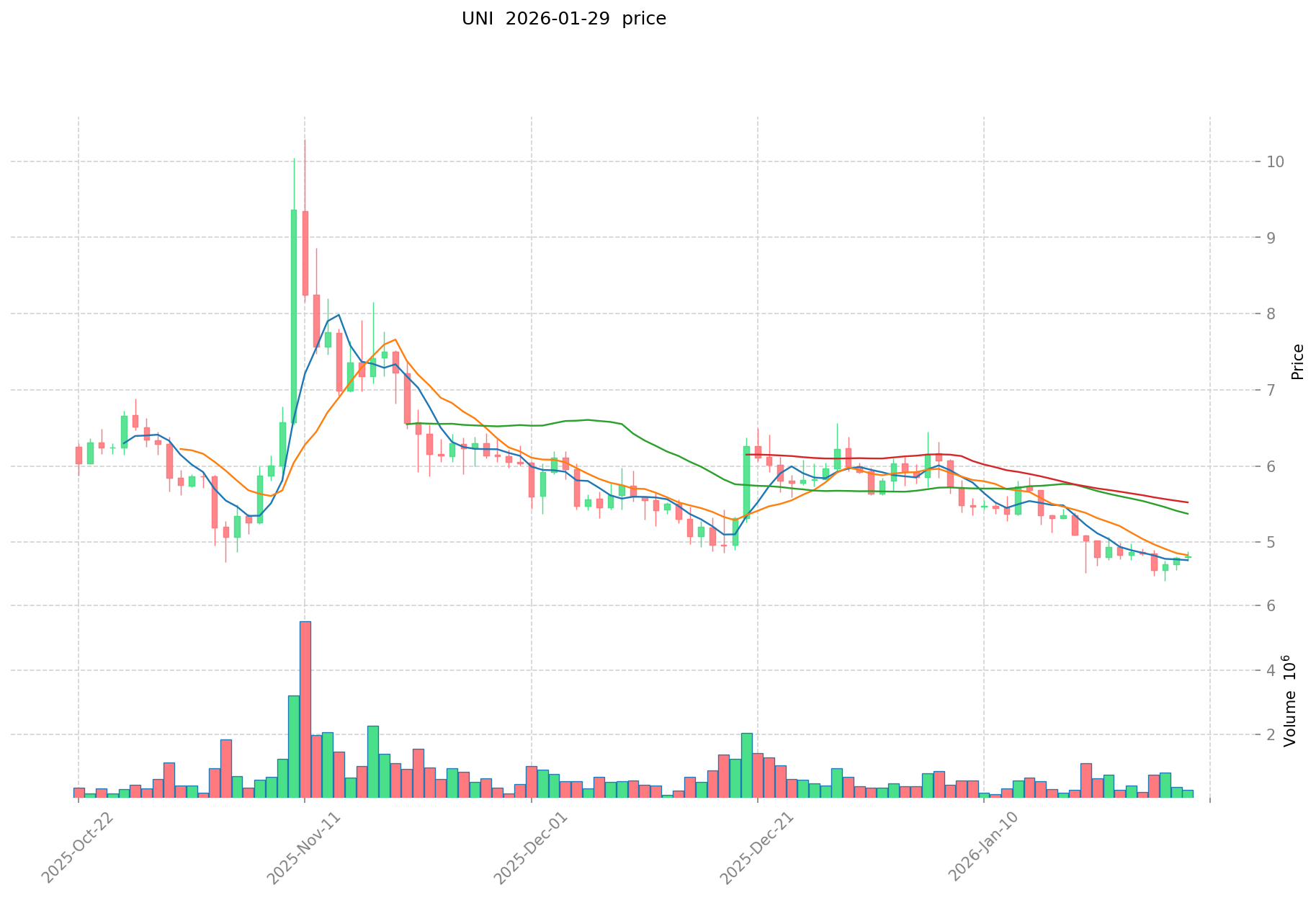
- Comparative Analysis: During various market cycles, DIMO declined from its peak of $2.00 to approximately $0.01161, while UNI decreased from $44.92 to around $4.769, demonstrating different volatility patterns across their respective market segments.
Current Market Status (2026-01-29)
- DIMO Current Price: $0.01161
- UNI Current Price: $4.769
- 24-Hour Trading Volume: DIMO $14,364.66 vs UNI $1,419,716.63
- Market Sentiment Index (Fear & Greed Index): 26 (Fear)
View Real-Time Prices:
- Check DIMO Current Price Market Price
- Check UNI Current Price Market Price
II. Core Factors Influencing DIMO vs UNI Investment Value
Supply Mechanism Comparison (Tokenomics)
- DIMO: Information regarding DIMO's specific supply mechanism is not detailed in available materials. Supply models such as fixed supply or deflationary mechanisms require further verification through project documentation.
- UNI: Uniswap operates with a governance token model where UNI serves as the protocol's native asset. The token distribution includes allocations to team members, investors, and community participants, with vesting schedules designed to align long-term incentives.
- 📌 Historical Pattern: Supply mechanisms have historically influenced price cycles through controlled inflation rates, vesting unlock schedules, and community-driven governance decisions that affect token velocity and market sentiment.
Institutional Adoption and Market Application
- Institutional Holdings: Uniswap has demonstrated appeal among institutional participants within the decentralized finance sector, as evidenced by its position as a leading decentralized exchange protocol. Material regarding DIMO's institutional interest remains limited in the reference sources.
- Enterprise Adoption: UNI has established itself within DeFi infrastructure, serving as a foundational protocol for token swaps and liquidity provision. Its application extends to portfolio diversification strategies employed by crypto-native institutions. Information on DIMO's enterprise-level integration is not extensively documented in available materials.
- Regulatory Landscape: Both projects operate within evolving regulatory frameworks across jurisdictions. Regulatory clarity varies by region, with certain markets adopting more accommodating stances toward decentralized protocols while others maintain cautious approaches pending comprehensive policy development.
Technical Development and Ecosystem Building
- DIMO Technical Progress: Specific technical upgrades and development milestones for DIMO are not extensively covered in the provided materials. Assessment of technical advancement requires access to project roadmaps and development activity metrics.
- UNI Technical Evolution: Uniswap continues to iterate on its automated market maker (AMM) model, with protocol versions introducing enhanced capital efficiency, concentrated liquidity features, and cross-chain deployment capabilities. These developments aim to improve user experience and expand protocol utility.
- Ecosystem Comparison: Uniswap maintains a substantial presence in DeFi infrastructure, facilitating token swaps, liquidity provision, and serving as a foundational component for numerous decentralized applications. Information regarding DIMO's ecosystem penetration in DeFi, NFT markets, payment systems, and smart contract implementations requires additional verification.
Macroeconomic Environment and Market Cycles
- Performance During Inflationary Periods: Cryptocurrency assets generally exhibit complex relationships with traditional inflation metrics. Neither DIMO nor UNI functions as traditional inflation hedges in the manner of physical commodities, though both may benefit from increased interest in alternative assets during periods of currency devaluation concerns.
- Macroeconomic Monetary Policy: Interest rate adjustments and U.S. dollar strength influence overall cryptocurrency market sentiment and capital flows. Tightening monetary conditions have historically corresponded with reduced risk appetite across digital asset markets, affecting both governance tokens and application-specific cryptocurrencies.
- Geopolitical Considerations: Cross-border transaction demand and international developments impact the broader cryptocurrency ecosystem. Regulatory developments, technological infrastructure adoption, and shifting attitudes toward decentralized systems continue to shape the operational environment for both projects.
III. 2026-2031 Price Prediction: DIMO vs UNI
Short-term Forecast (2026)
- DIMO: Conservative $0.0080-$0.0115 | Optimistic $0.0115-$0.0159
- UNI: Conservative $4.48-$4.77 | Optimistic $4.77-$5.53
Medium-term Forecast (2028-2029)
- DIMO may enter a gradual growth phase, with projected prices ranging from $0.0105 to $0.0239
- UNI may enter a consolidation and expansion phase, with projected prices ranging from $4.82 to $7.29
- Key drivers: institutional capital inflows, ETF developments, ecosystem growth
Long-term Forecast (2030-2031)
- DIMO: Baseline scenario $0.0149-$0.0206 | Optimistic scenario $0.0224-$0.0314
- UNI: Baseline scenario $4.90-$6.90 | Optimistic scenario $7.73-$9.59
View detailed price predictions for DIMO and UNI
Disclaimer
DIMO:
| Year |
Predicted High Price |
Predicted Average Price |
Predicted Low Price |
Price Change |
| 2026 |
0.0159114 |
0.01153 |
0.0079557 |
0 |
| 2027 |
0.017288082 |
0.0137207 |
0.010290525 |
18 |
| 2028 |
0.01922544484 |
0.015504391 |
0.01054298588 |
33 |
| 2029 |
0.0239635867296 |
0.01736491792 |
0.0135446359776 |
49 |
| 2030 |
0.024177175220016 |
0.0206642523248 |
0.014878261673856 |
77 |
| 2031 |
0.031388999281371 |
0.022420713772408 |
0.016815535329306 |
93 |
UNI:
| Year |
Predicted High Price |
Predicted Average Price |
Predicted Low Price |
Price Change |
| 2026 |
5.52856 |
4.766 |
4.48004 |
0 |
| 2027 |
6.3311544 |
5.14728 |
2.6251128 |
8 |
| 2028 |
7.288805844 |
5.7392172 |
4.993118964 |
20 |
| 2029 |
7.29569290464 |
6.514011522 |
4.82036852628 |
36 |
| 2030 |
8.5620167445168 |
6.90485221332 |
4.9024450714572 |
44 |
| 2031 |
9.589458753858816 |
7.7334344789184 |
6.264081927923904 |
62 |
IV. Investment Strategy Comparison: DIMO vs UNI
Long-term vs Short-term Investment Strategies
- DIMO: May appeal to investors interested in emerging decentralized physical infrastructure applications and early-stage project exposure. The token's positioning in automotive data and blockchain integration represents a specialized market segment that could attract those seeking exposure to niche technological developments.
- UNI: May appeal to investors seeking exposure to established DeFi infrastructure and decentralized exchange protocols. As a governance token for a widely-utilized platform, UNI offers positioning within core cryptocurrency trading infrastructure with demonstrated market presence.
Risk Management and Asset Allocation
- Conservative Investors: A portfolio approach emphasizing established protocols might consider allocations such as DIMO 10-15% vs UNI 85-90%, reflecting the relative market capitalization differences and operational track records of each project.
- Aggressive Investors: Those pursuing higher-risk allocations in pursuit of growth potential might consider distributions such as DIMO 30-40% vs UNI 60-70%, acknowledging increased volatility exposure associated with lower market cap assets.
- Hedging Tools: Portfolio risk management approaches may incorporate stablecoin allocations for liquidity preservation, options strategies for downside protection, and cross-asset positioning to manage correlation risks within cryptocurrency holdings.
V. Potential Risk Comparison
Market Risks
- DIMO: Characteristics include lower market capitalization ranking (1546), reduced trading volume ($14,364.66 daily), and concentration in specialized application segments. These factors may contribute to increased price volatility and liquidity constraints during market stress periods.
- UNI: Market positioning includes substantial trading volume ($1,419,716.63 daily) and ranking among established DeFi protocols (37th by market cap). Risk factors include exposure to decentralized exchange sector dynamics, competitive pressures from alternative AMM protocols, and regulatory developments affecting DeFi infrastructure.
Technical Risks
- DIMO: Technical considerations for emerging blockchain projects typically include infrastructure scalability questions, network adoption metrics, and integration complexity with target applications. Assessment of DIMO's technical risk profile requires evaluation of development activity and implementation milestones.
- UNI: Technical risk factors for Uniswap include smart contract security considerations, protocol upgrade implementations, and network congestion during high-activity periods. The platform's multi-chain deployment strategy introduces cross-chain bridge risks and operational complexity across different blockchain environments.
Regulatory Risks
- Global regulatory frameworks continue to evolve regarding cryptocurrency assets and DeFi protocols. DIMO's specialized positioning in automotive data may intersect with data privacy regulations and automotive industry compliance requirements across jurisdictions. UNI's role as a decentralized exchange protocol faces ongoing regulatory examination regarding securities classification, market structure, and financial services compliance. Regulatory developments in major markets including the United States, European Union, and Asian jurisdictions may differently impact each project's operational environment and market accessibility.
VI. Conclusion: Which Presents Different Considerations?
📌 Investment Characteristics Summary:
- DIMO Characteristics: Lower market capitalization positioning, specialized application focus in decentralized physical infrastructure, early-stage development profile with associated volatility patterns, and limited trading volume relative to established cryptocurrencies.
- UNI Characteristics: Established presence in DeFi infrastructure, substantial market capitalization within governance token sector, demonstrated protocol utility through Uniswap platform adoption, and relatively higher liquidity compared to emerging projects.
✅ Considerations for Different Investor Profiles:
- Newer Market Participants: Consideration might begin with established protocols demonstrating operational history and market liquidity, potentially emphasizing assets with clearer regulatory positioning and substantial documentation of use cases.
- Experienced Market Participants: Portfolio strategies may incorporate diversified exposure across market capitalization tiers, balancing established protocol positions with selective allocations to emerging projects aligned with specific technological thesis development.
- Institutional Participants: Investment approaches typically emphasize regulatory clarity, custody solutions, liquidity depth, and integration with existing infrastructure. Established protocols with demonstrated adoption patterns and governance frameworks may align more readily with institutional requirements.
⚠️ Risk Notice: Cryptocurrency markets exhibit substantial volatility characteristics. This analysis does not constitute investment advice, financial recommendations, or predictive certainty regarding future price movements. Market participants should conduct independent research, assess risk tolerance, and consider consultation with qualified financial advisors before making investment decisions.
VII. FAQ
Q1: What are the main differences between DIMO and UNI in terms of market positioning?
DIMO and UNI occupy fundamentally different market segments with distinct positioning characteristics. DIMO focuses on decentralized physical infrastructure, specifically automotive data liberation and blockchain-based vehicle digital twins, ranking 1546 with a market cap of approximately $4.87 million as of January 29, 2026. In contrast, UNI serves as the governance token for Uniswap, a leading decentralized exchange protocol in the DeFi sector, ranking 37th with a market cap of approximately $3.03 billion. This substantial difference in market capitalization—over 600 times larger for UNI—reflects their respective stages of adoption, operational track records, and ecosystem integration. UNI benefits from established infrastructure positioning with daily trading volume exceeding $1.4 million, while DIMO's trading volume remains around $14,364, indicating significantly different liquidity profiles and market maturity levels.
Q2: How do the supply mechanisms of DIMO and UNI differ?
The supply mechanisms between DIMO and UNI present different structural approaches to tokenomics. UNI operates with a defined governance token model where distribution includes allocations to team members, investors, and community participants, with vesting schedules designed to align long-term incentives across stakeholders. The current circulating supply stands at 634.54 million tokens. For DIMO, specific details regarding supply mechanism—such as whether it employs fixed supply caps, deflationary mechanisms, or inflationary models—are not extensively documented in available materials, with a current circulating supply of 419.53 million tokens. Historical patterns suggest that supply mechanisms significantly influence price cycles through controlled inflation rates, vesting unlock schedules, and governance decisions affecting token velocity. Investors should verify DIMO's specific tokenomic structure through project documentation before making allocation decisions.
Q3: Which asset demonstrates better price stability based on historical performance?
Based on historical price trends, UNI has demonstrated relatively greater price stability compared to DIMO, though both assets exhibit significant volatility characteristic of cryptocurrency markets. UNI reached its peak at $44.92 in May 2021 during the Uniswap V3 launch period and has since declined to approximately $4.769 as of January 29, 2026, representing roughly an 89% decline from peak levels. DIMO experienced a price peak of $2.00 in February 2024 and has declined to approximately $0.01161, representing approximately a 99% decline from its peak. The more extreme price movement in DIMO reflects characteristics typical of lower market cap assets, including higher volatility, lower liquidity depth, and greater sensitivity to market sentiment shifts. UNI's larger market capitalization, established trading infrastructure, and deeper liquidity pools contribute to comparatively reduced price volatility, though significant fluctuations remain inherent to both assets.
Q4: What are the key risk factors specific to each asset?
DIMO and UNI present distinct risk profiles requiring different assessment frameworks. DIMO's primary risk factors include: (1) lower market capitalization ranking creating heightened volatility exposure, (2) limited trading volume of approximately $14,364 daily resulting in potential liquidity constraints, (3) concentration in specialized decentralized physical infrastructure applications with uncertain adoption trajectories, and (4) early-stage development profile with limited operational history. UNI's risk considerations include: (1) exposure to competitive pressures from alternative automated market maker protocols, (2) smart contract security considerations inherent to DeFi infrastructure, (3) regulatory examination affecting decentralized exchange protocols across multiple jurisdictions, and (4) network congestion risks during high-activity periods. Both assets face broader market risks including macroeconomic conditions, regulatory developments, and cryptocurrency sector sentiment shifts, though these factors may affect each differently based on their respective market positioning.
Q5: How should investors approach portfolio allocation between DIMO and UNI?
Portfolio allocation strategies between DIMO and UNI should reflect individual risk tolerance, investment timeframes, and exposure objectives. Conservative investors seeking established infrastructure exposure might consider allocations emphasizing UNI (85-90%) with limited DIMO exposure (10-15%), reflecting the relative market capitalization differences and operational track records. This approach prioritizes liquidity, established use cases, and reduced volatility exposure. Aggressive investors pursuing growth potential in emerging technologies might consider increased DIMO allocation (30-40%) balanced with UNI positioning (60-70%), acknowledging higher volatility and liquidity risks associated with lower market cap assets. Institutional participants typically emphasize regulatory clarity, custody solutions, and liquidity depth, factors that currently favor UNI's positioning within established DeFi infrastructure. All allocation approaches should incorporate risk management tools including stablecoin reserves for liquidity preservation, position sizing appropriate to total portfolio risk capacity, and regular rebalancing to maintain intended exposure levels.
Q6: What factors could influence future price movements for DIMO and UNI?
Multiple factors may influence future price trajectories for both assets, though specific drivers differ based on their market positioning. For DIMO, key influences include: (1) adoption metrics within decentralized physical infrastructure applications, (2) partnership developments with automotive industry participants, (3) technical milestone achievements and network expansion, and (4) broader market sentiment toward specialized blockchain applications. For UNI, primary factors include: (1) Uniswap protocol trading volume growth and user adoption metrics, (2) competitive dynamics within the decentralized exchange sector, (3) DeFi ecosystem expansion and total value locked trends, (4) regulatory developments affecting decentralized trading infrastructure, and (5) technical upgrades enhancing protocol efficiency. Both assets remain subject to macroeconomic conditions including monetary policy shifts, institutional capital flows into cryptocurrency markets, and broader risk appetite dynamics. Price predictions spanning 2026-2031 suggest DIMO may range from $0.0080 to $0.0314 under various scenarios, while UNI projections range from $4.48 to $9.59, though substantial uncertainty accompanies all long-term forecasts.
Q7: What are the institutional adoption prospects for DIMO versus UNI?
Institutional adoption trajectories differ significantly between DIMO and UNI based on their current market positioning and operational characteristics. UNI has demonstrated established appeal among institutional participants within the decentralized finance sector, evidenced by its position as a leading decentralized exchange protocol with substantial trading infrastructure and liquidity depth. The protocol serves as foundational infrastructure for token swaps and liquidity provision, positioning it within portfolio diversification strategies employed by crypto-native institutions. Factors supporting institutional consideration include: (1) operational track record since September 2020, (2) established custody solutions and trading infrastructure, (3) governance framework participation mechanisms, and (4) regulatory examination providing increased clarity over time. Information regarding DIMO's institutional interest remains limited in available materials, reflecting its earlier-stage positioning and specialized application focus. Institutional adoption for emerging projects typically requires demonstrated use cases, operational history, regulatory clarity, and integration with existing infrastructure—factors that develop progressively as projects mature. The substantial difference in current institutional engagement reflects broader patterns where established protocols receive earlier institutional consideration compared to emerging specialized applications.
Q8: How do regulatory considerations differ between DIMO and UNI?
Regulatory considerations for DIMO and UNI involve different frameworks based on their respective applications and market positioning. UNI, as the governance token for a decentralized exchange protocol, faces ongoing regulatory examination regarding securities classification, market structure compliance, and financial services regulatory frameworks across multiple jurisdictions. Key considerations include: (1) potential classification under securities regulations depending on jurisdictional interpretation, (2) compliance requirements for decentralized trading infrastructure, (3) anti-money laundering and know-your-customer implementation approaches, and (4) regulatory developments affecting DeFi protocols in major markets including the United States, European Union, and Asian jurisdictions. DIMO's specialized positioning in automotive data and decentralized physical infrastructure introduces different regulatory intersections, potentially including: (1) data privacy regulations affecting vehicle information collection and management, (2) automotive industry compliance requirements across jurisdictions, (3) blockchain application regulations in specialized sectors, and (4) cross-border data transfer frameworks. Both projects operate within evolving regulatory environments where clarity varies significantly by region, requiring ongoing monitoring of policy developments that may affect operational parameters, market accessibility, and compliance requirements.
* The information is not intended to be and does not constitute financial advice or any other recommendation of any sort offered or endorsed by Gate.