This comprehensive analysis compares DMTR and ADA, two distinct blockchain tokens serving different market segments. DMTR, launched in 2021, focuses on democratizing agricultural technology through blockchain integration, while ADA, established in 2017, operates as a top-ranked smart contract platform. The article examines critical investment factors including historical price trends, current market status, tokenomics, institutional adoption, and technological ecosystems. DMTR currently trades at $0.007863 with a market cap of $5.48 million (Rank #1487), whereas ADA trades at $0.36 with $13.24 billion market cap (Rank #11), reflecting significantly different liquidity profiles and market positioning. Price projections through 2031 suggest varying growth trajectories based on risk tolerance, with ADA offering established stability and DMTR presenting niche growth potential. Investment recommendations vary by investor profile, with conservative investors favoring ADA's higher liquidity and institutional recogni
Introduction: DMTR vs ADA Investment Comparison
In the cryptocurrency market, the comparison between DMTR vs ADA has become a topic of interest for investors. These two assets demonstrate notable differences in market capitalization ranking, application scenarios, and price performance, representing distinct positioning within the crypto asset landscape.
Dimitra (DMTR): Launched in 2021, this blockchain platform focuses on democratizing global agricultural technology through mobile-accessible solutions integrating blockchain, machine learning, IoT sensors, and satellite technology.
Cardano (ADA): Since its launch in 2017, Cardano has established itself as a layered blockchain protocol supporting financial applications and smart contracts, maintaining a position among the top cryptocurrencies by market capitalization and trading volume.
This article will provide a comprehensive analysis of DMTR vs ADA investment value comparison, examining historical price trends, supply mechanisms, institutional adoption, technological ecosystems, and future prospects, attempting to address investors' primary concern:
"Which represents a more suitable investment consideration based on current market conditions?"
I. Historical Price Comparison and Current Market Status
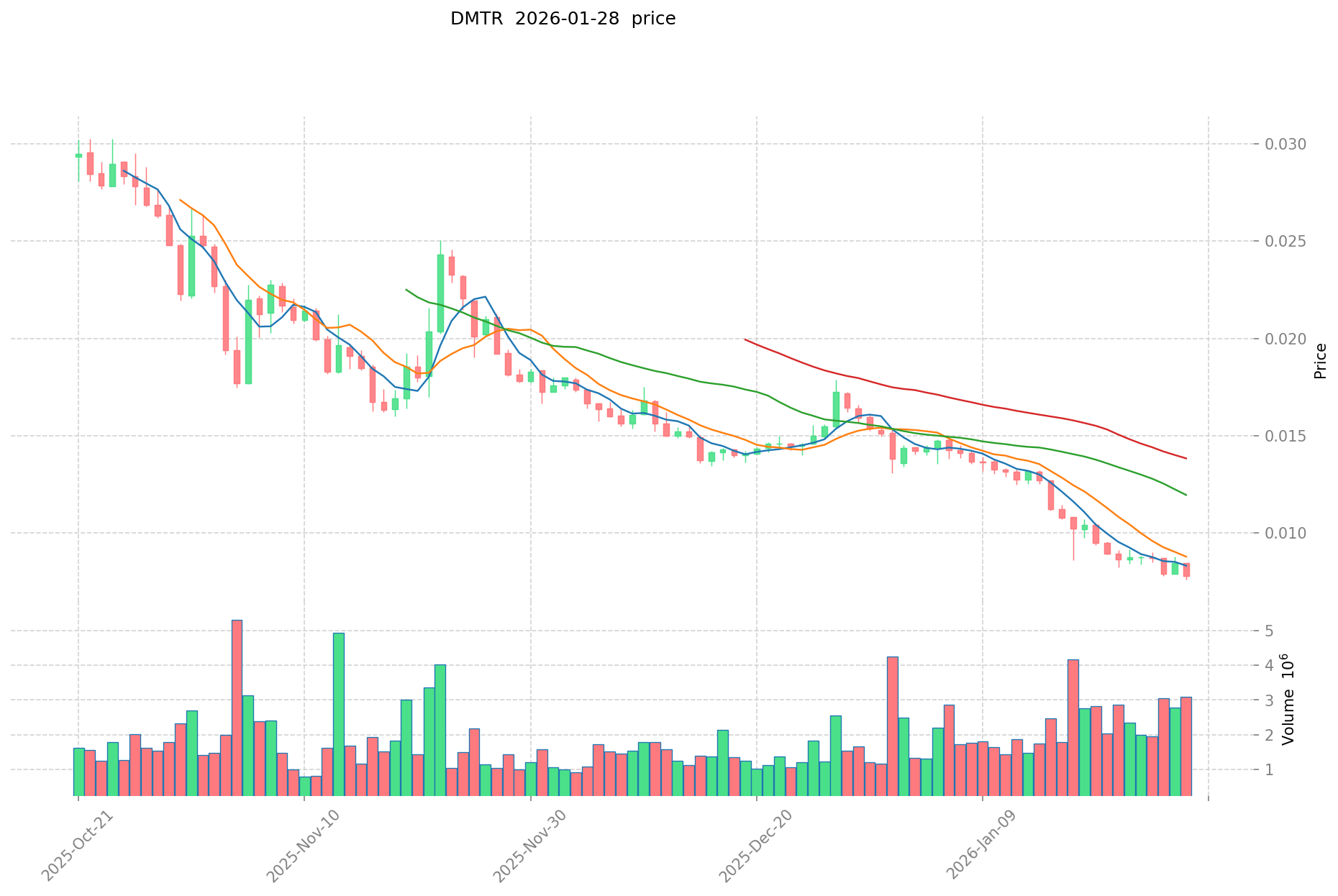
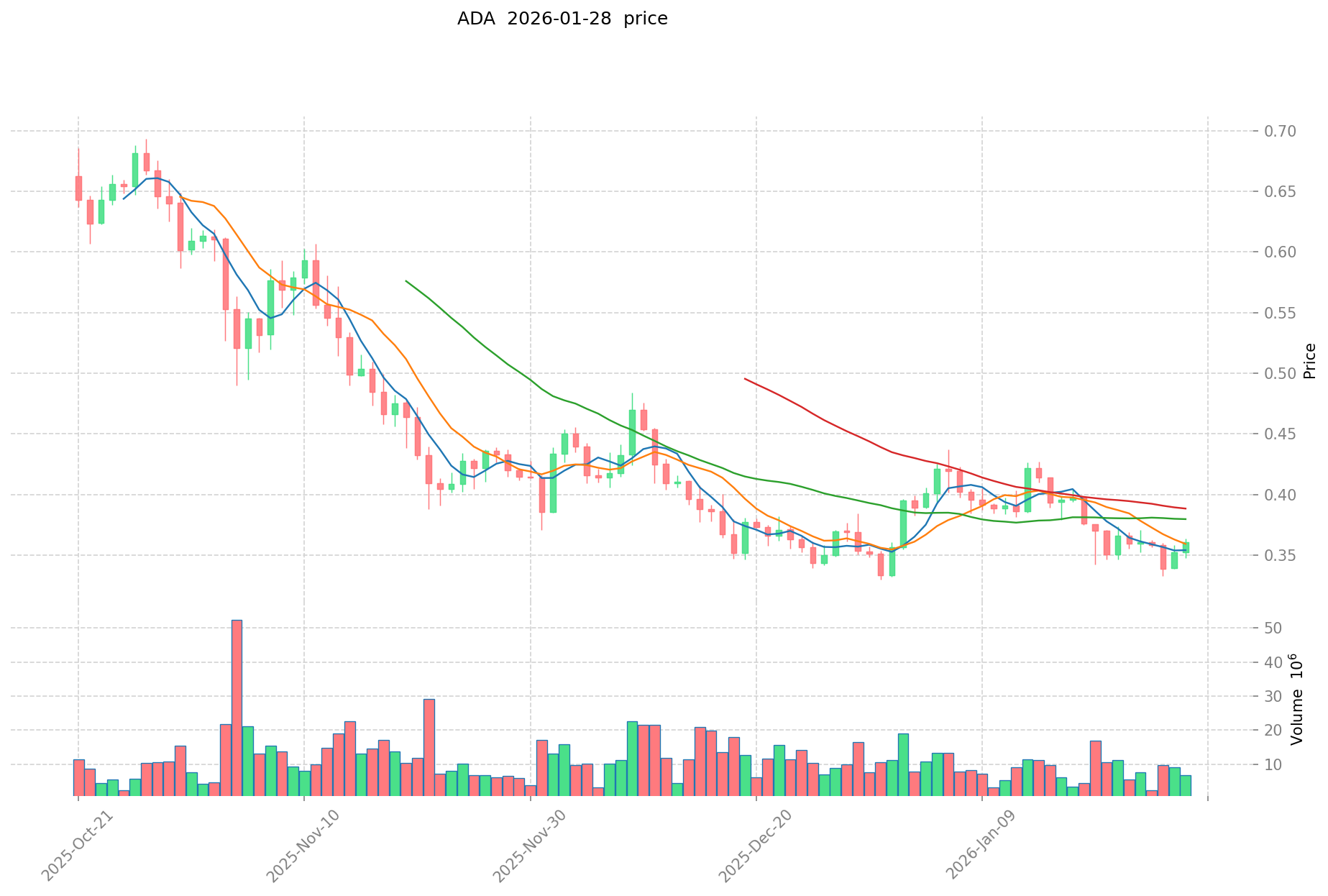
DMTR (Dimitra) and ADA (Cardano) Historical Price Trends
- 2021: DMTR experienced significant price movement, reaching its all-time high of $5.95 on September 23, 2021, following the broader cryptocurrency market rally during that period.
- 2021: ADA achieved its all-time high of $3.09 on September 2, 2021, driven by anticipation of smart contract functionality launch and increased institutional interest in the Cardano ecosystem.
- 2022: DMTR declined to its all-time low of $0.00269344 on December 17, 2022, amid broader market downturn and reduced liquidity in smaller-cap tokens.
- 2020: ADA recorded its all-time low of $0.01925275 on March 13, 2020, during the global market crash triggered by pandemic-related uncertainty.
- Comparative Analysis: During the 2021-2022 market cycle, DMTR experienced a decline of approximately 99.9% from its all-time high of $5.95 to its low of $0.00269344, while ADA decreased by approximately 99.4% from its peak of $3.09 to its low of $0.01925275 during the 2020 market correction, demonstrating relatively different volatility patterns between the two assets.
Current Market Status (January 29, 2026)
- DMTR Current Price: $0.007863
- ADA Current Price: $0.36
- 24-Hour Trading Volume: DMTR $23,970.02 vs ADA $2,146,397.40
- Market Capitalization: DMTR $5,481,219.10 (Rank #1487) vs ADA $13,241,125,336.01 (Rank #11)
- Market Sentiment Index (Fear & Greed Index): 29 (Fear)
- 24-Hour Price Change: DMTR +1.01% vs ADA +2.25%
View Real-Time Prices:
II. Core Factors Influencing DMTR vs ADA Investment Value
Tokenomics Comparison
- DMTR: The reference materials mention DMarket's core functionality involves trading virtual game items on a blockchain-based platform, though specific supply mechanism details are not elaborated in the provided sources.
- ADA: No specific tokenomics information regarding ADA's supply mechanism is available in the reference materials.
- 📌 Historical Pattern: Supply mechanisms can influence price cycles through scarcity dynamics and emission schedules, though specific historical data for these assets is not provided in the materials.
Institutional Adoption and Market Application
- Institutional Holdings: The reference materials do not provide comparative data on institutional preference between DMTR and ADA.
- Enterprise Adoption: DMTR appears focused on gaming industry applications through its virtual item trading platform. The materials reference Ada Health's AI-driven healthcare solutions, which integrate medical information and AI algorithms for user consultations, though this relates to a different Ada entity rather than the ADA cryptocurrency.
- Regulatory Landscape: The provided materials do not contain specific information regarding different countries' regulatory approaches toward either asset.
Technology Development and Ecosystem Building
- DMTR Technology: The platform utilizes blockchain technology to ensure security and transparency in virtual item trading within gaming environments.
- ADA Technology: The reference materials do not provide specific technical development information for ADA cryptocurrency.
- Ecosystem Comparison: The materials lack detailed information comparing DeFi, NFT, payment systems, or smart contract implementation between DMTR and ADA ecosystems.
Macroeconomic Environment and Market Cycles
- Performance in Inflationary Environments: The reference materials do not contain data comparing anti-inflation characteristics of either asset.
- Macroeconomic Monetary Policy: No specific information is provided regarding how interest rates or the US Dollar Index affect these assets.
- Geopolitical Factors: The materials do not address cross-border transaction demand or international situations related to either DMTR or ADA.
III. 2026-2031 Price Prediction: DMTR vs ADA
Short-term Prediction (2026)
- DMTR: Conservative $0.0041-$0.0079 | Optimistic $0.0079-$0.0105
- ADA: Conservative $0.27-$0.36 | Optimistic $0.36-$0.53
Mid-term Prediction (2028-2029)
- DMTR may enter a gradual growth phase, with estimated price range of $0.0078-$0.0141 in 2028 and $0.0094-$0.0132 in 2029
- ADA may enter a consolidation phase, with estimated price range of $0.32-$0.56 in 2028 and $0.35-$0.55 in 2029
- Key drivers: institutional capital inflows, ETF developments, ecosystem expansion
Long-term Prediction (2030-2031)
- DMTR: Base scenario $0.0098-$0.0126 | Optimistic scenario $0.0126-$0.0186
- ADA: Base scenario $0.33-$0.53 | Optimistic scenario $0.53-$0.73
View detailed price predictions for DMTR and ADA
Disclaimer
DMTR:
| Year |
Predicted High Price |
Predicted Average Price |
Predicted Low Price |
Price Change |
| 2026 |
0.01053642 |
0.007863 |
0.00408876 |
0 |
| 2027 |
0.0104876694 |
0.00919971 |
0.0051518376 |
17 |
| 2028 |
0.014076476271 |
0.0098436897 |
0.007776514863 |
25 |
| 2029 |
0.01315609128405 |
0.0119600829855 |
0.009448465558545 |
52 |
| 2030 |
0.018460388088119 |
0.012558087134775 |
0.009795307965124 |
59 |
| 2031 |
0.018611085133736 |
0.015509237611447 |
0.009305542566868 |
97 |
ADA:
| Year |
Predicted High Price |
Predicted Average Price |
Predicted Low Price |
Price Change |
| 2026 |
0.533122 |
0.3578 |
0.26835 |
0 |
| 2027 |
0.50782554 |
0.445461 |
0.34300497 |
23 |
| 2028 |
0.5624390586 |
0.47664327 |
0.3193509909 |
32 |
| 2029 |
0.545518222515 |
0.5195411643 |
0.348092580081 |
44 |
| 2030 |
0.729565679968275 |
0.5325296934075 |
0.441999645528225 |
47 |
| 2031 |
0.656289594155403 |
0.631047686687887 |
0.33445527394458 |
75 |
IV. Investment Strategy Comparison: DMTR vs ADA
Long-term vs Short-term Investment Strategy
- DMTR: May be suitable for investors with higher risk tolerance seeking exposure to niche blockchain applications in the gaming and virtual item trading sector, though liquidity considerations should be noted given the lower trading volume
- ADA: May be suitable for investors seeking exposure to established smart contract platforms with broader ecosystem development and higher market liquidity
Risk Management and Asset Allocation
- Conservative Investors: DMTR 5-10% vs ADA 15-25%
- Aggressive Investors: DMTR 15-25% vs ADA 30-40%
- Hedging Tools: Stablecoin allocation, options strategies, cross-asset portfolio diversification
V. Potential Risk Comparison
Market Risk
- DMTR: Lower market capitalization (Rank #1487) and trading volume ($23,970.02 in 24 hours) may result in higher price volatility and liquidity constraints during market stress periods
- ADA: Despite higher market capitalization (Rank #11) and trading volume ($2,146,397.40 in 24 hours), remains subject to broader cryptocurrency market sentiment fluctuations
Technical Risk
- DMTR: Scalability considerations and network stability factors related to its blockchain-based gaming item trading platform
- ADA: Network performance considerations and potential security vulnerabilities inherent in smart contract platform operations
Regulatory Risk
- Global regulatory policy developments may affect both assets differently based on their respective use cases, with gaming-focused applications and smart contract platforms potentially facing distinct regulatory frameworks across jurisdictions
VI. Conclusion: Which Is the Better Buy?
📌 Investment Value Summary:
- DMTR Advantages: Specialized focus on blockchain gaming applications, potential for growth in virtual item trading sector
- ADA Advantages: Established market position (Rank #11), higher liquidity, broader ecosystem development in smart contract and DeFi applications
✅ Investment Recommendations:
- Novice Investors: Consider starting with more established assets like ADA due to higher liquidity and broader market recognition, while maintaining appropriate position sizing
- Experienced Investors: May consider portfolio diversification across both assets based on risk tolerance, with careful attention to liquidity dynamics and market cycle positioning
- Institutional Investors: Focus on assets with sufficient market depth and established regulatory clarity, conducting thorough due diligence on technological fundamentals and ecosystem development
⚠️ Risk Disclosure: Cryptocurrency markets exhibit high volatility. This article does not constitute investment advice.
VII. FAQ
Q1: What are the main differences between DMTR and ADA in terms of market positioning?
DMTR focuses on blockchain-based gaming and virtual item trading applications, while ADA operates as an established smart contract platform with broader ecosystem development. DMTR ranks #1487 with a market cap of $5.48 million and 24-hour trading volume of $23,970, positioning it as a niche asset in the gaming sector. In contrast, ADA ranks #11 with a market cap of $13.24 billion and 24-hour trading volume of $2.15 million, representing a mature smart contract platform with significantly higher liquidity and institutional recognition.
Q2: How do the historical volatility patterns compare between DMTR and ADA?
Both assets experienced substantial drawdowns during market corrections, though with different magnitudes. DMTR declined approximately 99.9% from its all-time high of $5.95 (September 2021) to its low of $0.00269344 (December 2022). ADA decreased approximately 99.4% from its peak of $3.09 (September 2021) to its low of $0.01925275 (March 2020). These patterns indicate that DMTR exhibited slightly higher volatility during the 2021-2022 market cycle, which may be attributed to its lower market capitalization and reduced liquidity compared to ADA.
Q3: What are the projected price ranges for DMTR and ADA in 2026?
For 2026, DMTR's conservative price prediction ranges from $0.0041 to $0.0079, with an optimistic scenario of $0.0079 to $0.0105. ADA's conservative prediction ranges from $0.27 to $0.36, with an optimistic scenario of $0.36 to $0.53. These projections suggest that while DMTR may offer higher percentage growth potential from its current low base, ADA provides more established price stability with substantial absolute value positioning. Current prices as of January 29, 2026 are $0.007863 for DMTR and $0.36 for ADA.
Q4: How should different investor profiles approach DMTR vs ADA allocation?
Conservative investors may consider DMTR allocation of 5-10% versus ADA allocation of 15-25%, reflecting the higher risk-reward profile of DMTR's smaller market cap position. Aggressive investors may allocate 15-25% to DMTR versus 30-40% to ADA, accepting higher volatility for potential growth exposure. Novice investors should prioritize ADA due to its higher liquidity ($2.15M daily volume versus $23,970 for DMTR) and broader market recognition, while experienced investors may diversify across both assets based on risk tolerance and market cycle assessment.
Q5: What are the primary liquidity considerations when comparing DMTR and ADA?
Liquidity represents a critical differentiator between these assets. ADA's 24-hour trading volume of $2,146,397.40 provides approximately 90 times more liquidity than DMTR's $23,970.02 volume. This substantial difference impacts execution quality, price slippage, and exit flexibility during market stress periods. DMTR's lower liquidity may result in wider bid-ask spreads and difficulty executing large orders without significant price impact, while ADA's higher liquidity facilitates more efficient trading and portfolio rebalancing operations.
Q6: How do market risk factors differ between DMTR and ADA?
DMTR's market risk profile is characterized by its lower market cap ranking (#1487) and limited trading volume, potentially resulting in higher price volatility and liquidity constraints during market downturns. ADA, despite ranking #11 with substantially higher market capitalization and trading volume, remains exposed to broader cryptocurrency market sentiment fluctuations. The current market sentiment index of 29 (Fear) suggests cautious positioning may be appropriate for both assets, though DMTR's smaller market presence may amplify downside volatility during risk-off periods.
Q7: What technological risk considerations apply to DMTR versus ADA?
DMTR faces technical risks related to its blockchain-based gaming platform, including scalability challenges in handling virtual item transactions and network stability considerations specific to gaming applications. ADA encounters technical risks associated with smart contract platform operations, including network performance optimization requirements and potential security vulnerabilities inherent in decentralized application infrastructure. Both platforms require ongoing technical development to maintain competitive positioning within their respective market segments.
Q8: What are the long-term growth prospects for DMTR and ADA through 2031?
According to price projections, DMTR's base scenario for 2031 ranges from $0.0098 to $0.0126, with an optimistic scenario of $0.0126 to $0.0186, representing potential growth of 59-97% from 2026 levels. ADA's base scenario for 2031 ranges from $0.33 to $0.53, with an optimistic scenario of $0.53 to $0.73, representing potential growth of 47-75% from 2026 levels. Key growth drivers include institutional capital inflows, ETF developments, and ecosystem expansion, though actual outcomes depend on market conditions, regulatory developments, and technological advancement across both platforms.
* The information is not intended to be and does not constitute financial advice or any other recommendation of any sort offered or endorsed by Gate.