This comprehensive analysis compares DODO and XLM as distinct cryptocurrency investment opportunities. DODO operates as next-generation decentralized exchange infrastructure using Proactive Market Maker algorithm since 2020, while XLM serves cross-border payments since 2014. As of January 2026, DODO trades at $0.01742 (ranked #936) with $13.7K daily volume, having declined 99.79% from its peak. XLM trades at $0.21681 (ranked #20) with $1.89M daily volume, down 75.24% from peak. The article examines historical trends, market status, tokenomics, institutional adoption, technology ecosystems, price projections through 2031, and risk profiles. Investment strategies vary by risk tolerance: conservative allocations favor XLM's stability and market depth, while aggressive portfolios may diversify into DODO's early-stage DeFi positioning. Suitable for investors comparing established payment infrastructure against emerging liquidity protocols on Gate.
Introduction: DODO vs XLM Investment Comparison
In the cryptocurrency market, the comparison between DODO vs XLM has been a topic of interest for investors. The two differ notably in market cap ranking, application scenarios, and price performance, representing distinct positioning within the crypto asset landscape.
DODO (DODO): Launched in 2020, it has gained market recognition through its positioning as a next-generation on-chain liquidity infrastructure based on Proactive Market Maker (PMM) algorithm, operating as a decentralized trading platform with fund pool mode and pure on-chain transactions.
XLM (XLM): Since its launch in 2014, Stellar has been recognized for facilitating cross-border payment efficiency through a decentralized gateway between digital currency and fiat currency, enabling rapid, stable, and low-cost transfers of digital assets among banks, payment institutions, and individuals.
This article will provide a comprehensive analysis of DODO vs XLM investment value comparison, covering historical price trends, supply mechanisms, institutional adoption, technical ecosystems, and future projections, attempting to address the question investors care about most:
"Which is the better buy right now?"
I. Historical Price Comparison and Current Market Status
Historical Price Trends of DODO (Coin A) and XLM (Coin B)
- 2018: XLM reached its all-time high price of $0.875563 on January 3, 2018, during the cryptocurrency market boom period.
- 2021: DODO achieved its historical peak of $8.38 on February 20, 2021, reflecting strong initial market interest in its active market maker algorithm-based liquidity infrastructure.
- 2025: DODO recorded its all-time low of $0.01663396 on December 19, 2025, representing a significant correction from its peak.
- Comparative Analysis: During the market cycle from peak to current levels, DODO declined from $8.38 to $0.01742, a decrease of approximately 99.79%, while XLM dropped from $0.875563 to $0.21681, representing a decline of approximately 75.24%.
Current Market Status (January 24, 2026)
- DODO Current Price: $0.01742
- XLM Current Price: $0.21681
- 24-hour Trading Volume: DODO $13,719.79 vs XLM $1,887,976.75
- Market Capitalization: DODO $17.42 million (Rank #936) vs XLM $7.03 billion (Rank #20)
- Market Sentiment Index (Fear & Greed Index): 24 (Extreme Fear)
View Real-time Prices:
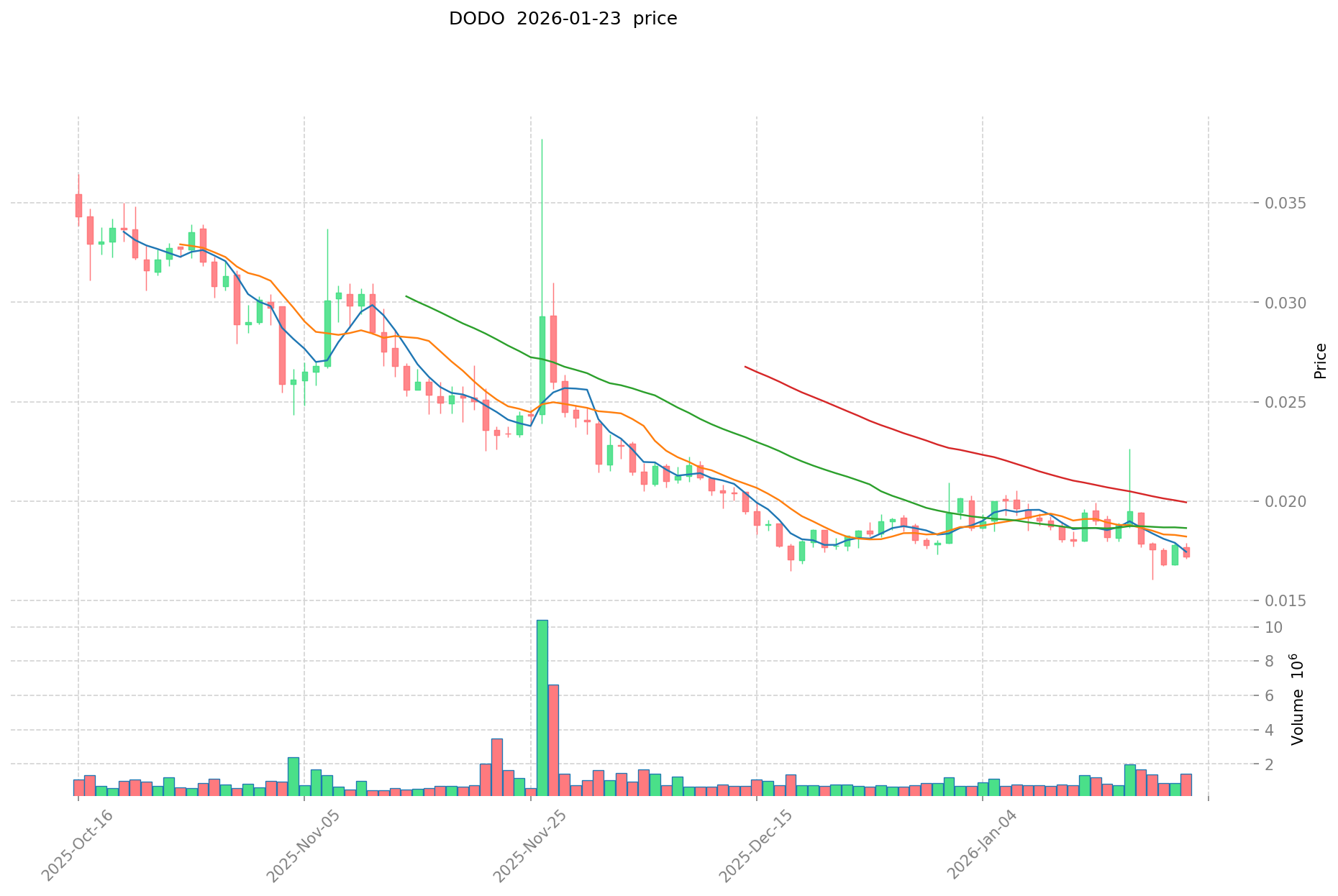
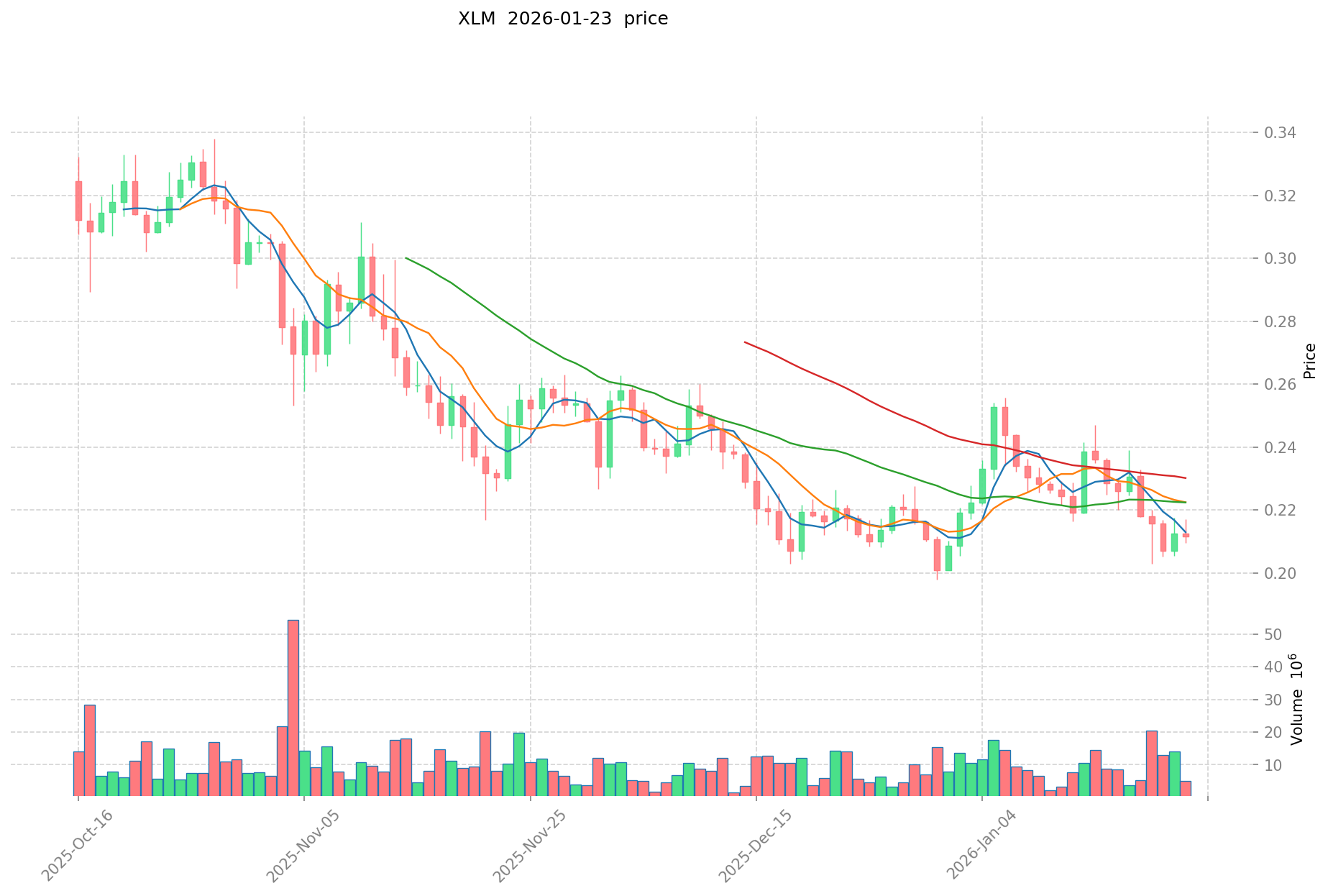
II. Core Factors Affecting DODO vs XLM Investment Value
Supply Mechanism Comparison (Tokenomics)
Due to limited available data on the specific supply mechanisms of DODO and XLM, a comprehensive comparison cannot be provided at this time. Generally speaking, token supply models may include fixed supply caps, inflationary models, deflationary mechanisms, or periodic emission schedules. Understanding these mechanisms is essential for evaluating long-term value potential, as supply dynamics directly influence scarcity and price behavior over market cycles.
Institutional Adoption and Market Applications
Without sufficient reference materials detailing institutional holdings, enterprise adoption patterns, or regulatory stances toward DODO and XLM across different jurisdictions, this section cannot be comprehensively addressed. Institutional interest and real-world use cases such as cross-border payments, settlement systems, and portfolio diversification typically play significant roles in determining market demand and price stability.
Technology Development and Ecosystem Building
Insufficient data is available regarding recent technology upgrades, development roadmaps, or ecosystem expansion activities for DODO and XLM. Key considerations in this area would typically include DeFi integrations, NFT infrastructure support, payment processing capabilities, and smart contract functionalities. Such developments often serve as indicators of project maturity and long-term viability.
Macroeconomic Environment and Market Cycles
Given the absence of detailed information on how DODO and XLM have performed under various macroeconomic conditions, specific insights cannot be provided. Generally, factors such as inflation rates, monetary policy shifts, interest rate adjustments, and USD strength may influence cryptocurrency valuations differently. Additionally, geopolitical developments and cross-border transaction demands can affect adoption rates and market sentiment for different digital assets.
III. 2026-2031 Price Prediction: DODO vs XLM
Short-term Forecast (2026)
- DODO: Conservative $0.0138-$0.0175 | Optimistic $0.0175-$0.0191
- XLM: Conservative $0.157-$0.218 | Optimistic $0.218-$0.274
Mid-term Forecast (2028-2029)
- DODO may enter a consolidation phase, with projected prices ranging from $0.0166 to $0.0322
- XLM may enter a growth phase, with projected prices ranging from $0.250 to $0.405
- Key drivers: institutional capital inflows, ETF developments, ecosystem expansion
Long-term Forecast (2030-2031)
- DODO: Baseline scenario $0.0168-$0.0289 | Optimistic scenario $0.0227-$0.0410
- XLM: Baseline scenario $0.236-$0.357 | Optimistic scenario $0.355-$0.455
View detailed price predictions for DODO and XLM
Disclaimer
DODO:
| Year |
Predicted High Price |
Predicted Average Price |
Predicted Low Price |
Price Change |
| 2026 |
0.019075 |
0.0175 |
0.013825 |
0 |
| 2027 |
0.02596825 |
0.0182875 |
0.017007375 |
4 |
| 2028 |
0.02898751625 |
0.022127875 |
0.01659590625 |
27 |
| 2029 |
0.0322026964875 |
0.025557695625 |
0.01303442476875 |
46 |
| 2030 |
0.041009878399875 |
0.02888019605625 |
0.016750513712625 |
65 |
| 2031 |
0.03913844169543 |
0.034945037228062 |
0.02271427419824 |
100 |
XLM:
| Year |
Predicted High Price |
Predicted Average Price |
Predicted Low Price |
Price Change |
| 2026 |
0.2742264 |
0.21764 |
0.1567008 |
0 |
| 2027 |
0.280363848 |
0.2459332 |
0.211502552 |
13 |
| 2028 |
0.3552505074 |
0.263148524 |
0.2499910978 |
21 |
| 2029 |
0.405051365567 |
0.3091995157 |
0.290647544758 |
42 |
| 2030 |
0.389266730290515 |
0.3571254406335 |
0.23570279081811 |
64 |
| 2031 |
0.455299224263649 |
0.373196085462007 |
0.354536281188907 |
72 |
IV. Investment Strategy Comparison: DODO vs XLM
Long-term vs Short-term Investment Strategies
- DODO: May appeal to investors interested in decentralized exchange infrastructure and liquidity provision mechanisms, particularly those exploring early-stage DeFi protocols with active market maker algorithms.
- XLM: May suit investors focused on cross-border payment solutions and digital asset transfer efficiency, as well as those seeking projects with established market presence since 2014.
Risk Management and Asset Allocation
- Conservative Investors: DODO 10-15% vs XLM 85-90%
- Aggressive Investors: DODO 30-40% vs XLM 60-70%
- Hedging Tools: stablecoin allocation, options strategies, cross-asset portfolio diversification
V. Potential Risk Comparison
Market Risks
- DODO: Experienced a decline of approximately 99.79% from its February 2021 peak to its December 2025 low, reflecting significant volatility. The project ranks #936 by market capitalization with relatively limited trading volume of $13,719.79 in 24 hours, which may indicate lower liquidity.
- XLM: Declined approximately 75.24% from its January 2018 peak to current levels. With a market cap ranking of #20 and 24-hour trading volume of $1,887,976.75, it demonstrates comparatively higher market depth and liquidity than DODO.
Technical Risks
- DODO: Considerations regarding scalability and network stability for on-chain liquidity infrastructure platforms.
- XLM: Considerations regarding network decentralization levels and potential security vulnerabilities in gateway systems.
Regulatory Risks
Global regulatory developments may affect DODO and XLM differently. Cross-border payment-focused projects like XLM may face scrutiny related to financial transmission regulations, while decentralized exchange protocols like DODO may encounter evolving DeFi regulatory frameworks across various jurisdictions.
VI. Conclusion: Which Is the Better Buy?
📌 Investment Value Summary:
- DODO Characteristics: Positioned as next-generation on-chain liquidity infrastructure utilizing Proactive Market Maker algorithm; launched in 2020 with focus on decentralized trading and fund pool mechanisms.
- XLM Characteristics: Established since 2014 with focus on facilitating cross-border payments through decentralized gateways; aims to enable rapid and low-cost digital asset transfers among financial institutions.
✅ Investment Considerations:
- Novice Investors: May consider starting with projects demonstrating higher market capitalization, greater liquidity, and longer operational history to reduce exposure to extreme volatility.
- Experienced Investors: May evaluate portfolio diversification strategies that account for different risk-return profiles, technological focuses, and market positioning of both assets.
- Institutional Investors: May assess factors including market depth, regulatory clarity, use case validation, and ecosystem maturity when considering allocation decisions.
⚠️ Risk Disclosure: The cryptocurrency market exhibits substantial volatility. This content does not constitute investment advice.
VII. FAQ
Q1: What are the main differences between DODO and XLM in terms of their core use cases?
DODO focuses on decentralized exchange infrastructure and on-chain liquidity provision using its Proactive Market Maker (PMM) algorithm, while XLM specializes in facilitating cross-border payments and serving as a decentralized gateway between digital currencies and fiat currencies. DODO launched in 2020 as a next-generation DeFi protocol for decentralized trading with fund pool mechanisms, whereas XLM has operated since 2014 with emphasis on enabling rapid, stable, and low-cost digital asset transfers among banks, payment institutions, and individuals. These fundamental differences reflect distinct positioning: DODO targets the DeFi liquidity infrastructure market, while XLM addresses the cross-border payment and financial institution settlement space.
Q2: How do the historical price performances of DODO and XLM compare?
DODO has experienced significantly higher volatility, declining approximately 99.79% from its all-time high of $8.38 in February 2021 to its low of $0.01663396 in December 2025, while XLM dropped approximately 75.24% from its peak of $0.875563 in January 2018 to its current level. As of January 24, 2026, DODO trades at $0.01742 with a market cap ranking of #936, whereas XLM trades at $0.21681 with a ranking of #20. The 24-hour trading volumes also differ dramatically: DODO at $13,719.79 versus XLM at $1,887,976.75, indicating substantially higher liquidity and market depth for XLM. These metrics suggest XLM has demonstrated relatively greater price stability and market resilience compared to DODO's more volatile trajectory.
Q3: What are the projected price ranges for DODO and XLM through 2031?
For DODO, short-term 2026 forecasts suggest a conservative range of $0.0138-$0.0175 and an optimistic range of $0.0175-$0.0191, with long-term 2030-2031 baseline projections between $0.0168-$0.0289 and optimistic scenarios reaching $0.0227-$0.0410. For XLM, 2026 conservative estimates range from $0.157-$0.218 with optimistic projections of $0.218-$0.274, while 2030-2031 baseline forecasts suggest $0.236-$0.357 and optimistic scenarios reaching $0.355-$0.455. XLM's projections indicate potentially higher absolute price appreciation from current levels, though these forecasts should be viewed as speculative estimates rather than guarantees. Multiple factors including institutional adoption, technological developments, regulatory changes, and macroeconomic conditions will influence actual price outcomes for both assets.
Q4: How should different investor types approach DODO vs XLM allocation?
Conservative investors may consider a portfolio weighting of 10-15% DODO versus 85-90% XLM, reflecting XLM's higher market capitalization, greater liquidity, and longer operational track record. Aggressive investors might allocate 30-40% to DODO and 60-70% to XLM, accepting higher volatility exposure in exchange for potential upside from DODO's early-stage DeFi infrastructure positioning. Novice investors may prioritize projects with higher market capitalization and liquidity like XLM to reduce extreme volatility exposure, while experienced investors might evaluate diversification strategies accounting for different technological focuses and risk-return profiles. Institutional investors typically assess market depth, regulatory clarity, use case validation, and ecosystem maturity when making allocation decisions between these distinct asset types.
Q5: What are the primary risks associated with investing in DODO versus XLM?
DODO faces significant market risk evidenced by its 99.79% decline from peak levels, limited liquidity with only $13,719.79 in 24-hour trading volume, and lower market cap ranking at #936, which may result in higher price volatility and potential execution challenges. Technical risks include considerations around scalability and network stability for its on-chain liquidity infrastructure. XLM, while experiencing a 75.24% decline from its peak, demonstrates comparatively higher market depth with $1,887,976.75 in daily volume and ranks #20 by market capitalization. However, XLM faces technical considerations regarding network decentralization levels and potential gateway system vulnerabilities. Both assets face regulatory risks: XLM may encounter scrutiny under financial transmission regulations given its cross-border payment focus, while DODO may face evolving DeFi regulatory frameworks across various jurisdictions.
Q6: What makes XLM potentially more suitable for cross-border payment use cases compared to DODO?
XLM was specifically designed since 2014 to facilitate cross-border payments through a decentralized gateway architecture connecting digital currencies with fiat currencies, enabling rapid, stable, and low-cost transfers among banks, payment institutions, and individuals. This targeted functionality differs fundamentally from DODO's core purpose as a decentralized exchange and liquidity infrastructure platform. XLM's longer operational history, higher market capitalization ($7.03 billion versus $17.42 million), and substantially greater trading volume ($1,887,976.75 versus $13,719.79 daily) suggest broader adoption and deeper liquidity for payment settlement scenarios. While DODO excels in providing on-chain liquidity through its Proactive Market Maker algorithm, it serves the DeFi trading infrastructure market rather than the direct payment facilitation space that XLM addresses.
Q7: How do market sentiment and current market conditions affect investment decisions between DODO and XLM?
As of January 24, 2026, the market sentiment index registers at 24 (Extreme Fear), indicating widespread caution in the cryptocurrency market that typically affects all digital assets. In such conditions, lower market cap assets like DODO (ranked #936) with limited liquidity may experience amplified volatility and potentially sharper declines compared to more established assets. XLM's position as a top-20 cryptocurrency with significantly higher trading volume may provide relatively greater stability during periods of extreme fear, though it remains subject to broader market movements. Investors should consider that extreme fear conditions often present opportunities for long-term positioning, but require careful risk management and asset allocation strategies. The current environment may favor projects with established track records, institutional recognition, and demonstrated utility, factors that differ substantially between these two assets.
Q8: What role do technological developments and ecosystem growth play in the future prospects of DODO versus XLM?
While specific recent technological upgrades and development roadmaps require further research, the fundamental technological differences between DODO and XLM shape their respective growth trajectories. DODO's Proactive Market Maker algorithm and on-chain liquidity infrastructure position it within the evolving DeFi ecosystem, where success depends on factors including smart contract functionality, integration with other DeFi protocols, capital efficiency, and adoption by liquidity providers and traders. XLM's cross-border payment focus ties its prospects to adoption by financial institutions, payment processors, regulatory compliance capabilities, and network scalability for handling transaction volumes. DeFi integrations, NFT infrastructure support, payment processing capabilities, and ecosystem partnerships typically serve as indicators of project maturity and long-term viability for both assets, though the specific metrics of success differ based on their distinct use cases and target markets.
* The information is not intended to be and does not constitute financial advice or any other recommendation of any sort offered or endorsed by Gate.