This comprehensive analysis compares DOGE and XRP as investment assets in 2024, examining their distinct market positions and value propositions. DOGE, launched in 2013, operates as a community-driven cryptocurrency with unlimited inflationary supply, while XRP, since 2011, functions as institutional payment infrastructure with fixed supply and 3-second transaction speeds at $0.0002 cost. The article evaluates historical price trends, supply mechanisms, institutional adoption rates, technological ecosystems, and comparative risk factors. XRP demonstrates stronger institutional integration through Ripple's cross-border payment network targeting $187 trillion market opportunity, whereas DOGE maintains primarily retail participation. Through detailed forecasts, investment strategies, and risk analysis on Gate, this guide helps investors determine which asset aligns with their portfolio objectives and risk tolerance.
Introduction: DOGE vs XRP Investment Comparison
In the cryptocurrency market, the comparison between DOGE and XRP has consistently been a topic of interest for investors. The two assets differ notably in market cap ranking, use cases, and price performance, representing distinct positions within the crypto asset landscape.
DOGE (DOGE): Launched in 2013, it has gained market recognition through its positioning as a fun, light-hearted cryptocurrency with broader appeal beyond traditional crypto audiences.
XRP (XRP): Since its launch in 2011, it has been recognized for its focus on payment infrastructure - offering fast transaction speeds (approximately 3 seconds per transaction), low costs ($0.0002 per transaction), and scalability (1,500+ tps).
This article will comprehensively analyze the investment value comparison between DOGE and XRP, covering historical price trends, supply mechanisms, institutional adoption, technical ecosystems, and future projections, attempting to address the question investors care about most:
"Which is the better buy right now?"
I. Historical Price Comparison and Current Market Status
DOGE and XRP Historical Price Trends
- 2021: DOGE experienced notable price movements driven by social media attention and endorsements from public figures, with its price reaching an all-time high of $0.731578 on May 8, 2021.
- 2025: XRP recorded its all-time high of $3.65 on July 18, 2025, reflecting increased market interest during that period.
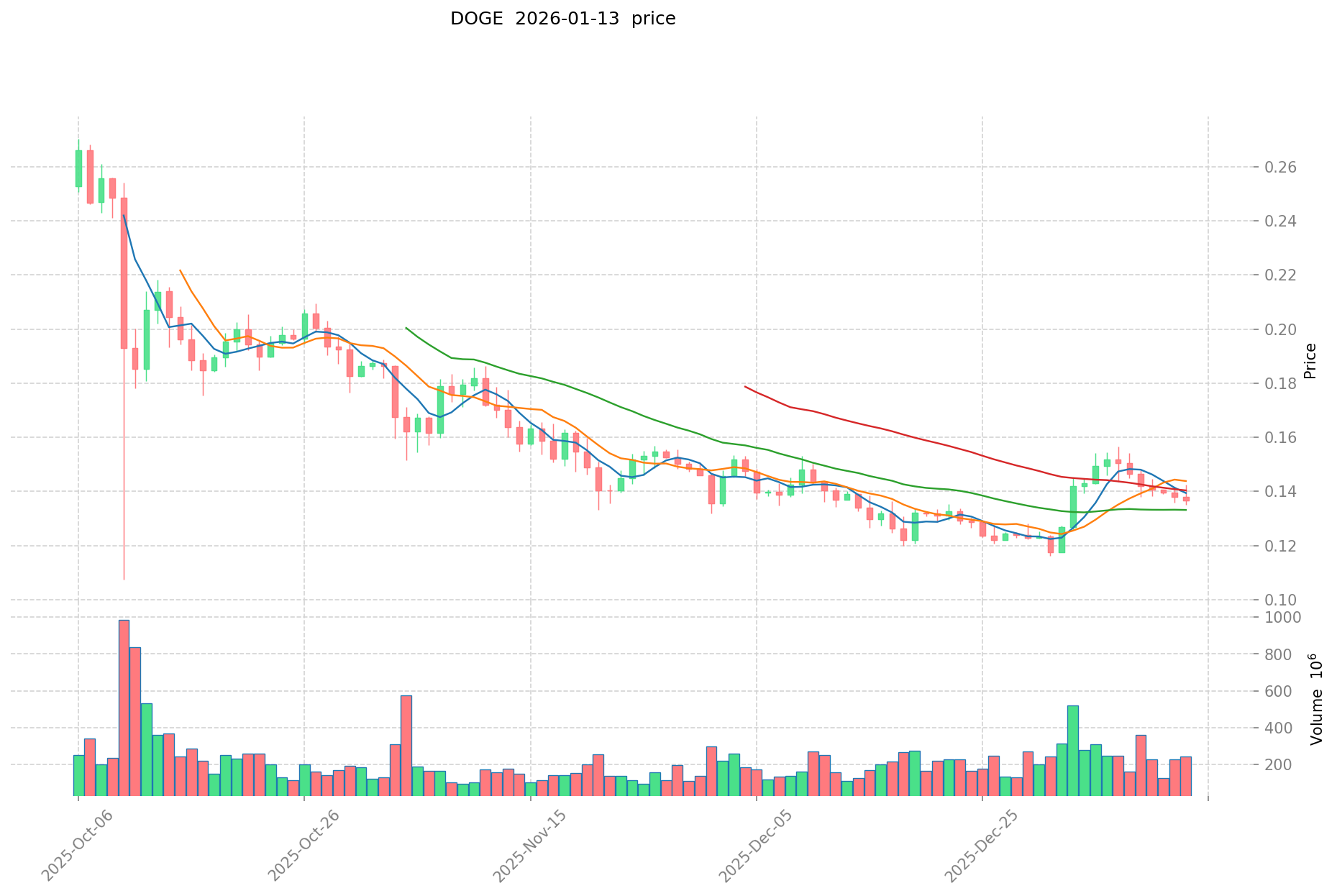
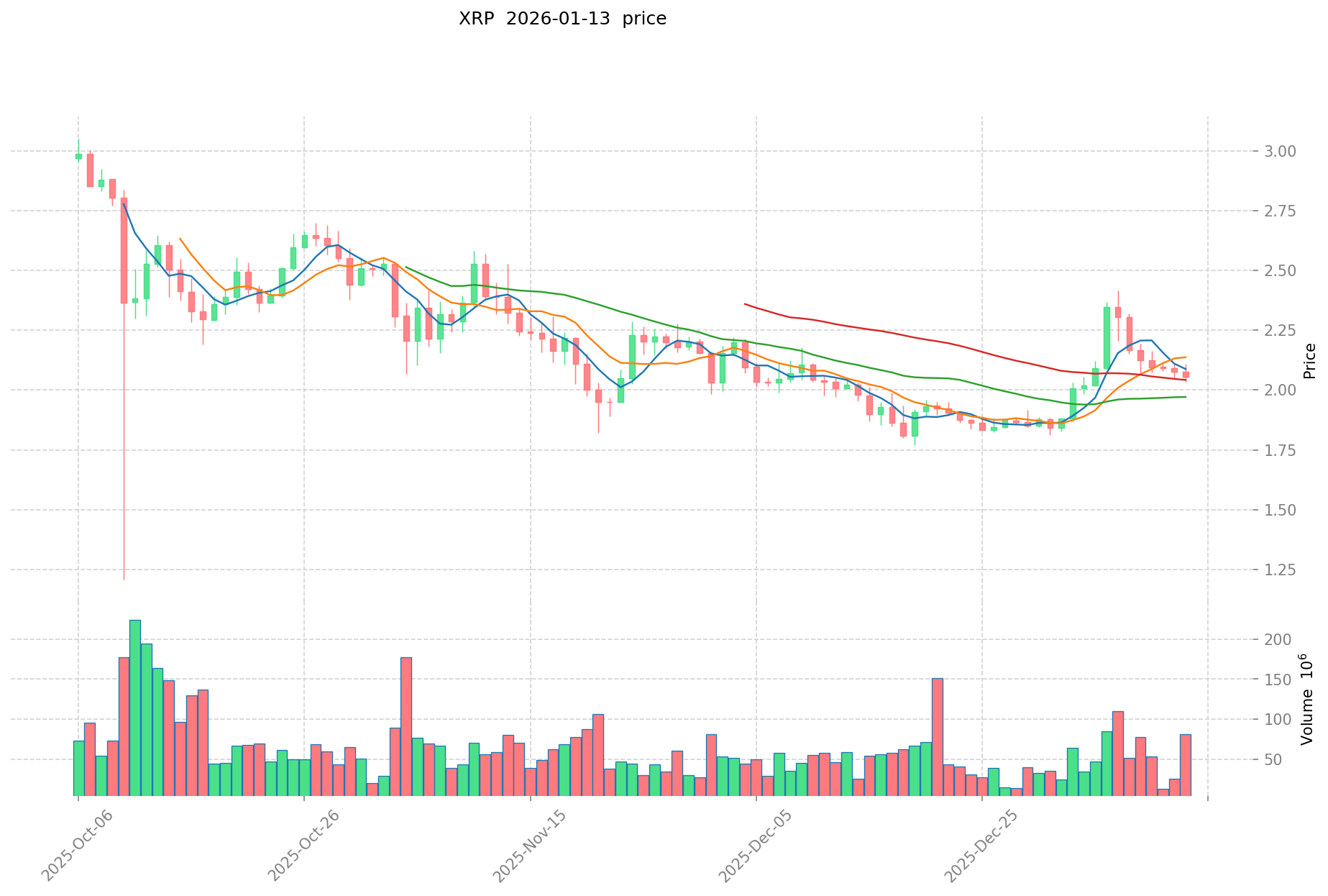
- Comparative Analysis: During the market cycle from their respective peaks, DOGE declined from $0.731578 to its current level of $0.13897, while XRP decreased from $3.65 to $2.066.
Current Market Status (January 13, 2026)
- DOGE Current Price: $0.13897
- XRP Current Price: $2.066
- 24-Hour Trading Volume: DOGE recorded $29,070,244.69 compared to XRP's $144,415,508.40
- Market Sentiment Index (Fear & Greed Index): 26 (Fear)
View real-time prices:
II. Core Factors Influencing DOGE vs XRP Investment Value
Supply Mechanism Comparison (Tokenomics)
-
XRP: Fixed maximum supply of 100 billion tokens, with a portion held in escrow by Ripple. The token economics are designed to support institutional cross-border payments, with transaction fees burned to create deflationary pressure over time.
-
DOGE: Unlimited supply with approximately 5 billion new tokens mined annually, creating an inflationary model. This continuous issuance dilutes existing holdings and differs fundamentally from scarcity-based value propositions.
-
📌 Historical Pattern: Supply mechanisms have historically influenced price cycles, with scarcity-based models experiencing different volatility patterns compared to inflationary models during market cycles.
Institutional Adoption and Market Application
-
Institutional Holdings: XRP demonstrates stronger institutional interest, with financial institutions exploring its use in cross-border payment systems. DOGE maintains primarily retail-driven market participation.
-
Enterprise Adoption: XRP is utilized in Ripple's payment network by financial institutions for international settlements, with transaction costs around $0.0002 and settlement times of 3-5 seconds. DOGE has limited enterprise adoption, with approximately 2,141 merchants globally accepting it as payment according to Cryptwerk data.
-
Regulatory Environment: Following the SEC settlement in 2025, XRP received regulatory clarity as a non-security in secondary markets. Multiple XRP ETFs, including ProShares Ultra XRP ETF, have received approval. DOGE ETFs have also been approved by exchanges, though market response has been more subdued.
Technology Development and Ecosystem Building
-
XRP Technical Infrastructure: Ripple's ODL (On-Demand Liquidity) service eliminates nostro/vostro account requirements, potentially releasing approximately $27 trillion in locked capital globally. The network processes cross-border payments significantly faster than traditional systems like SWIFT.
-
DOGE Technical Status: Originally created as a lighter alternative to Bitcoin, DOGE has not undergone substantial technical upgrades or development. The project lacks a clear development roadmap focused on utility expansion.
-
Ecosystem Comparison: XRP focuses on B2B payment infrastructure with strategic partnerships including Santander Bank and SBI Holdings, targeting the $187 trillion global cross-border payment market. DOGE ecosystem remains primarily community-driven without significant DeFi, NFT, or smart contract integration.
Macroeconomic Environment and Market Cycles
-
Performance in Different Economic Conditions: XRP's utility-based value proposition may provide more stability during market transitions, while DOGE's performance has historically correlated with speculative sentiment and social media trends.
-
Monetary Policy Impact: Interest rate changes and dollar strength affect both assets, though XRP's institutional use case in cross-border payments may create different response patterns compared to DOGE's retail-driven volatility.
-
Geopolitical Factors: Growing cross-border transaction demand and international payment efficiency requirements may favor payment-focused solutions. XRP's positioning in the financial infrastructure space aligns with these trends, while DOGE lacks similar utility-driven demand drivers.
III. 2026-2031 Price Forecast: DOGE vs XRP
Short-term Forecast (2026)
- DOGE: Conservative $0.1099-$0.1391 | Optimistic $0.1391-$0.1461
- XRP: Conservative $1.4028-$2.063 | Optimistic $2.063-$2.7438
Mid-term Forecast (2028-2029)
- DOGE may enter a consolidation phase, with projected price range of $0.1098-$0.1761
- XRP may enter a growth phase, with projected price range of $1.4590-$3.7102
- Key drivers: institutional capital inflows, ETF developments, ecosystem expansion
Long-term Forecast (2031)
- DOGE: Baseline scenario $0.1445-$0.1830 | Optimistic scenario $0.1830-$0.2232
- XRP: Baseline scenario $2.0858-$3.3641 | Optimistic scenario $3.3641-$3.8687
View detailed price predictions for DOGE and XRP
Disclaimer
DOGE:
| Year |
Predicted High Price |
Predicted Average Price |
Predicted Low Price |
Price Change |
| 2026 |
0.1460865 |
0.13913 |
0.1099127 |
0 |
| 2027 |
0.1525908275 |
0.14260825 |
0.1098083525 |
2 |
| 2028 |
0.1535035203 |
0.14759953875 |
0.1402195618125 |
6 |
| 2029 |
0.17614528954425 |
0.150551529525 |
0.12194673891525 |
8 |
| 2030 |
0.202552027822935 |
0.163348409534625 |
0.122511307150968 |
17 |
| 2031 |
0.223199266788111 |
0.18295021867878 |
0.144530672756236 |
31 |
XRP:
| Year |
Predicted High Price |
Predicted Average Price |
Predicted Low Price |
Price Change |
| 2026 |
2.74379 |
2.063 |
1.40284 |
0 |
| 2027 |
2.71583635 |
2.403395 |
2.0188518 |
16 |
| 2028 |
3.14832728025 |
2.559615675 |
1.45898093475 |
23 |
| 2029 |
3.7101629209125 |
2.853971477625 |
2.5685743298625 |
38 |
| 2030 |
3.446170559232187 |
3.28206719926875 |
2.461550399451562 |
58 |
| 2031 |
3.868736711138039 |
3.364118879250468 |
2.08575370513529 |
62 |
IV. Investment Strategy Comparison: DOGE vs XRP
Long-term vs Short-term Investment Strategies
-
XRP: May be suitable for investors focused on utility-driven assets with institutional adoption potential in cross-border payment infrastructure. The asset's positioning in financial services and regulatory clarity following the 2025 SEC settlement may appeal to those seeking exposure to payment technology adoption.
-
DOGE: May attract investors interested in community-driven assets with retail participation characteristics. The inflationary supply model and social media influence patterns suggest consideration of holding period impact on value retention.
Risk Management and Asset Allocation
-
Conservative Investors: Consider diversified exposure with lower allocation to volatile assets. A potential approach might involve XRP at higher weight relative to DOGE, given institutional adoption patterns and utility-based demand drivers.
-
Aggressive Investors: May consider higher allocation to assets with greater volatility profiles, while maintaining awareness of downside risks associated with speculative sentiment shifts.
-
Hedging Tools: Stablecoin reserves for rebalancing opportunities, options strategies for volatility management, and cross-asset portfolio construction to reduce correlation risk.
V. Comparative Risk Analysis
Market Risks
-
XRP: Price sensitivity to institutional adoption rates, competitive pressure from central bank digital currencies (CBDCs) and alternative payment solutions, and potential impact from changes in cross-border payment demand patterns.
-
DOGE: Elevated exposure to social media sentiment shifts and retail investor behavior patterns. The unlimited supply model creates ongoing dilution pressure, while limited utility development may affect long-term value retention during market cycles.
Technical Risks
-
XRP: Network dependency on validator consensus mechanisms and potential technical challenges in scaling institutional payment volumes. System reliability requirements for financial infrastructure applications.
-
DOGE: Limited technical development activity and absence of substantial protocol upgrades. Network security considerations related to mining concentration and computational resource allocation.
Regulatory Risks
- Global regulatory frameworks continue to evolve, with different implications for payment-focused cryptocurrencies versus community-driven assets. XRP's classification clarity in certain jurisdictions contrasts with the uncertain regulatory treatment of assets without clear utility propositions. Cross-border regulatory coordination and evolving compliance requirements may affect both assets differently based on their respective use cases and market positioning.
VI. Conclusion: Which Is the Better Buy?
📌 Investment Value Summary:
-
XRP Characteristics: Institutional adoption in payment infrastructure, regulatory clarity in secondary markets following 2025 SEC settlement, established partnerships with financial institutions, utility-driven demand from cross-border payment efficiency requirements, and fixed supply economics with deflationary transaction fee mechanism.
-
DOGE Characteristics: Strong community engagement and retail market presence, broad merchant acceptance with approximately 2,141 global merchants accepting payments, social media influence on price dynamics, and accessibility for new market participants.
✅ Investment Considerations:
-
New Market Participants: Consider starting with smaller position sizes to understand volatility patterns and market dynamics. Focus on understanding fundamental differences in supply mechanisms, use cases, and value drivers before increasing exposure.
-
Experienced Market Participants: Evaluate portfolio fit based on existing exposure to payment infrastructure assets versus community-driven cryptocurrencies. Consider correlation with broader market movements and specific risk factors associated with each asset class.
-
Institutional Participants: Assessment of XRP may involve analyzing alignment with payment technology adoption trends, regulatory clarity requirements, and integration potential with existing financial infrastructure. DOGE evaluation may focus on retail market exposure and social sentiment indicators.
⚠️ Risk Disclosure: Cryptocurrency markets exhibit high volatility with potential for substantial value fluctuations. This content does not constitute investment advice, financial guidance, or recommendations for specific investment actions. Market participants should conduct independent research and consult qualified financial professionals before making investment decisions.
VII. FAQ
Q1: What is the fundamental difference between DOGE and XRP's supply mechanisms?
XRP has a fixed maximum supply of 100 billion tokens with deflationary pressure through transaction fee burning, while DOGE has an unlimited supply with approximately 5 billion new tokens mined annually, creating ongoing inflationary dilution. XRP's scarcity-based model aligns with institutional value preservation requirements, whereas DOGE's continuous issuance fundamentally differs from traditional store-of-value propositions and may impact long-term price stability during extended holding periods.
Q2: Which cryptocurrency has stronger institutional adoption?
XRP demonstrates significantly stronger institutional adoption. XRP is utilized in Ripple's payment network by financial institutions for international settlements, with partnerships including Santander Bank and SBI Holdings, targeting the $187 trillion global cross-border payment market. XRP's ODL (On-Demand Liquidity) service potentially releases approximately $27 trillion in globally locked capital. In contrast, DOGE maintains primarily retail-driven market participation with approximately 2,141 merchants globally accepting payments, but lacks substantial enterprise-level financial infrastructure integration.
Q3: How did the 2025 SEC settlement affect XRP's investment profile?
The 2025 SEC settlement provided regulatory clarity by classifying XRP as a non-security in secondary markets, which subsequently enabled the approval of multiple XRP ETFs including the ProShares Ultra XRP ETF. This regulatory certainty reduced compliance uncertainty for institutional participants and established clearer operational frameworks for exchanges and financial service providers handling XRP. The settlement represented a significant shift from the previous regulatory ambiguity that had constrained institutional participation since 2020.
Q4: What are the projected price ranges for DOGE and XRP by 2031?
Based on current market analysis models:
For DOGE by 2031: Baseline scenario projects $0.1445-$0.1830, with an optimistic scenario ranging from $0.1830-$0.2232, representing a 31% price change from 2026 levels.
For XRP by 2031: Baseline scenario projects $2.0858-$3.3641, with an optimistic scenario ranging from $3.3641-$3.8687, representing a 62% price change from 2026 levels.
These projections factor in institutional capital inflows, ETF developments, ecosystem expansion, and macro-economic conditions, though actual outcomes may vary significantly based on market dynamics and unforeseen developments.
Q5: What is XRP's transaction speed advantage over traditional payment systems?
XRP processes cross-border payments in approximately 3-5 seconds with transaction costs around $0.0002, compared to traditional SWIFT-based international transfers which typically require 3-5 business days and incur fees of $25-$50 per transaction. The network's capacity exceeds 1,500 transactions per second, providing significant operational efficiency improvements for financial institutions managing high-volume international payment flows. This speed and cost advantage addresses critical pain points in the $187 trillion global cross-border payment infrastructure.
Q6: How does social media influence affect DOGE's price performance?
DOGE's price dynamics exhibit strong correlation with social media sentiment and endorsements from public figures, as evidenced by its all-time high of $0.731578 on May 8, 2021, driven largely by social media attention. This characteristic creates elevated volatility exposure tied to sentiment shifts rather than fundamental utility developments. Unlike XRP's institutional demand drivers based on payment infrastructure adoption, DOGE's value proposition remains primarily dependent on community engagement and retail market participation patterns, which may experience rapid fluctuations based on trending topics and influencer commentary.
Q7: What risk management approach should different investor types consider for DOGE vs XRP allocation?
Conservative investors may consider diversified exposure with higher weight to XRP relative to DOGE, given institutional adoption patterns and utility-based demand drivers, potentially combined with stablecoin reserves for rebalancing opportunities during volatility.
Aggressive investors may allocate higher percentages to both assets while maintaining awareness of downside risks, utilizing options strategies for volatility management and establishing clear exit criteria for speculative positions.
Institutional participants should assess XRP based on alignment with payment technology adoption trends and regulatory clarity requirements, while DOGE evaluation may focus on retail market exposure metrics and social sentiment indicators within broader portfolio diversification frameworks.
Q8: What is the current market sentiment status for cryptocurrency assets?
As of January 13, 2026, the market sentiment index (Fear & Greed Index) stands at 26, indicating "Fear" conditions. This reflects cautious market positioning and may suggest potential accumulation opportunities for longer-term participants, though fear conditions can persist or intensify before reversal. DOGE recorded 24-hour trading volume of $29,070,244.69 compared to XRP's $144,415,508.40, indicating substantially higher liquidity and institutional participation in XRP markets during current market conditions.
* The information is not intended to be and does not constitute financial advice or any other recommendation of any sort offered or endorsed by Gate.