This comprehensive analysis compares DOGEGOV and ETH as decentralized governance platforms, examining their investment potential across multiple dimensions. DOGEGOV, launched August 2024, functions as a speculative meme coin with limited ecosystem development, while ETH represents an established blockchain infrastructure supporting smart contracts and decentralized applications since 2014. The article analyzes historical price trends, tokenomics, institutional adoption patterns, and technical ecosystems to evaluate governance capabilities. ETH demonstrates superior institutional support, regulatory clarity, and proven use cases across DeFi and enterprise applications, whereas DOGEGOV exhibits extreme volatility with 99.6% peak decline and minimal liquidity ($19,768 daily volume). Through 2031 price projections, investment allocation strategies, and risk comparisons, this analysis concludes that ETH offers stronger long-term governance potential for risk-conscious investors, while DOGEGOV suits only experience
Introduction: DOGEGOV vs ETH Investment Comparison
In the cryptocurrency market, the comparison between DOGEGOV and ETH has become a topic that investors cannot ignore. The two not only show significant differences in market capitalization ranking, application scenarios, and price performance, but also represent different positioning in crypto assets.
DOGEGOV (DOGEGOV): Launched in August 2024, this token is positioned within the meme coin sector, though specific application scenarios remain limited in available data.
ETH (ETH): Since its launch in July 2014, it has been recognized as a decentralized blockchain platform supporting smart contracts and decentralized applications (DApps), ranking as one of the cryptocurrencies with substantial global trading volume and market capitalization.
This article will provide a comprehensive analysis of the investment value comparison between DOGEGOV and ETH, focusing on historical price trends, supply mechanisms, institutional adoption, technical ecosystems, and future predictions, attempting to answer the question that concerns investors most:
"Which is the better buy right now?"
I. Historical Price Comparison and Current Market Status
DOGEGOV (Coin A) vs ETH (Coin B) Historical Price Trends
-
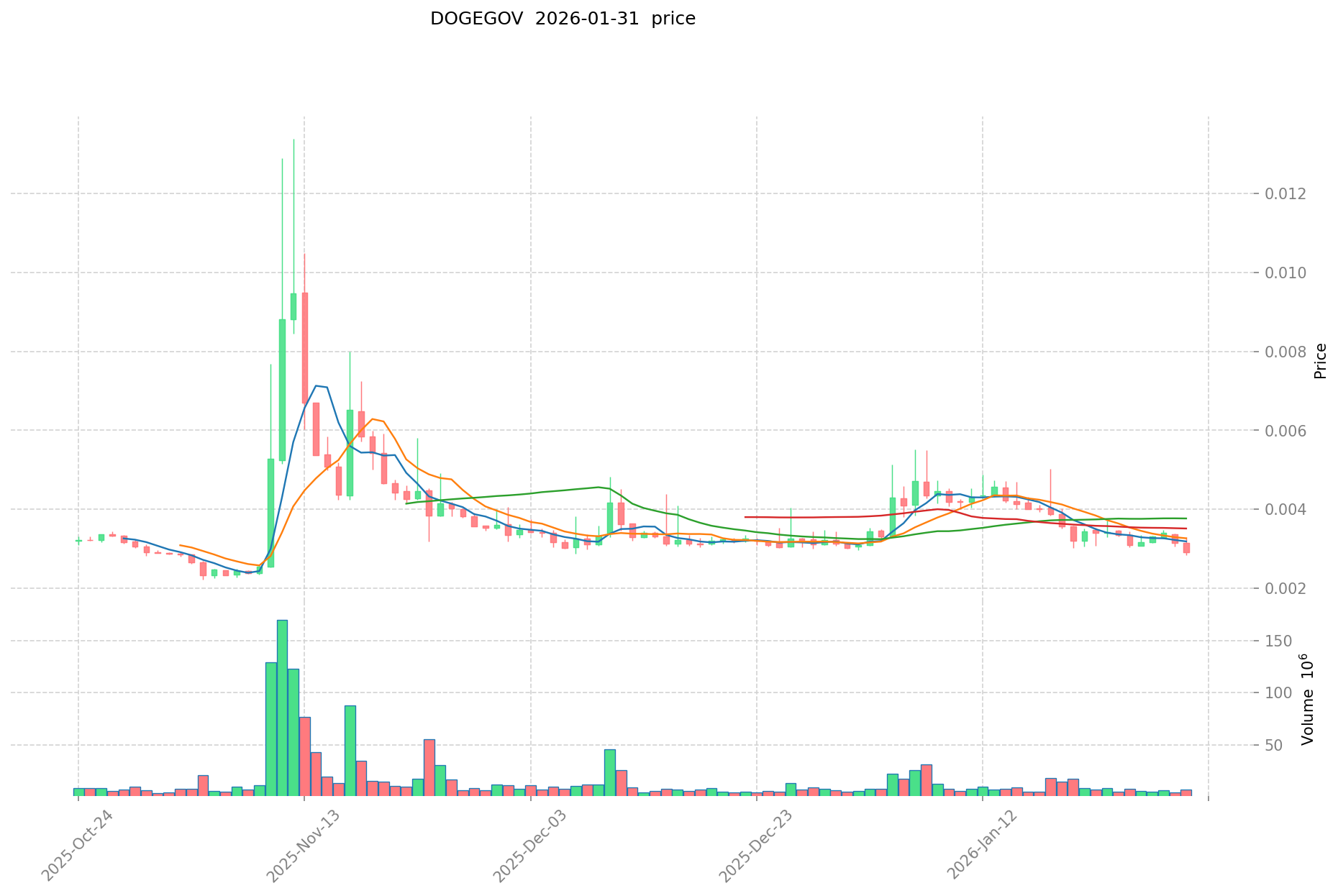
2024: DOGEGOV experienced notable volatility following its launch in August 2024 at $0.142. The token reached an all-time high of $0.61019 in November 2024, demonstrating significant early-stage price appreciation.
-
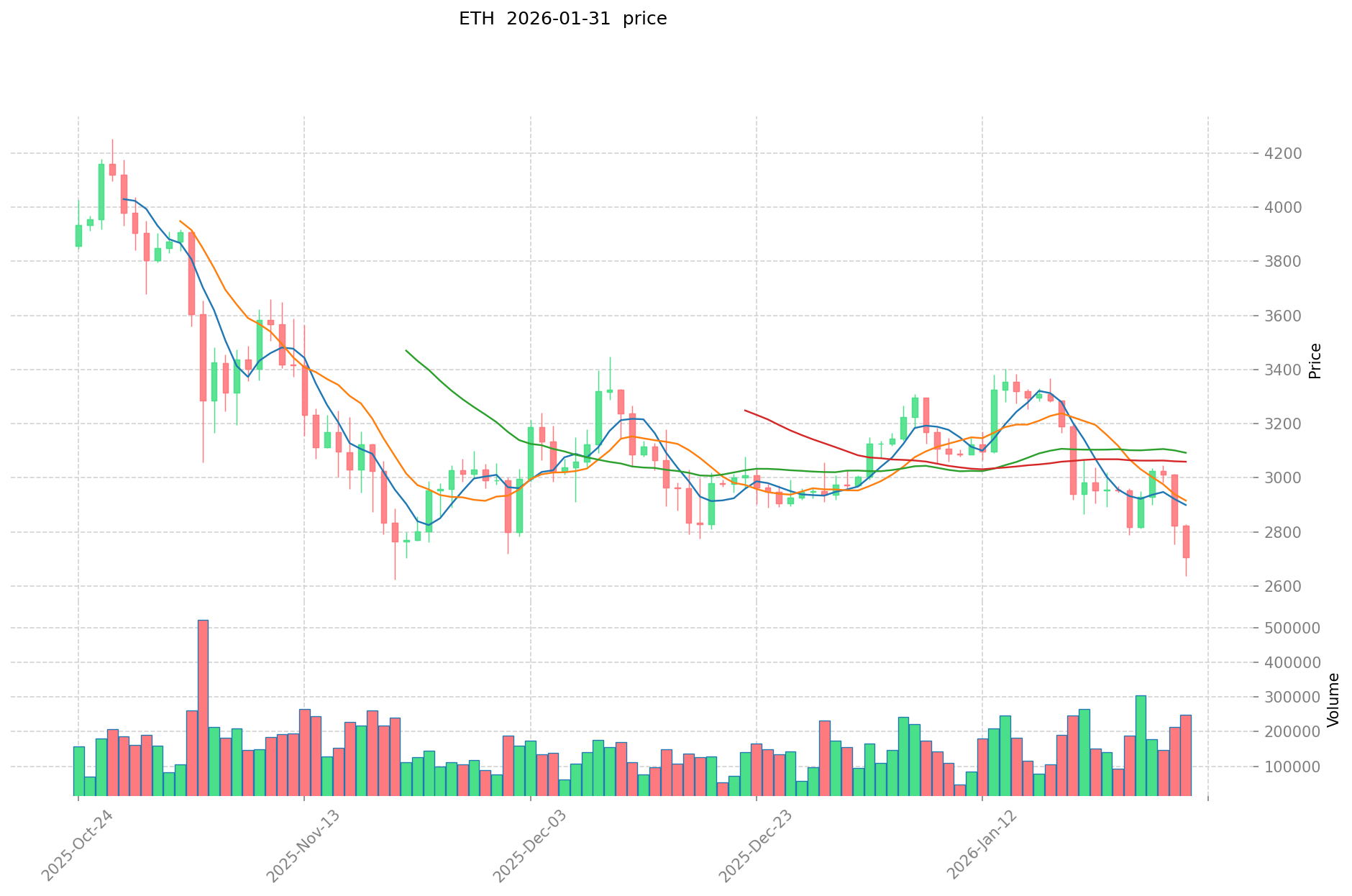
2025: ETH showed resilience throughout 2025, with its Pectra upgrade in May introducing EIP-7251 and raising validator staking limits to 2048 ETH. The token reached an all-time high of $4,946.05 in August 2025, though it faced subsequent corrections.
-
Comparative Analysis: During the recent market cycle, DOGEGOV declined from its peak of $0.61019 to a low of $0.002219 (representing a decline of approximately 99.6%), while ETH experienced a more moderate correction from $4,946.05 to current levels around $2,695.62.
Current Market Status (January 31, 2026)
- DOGEGOV Current Price: $0.002882
- ETH Current Price: $2,695.62
- 24-Hour Trading Volume: DOGEGOV recorded $19,768.04 compared to ETH's substantially higher $610,988,533.30
- Market Sentiment Index (Fear & Greed Index): 20 (Extreme Fear)
View real-time prices:
II. Core Factors Influencing DOGEGOV vs ETH Investment Value
Tokenomics Comparison
- DOGEGOV: Characterized by high volatility and political-driven dynamics, with a market capitalization of approximately 3.07 million USD and limited daily liquidity of around 17,000 USD. The token operates as a speculative asset within a niche market segment.
- ETH: Features a well-established supply mechanism with network utility-driven demand. ETH's value proposition is closely tied to blockchain technology adoption and the broader Ethereum ecosystem's development.
- 📌 Historical Pattern: Supply mechanisms play a significant role in driving price cycles, with established tokens showing more stable long-term trajectories compared to meme-based assets.
Institutional Adoption and Market Application
- Institutional Holdings: ETH demonstrates stronger appeal to institutional investors due to its proven track record and broader use cases in decentralized finance and smart contract applications.
- Enterprise Adoption: ETH has gained traction in cross-border payments, settlement systems, and investment portfolios. DOGEGOV remains primarily positioned as a small-scale speculative instrument with limited enterprise integration.
- Regulatory Landscape: Different jurisdictions maintain varying regulatory stances, with established cryptocurrencies like ETH generally receiving more regulatory clarity compared to meme coins.
Technical Development and Ecosystem Building
- DOGEGOV Technical Features: Operates as an innovative yet high-risk digital asset with political themes, though technical infrastructure details remain limited in available materials.
- ETH Technical Evolution: Continues to develop its blockchain infrastructure with ongoing protocol improvements and network enhancements.
- Ecosystem Comparison: ETH maintains significant presence across DeFi protocols, NFT marketplaces, payment solutions, and smart contract implementations. DOGEGOV's ecosystem application remains comparatively narrow, focusing primarily on speculative trading activities.
Macroeconomic Environment and Market Cycles
- Performance in Inflationary Conditions: When traditional currencies weaken due to inflation or policy changes, market participants may seek alternative digital assets. However, the choice between established tokens and speculative meme coins varies based on risk tolerance.
- Macroeconomic Monetary Policy: Interest rates, inflation metrics, and GDP performance influence investor sentiment toward different crypto asset categories, with established tokens generally showing different correlation patterns compared to meme coins.
- Geopolitical Considerations: Cross-border transaction demands and international market dynamics affect adoption patterns, with utility-focused tokens potentially benefiting from increased institutional interest during periods of economic uncertainty.
III. 2026-2031 Price Forecast: DOGEGOV vs ETH
Short-Term Forecast (2026)
- DOGEGOV: Conservative $0.00193 - $0.00288 | Optimistic $0.00288 - $0.00314
- ETH: Conservative $2,150 - $2,688 | Optimistic $2,688 - $3,359
Mid-Term Forecast (2028-2029)
- DOGEGOV may enter a gradual growth phase, with projected prices ranging from $0.00252 to $0.00402 in 2028, and $0.00318 to $0.00421 in 2029
- ETH may enter a consolidation phase, with projected prices ranging from $2,865 to $4,484 in 2028, and $2,749 to $4,674 in 2029
- Key drivers: institutional capital inflows, ETF developments, ecosystem expansion
Long-Term Forecast (2030-2031)
- DOGEGOV: Baseline scenario $0.00288 - $0.00389 (2030), $0.00289 - $0.00432 (2031) | Optimistic scenario $0.00389 - $0.00475 (2030), $0.00432 - $0.00570 (2031)
- ETH: Baseline scenario $2,709 - $4,300 (2030), $2,719 - $4,688 (2031) | Optimistic scenario $4,300 - $5,075 (2030), $4,688 - $5,531 (2031)
View detailed price predictions for DOGEGOV and ETH
Disclaimer: Price predictions are based on historical data analysis and market trend modeling. Cryptocurrency markets are highly volatile and subject to various external factors. These forecasts should not be considered as investment advice. Users should conduct their own research and assess their risk tolerance before making any investment decisions.
DOGEGOV:
| Year |
Predicted High Price |
Predicted Average Price |
Predicted Low Price |
Price Change |
| 2026 |
0.00314138 |
0.002882 |
0.00193094 |
0 |
| 2027 |
0.0032225083 |
0.00301169 |
0.0017467802 |
4 |
| 2028 |
0.0040210579035 |
0.00311709915 |
0.0025248503115 |
8 |
| 2029 |
0.004211512661565 |
0.00356907852675 |
0.003176479888807 |
23 |
| 2030 |
0.004746160624872 |
0.003890295594157 |
0.002878818739676 |
34 |
| 2031 |
0.005700061104559 |
0.004318228109514 |
0.002893212833374 |
49 |
ETH:
| Year |
Predicted High Price |
Predicted Average Price |
Predicted Low Price |
Price Change |
| 2026 |
3359.375 |
2687.5 |
2150 |
0 |
| 2027 |
3718.828125 |
3023.4375 |
2237.34375 |
12 |
| 2028 |
4483.606640625 |
3371.1328125 |
2865.462890625 |
25 |
| 2029 |
4673.569974609375 |
3927.3697265625 |
2749.15880859375 |
45 |
| 2030 |
5074.55442369140625 |
4300.4698505859375 |
2709.296005869140625 |
59 |
| 2031 |
5531.264321823632812 |
4687.512137138671875 |
2718.757039540429687 |
73 |
IV. Investment Strategy Comparison: DOGEGOV vs ETH
Long-Term vs Short-Term Investment Strategies
-
DOGEGOV: More suited for speculative traders with high risk tolerance who seek short-term opportunities in volatile meme coin markets. The token's limited liquidity and narrow use cases make it primarily suitable for traders comfortable with significant price fluctuations and potential capital loss.
-
ETH: Appropriate for investors focused on blockchain infrastructure adoption, decentralized application development, and long-term value appreciation tied to technological advancement. The token's established ecosystem and broader market acceptance position it as a candidate for both medium-term and long-term holding strategies.
Risk Management and Asset Allocation
-
Conservative Investors: DOGEGOV 0-5% vs ETH 15-25% (with remainder in stablecoins and traditional assets)
-
Aggressive Investors: DOGEGOV 5-15% vs ETH 30-50% (with diversification across multiple crypto assets)
-
Hedging Instruments: Stablecoin reserves for market downturns, options contracts for downside protection, cross-asset portfolio construction combining different risk profiles
V. Potential Risk Comparison
Market Risk
-
DOGEGOV: Characterized by extreme volatility with historical price declines exceeding 99% from peak levels. Limited trading volume (approximately $19,768 daily) creates liquidity constraints and susceptibility to price manipulation. Market sentiment remains highly speculative with minimal fundamental support.
-
ETH: Subject to broader cryptocurrency market cycles and correlation with Bitcoin price movements. Vulnerable to macroeconomic shifts including interest rate changes and regulatory developments. Despite established market presence, significant price corrections remain possible during market-wide downturns.
Technical Risk
-
DOGEGOV: Limited technical infrastructure documentation and narrow ecosystem development raise concerns about long-term viability. Dependency on community sentiment and social media trends creates unpredictable technical development trajectories.
-
ETH: Network scalability challenges during periods of high transaction demand may impact user experience. Protocol upgrade risks exist during major network transitions, though historical execution has demonstrated relative stability. Ongoing development of Layer 2 solutions addresses some scalability concerns.
Regulatory Risk
- Global regulatory frameworks continue evolving with varying approaches across jurisdictions. Established cryptocurrencies like ETH generally receive clearer regulatory guidance compared to meme-based tokens. Potential classification changes or stricter oversight could affect market accessibility and institutional participation differently for each asset category.
VI. Conclusion: Which Is the Better Buy?
📌 Investment Value Summary:
-
DOGEGOV Characteristics: High-risk speculative instrument with extreme volatility potential. Limited liquidity and narrow use cases restrict suitability to traders seeking short-term price movements. Historical performance shows significant downside risk with limited fundamental support.
-
ETH Characteristics: Established blockchain infrastructure with diverse ecosystem applications across DeFi, NFTs, and smart contracts. Stronger institutional adoption patterns and regulatory clarity compared to meme coins. Technical development roadmap provides potential catalysts for long-term value appreciation.
✅ Investment Considerations:
-
Novice Investors: Consider focusing allocation toward established assets with proven track records and broader market acceptance. Limit exposure to highly speculative instruments until developing stronger risk assessment capabilities and market understanding.
-
Experienced Investors: May incorporate small speculative positions in high-volatility assets while maintaining core holdings in established cryptocurrencies. Risk management through position sizing and stop-loss mechanisms becomes essential for volatile asset exposure.
-
Institutional Investors: Typically favor assets with regulatory clarity, substantial liquidity, and established use cases. Infrastructure-focused cryptocurrencies align more closely with institutional investment mandates compared to meme-based tokens.
⚠️ Risk Disclosure: Cryptocurrency markets exhibit extreme volatility and uncertainty. This analysis does not constitute investment advice. Market participants should conduct independent research, assess personal risk tolerance, and consult qualified financial advisors before making investment decisions.
VII. FAQ
Q1: What is the main difference between DOGEGOV and ETH in terms of investment risk profile?
DOGEGOV represents an extremely high-risk speculative instrument with volatility exceeding 99% decline from peak levels, while ETH functions as a relatively more stable blockchain infrastructure asset with established market acceptance. DOGEGOV operates primarily as a meme coin with limited liquidity (approximately $19,768 daily trading volume) and narrow use cases, making it susceptible to dramatic price swings and potential manipulation. In contrast, ETH benefits from broader institutional adoption, substantial daily trading volume ($610,988,533.30), and diverse ecosystem applications across DeFi, NFTs, and smart contracts. The regulatory landscape also differs significantly, with ETH receiving clearer regulatory guidance compared to meme-based tokens like DOGEGOV.
Q2: Which cryptocurrency is more suitable for long-term investment: DOGEGOV or ETH?
ETH demonstrates stronger characteristics for long-term investment strategies compared to DOGEGOV. ETH's established blockchain infrastructure, ongoing technical development (including the Pectra upgrade raising validator staking limits to 2048 ETH), and proven track record since July 2014 provide fundamental support for long-term value appreciation. The token's integration across multiple sectors including cross-border payments, settlement systems, and decentralized applications creates sustained demand beyond speculative trading. DOGEGOV, launched in August 2024, lacks comparable ecosystem depth and remains primarily dependent on community sentiment and social media trends, positioning it as more suitable for short-term speculative trading rather than long-term holding strategies.
Q3: How should investors allocate capital between DOGEGOV and ETH based on risk tolerance?
Asset allocation between DOGEGOV and ETH should align directly with individual risk tolerance and investment objectives. Conservative investors might consider 0-5% allocation to DOGEGOV versus 15-25% to ETH, with the remainder in stablecoins and traditional assets to maintain portfolio stability. Aggressive investors comfortable with higher volatility could allocate 5-15% to DOGEGOV and 30-50% to ETH, while maintaining diversification across multiple crypto assets. Novice investors should prioritize established assets like ETH with proven track records and limit exposure to highly speculative instruments until developing stronger market understanding. Experienced traders may incorporate small speculative positions in volatile assets like DOGEGOV while implementing strict risk management through position sizing and stop-loss mechanisms.
Q4: What are the projected price ranges for DOGEGOV and ETH through 2031?
Price forecasts suggest divergent trajectories for both assets based on historical data analysis and market trend modeling. For DOGEGOV, conservative 2026 projections range from $0.00193 to $0.00288, potentially reaching $0.00289 to $0.00432 by 2031 under baseline scenarios, with optimistic scenarios projecting up to $0.00570. ETH shows more substantial price ranges, with conservative 2026 estimates between $2,150 and $2,688, potentially reaching $2,719 to $4,688 by 2031 in baseline scenarios, with optimistic projections extending to $5,531. However, these forecasts carry significant uncertainty due to cryptocurrency market volatility, regulatory developments, and macroeconomic factors. Historical performance indicates ETH demonstrates more moderate correction patterns compared to DOGEGOV's extreme volatility, which experienced approximately 99.6% decline from its November 2024 peak.
Q5: What technical and ecosystem advantages does ETH have over DOGEGOV?
ETH maintains substantial technical and ecosystem advantages compared to DOGEGOV across multiple dimensions. ETH's blockchain infrastructure supports smart contracts and decentralized applications with ongoing protocol improvements, including the Pectra upgrade that enhanced validator staking capabilities. The ecosystem encompasses significant presence across DeFi protocols, NFT marketplaces, payment solutions, and cross-border settlement systems, creating diverse demand sources beyond speculative trading. DOGEGOV's technical infrastructure remains limited in available documentation, with ecosystem applications focused primarily on speculative trading activities. ETH's network benefits from substantial developer activity, established Layer 2 scaling solutions addressing throughput concerns, and institutional-grade infrastructure supporting enterprise adoption. These technical foundations contribute to ETH's stronger institutional appeal and regulatory clarity compared to meme-based tokens.
Q6: How do market liquidity differences between DOGEGOV and ETH impact investment decisions?
Market liquidity represents a critical differentiating factor between DOGEGOV and ETH that significantly impacts investment execution and risk management. DOGEGOV's limited daily trading volume of approximately $19,768 creates substantial liquidity constraints, making large position entries or exits challenging without significant price impact. This low liquidity environment increases susceptibility to price manipulation and creates wider bid-ask spreads that erode trading profitability. ETH's substantially higher daily trading volume of $610,988,533.30 provides deeper market liquidity, enabling institutional-sized transactions with minimal slippage and tighter spreads. The liquidity differential also affects risk management capabilities, as DOGEGOV holders may face difficulty implementing stop-loss orders or exit strategies during market stress, while ETH's liquid markets facilitate more reliable risk management execution.
Q7: What regulatory considerations should investors evaluate when comparing DOGEGOV and ETH?
Regulatory landscape differences between DOGEGOV and ETH present important considerations for investment decision-making. Established cryptocurrencies like ETH generally receive clearer regulatory guidance across major jurisdictions due to their proven track record and established use cases in blockchain infrastructure. Regulatory frameworks continue evolving globally with varying approaches, but utility-focused tokens typically benefit from more predictable treatment compared to meme-based assets. DOGEGOV's classification as a meme coin with political themes may face heightened scrutiny or uncertain regulatory status, potentially affecting market accessibility and institutional participation. Investors should monitor jurisdiction-specific developments, potential classification changes, and evolving oversight frameworks that could differentially impact these asset categories. Institutional investors particularly prioritize regulatory clarity when evaluating cryptocurrency exposure, typically favoring assets with established compliance frameworks and transparent regulatory positioning.
Q8: What role does institutional adoption play in the investment value comparison between DOGEGOV and ETH?
Institutional adoption patterns significantly influence the long-term investment value proposition for ETH compared to DOGEGOV. ETH demonstrates stronger appeal to institutional investors through its proven track record, broader use cases in decentralized finance, and integration into enterprise blockchain initiatives. Institutional holdings contribute to price stability, enhanced liquidity, and sustained demand beyond retail speculation. ETH's presence in cross-border payments, settlement systems, and investment portfolios reflects growing institutional confidence in blockchain infrastructure. DOGEGOV remains primarily positioned as a small-scale speculative instrument with minimal enterprise integration or institutional interest. The institutional adoption differential affects market dynamics during stress periods, as assets with established institutional support typically demonstrate more resilient price action compared to purely retail-driven speculative tokens. This institutional foundation provides ETH with additional value support mechanisms absent in meme coin markets.
* The information is not intended to be and does not constitute financial advice or any other recommendation of any sort offered or endorsed by Gate.