This comprehensive article analyzes EDEN versus STX, two distinct blockchain assets serving different market niches. EDEN, launched in 2022, focuses on real-world asset tokenization with regulatory compliance, currently priced at $0.05632 with a $10.36M market cap. STX, established in 2019, functions as a decentralized application platform, trading at $0.2824 with a $500.76M market cap. The comparison covers historical price trends, supply mechanisms, institutional adoption, ecosystem development, and risk factors. EDEN exhibits extreme volatility, declining 95% from peak, while STX shows relative stability with 93% decline. Key differences include supply distribution—EDEN at 18.39% circulating versus STX at 97.54%—and liquidity metrics. Price projections through 2031 suggest STX's higher appreciation potential. Investment recommendations prioritize STX (70-80%) for conservative investors and balanced allocation for aggressive investors. The article provides allocation strategies, risk assessments, and detail
Introduction: Investment Comparison Between EDEN and STX
In the cryptocurrency market, the comparison between EDEN vs STX has become a topic that investors cannot bypass. The two tokens demonstrate notable differences in market cap ranking, application scenarios, and price performance, representing distinct positioning within the crypto asset landscape.
OpenEden (EDEN): Launched in 2022, this platform has garnered market recognition through its focus on real-world asset (RWA) tokenization, bridging traditional finance and decentralized finance with regulatory compliance as its core principle.
Stacks (STX): Emerging in 2019, it has been positioned as a decentralized application platform that empowers users with data ownership and builds an open-source development ecosystem for blockchain applications.
This article will comprehensively analyze the investment value comparison between EDEN vs STX around historical price trends, supply mechanisms, institutional adoption, technological ecosystems, and future predictions, attempting to answer the question investors care about most:
"Which is the better buy right now?"
I. Historical Price Comparison and Current Market Conditions
EDEN (Coin A) vs STX (Coin B) Historical Price Trends
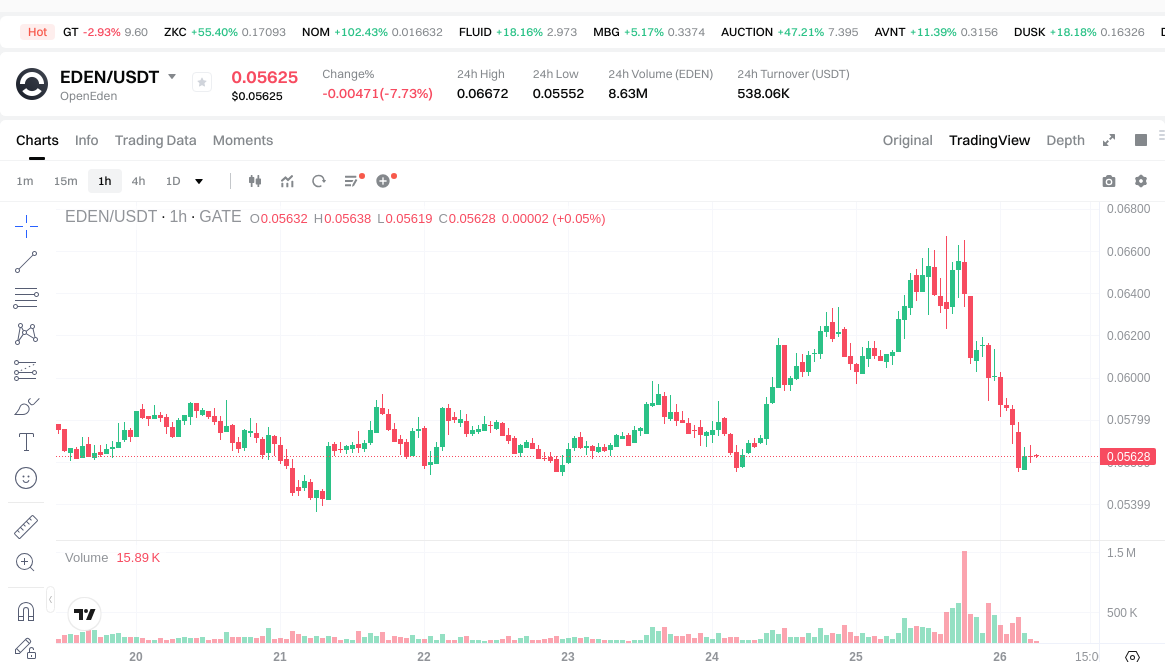
- 2024-2025: EDEN experienced significant price volatility, reaching an all-time high of $1.1123 on September 30, 2025, before declining sharply.
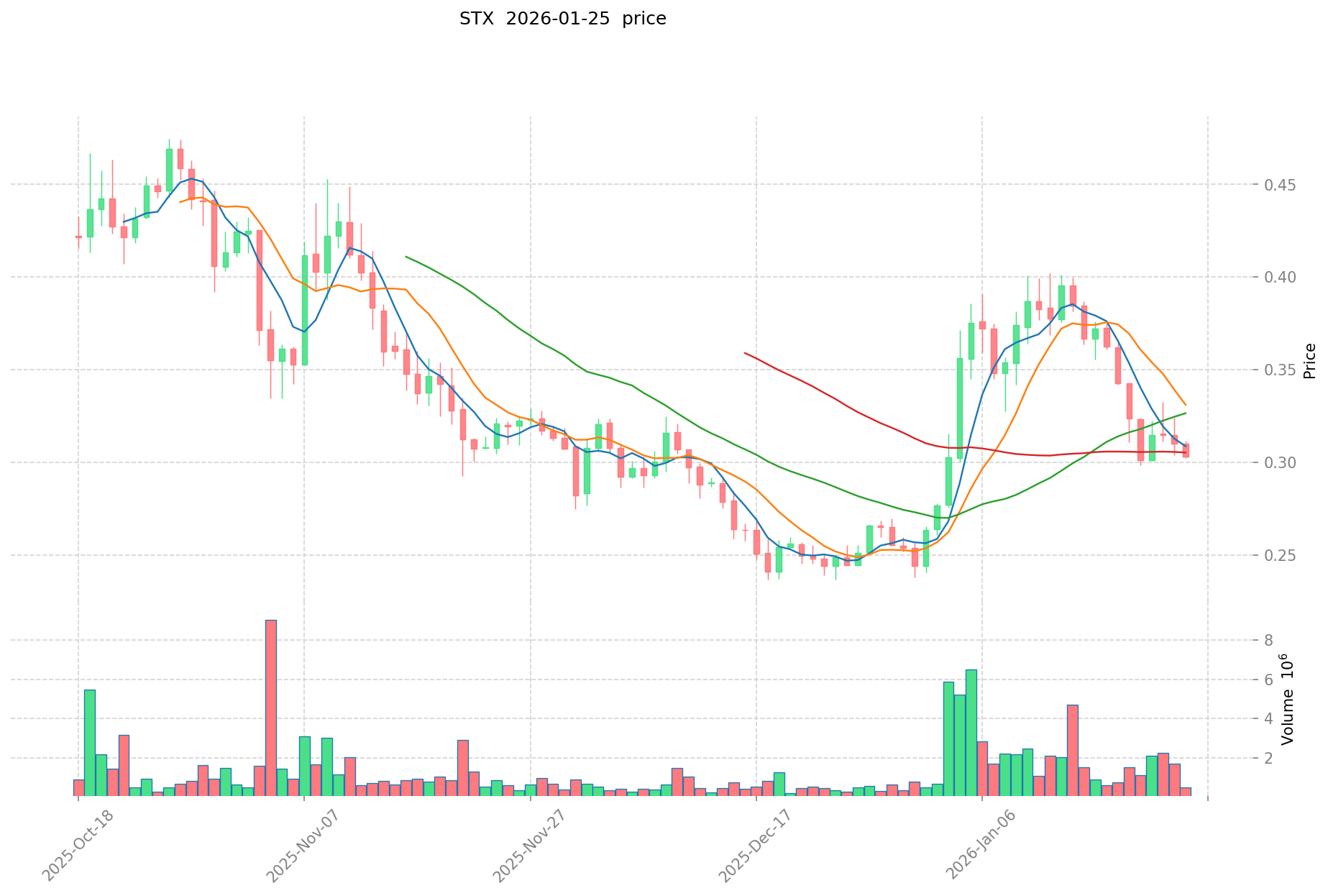
- 2024: STX reached its historical peak of $3.86 on April 1, 2024, amid broader market momentum.
- 2020: STX recorded its all-time low of $0.04559639 on March 13, 2020, during a period of market-wide correction.
- 2026: EDEN dropped to its all-time low of $0.05268 on January 19, 2026, reflecting recent market challenges.
- Comparative Analysis: During the recent market cycle, EDEN declined from $1.1123 to $0.05268, representing substantial downward pressure, while STX showed resilience with its current price at $0.2824, maintaining a more moderate decline from its peak.
Current Market Conditions (January 26, 2026)
- EDEN Current Price: $0.05632
- STX Current Price: $0.2824
- 24-Hour Trading Volume: EDEN $537,705.45 vs STX $659,043.97
- Market Sentiment Index (Fear & Greed Index): 25 (Extreme Fear)
- EDEN 24-Hour Price Change: -7.67%
- STX 24-Hour Price Change: -7.11%
- Market Capitalization: EDEN $10.36M vs STX $500.76M
- Circulating Supply: EDEN 183.87M (18.39% of max supply) vs STX 1.77B (97.54% of max supply)
View real-time prices:
- Check EDEN Current Price Market Price
- Check STX Current Price Market Price
II. Core Factors Affecting EDEN vs STX Investment Value
Supply Mechanism Comparison (Tokenomics)
Due to limited available data on the specific supply mechanisms of EDEN and STX, a detailed comparison cannot be provided at this time. Supply mechanisms such as fixed supply models, deflationary structures, or halving schedules typically play significant roles in token value dynamics, but concrete information for these two assets is not currently accessible.
Institutional Adoption and Market Application
- Institutional Holdings: Specific data regarding institutional preference between EDEN and STX is not available in the provided materials.
- Enterprise Adoption: Information on the application of EDEN or STX in cross-border payments, settlement systems, or investment portfolios is not documented in the reference materials.
- National Policies: Regulatory attitudes from different jurisdictions toward EDEN and STX are not covered in the available data.
Technical Development and Ecosystem Building
- EDEN Technical Development: Detailed information on technical upgrades and their potential impacts is not available in the reference materials.
- STX Technical Development: Specific details on technical advancements and ecosystem implications are not documented.
- Ecosystem Comparison: Data on DeFi integration, NFT applications, payment solutions, and smart contract implementations for both EDEN and STX is not present in the provided materials.
Macroeconomic Factors and Market Cycles
- Performance in Inflationary Environments: Comparative analysis of inflation-hedging characteristics between EDEN and STX cannot be conducted due to insufficient data.
- Macroeconomic Monetary Policy: The specific impacts of interest rates and dollar index fluctuations on EDEN and STX are not documented in the available materials.
- Geopolitical Factors: Information regarding cross-border transaction demand and international dynamics affecting these assets is not available.
III. 2026-2031 Price Prediction: EDEN vs STX
Short-term Forecast (2026)
- EDEN: Conservative $0.035-$0.056 | Optimistic $0.056-$0.060
- STX: Conservative $0.155-$0.282 | Optimistic $0.282-$0.419
Mid-term Forecast (2028-2029)
- EDEN may enter a consolidation phase, with estimated price range of $0.050-$0.074
- STX may enter an expansion phase, with estimated price range of $0.334-$0.507
- Key drivers: institutional capital inflows, ETF developments, ecosystem growth
Long-term Forecast (2030-2031)
- EDEN: Base scenario $0.054-$0.099 | Optimistic scenario $0.073-$0.099
- STX: Base scenario $0.313-$0.655 | Optimistic scenario $0.395-$0.668
View detailed price predictions for EDEN and STX
Disclaimer
EDEN:
| Year |
Predicted High Price |
Predicted Average Price |
Predicted Low Price |
Price Change |
| 2026 |
0.0596674 |
0.05629 |
0.0348998 |
0 |
| 2027 |
0.074792523 |
0.0579787 |
0.053920191 |
2 |
| 2028 |
0.073688028765 |
0.0663856115 |
0.05045306474 |
17 |
| 2029 |
0.100152652789475 |
0.0700368201325 |
0.04062135567685 |
24 |
| 2030 |
0.087647578554817 |
0.085094736460987 |
0.073181473356449 |
51 |
| 2031 |
0.099326831134087 |
0.086371157507902 |
0.053550117654899 |
53 |
STX:
| Year |
Predicted High Price |
Predicted Average Price |
Predicted Low Price |
Price Change |
| 2026 |
0.419435 |
0.2815 |
0.154825 |
0 |
| 2027 |
0.44158905 |
0.3504675 |
0.25934595 |
24 |
| 2028 |
0.47127364725 |
0.396028275 |
0.36830629575 |
40 |
| 2029 |
0.50737162451625 |
0.433650961125 |
0.33391124006625 |
53 |
| 2030 |
0.668126035805287 |
0.470511292820625 |
0.395229485969325 |
66 |
| 2031 |
0.654716463959899 |
0.569318664312956 |
0.313125265372125 |
101 |
IV. Investment Strategy Comparison: EDEN vs STX
Long-term vs Short-term Investment Strategies
-
EDEN: May be suitable for investors seeking exposure to real-world asset tokenization with a higher risk tolerance, given its early-stage market positioning and relatively limited circulating supply (18.39% of max supply). The significant price volatility observed in recent periods suggests this asset requires careful monitoring.
-
STX: May appeal to investors interested in decentralized application ecosystems with a more established market presence. With 97.54% of max supply already in circulation and a substantially larger market capitalization ($500.76M vs EDEN's $10.36M), STX presents different risk-reward characteristics.
Risk Management and Asset Allocation
-
Conservative Investors: Consider a weighted allocation favoring STX (70-80%) over EDEN (20-30%) due to STX's larger market capitalization and more mature market position.
-
Aggressive Investors: May explore a more balanced allocation of EDEN (40-50%) vs STX (50-60%), recognizing EDEN's higher volatility potential alongside STX's established ecosystem.
-
Hedging Tools: Diversification through stablecoin reserves, options strategies where available, and cross-asset portfolio construction can help manage downside risks in both positions.
V. Potential Risk Comparison
Market Risk
-
EDEN: Exhibits substantial price volatility, having declined from $1.1123 to $0.05268 within a relatively short period. The current 24-hour trading volume of $537,705.45 and market cap of $10.36M indicate lower liquidity compared to more established assets. Recent 24-hour price change of -7.67% reflects ongoing market pressure.
-
STX: While showing more price stability relative to EDEN, STX still experienced a -7.11% decline in the past 24 hours. With a market cap of $500.76M and 24-hour trading volume of $659,043.97, STX demonstrates greater liquidity. The current market sentiment index of 25 (Extreme Fear) affects both assets but may impact smaller-cap tokens like EDEN more severely.
Technical Risk
-
EDEN: Limited information is available regarding specific technical infrastructure, scalability solutions, or network stability measures. The early-stage nature of the project (launched in 2022) suggests ongoing technical development may be required.
-
STX: As a platform for decentralized applications established in 2019, STX has a longer operational history. However, specific details regarding network scalability, security architecture, and potential technical vulnerabilities are not documented in available materials.
Regulatory Risk
- Global regulatory developments in cryptocurrency markets could impact both EDEN and STX differently. EDEN's focus on real-world asset tokenization and regulatory compliance may subject it to evolving securities regulations and compliance frameworks across jurisdictions. STX's positioning as a decentralized application platform may face different regulatory considerations related to smart contract governance and data ownership. Investors should monitor regulatory developments in major markets that could affect token classification, trading availability, and institutional adoption for both assets.
VI. Conclusion: Which Is the Better Buy?
📌 Investment Value Summary:
-
EDEN Advantages: Focus on real-world asset tokenization represents exposure to an emerging sector within crypto markets; limited circulating supply (18.39%) may create different supply dynamics; regulatory compliance focus may position the project favorably as frameworks evolve.
-
STX Advantages: Established market presence since 2019 with substantially larger market capitalization ($500.76M); higher liquidity with 97.54% of supply in circulation; positioning in decentralized application development and data ownership represents participation in foundational blockchain infrastructure.
✅ Investment Recommendations:
-
Beginner Investors: May consider starting with STX given its more established market presence and higher liquidity, allocating only a small portion to higher-risk assets like EDEN after thorough research and understanding of personal risk tolerance.
-
Experienced Investors: Could evaluate both assets within a diversified portfolio strategy, considering EDEN for speculative exposure to RWA tokenization and STX for participation in decentralized application ecosystems, while maintaining appropriate position sizing relative to overall portfolio risk.
-
Institutional Investors: Should conduct comprehensive due diligence on both projects' compliance frameworks, technical infrastructure, and long-term viability, considering STX's larger market cap and liquidity profile alongside EDEN's regulatory-focused approach to asset tokenization.
⚠️ Risk Disclosure: The cryptocurrency market exhibits extreme volatility. This analysis does not constitute investment advice. Investors should conduct independent research, consider their own financial situation and risk tolerance, and consult with qualified financial advisors before making investment decisions.
VII. FAQ
Q1: What are the main differences between EDEN and STX in terms of market positioning?
EDEN focuses on real-world asset (RWA) tokenization with regulatory compliance as its core principle, while STX positions itself as a decentralized application platform emphasizing user data ownership. EDEN, launched in 2022, bridges traditional finance and decentralized finance through tokenized assets, representing a newer entrant in the crypto space. STX, established in 2019, has built an open-source development ecosystem for blockchain applications with a more mature market presence. The market capitalization difference is substantial: STX commands $500.76M compared to EDEN's $10.36M, reflecting their different stages of adoption and market acceptance.
Q2: How do the supply mechanisms of EDEN and STX differ?
EDEN has only 18.39% of its maximum supply currently in circulation (183.87M tokens), indicating significant future token releases ahead. STX has 97.54% of its maximum supply already circulating (1.77B tokens), suggesting near-complete token distribution. This fundamental difference impacts potential price dynamics: EDEN faces potential downward pressure from future supply increases, while STX's supply is largely established. The limited circulating supply of EDEN creates different scarcity dynamics but also introduces uncertainty regarding future dilution effects on token value.
Q3: Which asset demonstrates better price stability and lower volatility?
STX demonstrates relatively better price stability compared to EDEN. While STX declined -7.11% in the past 24 hours, EDEN experienced a sharper -7.67% decline. Historical data reveals EDEN's extreme volatility, dropping from an all-time high of $1.1123 (September 30, 2025) to $0.05268 (January 19, 2026)—a decline of approximately 95%. STX, though volatile, showed more moderate movement from its peak of $3.86 (April 1, 2024) to its current price of $0.2824—approximately 93% below peak but with a longer consolidation period. STX's larger market cap and higher trading volume ($659,043.97 vs EDEN's $537,705.45) contribute to relatively improved liquidity and price stability.
Q4: What are the projected price ranges for EDEN and STX through 2031?
For 2026, EDEN's conservative forecast ranges $0.035-$0.056 with an optimistic scenario of $0.056-$0.060, while STX projects $0.155-$0.282 conservatively and $0.282-$0.419 optimistically. By 2031, EDEN's base scenario estimates $0.054-$0.099 with an optimistic range of $0.073-$0.099, representing a potential 53% increase from current levels. STX's 2031 projections show a base scenario of $0.313-$0.655 and an optimistic scenario of $0.395-$0.668, indicating a potential 101% increase. These forecasts suggest STX may offer higher absolute price appreciation potential, though both projections carry significant uncertainty given current market conditions.
Q5: How should investors allocate between EDEN and STX based on risk tolerance?
Conservative investors should consider a weighted allocation favoring STX (70-80%) over EDEN (20-30%) due to STX's larger market capitalization, established market presence, and higher liquidity profile. Aggressive investors may explore a more balanced allocation of EDEN (40-50%) versus STX (50-60%), recognizing EDEN's higher volatility potential and speculative exposure to RWA tokenization alongside STX's established ecosystem. Beginner investors should prioritize STX given its more mature market positioning, allocating only small portions to higher-risk assets like EDEN after thorough research and understanding of personal risk tolerance.
Q6: What are the primary regulatory risks facing EDEN and STX?
EDEN's focus on real-world asset tokenization subjects it to evolving securities regulations and compliance frameworks across multiple jurisdictions, particularly regarding asset-backed token classification and investor protection requirements. STX's positioning as a decentralized application platform faces different regulatory considerations related to smart contract governance, data ownership frameworks, and potential securities classification of applications built on its ecosystem. Both assets are vulnerable to sudden regulatory changes in major markets that could affect token classification, trading availability on exchanges, and institutional adoption rates. Investors should monitor regulatory developments in the United States, European Union, and major Asian markets that historically influence cryptocurrency policy globally.
Q7: Which asset offers better liquidity for trading and position management?
STX offers substantially better liquidity compared to EDEN across multiple metrics. STX's 24-hour trading volume of $659,043.97 exceeds EDEN's $537,705.45, while its market capitalization of $500.76M dwarfs EDEN's $10.36M. The higher circulating supply percentage (97.54% vs 18.39%) and broader market adoption of STX translate to tighter bid-ask spreads, reduced slippage on larger orders, and improved ability to enter or exit positions efficiently. For investors prioritizing liquidity and ease of trade execution, particularly those managing larger position sizes, STX presents clear advantages. EDEN's lower liquidity increases transaction costs and execution risk, particularly during periods of market stress.
Q8: What market conditions favor investment in EDEN versus STX?
EDEN may perform relatively better during periods of increased institutional interest in real-world asset tokenization, regulatory clarity favoring compliant tokenized securities, and broader adoption of blockchain technology in traditional finance. Its limited circulating supply could create upward price pressure if demand increases significantly. STX may outperform during periods favoring decentralized application development, increased adoption of blockchain-based data ownership solutions, and broader cryptocurrency market recoveries that benefit established Layer 1 and infrastructure projects. The current market sentiment index of 25 (Extreme Fear) suggests both assets face headwinds, though STX's established position may provide relative stability. Investors should consider macroeconomic factors, regulatory developments, and sector-specific catalysts when timing allocations between these assets.
* The information is not intended to be and does not constitute financial advice or any other recommendation of any sort offered or endorsed by Gate.