This comprehensive comparison examines ELIZAOS versus ADA across multiple investment dimensions. ELIZAOS, an emerging AI-focused open-source framework launched in 2025, currently ranks #905 with $25.08M market cap, while ADA, an established smart contract platform since 2017, ranks #11 with $16.15B market cap. The article analyzes historical price trends, supply mechanisms, technological ecosystems, and institutional adoption patterns. Key findings reveal ELIZAOS exhibits higher volatility typical of early-stage assets with $405K daily volume, while ADA demonstrates greater liquidity and market stability with $2.08M daily volume. Risk assessments and allocation strategies differ significantly by investor type: conservative investors favor ADA (15-25% allocation) over ELIZAOS (5-10%), while experienced investors may diversify across both. Long-term price projections through 2031 and institutional investor considerations complete this framework for evaluating distinct risk-reward profiles on Gate.
Introduction: Investment Comparison Between ELIZAOS and ADA
In the cryptocurrency market, the comparison between ELIZAOS vs ADA has become a topic of interest for investors. Both assets differ in market cap ranking, application scenarios, and price performance, representing distinct positions within the crypto asset landscape.
ELIZAOS (ELIZAOS): Launched in 2025, this open-source agentic framework from the AI16z community has gained recognition for powering crypto-native plugins through modular architecture and is evolving into an agent-as-a-service platform.
Cardano (ADA): Since its launch in 2017, Cardano has positioned itself as a layered blockchain platform designed to run financial applications for individuals, organizations, and governments, with a focus on smart contract functionality and secure digital transfers.
This article will provide a comprehensive analysis of ELIZAOS vs ADA around historical price trends, supply mechanisms, institutional adoption, technological ecosystems, and future outlook, attempting to address investors' most pressing question:
"Which presents different risk-reward profiles for consideration?"
With ELIZAOS currently ranked #905 with a market cap of approximately $25.08 million and ADA ranked #11 with a market cap of approximately $16.15 billion, the comparison reveals contrasting maturity levels, adoption scales, and market positions that merit detailed examination.
I. Historical Price Comparison and Current Market Status
ELIZAOS (Coin A) and ADA (Coin B) Historical Price Movements
- 2025: ELIZAOS experienced notable volatility following its launch in November 2025, with price fluctuations influenced by its positioning as an open-source agentic framework.
- 2021: ADA was affected by the Alonzo hard fork milestone event, with the price reaching historical levels during this period.
- Comparative Analysis: During recent market cycles, ELIZAOS moved from a high of $0.012854 to a low of $0.002195, while ADA experienced a different pattern, moving from its historical high of $3.09 to significantly lower levels during broader market corrections.
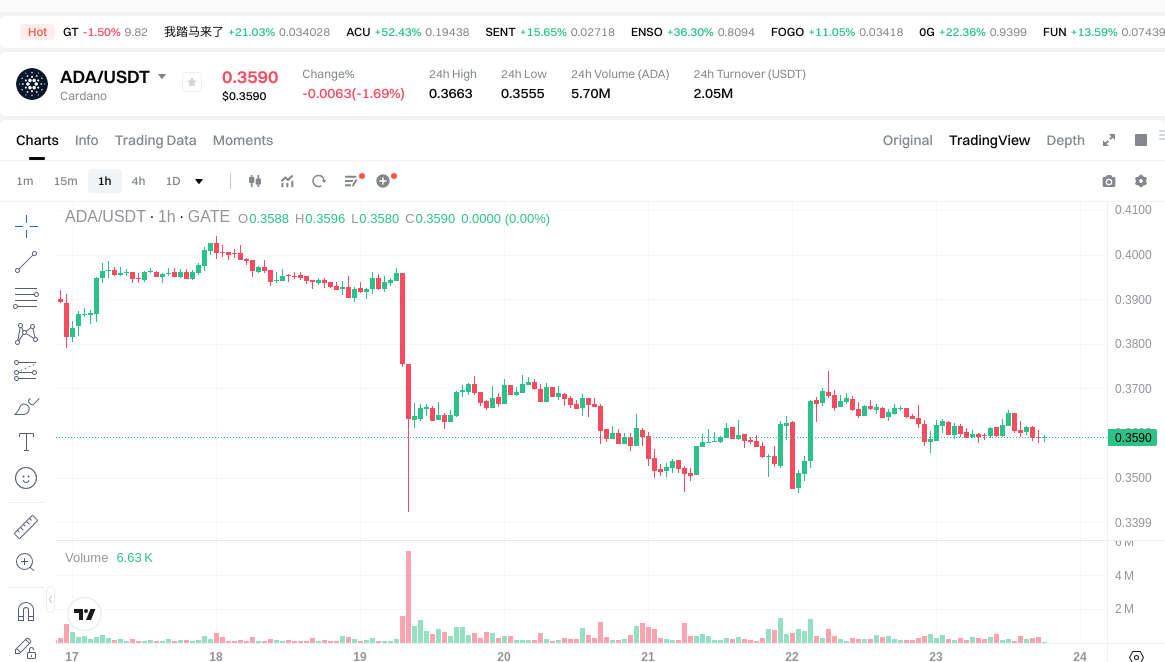
Current Market Situation (2026-01-23)
- ELIZAOS Current Price: $0.00252
- ADA Current Price: $0.3588
- 24-Hour Trading Volume: ELIZAOS $405,176.23 vs ADA $2,081,630.86
- Market Sentiment Index (Fear & Greed Index): 24 (Extreme Fear)
View real-time prices:

II. Core Factors Affecting ELIZAOS vs ADA Investment Value
Supply Mechanism Comparison (Tokenomics)
Due to limited available information in the provided materials, a detailed comparison of supply mechanisms between ELIZAOS and ADA cannot be presented at this time.
Institutional Adoption and Market Application
Without sufficient data regarding institutional holdings, enterprise adoption patterns, or regulatory positions across different jurisdictions for these two assets, a meaningful comparison cannot be established in this section.
Technology Development and Ecosystem Building
The provided materials do not contain specific information about recent technology upgrades, development roadmaps, or ecosystem activities (such as DeFi protocols, NFT platforms, payment systems, or smart contract implementations) for either ELIZAOS or ADA that would enable a substantive comparison.
Macroeconomic Environment and Market Cycles
A comparative analysis of how ELIZAOS and ADA perform under different macroeconomic conditions—including inflationary pressures, monetary policy shifts, interest rate changes, or geopolitical developments—cannot be conducted based on the available reference materials.
III. 2026-2031 Price Prediction: ELIZAOS vs ADA
Short-term Forecast (2026)
- ELIZAOS: Conservative $0.001355 - $0.00251 | Optimistic $0.00251 - $0.002736
- ADA: Conservative $0.2435 - $0.3581 | Optimistic $0.3581 - $0.5192
Medium-term Forecast (2028-2029)
- ELIZAOS may enter a consolidation phase with anticipated price range of $0.001813 - $0.003031 by 2028, potentially reaching $0.002258 - $0.003079 by 2029
- ADA may enter an expansion phase with projected price range of $0.3635 - $0.5975 by 2028, potentially advancing to $0.4381 - $0.6463 by 2029
- Key drivers include institutional capital inflows, ETF developments, and ecosystem expansion
Long-term Forecast (2031)
- ELIZAOS: Baseline scenario $0.002185 - $0.003261 | Optimistic scenario $0.003261 - $0.003685
- ADA: Baseline scenario $0.5468 - $0.6835 | Optimistic scenario $0.6835 - $0.8407
View detailed price predictions for ELIZAOS and ADA
Disclaimer: Price predictions are subject to market volatility and should not be considered as financial advice.
ELIZAOS:
| Year |
Predicted High Price |
Predicted Average Price |
Predicted Low Price |
Price Change |
| 2026 |
0.0027359 |
0.00251 |
0.0013554 |
0 |
| 2027 |
0.003042622 |
0.00262295 |
0.0014426225 |
4 |
| 2028 |
0.00303108102 |
0.002832786 |
0.00181298304 |
12 |
| 2029 |
0.0030785301855 |
0.00293193351 |
0.0022575888027 |
16 |
| 2030 |
0.003516121261867 |
0.00300523184775 |
0.002344080841245 |
19 |
| 2031 |
0.003684564506933 |
0.003260676554808 |
0.002184653291721 |
29 |
ADA:
| Year |
Predicted High Price |
Predicted Average Price |
Predicted Low Price |
Price Change |
| 2026 |
0.519245 |
0.3581 |
0.243508 |
0 |
| 2027 |
0.557114075 |
0.4386725 |
0.3158442 |
22 |
| 2028 |
0.597471945 |
0.4978932875 |
0.363462099875 |
38 |
| 2029 |
0.646265487175 |
0.54768261625 |
0.438146093 |
52 |
| 2030 |
0.770096526709125 |
0.5969740517125 |
0.382063393096 |
66 |
| 2031 |
0.840748405729299 |
0.683535289210812 |
0.54682823136865 |
90 |
IV. Investment Strategy Comparison: ELIZAOS vs ADA
Long-term vs Short-term Investment Strategies
- ELIZAOS: May appeal to investors interested in emerging AI-focused frameworks and early-stage technology platforms, though its limited market history requires consideration of higher volatility patterns
- ADA: May appeal to investors seeking exposure to established smart contract platforms with longer operational history and larger ecosystem presence
Risk Management and Asset Allocation
- Conservative Investors: ELIZAOS 5-10% vs ADA 15-25%
- Aggressive Investors: ELIZAOS 15-25% vs ADA 25-35%
- Hedging Tools: Stablecoin allocation, options strategies, cross-asset portfolio diversification
V. Potential Risk Comparison
Market Risk
- ELIZAOS: Exhibits characteristics associated with lower market cap assets, including potentially wider price fluctuations and lower liquidity levels as reflected in its $405,176.23 24-hour trading volume
- ADA: Demonstrates characteristics of more established market positions, though remains subject to broader cryptocurrency market dynamics as evidenced by historical price movements from higher levels
Technical Risk
- ELIZAOS: As an emerging framework launched in 2025, considerations include platform maturity, adoption trajectory, and network stability during early development phases
- ADA: Established blockchain platforms face ongoing considerations regarding scalability optimization, network congestion management, and technical upgrade implementation
Regulatory Risk
- Both assets operate within evolving regulatory frameworks across different jurisdictions, with potential variations in treatment based on asset classification, market positioning, and functional characteristics
VI. Conclusion: Which Is the Better Buy?
📌 Investment Value Summary:
- ELIZAOS Characteristics: Represents exposure to AI-focused framework development with positioning in emerging technology sectors, though accompanied by considerations related to market cap ranking (#905) and limited operational history
- ADA Characteristics: Offers exposure to established blockchain infrastructure with longer operational track record since 2017, larger ecosystem presence (#11 market cap ranking), and higher liquidity levels
✅ Investment Considerations:
- New Investors: Consider focusing on assets with established track records, higher liquidity, and clearer market positioning while building understanding of cryptocurrency market dynamics
- Experienced Investors: May evaluate portfolio diversification across different market cap segments, technological approaches, and risk-reward profiles based on individual investment frameworks
- Institutional Investors: Assessment criteria may include liquidity depth, regulatory clarity, custody solutions, and alignment with institutional investment mandates
⚠️ Risk Disclaimer: Cryptocurrency markets involve significant volatility and risk. This content does not constitute investment advice. Conduct thorough research and consider consulting financial professionals before making investment decisions.
VII. FAQ
Q1: What are the main differences in market maturity between ELIZAOS and ADA?
ADA represents a significantly more mature asset with a market cap ranking of #11 ($16.15 billion) and operational history since 2017, while ELIZAOS is an emerging framework launched in November 2025, currently ranked #905 with a market cap of approximately $25.08 million. This fundamental difference reflects distinct stages of market adoption, with ADA demonstrating established infrastructure, larger ecosystem presence, and substantially higher liquidity evidenced by its 24-hour trading volume of $2,081,630.86 compared to ELIZAOS's $405,176.23. The maturity gap suggests different risk-reward profiles, with ELIZAOS positioning as an early-stage AI-focused framework while ADA operates as an established smart contract platform with longer operational track record and broader institutional recognition.
Q2: How do the price volatility patterns differ between these two assets?
ELIZAOS exhibits characteristics associated with lower market cap assets, including wider price fluctuations as demonstrated by its movement from a high of $0.012854 to a low of $0.002195, representing significant percentage swings typical of emerging projects with limited market history. In contrast, ADA's historical price movements from its all-time high of $3.09 to current levels ($0.3588 as of 2026-01-23) reflect patterns more common to established cryptocurrencies that respond to broader market cycles and specific platform milestones such as the 2021 Alonzo hard fork. The volatility differential suggests ELIZAOS may experience more pronounced short-term price movements due to lower liquidity and smaller market cap, while ADA's price action tends to correlate more strongly with overall cryptocurrency market dynamics and platform-specific developments.
Q3: What are the projected price trajectories for 2026-2031?
Short-term forecasts for 2026 project ELIZAOS in a conservative range of $0.001355-$0.00251 (optimistic: $0.00251-$0.002736), while ADA is projected at $0.2435-$0.3581 (optimistic: $0.3581-$0.5192). By 2028-2029, ELIZAOS may enter consolidation with anticipated ranges of $0.001813-$0.003031 (2028) and $0.002258-$0.003079 (2029), whereas ADA may experience expansion phases reaching $0.3635-$0.5975 (2028) and $0.4381-$0.6463 (2029). Long-term projections for 2031 suggest ELIZAOS baseline scenarios of $0.002185-$0.003261 (optimistic: $0.003261-$0.003685) and ADA baseline scenarios of $0.5468-$0.6835 (optimistic: $0.6835-$0.8407). These predictions should be interpreted with awareness that cryptocurrency markets remain subject to significant volatility and unpredictable factors.
Q4: How should investors approach risk management when comparing these assets?
Risk management approaches differ significantly based on investor profile and risk tolerance. Conservative investors might consider allocating 5-10% to ELIZAOS versus 15-25% to ADA within a diversified cryptocurrency portfolio, reflecting the higher risk profile of emerging frameworks compared to established platforms. Aggressive investors may increase allocations to 15-25% for ELIZAOS and 25-35% for ADA, accepting higher volatility in pursuit of potentially greater returns. Both allocation strategies should incorporate hedging tools including stablecoin reserves, options strategies where available, and cross-asset diversification to mitigate cryptocurrency-specific risks. The substantial liquidity difference between these assets necessitates different position-sizing considerations, with larger positions more feasible in ADA due to deeper market depth.
Q5: What technical and regulatory considerations distinguish these investments?
Technical considerations for ELIZAOS center on platform maturity, adoption trajectory, and network stability during early development phases as an open-source agentic framework launched in 2025, requiring assessment of development roadmap execution and ecosystem growth. ADA's technical considerations involve ongoing scalability optimization, network congestion management, and technical upgrade implementation as an established blockchain platform operational since 2017. Regulatory risk affects both assets differently based on their functional characteristics—ELIZAOS as an emerging AI-focused framework may face evolving classification questions, while ADA's longer operational history provides some regulatory precedent though both remain subject to jurisdiction-specific regulatory developments. Neither asset should be assumed to have regulatory clarity across all markets, necessitating jurisdiction-specific research for compliance considerations.
Q6: Which asset is more suitable for different investor types?
New investors may find greater value focusing on ADA's established track record, higher liquidity levels, and clearer market positioning (#11 ranking) while building foundational understanding of cryptocurrency market dynamics and risk management principles. Experienced investors capable of evaluating emerging technologies and managing higher volatility may consider ELIZAOS for portfolio diversification across different market cap segments and technological approaches, though such positions typically warrant smaller allocations due to elevated risk profiles. Institutional investors face additional considerations including liquidity depth requirements, regulatory clarity expectations, custody solution availability, and alignment with institutional investment mandates—factors that currently favor more established assets like ADA over emerging frameworks. Investment suitability ultimately depends on individual risk tolerance, investment timeframes, and portfolio construction methodologies rather than universal recommendations.
Q7: What role does current market sentiment play in evaluating these assets?
The current Fear & Greed Index reading of 24 (Extreme Fear) as of 2026-01-23 indicates heightened market pessimism that historically affects lower market cap assets like ELIZAOS more severely than established cryptocurrencies like ADA. During extreme fear periods, liquidity typically contracts more dramatically for smaller assets, potentially amplifying downside volatility while also creating potential entry opportunities for investors with longer time horizons and higher risk tolerance. ADA's larger market cap and higher liquidity may provide relatively more stability during market fear phases, though established assets remain vulnerable to broader market sell-offs. Market sentiment metrics should be evaluated alongside fundamental factors rather than used as standalone investment signals, recognizing that extreme fear periods have historically preceded both extended downturns and eventual market recoveries in cryptocurrency markets.
Q8: What are the key unknowns that limit definitive investment comparisons?
Several critical information gaps prevent comprehensive investment comparison between ELIZAOS and ADA. Detailed tokenomics data including supply mechanisms, emission schedules, and token distribution models for ELIZAOS remain limited in available materials, restricting supply-demand analysis. Institutional adoption patterns, enterprise integration levels, and regulatory positions across different jurisdictions cannot be meaningfully compared without additional data. Technology development specifics including recent upgrades, development roadmaps, ecosystem activities (DeFi protocols, NFT platforms, smart contract implementations), and competitive positioning within their respective market segments require further research. Macroeconomic sensitivity analysis showing how each asset performs under different economic conditions (inflationary pressures, monetary policy shifts, interest rate changes) would enhance investment evaluation but remains unavailable in current reference materials. Investors should conduct supplementary research to address these information gaps before making allocation decisions.
* The information is not intended to be and does not constitute financial advice or any other recommendation of any sort offered or endorsed by Gate.













