The article "EMC vs SOL: The Battle for Data Storage Supremacy in Enterprise Systems" offers a comprehensive investment comparison between Edge Matrix Chain (EMC) and Solana (SOL). It highlights their key market differences, historical price trends, supply mechanisms, institutional adoption, and technical development. Aimed at both new and experienced investors, the analysis assesses which cryptocurrency holds better investment potential currently. Addressing aspects like price predictions, investment strategies, and potential risks, the article caters to those seeking informed decisions in crypto investments. For real-time prices, visit Gate for current market data on EMC and SOL.
Introduction: EMC vs SOL Investment Comparison
In the cryptocurrency market, the comparison between EMC and SOL has always been a topic that investors can't ignore. The two not only show significant differences in market cap ranking, application scenarios, and price performance, but also represent different positioning in the crypto asset space.
Edge Matrix Chain (EMC): Since its launch, it has gained market recognition for its multi-chain AI infrastructure aimed at decentralized AI (DeAI).
Solana (SOL): Since its inception in late 2017, it has been hailed as a high-performance blockchain protocol, becoming one of the cryptocurrencies with the highest global trading volume and market capitalization.
This article will provide a comprehensive analysis of the investment value comparison between EMC and SOL, focusing on historical price trends, supply mechanisms, institutional adoption, technological ecosystems, and future predictions, attempting to answer the question that concerns investors the most:
"Which is the better buy right now?"
I. Price History Comparison and Current Market Status
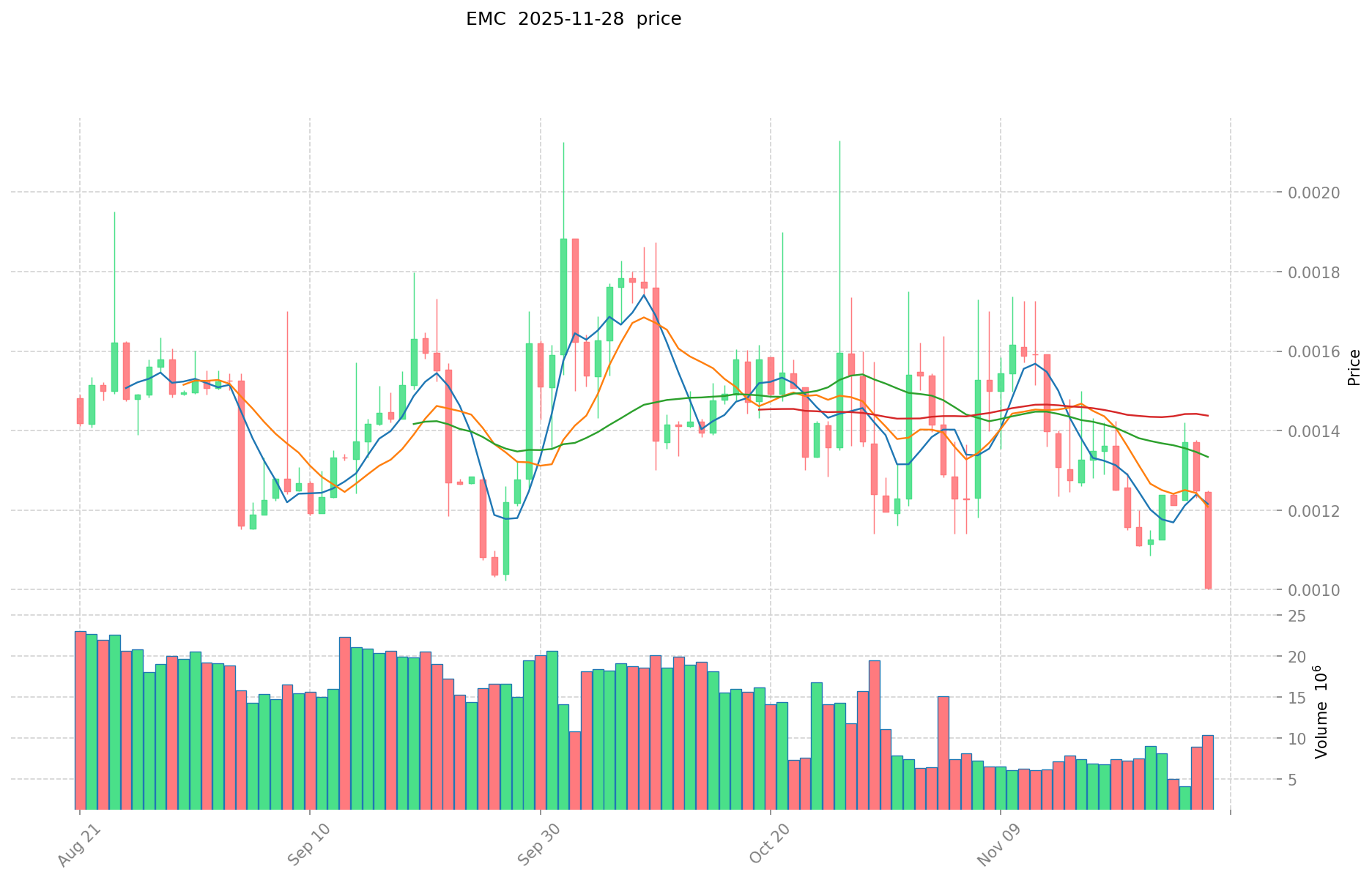
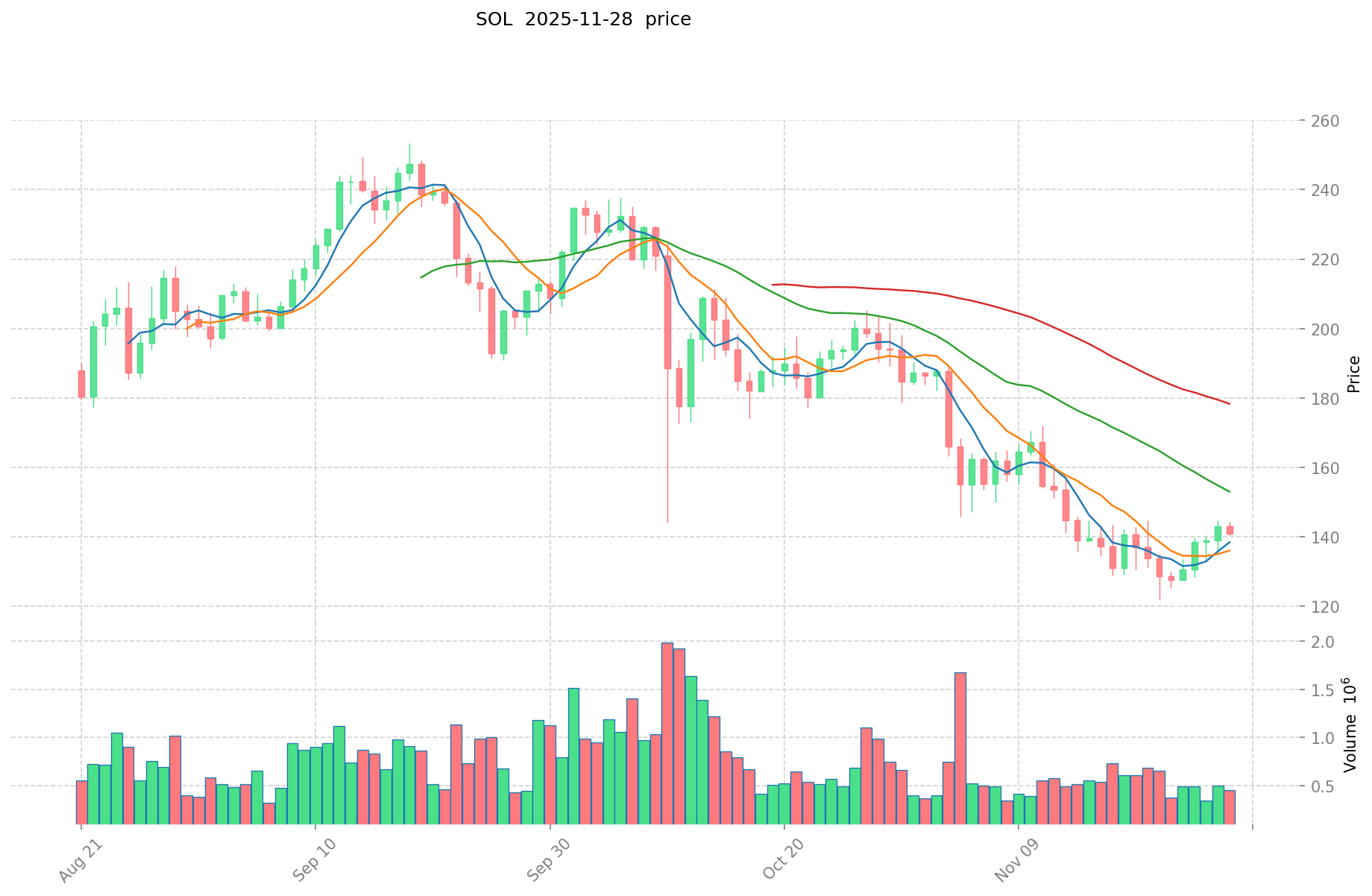
EMC and SOL Historical Price Trends
- 2024: EMC reached its all-time high of $1.958 on April 12, 2024.
- 2025: SOL hit its all-time high of $293.31 on January 19, 2025.
- Comparative Analysis: In the current market cycle, EMC has fallen from its high of $1.958 to a low of $0.001, while SOL has declined from $293.31 to $141.39.
Current Market Situation (2025-11-28)
- EMC current price: $0.001076
- SOL current price: $141.39
- 24-hour trading volume: EMC $12,101.20 vs SOL $66,104,873.59
- Market Sentiment Index (Fear & Greed Index): 25 (Extreme Fear)
Click to view real-time prices:
- Check EMC current price Market Price
- Check SOL current price Market Price
II. Core Factors Affecting Investment Value of EMC vs SOL
Supply Mechanism Comparison (Tokenomics)
-
EMC: Fixed maximum supply of 50 million tokens with deflationary tokenomics; tokens are burned through transaction fees and buybacks
-
SOL: Inflationary model with approximately 4-7% annual inflation that decreases over time; includes partial fee burning mechanism
-
📌 Historical Pattern: Deflationary assets like EMC have historically shown stronger price performance during bull markets due to scarcity, while SOL's inflation can create selling pressure but supports network security through staking rewards.
Institutional Adoption and Market Applications
- Institutional Holdings: SOL has gained more institutional traction with investments from major funds like Alameda Research and Multicoin Capital; EMC has seen growing interest from smaller institutional investors
- Enterprise Adoption: SOL leads in payment infrastructure and settlement with partnerships across financial services; EMC focuses on private cross-border transactions and remittances
- National Policies: Both face varying regulatory treatment; SOL has broader exchange availability while EMC's privacy features have faced increased scrutiny in certain jurisdictions
Technical Development and Ecosystem Building
- EMC Technical Upgrades: Enhanced privacy features and zero-knowledge proofs; improved cross-chain interoperability
- SOL Technical Development: Continued scalability improvements and validator network expansion; enhanced consensus mechanism for higher TPS
- Ecosystem Comparison: SOL has a more extensive DeFi and NFT ecosystem with higher TVL; EMC offers specialized privacy-focused DApps and private smart contract capabilities
Macroeconomic and Market Cycles
- Performance in Inflationary Environments: EMC's fixed supply positions it as a potential inflation hedge; SOL relies more on ecosystem growth to offset inflationary tokenomics
- Macroeconomic Monetary Policies: Rising interest rates have historically impacted both assets negatively, with SOL showing higher correlation to traditional markets
- Geopolitical Factors: EMC benefits from increased demand for private cross-border transactions during geopolitical tensions; SOL's institutional backing provides stability during market uncertainty
III. 2025-2030 Price Prediction: EMC vs SOL
Short-term Prediction (2025)
- EMC: Conservative $0.00070752 - $0.001072 | Optimistic $0.001072 - $0.0013936
- SOL: Conservative $138.1474 - $142.42 | Optimistic $142.42 - $155.2378
Mid-term Prediction (2027)
- EMC may enter a growth phase, with prices estimated between $0.00091467596 and $0.00155881396
- SOL may enter a bullish market, with prices estimated between $149.907909525 and $245.143522635
- Key drivers: Institutional capital inflow, ETF, ecosystem development
Long-term Prediction (2030)
- EMC: Base scenario $0.001101115600892 - $0.001898475173952 | Optimistic scenario $0.001898475173952 - $0.002164261698305
- SOL: Base scenario $244.428034228117987 - $271.586704697908875 | Optimistic scenario $271.586704697908875 - $353.062716107281537
View detailed price predictions for EMC and SOL
Disclaimer: This analysis is based on historical data and current market trends. Cryptocurrency markets are highly volatile and unpredictable. This information should not be considered as financial advice. Always conduct your own research before making investment decisions.
EMC:
| 年份 |
预测最高价 |
预测平均价格 |
预测最低价 |
涨跌幅 |
| 2025 |
0.0013936 |
0.001072 |
0.00070752 |
0 |
| 2026 |
0.001343752 |
0.0012328 |
0.000653384 |
14 |
| 2027 |
0.00155881396 |
0.001288276 |
0.00091467596 |
19 |
| 2028 |
0.0018079021246 |
0.00142354498 |
0.0008683624378 |
32 |
| 2029 |
0.002181226795605 |
0.0016157235523 |
0.001405679490501 |
50 |
| 2030 |
0.002164261698305 |
0.001898475173952 |
0.001101115600892 |
76 |
SOL:
| 年份 |
预测最高价 |
预测平均价格 |
预测最低价 |
涨跌幅 |
| 2025 |
155.2378 |
142.42 |
138.1474 |
0 |
| 2026 |
203.895593 |
148.8289 |
84.832473 |
5 |
| 2027 |
245.143522635 |
176.3622465 |
149.907909525 |
24 |
| 2028 |
299.26909608585 |
210.7528845675 |
191.785124956425 |
49 |
| 2029 |
288.16241906914275 |
255.010990326675 |
130.05560506660425 |
80 |
| 2030 |
353.062716107281537 |
271.586704697908875 |
244.428034228117987 |
92 |
IV. Investment Strategy Comparison: EMC vs SOL
Long-term vs Short-term Investment Strategy
- EMC: Suitable for investors focused on privacy features and potential growth in decentralized AI applications
- SOL: Suitable for investors looking for ecosystem development and institutional adoption
Risk Management and Asset Allocation
- Conservative investors: EMC: 20% vs SOL: 80%
- Aggressive investors: EMC: 40% vs SOL: 60%
- Hedging tools: Stablecoin allocation, options, cross-currency portfolio
V. Potential Risk Comparison
Market Risk
- EMC: Higher volatility due to lower market cap and trading volume
- SOL: More susceptible to overall crypto market trends and macroeconomic factors
Technical Risk
- EMC: Scalability, network stability
- SOL: Centralization concerns, potential security vulnerabilities
Regulatory Risk
- Global regulatory policies may have different impacts on both assets, with EMC potentially facing more scrutiny due to privacy features
VI. Conclusion: Which Is the Better Buy?
📌 Investment Value Summary:
- EMC advantages: Deflationary tokenomics, focus on privacy and AI infrastructure
- SOL advantages: Established ecosystem, institutional backing, high performance blockchain
✅ Investment Advice:
- New investors: Consider a higher allocation to SOL due to its established market position
- Experienced investors: Balanced portfolio with both EMC and SOL, adjusting based on risk tolerance
- Institutional investors: SOL may be more suitable due to its liquidity and ecosystem maturity
⚠️ Risk Warning: The cryptocurrency market is highly volatile. This article does not constitute investment advice.
None
VII. FAQ
Q1: What are the main differences between EMC and SOL?
A: EMC is a multi-chain AI infrastructure focused on decentralized AI with a fixed supply of 50 million tokens, while SOL is a high-performance blockchain protocol with an inflationary model. EMC emphasizes privacy features, while SOL has a more extensive DeFi and NFT ecosystem.
Q2: Which cryptocurrency has shown better historical price performance?
A: SOL has reached a higher all-time high of $293.31 in January 2025, compared to EMC's all-time high of $1.958 in April 2024. However, both have experienced significant declines from their peak prices.
Q3: How do the supply mechanisms of EMC and SOL differ?
A: EMC has a fixed maximum supply of 50 million tokens with deflationary tokenomics, including token burning through transaction fees and buybacks. SOL has an inflationary model with approximately 4-7% annual inflation that decreases over time and includes a partial fee burning mechanism.
Q4: Which cryptocurrency has greater institutional adoption?
A: SOL has gained more institutional traction with investments from major funds like Alameda Research and Multicoin Capital. EMC has seen growing interest from smaller institutional investors but has less overall institutional adoption compared to SOL.
Q5: What are the key technical developments for each cryptocurrency?
A: EMC has enhanced privacy features, zero-knowledge proofs, and improved cross-chain interoperability. SOL has focused on continued scalability improvements, validator network expansion, and an enhanced consensus mechanism for higher transactions per second (TPS).
Q6: How do EMC and SOL compare in terms of ecosystem development?
A: SOL has a more extensive DeFi and NFT ecosystem with higher Total Value Locked (TVL). EMC offers specialized privacy-focused DApps and private smart contract capabilities, but its ecosystem is less developed compared to SOL's.
Q7: What are the potential risks associated with investing in EMC and SOL?
A: EMC faces higher volatility due to lower market cap and trading volume, as well as potential scalability and network stability issues. SOL is more susceptible to overall crypto market trends and macroeconomic factors, with centralization concerns and potential security vulnerabilities. Both face regulatory risks, with EMC potentially facing more scrutiny due to its privacy features.
* The information is not intended to be and does not constitute financial advice or any other recommendation of any sort offered or endorsed by Gate.













