This comprehensive analysis compares EPT and IMX, two distinct digital assets representing different segments of the blockchain ecosystem. EPT, launched in April 2025, is an AI-focused Web3 infrastructure platform enabling personalized AI agent creation for gaming applications, currently trading at $0.001007. IMX, operational since 2021, serves as an established Layer 2 NFT scaling solution on Ethereum with institutional derivatives support through platforms like Gate and Kraken, currently priced at $0.1894. The article examines investment value through multiple lenses: historical price trajectories showing EPT's decline from $0.03 highs and IMX's descent from $9.52 peaks; tokenomics comparing EPT's 1 billion supply cap with 23% community allocation; institutional adoption where IMX demonstrates stronger presence via futures markets; and 2026-2031 price projections offering conservative to optimistic scenarios. Investment strategies differentiate by risk tolerance, with conservative investors favoring IMX's e
Introduction: Investment Comparison Between EPT and IMX
In the cryptocurrency market, the comparison between Balance (EPT) and Immutable (IMX) has become a topic of interest for investors exploring different segments of the blockchain ecosystem. These two assets represent distinct positioning and development trajectories within the crypto space, differing significantly in market capitalization ranking, application scenarios, and price performance.
Balance (EPT): Launched in April 2025, this AI-focused Web3 user experience infrastructure integrates AI technology with Web3 frameworks, enabling users to create personalized AI agents for gaming and entertainment applications. The project employs a multi-layered architecture design encompassing application, platform, protocol, token, and infrastructure layers.
Immutable (IMX): Operating since 2021, IMX serves as a Layer 2 scaling solution for NFTs on Ethereum, providing instant transactions, massive scalability, and zero gas fees for minting and trading. As an ERC-20 utility token, IMX rewards network activities including trading, liquidity provision, and application development.
This article will examine the investment value comparison between EPT and IMX through the lenses of historical price trends, supply mechanisms, market adoption, technical ecosystems, and future outlook, addressing the question many investors consider:
"Which represents a more suitable investment opportunity based on current market conditions?"
I. Historical Price Comparison and Current Market Status
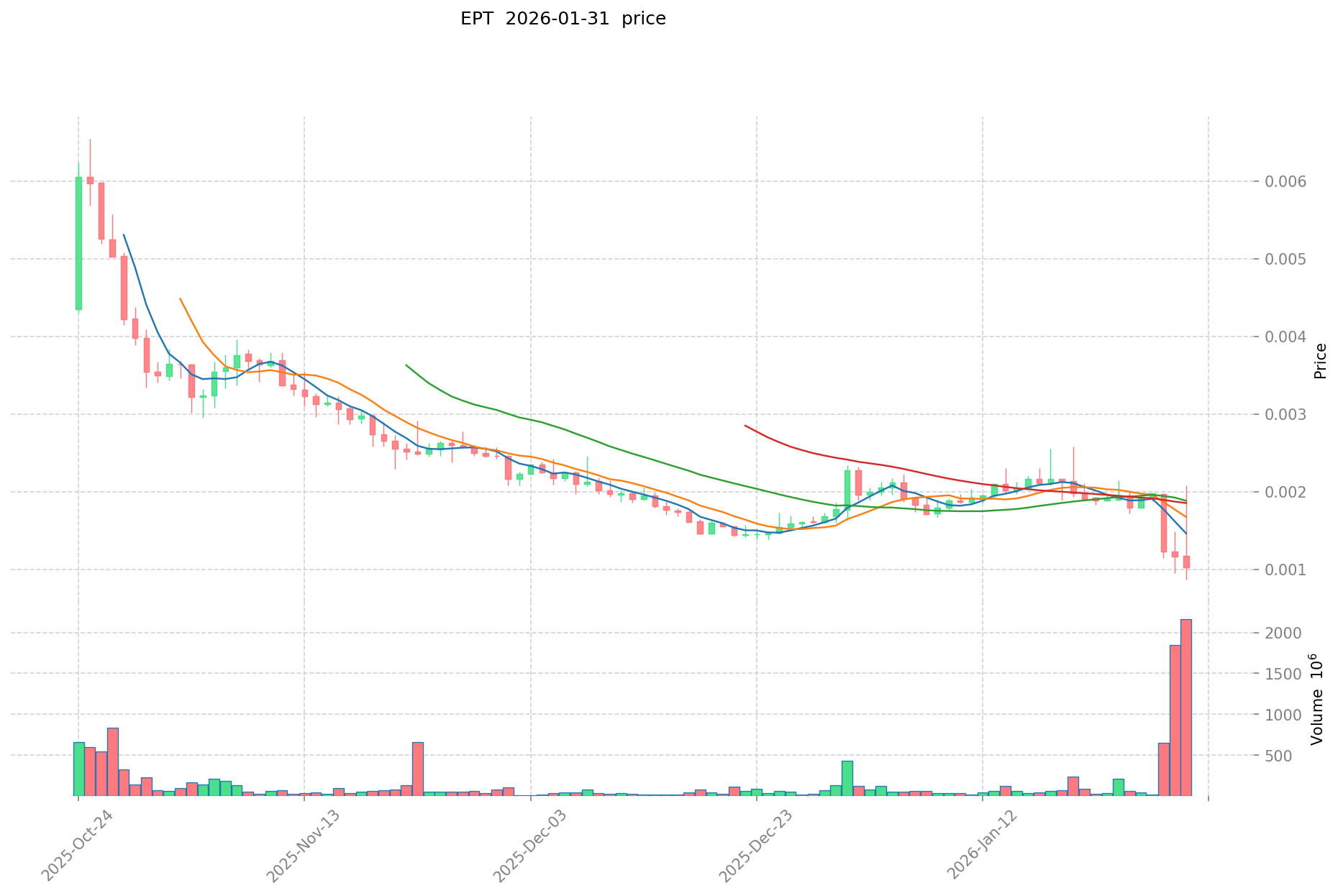
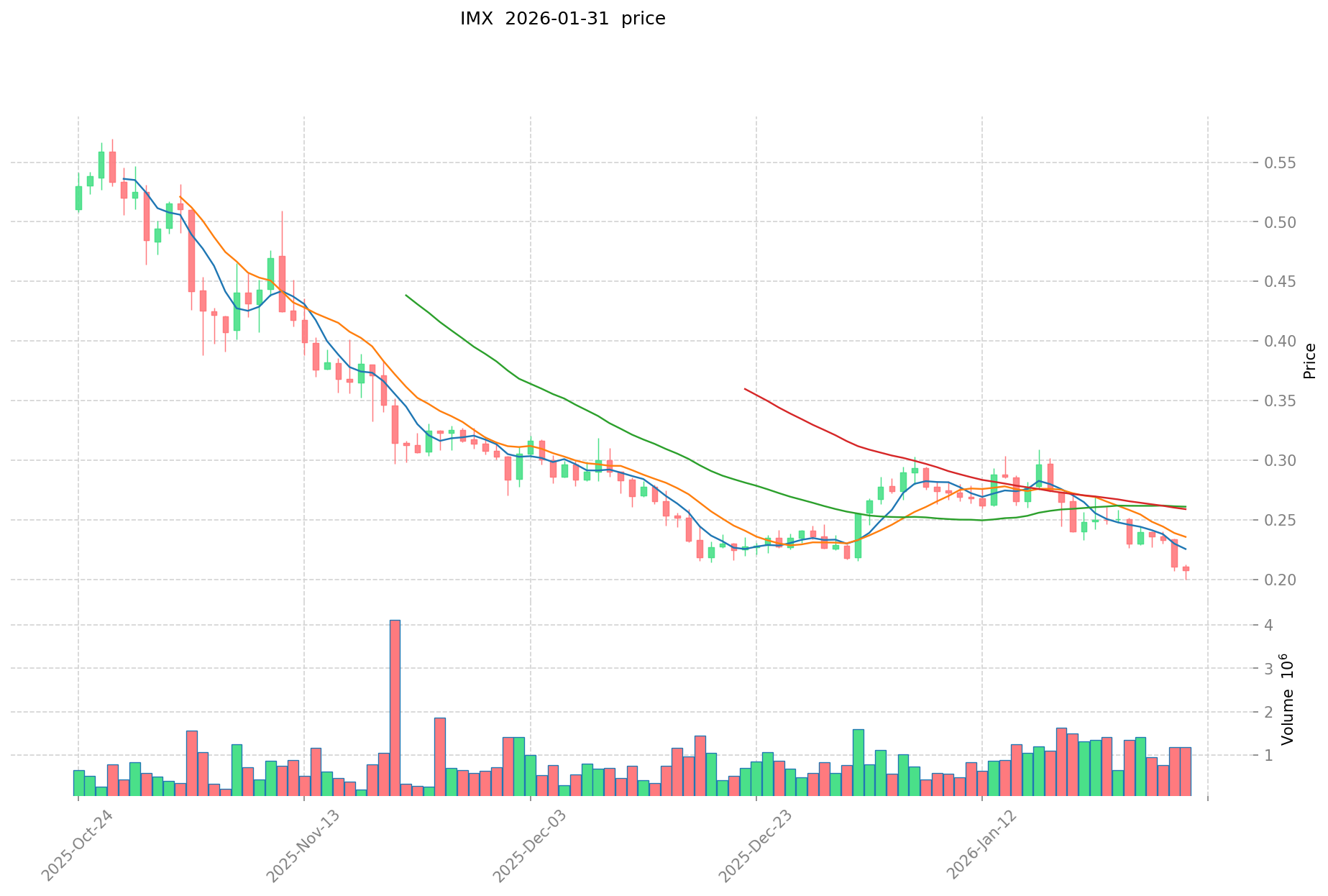
EPT (Coin A) and IMX (Coin B) Historical Price Trends
- 2025: EPT reached its historical high of $0.03 in April 2025, representing a significant price milestone during its early trading phase.
- 2021: IMX experienced a notable price surge to $9.52 in November 2021, reflecting strong market momentum during the broader cryptocurrency bull market cycle.
- Comparative Analysis: During the 2025-2026 market cycle, EPT declined from its high of $0.03 to a low of $0.000869, while IMX dropped from its historical peak of $9.52 to $0.186051, demonstrating different volatility patterns between the two assets.
Current Market Status (2026-01-31)
- EPT Current Price: $0.001007
- IMX Current Price: $0.1894
- 24-Hour Trading Volume: EPT $408,059.56 vs IMX $301,438.55
- Market Sentiment Index (Fear & Greed Index): 20 (Extreme Fear)
View real-time prices:
- View EPT Current Price Market Price
- View IMX Current Price Market Price
II. Core Factors Influencing EPT vs IMX Investment Value
Supply Mechanism Comparison (Tokenomics)
- EPT: Features a maximum total supply of 1 billion tokens, with 23% (230 million tokens) allocated for public issuance and community incentives.
- IMX: The reference materials indicate distinct tokenomics positioning, though specific supply mechanism details were not provided in the available data.
- 📌 Historical Pattern: Supply mechanisms have historically played a role in driving price cycle variations across digital assets.
Institutional Adoption and Market Applications
- Trading Platform Support: IMX has gained institutional-level trading infrastructure support, with platforms such as Kraken offering IMX futures trading services. Kraken Pro provides IMX/USD perpetual futures for eligible customers outside the United States, while U.S. customers can access CME-listed Immutable X futures through Kraken Derivatives US.
- Futures Trading Features: The availability of leveraged trading options and perpetual contracts without expiration dates indicates growing institutional interest in providing sophisticated trading instruments for IMX.
- Market Infrastructure: The implementation of funding rate mechanisms and multi-collateral support demonstrates the development of professional-grade trading infrastructure for IMX.
Technology Development and Ecosystem Building
- Market Positioning: Both EPT and IMX represent distinct approaches within the digital asset ecosystem, with differentiated technological foundations and market applications.
- Trading Infrastructure: IMX has established presence on professional trading platforms with advanced risk management tools, 24/7 customer support, and multiple collateral options including cryptocurrencies and stablecoins.
- Ecosystem Development: The reference materials suggest ongoing developments in both projects' respective ecosystems, though specific technical upgrade details were not extensively covered.
Macroeconomic Environment and Market Cycles
- Trading Accessibility: The availability of futures contracts and leveraged trading options reflects the integration of these assets into broader financial market structures.
- Platform Infrastructure: Professional trading platforms have implemented sophisticated mechanisms including funding rates, margin requirements, and multi-currency collateral systems to support institutional-grade trading activities.
- Market Dynamics: The development of derivatives markets and advanced trading tools indicates increasing market maturity and institutional participation in the digital asset space.
III. 2026-2031 Price Prediction: EPT vs IMX
Short-term Prediction (2026)
- EPT: Conservative $0.0006161 - $0.00101 | Optimistic $0.00101 - $0.0012524
- IMX: Conservative $0.107559 - $0.1887 | Optimistic $0.1887 - $0.266067
Medium-term Prediction (2028-2029)
- EPT may enter a gradual growth phase, with estimated price range of $0.00068991888 - $0.0013919416
- IMX may enter an expansion phase, with estimated price range of $0.195220103925 - $0.3245217312
- Key drivers: institutional capital flows, ETF developments, ecosystem expansion
Long-term Prediction (2031)
- EPT: Baseline scenario $0.001125629432466 - $0.0014618564058 | Optimistic scenario $0.0014618564058 - $0.001929650455656
- IMX: Baseline scenario $0.346236048147621 - $0.36833622143364 | Optimistic scenario $0.36833622143364 - $0.486203812292404
View detailed price predictions for EPT and IMX
Disclaimer
EPT:
| Year |
Predicted High Price |
Predicted Average Price |
Predicted Low Price |
Price Change |
| 2026 |
0.0012524 |
0.00101 |
0.0006161 |
0 |
| 2027 |
0.001289568 |
0.0011312 |
0.001097264 |
12 |
| 2028 |
0.0013919416 |
0.001210384 |
0.00068991888 |
20 |
| 2029 |
0.00143127908 |
0.0013011628 |
0.00071563954 |
29 |
| 2030 |
0.0015574918716 |
0.00136622094 |
0.0007787459358 |
35 |
| 2031 |
0.001929650455656 |
0.0014618564058 |
0.001125629432466 |
45 |
IMX:
| Year |
Predicted High Price |
Predicted Average Price |
Predicted Low Price |
Price Change |
| 2026 |
0.266067 |
0.1887 |
0.107559 |
0 |
| 2027 |
0.279681705 |
0.2273835 |
0.1819068 |
20 |
| 2028 |
0.3245217312 |
0.2535326025 |
0.195220103925 |
34 |
| 2029 |
0.335271513546 |
0.28902716685 |
0.1994287451265 |
52 |
| 2030 |
0.42452310266928 |
0.312149340198 |
0.2497194721584 |
65 |
| 2031 |
0.486203812292404 |
0.36833622143364 |
0.346236048147621 |
94 |
IV. Investment Strategy Comparison: EPT vs IMX
Long-term vs Short-term Investment Strategies
- EPT: May align with investors focused on emerging AI-Web3 integration narratives and early-stage project exposure, with higher risk tolerance for volatile price movements in nascent technology sectors.
- IMX: May align with investors seeking exposure to established NFT infrastructure and Layer 2 scaling solutions, with interest in projects demonstrating institutional adoption through derivatives market availability.
Risk Management and Asset Allocation
- Conservative Investors: EPT 10-15% vs IMX 20-30% - Conservative positioning might favor more established projects with institutional trading infrastructure
- Aggressive Investors: EPT 25-40% vs IMX 30-45% - Higher allocation ratios reflect willingness to accept increased volatility for potential growth exposure
- Hedging Tools: Stablecoin reserves for market downturns, futures contracts available for IMX position management, diversified portfolio construction across multiple digital asset categories
V. Potential Risk Comparison
Market Risks
- EPT: Trading at prices significantly below historical highs with limited trading volume of $408,059.56, indicating potential liquidity constraints and elevated price volatility during market stress periods.
- IMX: Despite institutional futures market presence, current price represents substantial decline from historical peaks, with 24-hour trading volume of $301,438.55 suggesting moderate liquidity conditions.
Technology Risks
- EPT: As an early-stage project launched in April 2025, faces developmental uncertainties related to AI-Web3 integration scalability and network stability during growth phases.
- IMX: Layer 2 infrastructure faces ongoing considerations regarding technical optimization, network performance under high transaction volumes, and potential security considerations inherent in scaling solutions.
Regulatory Risks
- Global regulatory developments may impact both assets differently based on their functional classifications - AI-focused platforms versus NFT infrastructure may face distinct regulatory frameworks across jurisdictions. Evolving policies regarding digital asset derivatives, particularly affecting IMX's futures market accessibility, represent ongoing considerations for institutional participants.
VI. Conclusion: Which Is the Better Buy?
📌 Investment Value Summary:
- EPT Characteristics: Represents early-stage exposure to AI-Web3 convergence with multi-layered architectural design, currently trading near lower price ranges with 230 million tokens allocated for community development.
- IMX Characteristics: Established Layer 2 NFT infrastructure with institutional derivatives market presence, operational since 2021 with demonstrated platform adoption through professional trading venue support.
✅ Investment Considerations:
- Novice Investors: Consider starting with smaller position sizes in more established projects with institutional infrastructure presence, maintaining significant stablecoin reserves, and focusing on understanding underlying technology and market dynamics before committing capital.
- Experienced Investors: May evaluate diversified exposure across both early-stage innovation (EPT) and established infrastructure (IMX) based on individual risk tolerance, utilizing available derivatives tools for IMX position management, and implementing systematic rebalancing strategies.
- Institutional Investors: Assess allocation frameworks considering liquidity requirements, derivatives market accessibility for IMX, counterparty risk management through multiple trading venues, and alignment with broader digital asset portfolio construction objectives.
⚠️ Risk Disclosure: Cryptocurrency markets demonstrate elevated volatility characteristics. Current market sentiment indicates extreme fear conditions (Fear & Greed Index: 20). This content does not constitute investment advice. Conduct independent research and consult qualified financial professionals before making investment decisions.
VII. FAQ
Q1: What are the key differences between EPT and IMX in terms of market positioning?
EPT is an early-stage AI-focused Web3 infrastructure project launched in April 2025, targeting personalized AI agent creation for gaming and entertainment, while IMX is an established Layer 2 scaling solution for NFTs operational since 2021, providing zero gas fee transactions and institutional-grade trading infrastructure. The fundamental difference lies in their market maturity—EPT represents emerging AI-Web3 convergence with higher developmental risk, whereas IMX offers established NFT infrastructure with proven institutional adoption through derivatives markets and professional trading platform support.
Q2: How do the supply mechanisms of EPT and IMX impact their investment value?
EPT features a maximum supply cap of 1 billion tokens with 23% (230 million tokens) allocated for public issuance and community incentives, creating a defined scarcity framework for early-stage distribution. This tokenomics structure influences potential price appreciation through controlled supply release mechanisms. While specific IMX supply details were not extensively covered in the reference materials, the token's established market presence since 2021 and institutional derivatives availability suggest a more mature supply distribution phase, which typically correlates with different price volatility patterns compared to newer token launches.
Q3: Which project demonstrates stronger institutional adoption?
IMX demonstrates significantly stronger institutional adoption, evidenced by futures trading availability on platforms like Kraken Pro (IMX/USD perpetual futures), CME-listed futures contracts accessible through Kraken Derivatives US, and advanced trading infrastructure including funding rate mechanisms and multi-collateral support systems. EPT, having launched in April 2025, shows limited institutional infrastructure development at this stage, with current 24-hour trading volume of $408,059.56 compared to IMX's $301,438.55, though both volumes indicate relatively modest institutional participation levels in current market conditions.
Q4: What are the realistic price expectations for 2026-2031?
For 2026, EPT projects a conservative range of $0.0006161-$0.00101 with optimistic scenarios reaching $0.0012524, while IMX forecasts $0.107559-$0.1887 conservatively and up to $0.266067 optimistically. By 2031, EPT's baseline scenario suggests $0.001125629432466-$0.0014618564058 (potentially reaching $0.001929650455656 in optimistic conditions), whereas IMX baseline projects $0.346236048147621-$0.36833622143364 (optimistic scenario up to $0.486203812292404). These predictions assume various factors including institutional capital flows, ecosystem expansion, and broader market cycle developments, though actual outcomes depend on numerous unpredictable variables in cryptocurrency markets.
Q5: How should investors approach risk management between these two assets?
Conservative investors might consider allocating 10-15% to EPT versus 20-30% to IMX, reflecting IMX's more established market position and institutional infrastructure. Aggressive investors may increase exposure to 25-40% EPT and 30-45% IMX based on higher risk tolerance for volatility. Key risk management strategies include maintaining substantial stablecoin reserves for market downturns, utilizing available IMX futures contracts for position hedging, diversifying across multiple digital asset categories, and implementing systematic rebalancing protocols. Given current extreme fear market conditions (Fear & Greed Index: 20), position sizing should reflect individual risk capacity and liquidity requirements.
Q6: What technology risks should investors consider for each project?
EPT faces early-stage developmental uncertainties related to AI-Web3 integration scalability, network stability during growth phases, and execution risks inherent in multi-layered architectural designs launched less than two years ago. IMX confronts Layer 2 infrastructure optimization challenges, including network performance under high transaction volumes, potential security considerations in scaling solutions, and ongoing technical evolution requirements to maintain competitive positioning against emerging Layer 2 alternatives. Both projects operate in rapidly evolving technological landscapes where unforeseen technical obstacles, security vulnerabilities, or competitive disruption could materially impact investment outcomes.
Q7: How do current market conditions affect investment decisions between EPT and IMX?
Current extreme fear market conditions (Fear & Greed Index: 20) present both challenges and potential opportunities. EPT trades at $0.001007, significantly below its April 2025 high of $0.03, while IMX trades at $0.1894, substantially down from its November 2021 peak of $9.52. These depressed price levels relative to historical highs may attract contrarian investors seeking accumulation opportunities, though prevailing sentiment suggests continued near-term volatility risk. Limited trading volumes ($408,059.56 for EPT, $301,438.55 for IMX) indicate reduced market liquidity, potentially amplifying price swings during sentiment shifts. Investment timing should consider both technical price levels and broader macroeconomic factors influencing digital asset markets.
Q8: Which asset better suits different investor profiles?
Novice investors should prioritize established projects with institutional infrastructure presence like IMX, starting with smaller position sizes while maintaining significant stablecoin reserves and focusing on understanding underlying technologies before committing capital. Experienced investors may evaluate diversified exposure across both early-stage innovation (EPT) and established infrastructure (IMX) based on individual risk tolerance, utilizing IMX derivatives tools for position management and implementing systematic rebalancing strategies. Institutional investors should assess allocation frameworks considering liquidity requirements, IMX derivatives market accessibility, counterparty risk management through multiple trading venues, and alignment with broader digital asset portfolio construction objectives, while carefully evaluating EPT's emerging market positioning against institutional risk parameters.
* The information is not intended to be and does not constitute financial advice or any other recommendation of any sort offered or endorsed by Gate.