This comprehensive guide compares Ethereum Classic (ETC) and Avalanche (AVAX), two distinct blockchain platforms serving different investment profiles. ETC operates as a proof-of-work continuation of the original Ethereum, emphasizing the "code is law" principle, while AVAX features high-throughput consensus achieving 1-second transaction finality with subnet architecture support. The article analyzes current market status with ETC at $13.036 and AVAX at $14.54, examines tokenomics and institutional adoption patterns, evaluates technical ecosystems and risk factors, and provides price forecasts through 2031. Investors can reference portfolio allocation frameworks ranging from conservative (30-40% allocation) to aggressive strategies (40-50%), alongside detailed risk management guidance. Real-time pricing and analysis tools available on Gate help inform investment decisions across varying experience levels.
Introduction: ETC vs AVAX Investment Comparison
In the cryptocurrency market, the comparison between ETC vs AVAX has consistently been a focal point for investors. The two not only differ significantly in market cap ranking, application scenarios, and price performance, but also represent distinct positioning within the crypto asset landscape.
Ethereum Classic (ETC): Launched in 2015, it has gained market recognition as the continuation of the original Ethereum chain, upholding the "code is law" principle and supporting smart contract execution without intermediaries.
Avalanche (AVAX): Since its launch in 2020, it has been positioned as an open-source platform for decentralized applications and interoperable blockchains, featuring 1-second transaction finality and Ethereum toolkit compatibility.
This article will comprehensively analyze the investment value comparison between ETC vs AVAX, focusing on historical price trends, supply mechanisms, institutional adoption, technical ecosystems, and future predictions, attempting to address the question investors care about most:
"Which is the better buy right now?"
I. Historical Price Comparison and Current Market Status
Ethereum Classic (ETC) vs Avalanche (AVAX) Historical Price Trends
-
2021: ETC reached a notable price level of $167.09 on May 7, 2021, reflecting significant market interest during the broader cryptocurrency market expansion. The token experienced substantial growth from its earlier price points.
-
2020-2021: AVAX launched in July 2020 at $0.583 and experienced considerable growth, reaching $144.96 on November 21, 2021, driven by the platform's innovative consensus mechanism and growing ecosystem adoption.
-
Comparative Analysis: During the 2021-2022 market cycle, ETC declined from its peak of $167.09 to current levels around $13.036, representing a significant correction. Similarly, AVAX experienced a decline from its high of $144.96 to approximately $14.54, demonstrating comparable market-wide downward pressure affecting both assets.
Current Market Status (January 14, 2026)
- ETC Current Price: $13.036
- AVAX Current Price: $14.54
- 24-Hour Trading Volume: ETC recorded $1,644,071.94 compared to AVAX's $1,434,891.66
- Market Sentiment Index (Fear & Greed Index): 26 (Fear)
View real-time prices:
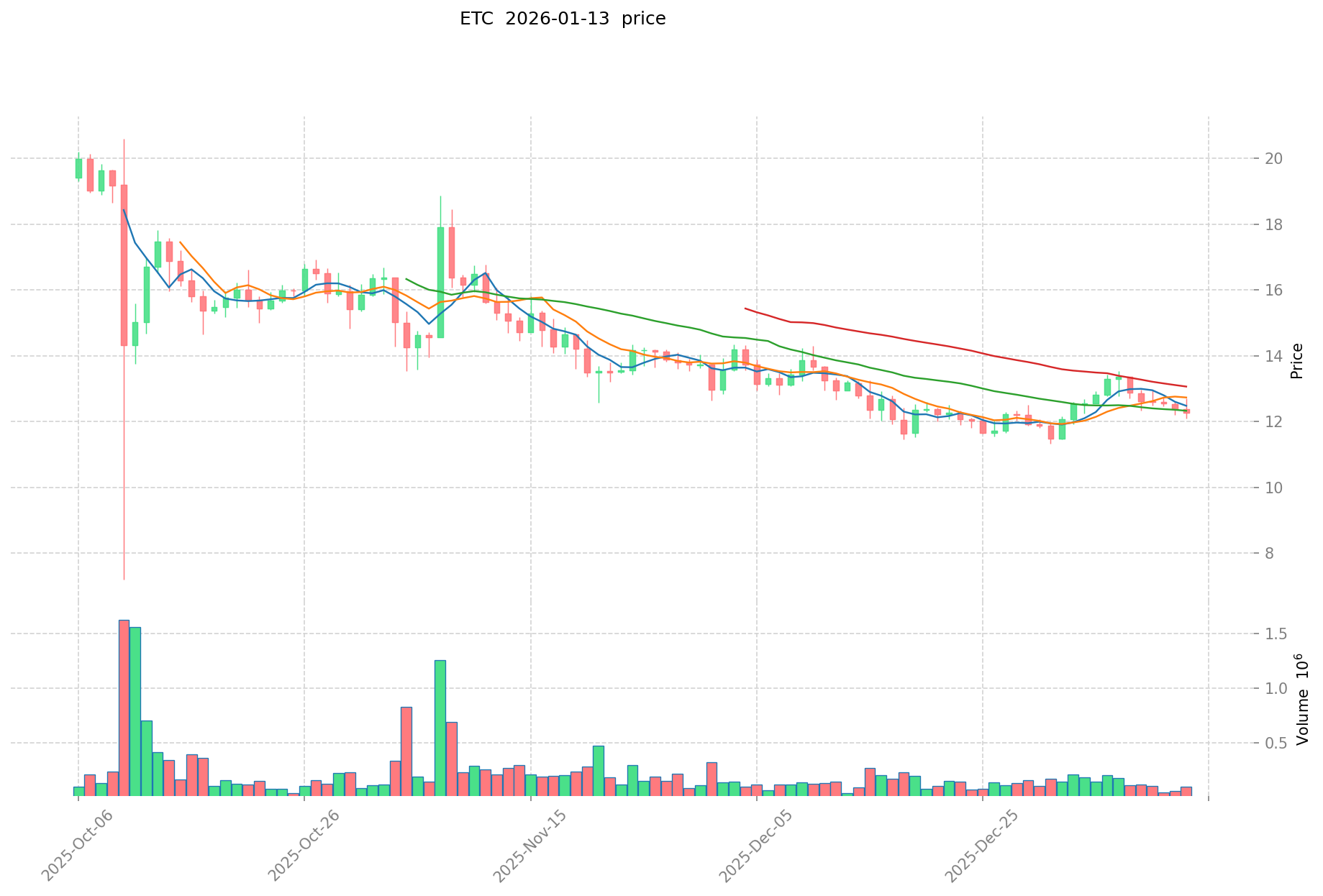
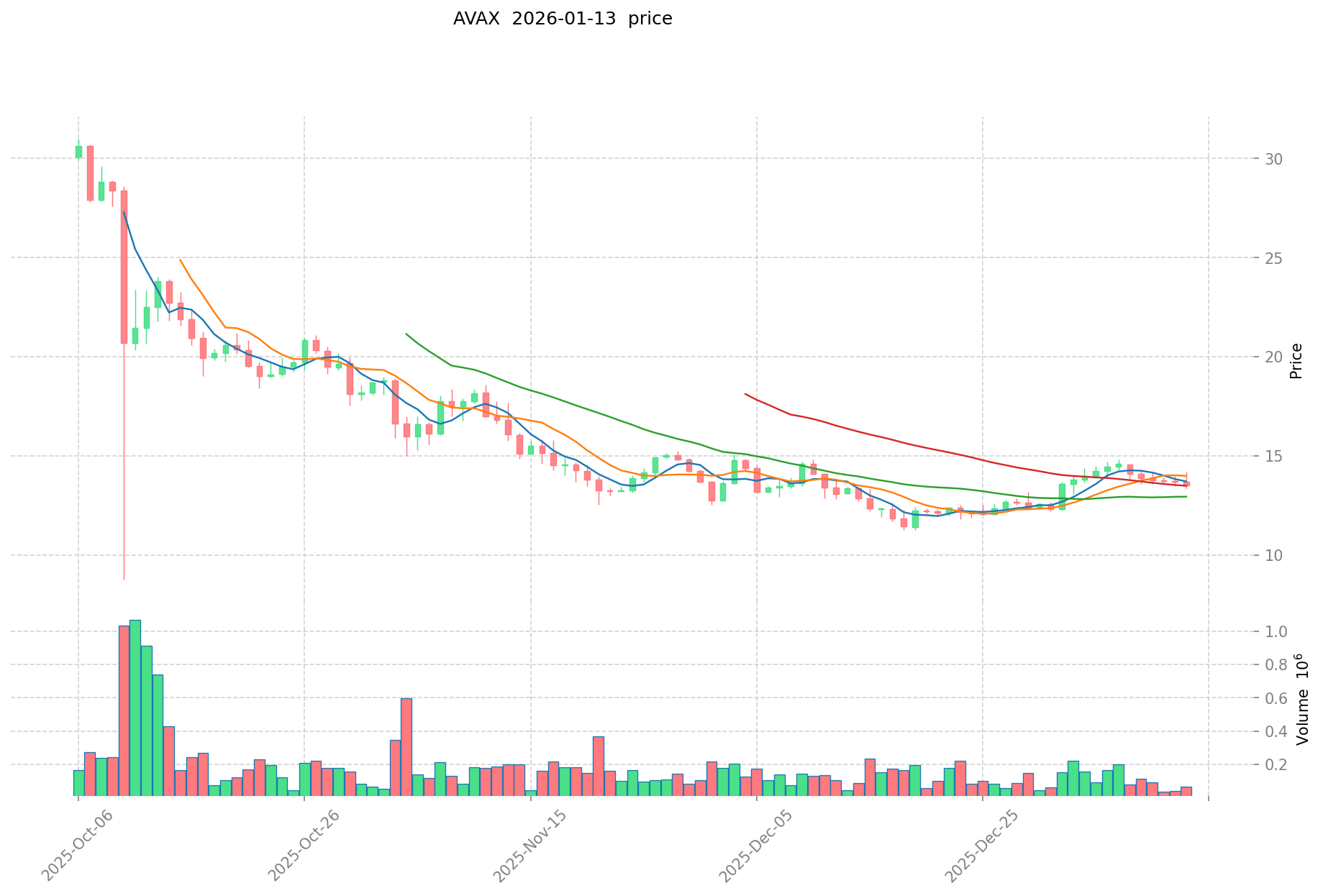
II. Core Factors Influencing ETC vs AVAX Investment Value
Tokenomics Comparison
- ETC: The investment value is influenced by staking rewards and the Ethereum merge impact, with staking validators earning additional transaction fees and MEV rewards post-merge.
- AVAX: The native token operates within a high-throughput, low-latency architecture where AVAX is used for transaction fee payments, staking validation, and governance participation.
- 📌 Historical Pattern: Supply mechanisms and protocol upgrades have demonstrated capacity to influence price cycles through changes in validator incentives and network economic models.
Institutional Adoption and Market Applications
- Institutional Holdings: Reference materials indicate varying institutional preferences, though specific comparative data between ETC and AVAX institutional positioning requires further analysis.
- Enterprise Adoption: AVAX technology infrastructure supports subnet architecture and multi-transaction processing capabilities through its DAG structure, potentially facilitating enterprise-level applications.
- Regulatory Landscape: Market participants should monitor evolving regulatory frameworks across jurisdictions, as policy developments may affect both assets differently.
Technology Development and Ecosystem Building
- ETC Technical Evolution: The Ethereum Classic network continues to operate as a proof-of-work blockchain, with its investment considerations linked to broader PoS and PoW network dynamics.
- AVAX Technical Development: Avalanche protocol employs a consensus mechanism built upon Snowball and Slush protocols, utilizing DAG structure for concurrent transaction processing, enabling high throughput and reduced latency.
- Ecosystem Comparison: Understanding the technological trajectory and ecosystem development of Avalanche remains important for evaluating AVAX value potential, particularly regarding DeFi infrastructure and validator network participation.
Macroeconomic Environment and Market Cycles
- Inflation Context: Reference materials suggest macroeconomic factors continue to exert influence on crypto asset markets broadly.
- Monetary Policy Impact: Interest rate policies and broader economic conditions may affect risk asset allocation decisions, including both ETC and AVAX positioning.
- Geopolitical Considerations: Cross-border transaction dynamics and international market conditions represent ongoing factors in digital asset valuation frameworks.
III. 2026-2031 Price Forecast: ETC vs AVAX
Short-term Forecast (2026)
- ETC: Conservative $11.34-$13.03 | Optimistic $13.03-$18.90
- AVAX: Conservative $11.75-$14.50 | Optimistic $14.50-$19.72
Medium-term Forecast (2028-2029)
- ETC may enter a consolidation phase, with projected price range of $10.69-$21.72
- AVAX may enter an expansion phase, with projected price range of $10.92-$26.12
- Key drivers: institutional capital inflows, ETF developments, ecosystem growth
Long-term Forecast (2030-2031)
- ETC: Base scenario $16.68-$21.21 | Optimistic scenario $19.99-$21.21
- AVAX: Base scenario $20.03-$36.35 | Optimistic scenario $24.13-$36.35
View detailed price predictions for ETC and AVAX
Disclaimer
ETC:
| Year |
Predicted High Price |
Predicted Average Price |
Predicted Low Price |
Price Change |
| 2026 |
18.8993 |
13.034 |
11.33958 |
0 |
| 2027 |
16.924649 |
15.96665 |
12.77332 |
22 |
| 2028 |
20.06369239 |
16.4456495 |
10.689672175 |
26 |
| 2029 |
21.72305842455 |
18.254670945 |
13.69100320875 |
40 |
| 2030 |
21.1881965658615 |
19.988864684775 |
17.590200922602 |
53 |
| 2031 |
21.206186544077797 |
20.58853062531825 |
16.676709806507782 |
57 |
AVAX:
| Year |
Predicted High Price |
Predicted Average Price |
Predicted Low Price |
Price Change |
| 2026 |
19.72 |
14.5 |
11.745 |
0 |
| 2027 |
21.9008 |
17.11 |
9.0683 |
17 |
| 2028 |
24.771858 |
19.5054 |
10.923024 |
34 |
| 2029 |
26.12358222 |
22.138629 |
13.72594998 |
52 |
| 2030 |
35.9553473589 |
24.13110561 |
20.0288176563 |
65 |
| 2031 |
36.3523040461845 |
30.04322648445 |
20.1289617445815 |
106 |
IV. Investment Strategy Comparison: ETC vs AVAX
Long-term vs Short-term Investment Strategies
-
ETC: May appeal to investors interested in proof-of-work blockchain continuity and those monitoring the evolution of legacy Ethereum protocol implementations. The asset's historical positioning as the original Ethereum chain continuation could attract participants focused on "code is law" principles.
-
AVAX: May appeal to investors seeking exposure to high-throughput blockchain infrastructure and DeFi ecosystem development. The platform's subnet architecture and rapid transaction finality features could attract participants interested in emerging decentralized application platforms.
Risk Management and Asset Allocation
-
Conservative Investors: Potential allocation framework could consider ETC 30-40% vs AVAX 30-40%, with remaining allocation to stablecoins or established assets for portfolio stability.
-
Aggressive Investors: Potential allocation framework could consider ETC 40-50% vs AVAX 40-50%, with higher exposure reflecting tolerance for volatility in pursuit of potential growth opportunities.
-
Hedging Tools: Portfolio risk management may incorporate stablecoin allocations, options strategies, and cross-asset diversification to mitigate concentration risk.
V. Potential Risk Comparison
Market Risk
-
ETC: Price volatility influenced by broader proof-of-work network dynamics, mining profitability fluctuations, and correlation with major cryptocurrency market movements. Historical price corrections demonstrate susceptibility to market-wide downturns.
-
AVAX: Price volatility influenced by DeFi sector performance, validator network participation rates, and competition from alternative Layer 1 platforms. Token performance remains subject to ecosystem adoption trajectories and technological development milestones.
Technical Risk
-
ETC: Network considerations include ongoing development of proof-of-work infrastructure, potential scalability limitations inherent to PoW architecture, and network security maintenance requirements.
-
AVAX: Network considerations include subnet architecture implementation complexity, validator network decentralization dynamics, and potential technical challenges associated with high-throughput consensus mechanisms.
Regulatory Risk
- Global regulatory developments may affect both assets differently based on their respective network architectures, consensus mechanisms, and use case positioning. Proof-of-work networks and DeFi-focused platforms may face distinct regulatory considerations across various jurisdictions.
VI. Conclusion: Which Is the Better Buy?
📌 Investment Value Summary:
-
ETC Advantages: Operates as continuation of original Ethereum blockchain with established proof-of-work infrastructure, maintains "code is law" positioning, and demonstrates historical market presence since 2015.
-
AVAX Advantages: Features high-throughput consensus mechanism with rapid transaction finality, supports subnet architecture for customizable blockchain deployments, and demonstrates growing DeFi ecosystem infrastructure.
✅ Investment Considerations:
-
New Investors: Consider starting with modest allocations to either asset while building understanding of blockchain technology fundamentals, proof-of-work versus alternative consensus mechanisms, and cryptocurrency market dynamics. Portfolio diversification across multiple assets may help manage exposure to individual token volatility.
-
Experienced Investors: May evaluate both assets based on technical architecture preferences, ecosystem development trajectories, and alignment with broader portfolio strategy. Analysis of validator economics, network activity metrics, and development roadmaps could inform allocation decisions.
-
Institutional Investors: Assessment may incorporate factors including network security architecture, validator infrastructure requirements, regulatory positioning, and liquidity depth across various trading venues.
⚠️ Risk Disclosure: Cryptocurrency markets exhibit substantial volatility. This content does not constitute investment advice. Market participants should conduct independent research and consider their risk tolerance before making investment decisions.
VII. FAQ
Q1: What are the key differences between ETC and AVAX consensus mechanisms?
ETC operates on a proof-of-work (PoW) consensus mechanism as the continuation of the original Ethereum blockchain, while AVAX utilizes an innovative consensus protocol built upon Snowball and Slush protocols with DAG structure for concurrent transaction processing. ETC maintains traditional mining-based security through computational work, whereas AVAX achieves 1-second transaction finality through its validator-based consensus system. This fundamental difference impacts network energy consumption, transaction speed, scalability potential, and validator participation requirements.
Q2: Which token has better short-term price potential in 2026?
Based on current market analysis, both tokens show similar conservative price ranges for 2026, with ETC projected at $11.34-$13.03 and AVAX at $11.75-$14.50. Under optimistic scenarios, AVAX demonstrates slightly higher potential ($14.50-$19.72) compared to ETC ($13.03-$18.90). However, short-term performance depends heavily on market sentiment (currently at Fear Index 26), institutional adoption patterns, and broader cryptocurrency market cycles. Investors should note that both assets have experienced significant corrections from their 2021 peaks.
Q3: How do the tokenomics differ between ETC and AVAX?
ETC's tokenomics are influenced by staking rewards and the Ethereum merge impact, with validators earning transaction fees and MEV rewards in the post-merge environment. AVAX operates within a high-throughput architecture where the native token serves multiple functions: transaction fee payments, staking validation, and governance participation. The supply mechanisms differ fundamentally due to their distinct consensus models, with ETC following traditional mining-based issuance while AVAX incorporates staking-based validator incentives and subnet-specific economic models.
Q4: What institutional adoption patterns distinguish ETC from AVAX?
While both assets attract institutional interest, they appeal to different institutional profiles. ETC may attract institutions focused on proof-of-work blockchain continuity and "code is law" principles, particularly those interested in the historical positioning of the original Ethereum protocol. AVAX may appeal to institutions seeking exposure to high-throughput DeFi infrastructure and customizable blockchain deployments through subnet architecture. Enterprise adoption for AVAX includes its multi-transaction processing capabilities and rapid finality features, potentially facilitating business-level applications.
Q5: What are the primary risk factors for each investment?
ETC faces market risks including price volatility from PoW network dynamics, mining profitability fluctuations, and correlation with broader crypto markets. Technical risks include scalability limitations inherent to PoW architecture and network security maintenance requirements. AVAX encounters market risks related to DeFi sector performance, validator participation rates, and competition from alternative Layer 1 platforms. Technical risks involve subnet architecture complexity, validator decentralization dynamics, and challenges associated with high-throughput consensus mechanisms. Both assets face regulatory considerations that may differ based on their network architectures.
Q6: How should portfolio allocation differ between conservative and aggressive investors?
Conservative investors may consider a balanced framework with ETC 30-40% and AVAX 30-40%, allocating the remainder to stablecoins or established assets for portfolio stability and risk mitigation. Aggressive investors might adopt ETC 40-50% and AVAX 40-50% allocations, accepting higher volatility exposure in pursuit of potential growth opportunities. Both strategies should incorporate hedging tools including stablecoin reserves, options strategies, and cross-asset diversification. Individual allocation decisions should align with risk tolerance, investment timeframe, and understanding of blockchain technology fundamentals.
Q7: What long-term price trajectory differences exist between ETC and AVAX through 2031?
Long-term forecasts suggest diverging trajectories, with ETC projected at $16.68-$21.21 (base scenario) and AVAX at $20.03-$36.35 by 2030-2031. Under optimistic scenarios, AVAX demonstrates potentially higher appreciation ($24.13-$36.35) compared to ETC ($19.99-$21.21). These projections reflect different growth drivers: ETC's trajectory depends on PoW network evolution and mining economics, while AVAX's potential correlates with DeFi ecosystem expansion, subnet adoption, and validator network growth. Key factors include institutional capital inflows, ETF developments, technological advancements, and macroeconomic conditions affecting risk asset allocation.
Q8: Which asset better suits new cryptocurrency investors?
New investors should consider starting with modest allocations to either asset while building foundational knowledge of blockchain technology, consensus mechanisms, and cryptocurrency market dynamics. Both ETC and AVAX serve different educational purposes: ETC provides exposure to proof-of-work blockchain principles and cryptocurrency history, while AVAX offers insights into modern high-throughput platforms and DeFi infrastructure. Portfolio diversification across multiple assets helps manage individual token volatility. Beginning investors should prioritize understanding technical fundamentals, network security models, and market cycle patterns before establishing significant positions in either asset.
* The information is not intended to be and does not constitute financial advice or any other recommendation of any sort offered or endorsed by Gate.