Discover strategies for trading Ethereum channel breakouts through in-depth technical analysis. Understand how to leverage the channel’s midline, identify support and resistance levels, and apply expert price projections. Access a comprehensive guide to trading on Gate, covering bullish targets up to $3,400 and critical CME-related risks to monitor.
Ethereum Market Overview
Ethereum, the second-largest cryptocurrency by market capitalization, is navigating a challenging trading environment amid ongoing market volatility. In recent weeks, Ethereum’s price has formed an upward channel on technical charts, indicating a positive long-term trajectory.
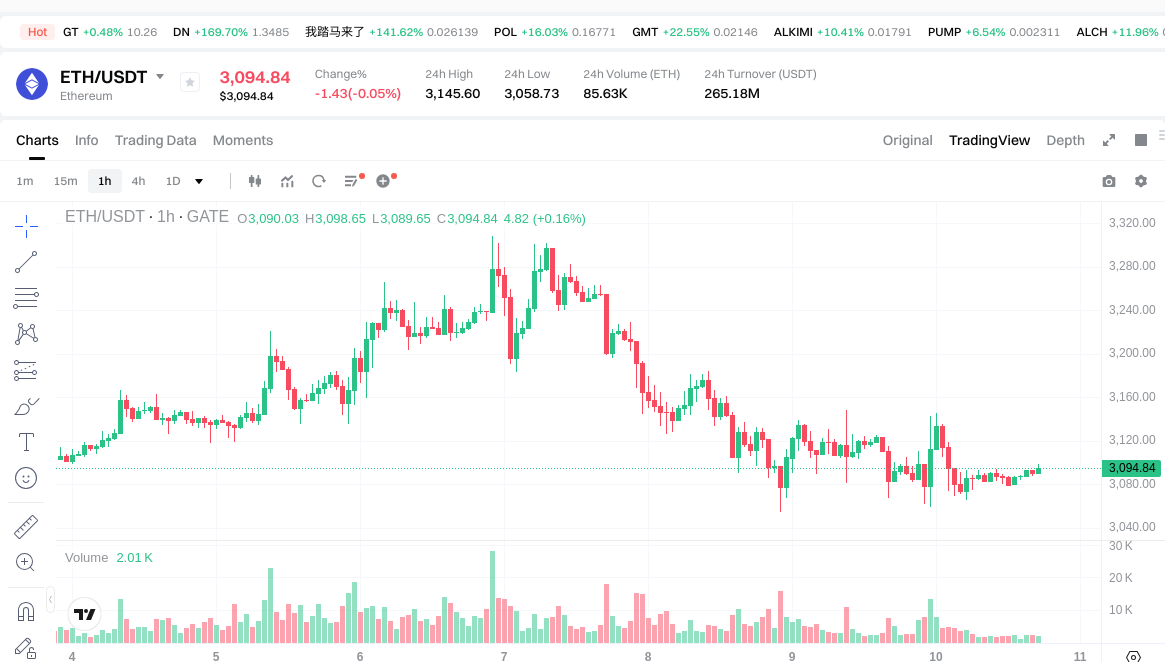 Still, price action has tightened within this channel, intensifying the battle between buyers and sellers.
A notable feature of the current phase is the development of a descending triangle pattern inside the ascending channel. This signals slowing bullish momentum, although the overall structure remains upward. The channel’s midline now serves as a pivotal strategic zone, where buyers and sellers are locked in a fierce contest for price control.
Technical Analysis: Ascending Channel and Midline
An ascending channel is a technical chart pattern formed when price moves between two parallel, upward-sloping trendlines. The upper trendline acts as resistance, while the lower trendline provides support. The channel’s midline is often used as a key reference to assess trend strength.
For Ethereum, the midline currently acts as a critical battleground. Repeated tests in this area show buyers striving to maintain control and defend this support zone against ongoing selling pressure. However, the inability to break above the midline decisively and advance toward the channel’s upper band suggests waning bullish momentum.
The emerging descending triangle within the channel also serves as a cautionary signal. Typically defined by lower highs and relatively flat lows, this pattern reflects diminishing buying pressure while sellers remain steady. If confirmed, it could signal a short-term price correction.
Market Expert Insights
Kamran Asghar, a prominent technical analyst and trader in the crypto community, provided a detailed assessment of Ethereum’s current situation. He observes that Ethereum’s price is forming higher highs and higher lows, a positive sign of an ongoing uptrend. However, he cautions that candlestick action near the midline indicates weakening buyer strength.
Asghar warns that a break below the channel’s lower trendline would invalidate the short-term uptrend. In this scenario, prices may drop to the $2,760 area, and if sellers maintain control, the next support zone lies at $2,700–$2,680. These price points are critical for traders to monitor closely when making trading decisions.
Meanwhile, Ted, an experienced market coordinator, highlights Ethereum’s efforts to reclaim the $2,800–$2,900 range. He notes that if Ethereum can decisively break through this resistance, bullish momentum could push prices toward the $3,300–$3,400 level. Such a rally would open up attractive profit opportunities for long-term investors.
Potential Price Scenarios
Based on current technical analysis, two key scenarios may unfold for Ethereum’s price in the near term:
Bullish Scenario: If buyers successfully defend the channel’s midline and drive prices above the $2,800–$2,900 resistance, Ethereum could move toward the upper band of the ascending channel. In this case, price targets include $3,100, $3,300, and potentially $3,400. A surge in trading volume and positive momentum indicators (such as RSI and MACD) would further support this scenario.
Bearish Scenario: Alternatively, if Ethereum fails to hold support at the midline and breaks below the channel’s lower trendline, the short-term uptrend will be invalidated. Prices could then fall to $2,760, followed by $2,700–$2,680 if selling pressure intensifies. The next crucial support level is near $2,600, where buyers may concentrate efforts to defend the price.
Traders should set appropriate stop-loss orders and manage risk carefully in this volatile market. Tracking trading volume and technical indicators will help identify which scenario is more likely.
Risk Factor: CME Gap
One important risk factor for investors is the possibility of a CME (Chicago Mercantile Exchange) gap. A CME gap occurs when the crypto market trades over the weekend while CME is closed, creating a price discrepancy between Friday’s close and Monday’s open on CME charts.
Ted points out that concerns about a potential CME gap due to weekend trading are causing many investors to exercise greater caution. Historical data show that such gaps are often “filled” within a few weeks, meaning prices typically return to the gap level before continuing the main trend.
Filling a CME gap can create temporary downward pressure, impacting investor expectations and trading strategies. This is especially relevant for short-term traders, who need to consider the likelihood of price correcting to the gap level before resuming an uptrend.
However, not all CME gaps are filled immediately—some may persist for extended periods. Investors should avoid relying solely on this factor for trading decisions and instead combine it with technical and fundamental analysis for a comprehensive market perspective.
FAQ
What is Ethereum? How does it differ from Bitcoin?
Ethereum is a programmable blockchain platform supporting smart contracts and decentralized applications, while Bitcoin is primarily designed for peer-to-peer payments. Ethereum utilizes an energy-efficient Proof of Stake consensus mechanism.
What are the midline channel and uptrend in crypto technical analysis?
The midline channel is an analytical tool for identifying price trends. An uptrend means prices are rising; when the midline channel slopes upward and price nears the upper trendline, it signals a strong trend.
How do you interpret major support and resistance levels in Ethereum’s price trend?
Support levels halt further price declines, while resistance levels prevent additional price increases. Analysts identify these levels based on historical price points to forecast Ethereum’s price movement.
What key technical challenges and opportunities does Ethereum currently face?
Ethereum must address scalability challenges, but Layer 2 solutions offer opportunities to improve performance. The platform’s dynamic developer ecosystem and decentralized network are significant advantages.
What risks should you consider when investing in Ethereum?
Investing in Ethereum involves high market volatility, technological risks, and regulatory uncertainty. Investors should remain alert to major price swings.
What is the outlook for Ethereum’s future development?
Ethereum has a positive outlook as a leader in DeFi and with Layer 2 technologies that enhance scalability. Demand for ETH is rising from decentralized applications. Long-term value will depend on widespread adoption and technological success.
* The information is not intended to be and does not constitute financial advice or any other recommendation of any sort offered or endorsed by Gate.