This comprehensive analysis compares ETHW and QNT, two distinct blockchain tokens with different market positioning and investment characteristics. ETHW, a Proof-of-Work Ethereum fork, appeals to users preferring mining-based consensus and PoW DeFi ecosystems, currently trading at $0.5567. QNT, an enterprise blockchain interoperability solution launched in 2018, focuses on cross-chain integration through Overledger technology, currently at $82.55. The article examines historical price trends, tokenomics differences, institutional adoption patterns, and ecosystem development before presenting 2026-2031 forecasts showing QNT's absolute growth potential ($211.77) against ETHW's percentage gains. Investment strategies vary by risk tolerance, with detailed risk analysis covering market volatility, technical infrastructure, and evolving regulatory frameworks. The comparison guides investors in assessing which asset aligns with their specific investment thesis—whether prioritizing PoW mining infrastructure or enterp
Introduction: ETHW vs QNT Investment Comparison
In the cryptocurrency market, the comparison between ETHW vs QNT has consistently been a topic of interest for investors. The two assets demonstrate notable differences in market capitalization ranking, application scenarios, and price performance, representing distinct positioning within the crypto asset landscape.
EthereumPoW (ETHW): Emerging from the Ethereum ecosystem as a digital currency and global payment technology originally derived from PoW-based Ethereum, it has established a presence in the digital economy space.
Quant (QNT): Launched in 2018, this project has been positioned as an enterprise blockchain interoperability solution through its Overledger operating system, serving businesses, regulators, governments, and individuals in creating secure digital interactions.
This article will provide a comprehensive analysis of ETHW vs QNT investment value comparison, examining historical price trends, supply mechanisms, institutional adoption patterns, technological ecosystems, and future projections, while addressing the question investors frequently consider:
"Which is the better buy right now?"
I. Historical Price Comparison and Current Market Status
ETHW and QNT Historical Price Trends
- 2022: ETHW emerged following Ethereum's transition to Proof of Stake, with its price reaching $58.54 on September 3, 2022.
- 2021: QNT experienced significant growth, reaching its all-time high of $427.42 on September 11, 2021.
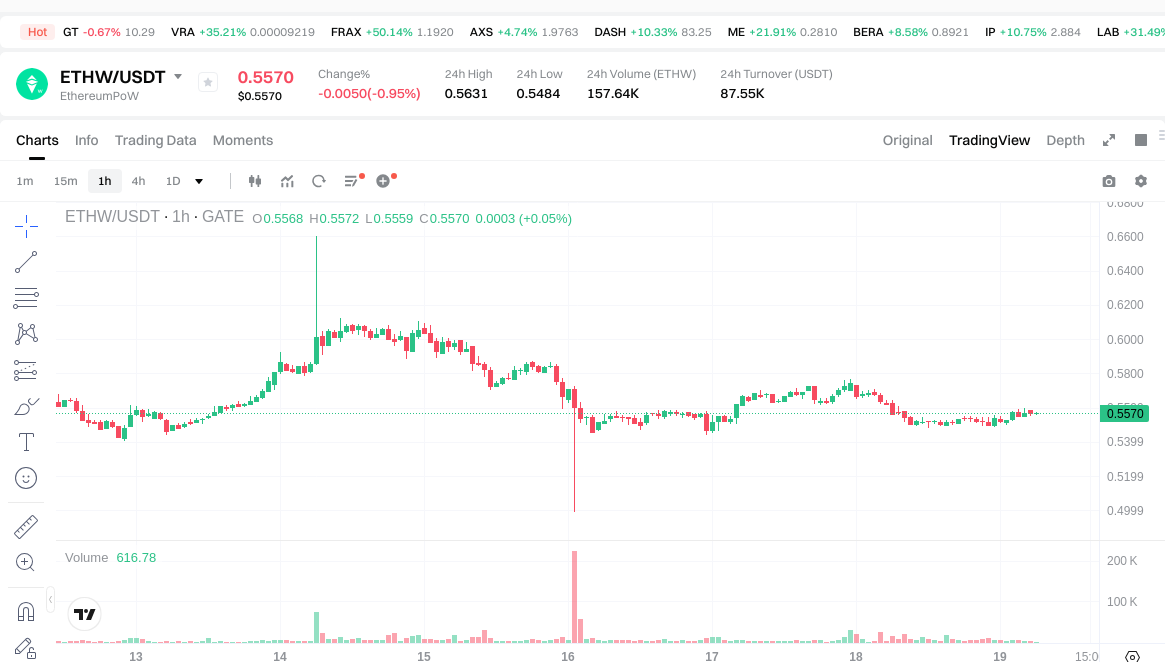
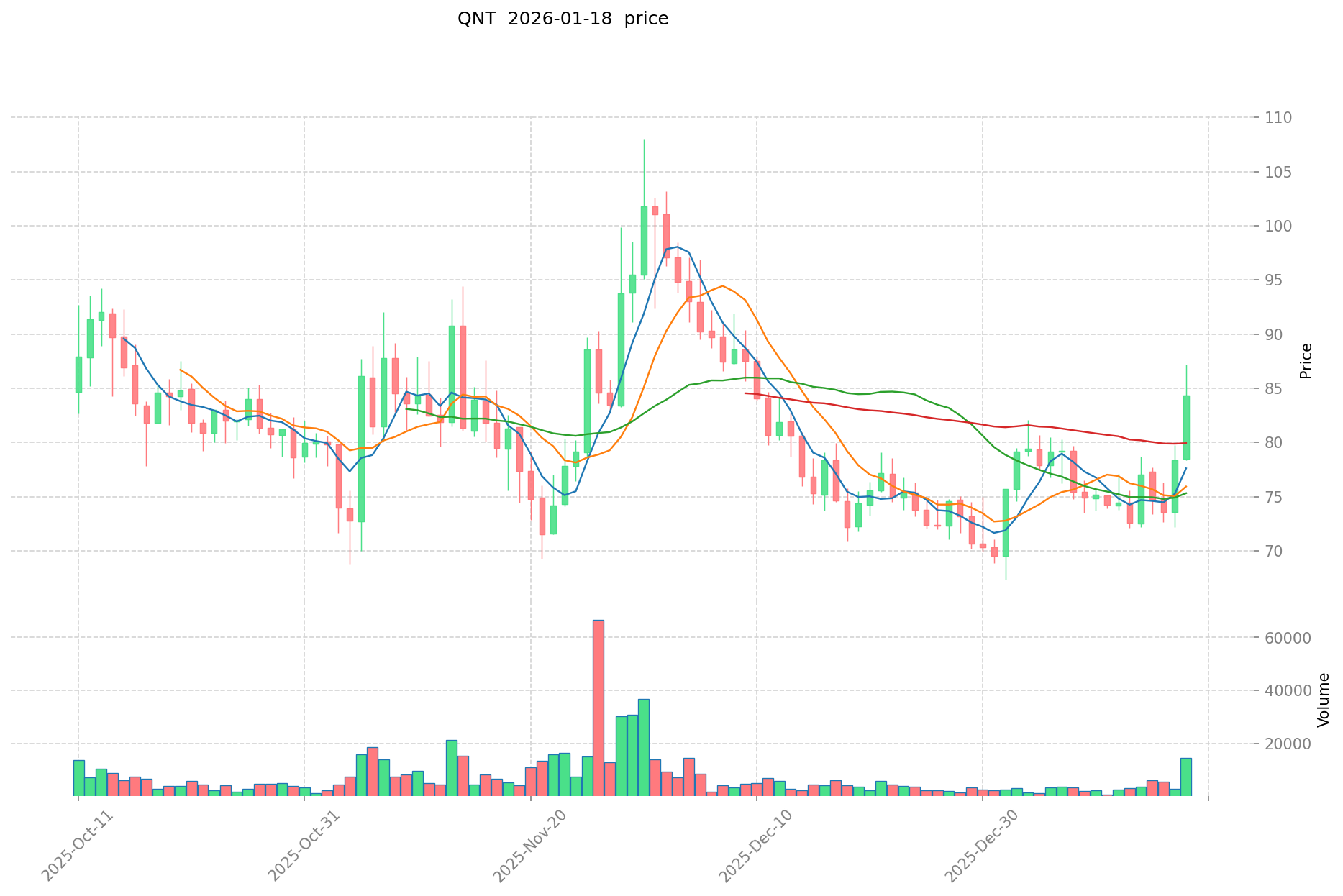
- Comparative analysis: During the 2022-2025 market cycle, ETHW declined from its peak of $58.54 to a low of $0.477377 on December 16, 2025, representing a substantial correction. In contrast, QNT showed more resilience, though it also experienced a decline from its 2021 peak of $427.42 to lower levels.
Current Market Status (January 19, 2026)
- ETHW current price: $0.5567
- QNT current price: $82.55
- 24-hour trading volume: ETHW $90,295.05 vs QNT $487,340.77
- Market Sentiment Index (Fear & Greed Index): 49 (Neutral)
View real-time prices:
II. Core Factors Influencing ETHW vs QNT Investment Value
Supply Mechanism Comparison (Tokenomics)
-
ETHW: As a fork of Ethereum maintaining the Proof-of-Work consensus mechanism, ETHW inherits Ethereum's original supply characteristics. The token supply continues to increase through mining rewards, following an inflationary model without a fixed maximum supply cap.
-
QNT: Quant Network (QNT) operates with a fixed supply model. The token has a maximum supply cap, which may create scarcity dynamics over time as adoption increases.
-
📌 Historical Pattern: Supply mechanisms play a role in shaping price cycle dynamics. Tokens with fixed supply caps may experience different price pressure patterns compared to inflationary models, particularly during periods of increased demand or market expansion phases.
Institutional Adoption and Market Application
-
Institutional Holdings: Available data suggests varying levels of institutional interest in different digital assets. Market positioning and use case development may influence institutional allocation decisions.
-
Enterprise Adoption: Both assets target different market segments. ETHW maintains compatibility with Ethereum-based applications that prefer PoW consensus, while QNT focuses on blockchain interoperability solutions for enterprise environments.
-
Regulatory Environment: Different jurisdictions maintain varying approaches to digital asset regulation. Regulatory frameworks continue to evolve, potentially affecting how these assets are classified and utilized across different markets.
Technology Development and Ecosystem Building
-
ETHW Technical Position: ETHW maintains the Proof-of-Work consensus mechanism that Ethereum originally used before transitioning to Proof-of-Stake. This positions ETHW as an alternative for users and developers who prefer PoW architecture.
-
QNT Technical Development: Quant Network focuses on developing Overledger technology, which aims to facilitate interoperability between different blockchain networks. The project targets enterprise blockchain integration use cases.
-
Ecosystem Comparison: The two assets serve different ecosystem niches. ETHW maintains compatibility with Ethereum-based DeFi applications, NFT platforms, and smart contracts that operate on PoW infrastructure. QNT focuses on cross-chain communication and enterprise blockchain connectivity solutions.
Macroeconomic Environment and Market Cycles
-
Performance in Inflationary Environments: Digital assets demonstrate varying characteristics during different economic conditions. Market participants evaluate assets based on multiple factors including supply dynamics, adoption trends, and utility functions.
-
Macroeconomic Policy Impact: Monetary policy decisions, interest rate adjustments, and currency market movements may influence digital asset valuations. The relationship between traditional financial indicators and digital asset prices remains subject to ongoing market observation.
-
Geopolitical Factors: Cross-border transaction requirements and international market dynamics may affect demand patterns for different digital assets. Various factors including regulatory developments and market infrastructure evolution continue to shape the operational environment for digital assets.
III. 2026-2031 Price Forecast: ETHW vs QNT
Short-term Forecast (2026)
- ETHW: Conservative $0.43-$0.56 | Optimistic $0.56-$0.73
- QNT: Conservative $79.69-$82.15 | Optimistic $82.15-$100.22
Medium-term Forecast (2028-2029)
- ETHW may enter a growth phase with estimated price range of $0.58-$1.25
- QNT may enter a consolidation phase with estimated price range of $58.32-$134.93
- Key drivers: institutional capital inflows, ETF developments, ecosystem expansion
Long-term Forecast (2030-2031)
- ETHW: Baseline scenario $0.54-$1.19 | Optimistic scenario $1.19-$1.57
- QNT: Baseline scenario $77.28-$150.19 | Optimistic scenario $150.19-$211.77
View detailed price predictions for ETHW and QNT
Disclaimer
ETHW:
| Year |
Predicted High Price |
Predicted Average Price |
Predicted Low Price |
Price Change |
| 2026 |
0.728884 |
0.5564 |
0.428428 |
0 |
| 2027 |
0.84828744 |
0.642642 |
0.58480422 |
15 |
| 2028 |
0.9989227248 |
0.74546472 |
0.5814624816 |
33 |
| 2029 |
1.247237023032 |
0.8721937224 |
0.689033040696 |
56 |
| 2030 |
1.31404706216784 |
1.059715372716 |
0.54045484008516 |
90 |
| 2031 |
1.566683207023334 |
1.18688121744192 |
1.008849034825632 |
113 |
QNT:
| Year |
Predicted High Price |
Predicted Average Price |
Predicted Low Price |
Price Change |
| 2026 |
100.223 |
82.15 |
79.6855 |
0 |
| 2027 |
127.6611 |
91.1865 |
85.71531 |
10 |
| 2028 |
119.271942 |
109.4238 |
59.088852 |
32 |
| 2029 |
134.93048778 |
114.347871 |
58.31741421 |
38 |
| 2030 |
175.7412429399 |
124.63917939 |
77.2762912218 |
50 |
| 2031 |
211.7681977425795 |
150.19021116495 |
108.136952038764 |
81 |
IV. Investment Strategy Comparison: ETHW vs QNT
Long-term vs Short-term Investment Strategies
-
ETHW: May be considered by investors interested in Proof-of-Work blockchain infrastructure and Ethereum-compatible applications. The asset's positioning as a PoW alternative could appeal to those focused on mining-based consensus mechanisms and DeFi ecosystems that operate on PoW architecture.
-
QNT: May attract investors evaluating enterprise blockchain interoperability solutions and cross-chain infrastructure development. The project's focus on Overledger technology and business-oriented blockchain connectivity could be relevant for those assessing institutional adoption trends in blockchain integration.
Risk Management and Asset Allocation
-
Conservative investors: A diversified approach might consider allocating smaller portions to higher-volatility assets while maintaining substantial positions in established digital assets or stable instruments. Example allocation framework: ETHW 15-20% vs QNT 20-25%, with remaining portfolio in established assets.
-
Aggressive investors: Higher-risk portfolios may include larger allocations to emerging or specialized blockchain projects. Example allocation framework: ETHW 30-40% vs QNT 35-45%, with flexibility for market-responsive adjustments.
-
Hedging instruments: Portfolio risk management approaches may include stablecoin allocations for liquidity preservation, derivatives instruments where available and appropriate, and cross-asset diversification strategies spanning different blockchain ecosystems and use cases.
V. Potential Risk Comparison
Market Risks
-
ETHW: Price volatility may be influenced by several factors including mining profitability dynamics, competition from other PoW networks, market sentiment toward Proof-of-Work consensus mechanisms, and the relative positioning compared to Ethereum's PoS ecosystem. Trading volume patterns and liquidity conditions may also affect price stability.
-
QNT: Market performance may be affected by enterprise adoption rates of blockchain interoperability solutions, competitive developments in cross-chain technology, broader institutional blockchain implementation timelines, and general market conditions affecting mid-cap digital assets. Demand for blockchain integration services may influence long-term value dynamics.
Technical Risks
-
ETHW: Technical considerations include network scalability as transaction demand fluctuates, maintenance of mining infrastructure and hash rate distribution, compatibility updates with evolving DeFi protocols, and ongoing development support for the PoW fork. Network stability depends on sustained miner participation and development activity.
-
QNT: Technical factors include the ongoing development and adoption of Overledger technology, successful implementation of cross-chain communication protocols, maintenance of security standards across multiple blockchain integrations, and the technical complexity of maintaining interoperability across diverse blockchain architectures.
Regulatory Risks
- Global regulatory frameworks continue to evolve regarding digital assets, with potential differential impacts on various token categories. Proof-of-Work networks may face regulatory discussions related to energy consumption and environmental considerations in certain jurisdictions. Enterprise-focused blockchain solutions may encounter regulatory requirements related to business applications, data handling, and cross-border transaction compliance. The regulatory environment varies significantly across different markets, and future policy developments may affect operational parameters and market access for different types of digital assets.
VI. Conclusion: Which Is the Better Buy?
📌 Investment Value Summary:
-
ETHW characteristics: Maintains Proof-of-Work consensus mechanism compatibility with Ethereum-based applications, provides an alternative for users preferring PoW architecture, supports mining-based token distribution model, and offers exposure to PoW-oriented DeFi and NFT ecosystems.
-
QNT characteristics: Focuses on enterprise blockchain interoperability through Overledger technology, targets business and institutional blockchain integration use cases, operates with a fixed supply model, and positions itself within the blockchain infrastructure and cross-chain communication sector.
✅ Investment Considerations:
-
Beginning investors: May benefit from thorough research into fundamental differences between projects, starting with smaller position sizes while developing understanding of market dynamics, maintaining diversification across multiple assets and sectors, and focusing on risk management principles including appropriate position sizing relative to overall portfolio.
-
Experienced investors: Could evaluate both assets within the context of broader portfolio strategy, assess technical development progress and ecosystem growth metrics, monitor institutional adoption patterns and enterprise blockchain trends, and consider how each asset's characteristics align with specific investment theses regarding PoW networks versus enterprise interoperability solutions.
-
Institutional participants: May conduct detailed due diligence on technology infrastructure, regulatory compliance frameworks, liquidity conditions and market depth, custody solutions and operational requirements, and strategic positioning within blockchain sector allocations based on specific mandates and risk parameters.
⚠️ Risk Disclosure: Cryptocurrency markets exhibit substantial volatility and uncertainty. This analysis does not constitute investment advice, financial guidance, or recommendations to buy or sell any assets. Market participants should conduct independent research, assess personal risk tolerance, and consult qualified financial advisors before making investment decisions.
VII. FAQ
Q1: What is the fundamental difference between ETHW and QNT?
ETHW is a Proof-of-Work fork of Ethereum that maintains mining-based consensus and compatibility with Ethereum applications, while QNT is an enterprise blockchain interoperability solution focused on cross-chain communication through its Overledger technology. ETHW emerged in 2022 after Ethereum's transition to Proof-of-Stake, positioning itself as an alternative for users preferring PoW architecture. In contrast, QNT launched in 2018 specifically to address enterprise blockchain integration challenges, targeting businesses, regulators, and institutions requiring secure multi-chain interactions.
Q2: Which asset demonstrates stronger price stability based on historical data?
Based on the reference data, QNT demonstrates relatively stronger price stability compared to ETHW. QNT reached its all-time high of $427.42 in September 2021 and currently trades at $82.55, while ETHW peaked at $58.54 in September 2022 and declined significantly to $0.477377 in December 2025 before recovering to $0.5567. The 24-hour trading volume also favors QNT at $487,340.77 versus ETHW's $90,295.05, indicating greater market liquidity and potentially lower volatility risk for QNT holders.
Q3: How do the supply mechanisms of ETHW and QNT affect their long-term investment potential?
ETHW operates with an inflationary supply model inherited from Ethereum's original PoW design, where token supply continuously increases through mining rewards without a fixed maximum cap, potentially creating ongoing sell pressure from miners. QNT employs a fixed supply model with a maximum token cap, which may generate scarcity dynamics as adoption increases over time. Historically, assets with capped supplies can experience different price pressure patterns during market expansion phases, potentially favoring QNT's value retention mechanism, though this depends on actual adoption rates and market demand for each asset's respective use cases.
Q4: What are the primary use cases driving demand for each asset?
ETHW serves users and developers preferring Proof-of-Work infrastructure, supporting Ethereum-compatible DeFi applications, NFT platforms, and smart contracts operating on PoW architecture, along with mining ecosystem participants. QNT focuses on enterprise blockchain interoperability, enabling businesses, regulators, and governments to create secure cross-chain interactions through Overledger technology. The distinct use case positioning means ETHW competes in the decentralized application and mining sectors, while QNT targets institutional blockchain integration markets, resulting in different demand drivers and adoption timelines.
Q5: Based on the 2026-2031 forecasts, which asset shows higher growth potential?
According to the forecast data, QNT demonstrates significantly higher absolute price potential, with optimistic 2031 projections reaching $211.77 compared to ETHW's $1.57. However, ETHW shows a higher percentage increase from current levels (approximately 182% from $0.5567 to $1.57) compared to QNT's increase (approximately 157% from $82.55 to $211.77) in optimistic scenarios. The forecasts suggest QNT may offer more substantial absolute gains for larger capital allocations, while ETHW could provide higher percentage returns from current price levels, though both projections carry significant uncertainty and depend on numerous market variables including adoption rates, regulatory developments, and macroeconomic conditions.
Q6: How should beginners approach investing in ETHW versus QNT?
Beginning investors should start with comprehensive research into each project's fundamental technology, use cases, and market positioning before committing capital. A prudent approach involves starting with smaller position sizes (potentially 5-10% of crypto portfolio allocation per asset) while developing understanding of market dynamics and volatility patterns. Diversification remains essential—avoid concentrating portfolio exclusively in either asset. Focus on risk management principles including setting clear stop-loss parameters, maintaining adequate liquidity reserves in stablecoins, and avoiding investment amounts that would cause financial stress if lost. Consider that ETHW may suit those interested in PoW mining ecosystems, while QNT may appeal to those evaluating enterprise blockchain infrastructure opportunities.
Q7: What regulatory risks should investors consider for ETHW and QNT?
Regulatory frameworks for digital assets continue evolving globally, with potential differential impacts on various token categories. ETHW may face regulatory scrutiny related to energy consumption associated with Proof-of-Work mining, particularly in jurisdictions implementing environmental regulations on cryptocurrency operations. Mining activities could encounter operational restrictions or taxation policies affecting profitability. QNT, as an enterprise-focused solution, may face regulatory requirements related to business blockchain applications, cross-border data handling compliance, and institutional transaction reporting standards. Both assets operate in a regulatory environment that varies significantly across different markets, and future policy developments could affect market access, operational parameters, and institutional adoption timelines. Investors should monitor regulatory developments in their specific jurisdictions and assess how changing compliance requirements might impact each asset's utility and market positioning.
* The information is not intended to be and does not constitute financial advice or any other recommendation of any sort offered or endorsed by Gate.