This comprehensive article compares ETN (Electroneum) and CHZ (Chiliz), two emerging blockchain projects with distinct market positions. ETN operates as an EVM-compatible Layer 1 blockchain serving 4 million users with 5-second transaction speeds, while CHZ functions as a sports fan engagement token exclusively for Socios.com platform. The article analyzes historical price trends, current market status, and investment value factors, revealing that ETN declined from $0.01 (April 2024) to $0.001314, while CHZ corrected from its all-time high of $0.878633 (March 2021) to $0.0529. Key differences include liquidity disparities (CHZ trading volume $2.1M versus ETN $21K) and distinct risk profiles. The analysis provides price predictions through 2031, investment strategy recommendations for different investor types, and detailed risk assessments covering market, technical, and regulatory factors. Suitable for investors seeking exposure to either payment infrastructure or sports entertainment blockchain applications,
Introduction: Investment Comparison Between ETN and CHZ
In the cryptocurrency market, the comparison between ETN vs CHZ has consistently been a topic that investors cannot overlook. Both exhibit notable differences in market capitalization ranking, application scenarios, and price performance, representing distinct positions within the crypto asset landscape.
Electroneum (ETN): Launched in 2017, it has gained market recognition through its positioning as an EVM-compatible Layer 1 blockchain serving over 4 million users globally, featuring 5-second transaction speeds and supporting the AnyTask.com freelance platform.
Chiliz (CHZ): Since its 2019 launch, it has been recognized as a fan engagement token for sports and esports, serving as the exclusive utility token for Socios.com, enabling fans to participate in team governance and strategic decisions.
This article will provide a comprehensive analysis of the ETN vs CHZ investment value comparison, covering historical price trends, supply mechanisms, institutional adoption, technical ecosystems, and future projections, attempting to address the question investors care about most:
"Which is the better buy right now?"
I. Historical Price Comparison and Current Market Status
Historical Price Trends of ETN (Coin A) and CHZ (Coin B)
- 2024: ETN experienced a price decline following its all-time high period, with the price dropping from $0.01 recorded on April 11, 2024.
- 2021: CHZ was influenced by market momentum during the cryptocurrency bull run, reaching its all-time high of $0.878633 on March 13, 2021.
- Comparative Analysis: During recent market cycles, ETN declined from its peak of $0.01 to a low of $0.001081 recorded on December 24, 2025, while CHZ experienced a significant correction from its historical high of $0.878633 to lower levels, with current trading near $0.0529.
Current Market Status (January 22, 2026)
- ETN current price: $0.001314
- CHZ current price: $0.0529
- 24-hour trading volume: ETN recorded $20,969.66 compared to CHZ's $2,109,454.10
- Market Sentiment Index (Fear & Greed Index): 20 (Extreme Fear)
View real-time prices:
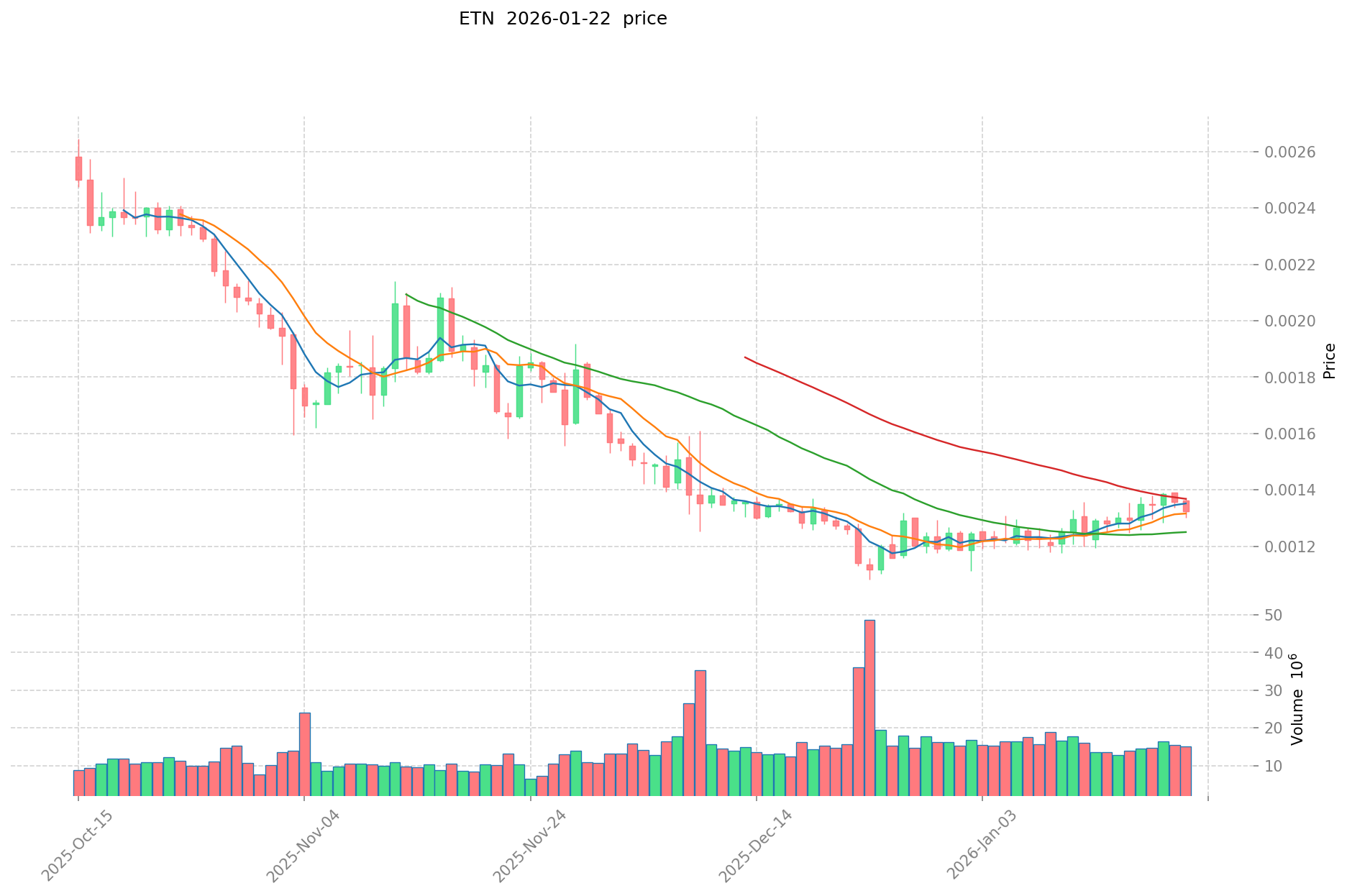
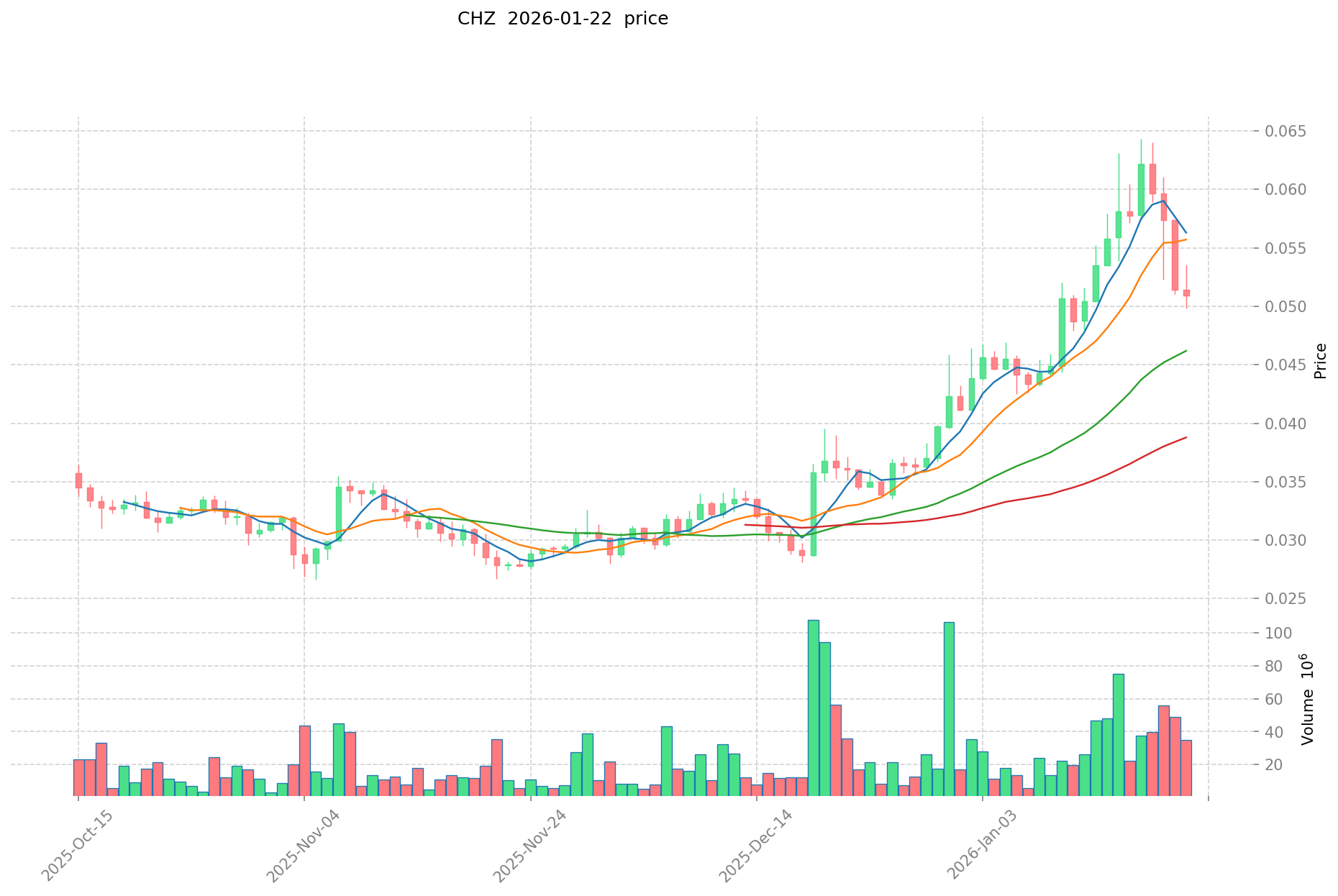
II. Core Factors Affecting ETN vs CHZ Investment Value
Given the absence of reference materials and verified information in the knowledge base regarding ETN and CHZ tokenomics, institutional adoption, technical developments, and macroeconomic performance, a comprehensive comparative analysis cannot be conducted at this time. Investment decisions should be based on thorough due diligence using verified data sources and professional financial advice.
III. 2026-2031 Price Prediction: ETN vs CHZ
Short-term Prediction (2026)
- ETN: Conservative $0.00112 - $0.00132 | Optimistic $0.00132 - $0.00196
- CHZ: Conservative $0.0322 - $0.0527 | Optimistic $0.0527 - $0.0606
Mid-term Prediction (2028-2029)
- ETN may enter a gradual growth phase, with projected prices ranging from $0.00132 to $0.00335
- CHZ may enter a consolidation and expansion phase, with projected prices ranging from $0.0426 to $0.0811
- Key drivers: institutional capital inflows, ETF developments, ecosystem expansion
Long-term Prediction (2030-2031)
- ETN: Base scenario $0.00249 - $0.00314 | Optimistic scenario $0.00314 - $0.00439
- CHZ: Base scenario $0.0393 - $0.0864 | Optimistic scenario $0.0864 - $0.118
View detailed price predictions for ETN and CHZ
Disclaimer: Price predictions are based on historical data analysis and market models. Cryptocurrency markets are highly volatile and subject to various risks including regulatory changes, technological developments, and market sentiment shifts. These projections should not be considered as investment advice. Users should conduct independent research and consult with qualified financial advisors before making any investment decisions.
ETN:
| Year |
Predicted High Price |
Predicted Average Price |
Predicted Low Price |
Price Change |
| 2026 |
0.00195935 |
0.001315 |
0.00111775 |
0 |
| 2027 |
0.0021283275 |
0.001637175 |
0.0010805355 |
24 |
| 2028 |
0.0027111618 |
0.00188275125 |
0.001317925875 |
43 |
| 2029 |
0.0033535565265 |
0.002296956525 |
0.0018835043505 |
74 |
| 2030 |
0.003446812961415 |
0.00282525652575 |
0.00248622574266 |
115 |
| 2031 |
0.004390448641015 |
0.003136034743582 |
0.002979233006403 |
138 |
CHZ:
| Year |
Predicted High Price |
Predicted Average Price |
Predicted Low Price |
Price Change |
| 2026 |
0.0606395 |
0.05273 |
0.0321653 |
0 |
| 2027 |
0.0765244125 |
0.05668475 |
0.0459146475 |
7 |
| 2028 |
0.073265039375 |
0.06660458125 |
0.042626932 |
25 |
| 2029 |
0.0811243799625 |
0.0699348103125 |
0.0531504558375 |
32 |
| 2030 |
0.097433177727375 |
0.0755295951375 |
0.0392753894715 |
42 |
| 2031 |
0.118479499412439 |
0.086481386432437 |
0.060536970502706 |
63 |
IV. Investment Strategy Comparison: ETN vs CHZ
Long-term vs Short-term Investment Strategies
-
ETN: May suit investors interested in Layer 1 blockchain technology and payment-focused platforms, particularly those seeking exposure to freelance economy applications through its connection to AnyTask.com. Given its lower price point and historical volatility, it may appeal to investors with higher risk tolerance seeking potential growth opportunities.
-
CHZ: May suit investors interested in the sports and entertainment industry convergence with blockchain technology, particularly those seeking exposure to fan engagement platforms and the growing tokenization of sports communities through Socios.com. Its established market presence since 2019 may attract investors seeking more proven utility cases.
Risk Management and Asset Allocation
-
Conservative investors: ETN 20-30% vs CHZ 70-80% allocation consideration, given CHZ's larger market presence and established platform adoption.
-
Aggressive investors: ETN 50-60% vs CHZ 40-50% allocation consideration, balancing higher risk potential of ETN with CHZ's market positioning.
-
Hedging instruments: Stablecoin allocation for liquidity management, options strategies for downside protection, cross-cryptocurrency portfolio diversification to mitigate single-asset risk.
V. Potential Risk Comparison
Market Risks
-
ETN: Subject to significant price volatility, as evidenced by the decline from $0.01 in April 2024 to $0.001081 in December 2025. Lower trading volume of $20,969.66 may indicate reduced liquidity and potential for wider bid-ask spreads.
-
CHZ: Experienced substantial correction from its all-time high of $0.878633 in March 2021 to current levels near $0.0529. Market performance may be influenced by broader sports industry trends and fan engagement platform adoption rates. Current trading volume of $2,109,454.10 suggests relatively better liquidity compared to ETN.
Technical Risks
-
ETN: As a Layer 1 blockchain claiming 5-second transaction speeds, scalability and network stability require ongoing monitoring. Technical infrastructure supporting over 4 million users globally necessitates continuous development and maintenance.
-
CHZ: Platform dependency on Socios.com ecosystem creates concentration risk. Technical infrastructure must support fan engagement activities across multiple sports partnerships and maintain platform security.
Regulatory Risks
- Global regulatory developments may impact both assets differently based on their respective use cases. ETN's positioning as a payment-focused platform may face scrutiny under evolving payment and financial services regulations. CHZ's sports fan token model may encounter regulations specific to fan engagement, gaming, or securities laws depending on jurisdictional interpretations. Both assets remain subject to broader cryptocurrency regulatory frameworks that continue to evolve across different regions.
VI. Conclusion: Which Is the Better Buy?
📌 Investment Value Summary:
-
ETN advantages: Operates as an EVM-compatible Layer 1 blockchain with fast transaction speeds, serves over 4 million users, and maintains connection to the freelance platform economy through AnyTask.com. Lower current price point may present higher risk-reward potential for risk-tolerant investors.
-
CHZ advantages: Established market presence since 2019 with clear utility case in sports fan engagement, serves as the exclusive token for Socios.com platform, benefits from sports industry partnerships. Higher trading volume and market liquidity compared to ETN may provide better entry and exit opportunities.
✅ Investment Recommendations:
-
Beginner investors: Consider starting with smaller position sizes in either asset, prioritizing understanding of underlying platform mechanics and use cases. CHZ may offer more accessible entry point due to established platform and clearer utility demonstration.
-
Experienced investors: Evaluate portfolio allocation based on risk tolerance and sector exposure preferences. Consider diversification across both assets if seeking exposure to distinct blockchain applications (payment infrastructure vs fan engagement platforms).
-
Institutional investors: Conduct comprehensive due diligence on platform adoption metrics, partnership developments, and regulatory compliance frameworks. Consider both assets' roles within broader digital asset allocation strategies based on specific investment mandates.
⚠️ Risk Warning: The cryptocurrency market exhibits high volatility. This article does not constitute investment advice. The current market sentiment reflects extreme fear (Fear & Greed Index: 20), indicating heightened caution among market participants. Investors should conduct independent research, assess personal risk tolerance, and consult qualified financial advisors before making any investment decisions. Past performance does not guarantee future results.
VII. FAQ
Q1: What are the main differences between ETN and CHZ in terms of use cases?
ETN (Electroneum) and CHZ (Chiliz) serve fundamentally different purposes in the cryptocurrency ecosystem. ETN functions as an EVM-compatible Layer 1 blockchain focused on payment infrastructure and freelance economy applications, primarily through its AnyTask.com platform serving over 4 million users with 5-second transaction speeds. CHZ, on the other hand, operates exclusively within the sports and entertainment sector as a fan engagement token, serving as the utility token for Socios.com where it enables fans to participate in team governance and strategic decisions. This fundamental difference means ETN targets payment processing and gig economy participants, while CHZ targets sports enthusiasts and fan communities seeking deeper engagement with their favorite teams.
Q2: Which cryptocurrency has better liquidity - ETN or CHZ?
CHZ demonstrates significantly better liquidity compared to ETN. As of January 22, 2026, CHZ records a 24-hour trading volume of $2,109,454.10, while ETN's trading volume stands at only $20,969.66 - approximately 100 times lower. This substantial difference in trading volume indicates that CHZ offers easier entry and exit opportunities for investors, with potentially tighter bid-ask spreads and reduced slippage during transactions. Higher liquidity generally provides better price discovery and reduces the risk of experiencing significant price impacts when executing larger trades, making CHZ more suitable for investors who prioritize trading flexibility.
Q3: How have ETN and CHZ performed historically compared to their all-time highs?
Both cryptocurrencies have experienced significant corrections from their historical peaks, though at different magnitudes and timeframes. ETN reached its recent high of $0.01 on April 11, 2024, and has since declined approximately 87% to its current price of $0.001314, with a low of $0.001081 recorded on December 24, 2025. CHZ achieved its all-time high of $0.878633 on March 13, 2021, during the broader cryptocurrency bull run, and has corrected approximately 94% to its current price of $0.0529. CHZ's peak occurred earlier in the market cycle, while ETN's high was more recent, suggesting different market dynamics and adoption trajectories for each asset.
Q4: What are the price predictions for ETN and CHZ through 2031?
Price projections suggest divergent growth trajectories for both assets. For ETN, conservative estimates predict a range of $0.00112-$0.00132 in 2026, potentially reaching $0.00249-$0.00314 by 2030-2031 under base scenarios, with optimistic scenarios projecting up to $0.00439 by 2031. CHZ shows higher absolute price predictions, with conservative 2026 estimates of $0.0322-$0.0527, potentially reaching $0.0393-$0.0864 by 2030-2031 under base scenarios, with optimistic projections up to $0.118 by 2031. However, it's crucial to note that cryptocurrency markets are highly volatile, and these predictions are based on historical data models that cannot account for unforeseen market developments, regulatory changes, or technological disruptions. These projections should not be considered as investment advice.
Q5: Which asset is more suitable for conservative versus aggressive investors?
Conservative investors may find CHZ more suitable due to its established market presence since 2019, higher liquidity, proven utility case through Socios.com, and larger trading volume providing better market stability. A suggested allocation might be 70-80% CHZ versus 20-30% ETN for conservative portfolios. Aggressive investors seeking higher risk-reward potential might consider a more balanced or ETN-weighted allocation (50-60% ETN versus 40-50% CHZ), given ETN's lower price point, potential for higher percentage gains, and exposure to the growing freelance economy sector. Regardless of risk profile, diversification across both assets and other cryptocurrencies, combined with stablecoin holdings for liquidity management, can help mitigate single-asset concentration risk.
Q6: What regulatory risks should investors consider for ETN and CHZ?
Both assets face distinct regulatory challenges based on their respective use cases. ETN, positioning itself as a payment-focused platform, may encounter increased scrutiny under evolving payment services and financial regulations, particularly regarding money transmission licenses, anti-money laundering compliance, and payment processing regulations across different jurisdictions. CHZ's sports fan token model presents unique regulatory considerations, potentially falling under gaming regulations, securities laws (depending on how token rights are structured), or sports betting regulations in certain jurisdictions. Additionally, both assets remain subject to broader cryptocurrency regulatory frameworks that continue to evolve globally, including taxation policies, exchange listing requirements, and consumer protection regulations. Investors should monitor regulatory developments in their respective jurisdictions and assess how regulatory changes might impact each platform's operational capabilities.
Q7: How does the current market sentiment affect investment decisions for ETN and CHZ?
The current Fear & Greed Index of 20 indicates "Extreme Fear" in the cryptocurrency market as of January 22, 2026, suggesting heightened caution and potential selling pressure among market participants. During such conditions, both ETN and CHZ may experience increased volatility and downward price pressure regardless of their fundamental developments. However, extreme fear conditions can also present buying opportunities for long-term investors, as assets may trade below their intrinsic value due to market panic rather than fundamental deterioration. Investors should consider dollar-cost averaging strategies during extreme fear periods to mitigate timing risk, maintain adequate cash reserves for potential further declines, and avoid making emotional decisions based solely on short-term market sentiment. Historical data suggests that extreme fear periods have often preceded market recoveries, though past performance does not guarantee future results.
Q8: What are the key technical risks associated with ETN and CHZ platforms?
ETN's technical risks center around its Layer 1 blockchain infrastructure, which must maintain its claimed 5-second transaction speeds while scaling to support over 4 million users globally. Network congestion, security vulnerabilities, or consensus mechanism issues could impact platform reliability and user confidence. The AnyTask.com integration creates dependency risks where platform downtime or technical failures could affect the broader ecosystem. CHZ faces concentration risk through its dependency on the Socios.com ecosystem, where technical failures, security breaches, or platform disruptions could directly impact token utility and value. Both platforms require continuous development investment to maintain competitiveness, address security vulnerabilities, and adapt to evolving blockchain technology standards. Investors should monitor each platform's development activity, security audit results, and user adoption metrics to assess ongoing technical viability.
* The information is not intended to be and does not constitute financial advice or any other recommendation of any sort offered or endorsed by Gate.