This comprehensive analysis compares Energy Web Token (EWT) and Internet Computer (ICP)—two leading enterprise blockchain infrastructure assets—to help investors determine which better suits their portfolio. The article examines critical investment factors including historical price performance, tokenomics, institutional adoption, and technical ecosystems. EWT specializes in energy sector blockchain infrastructure with current price of $0.7468, while ICP functions as a decentralized cloud platform priced at $4.033, demonstrating 175x superior trading liquidity. Through detailed price predictions extending to 2031, investment strategy frameworks tailored to conservative and aggressive investors, and comprehensive risk assessments, this guide addresses the pressing question: which token represents the better buy. Whether you're a novice exploring blockchain infrastructure or an experienced crypto investor evaluating sector-specific exposure, this article provides the data-driven insights needed to make informed
Introduction: EWT vs ICP Investment Comparison
In the cryptocurrency market, the comparison between Energy Web (EWT) and Internet Computer (ICP) has become a topic of interest for investors seeking exposure to blockchain infrastructure projects. Both assets represent distinct approaches to decentralized technology, with notable differences in market capitalization rankings, application scenarios, and price performance.
Energy Web (EWT): Launched as a verified public blockchain, it is supported by a validator network comprising major companies in the energy sector. EWT serves as the native first-layer utility token, primarily used to secure the network against malicious behavior and compensate validators through transaction fees and validation rewards.
Internet Computer (ICP): Since its launch in 2019, it has positioned itself as a decentralized cloud blockchain capable of hosting secure and resilient applications, websites, and enterprise systems while enabling trustless multi-chain interactions. It also functions as a "self-writing cloud" where AI can create mass-market applications based on user instructions.
This article will provide a comprehensive analysis of the investment value comparison between EWT and ICP, examining historical price trends, supply mechanisms, institutional adoption, technical ecosystems, and future predictions, while attempting to address investors' most pressing question:
"Which is the better buy right now?"
I. Historical Price Comparison and Current Market Status
Price History of EWT (Coin A) and ICP (Coin B)
-
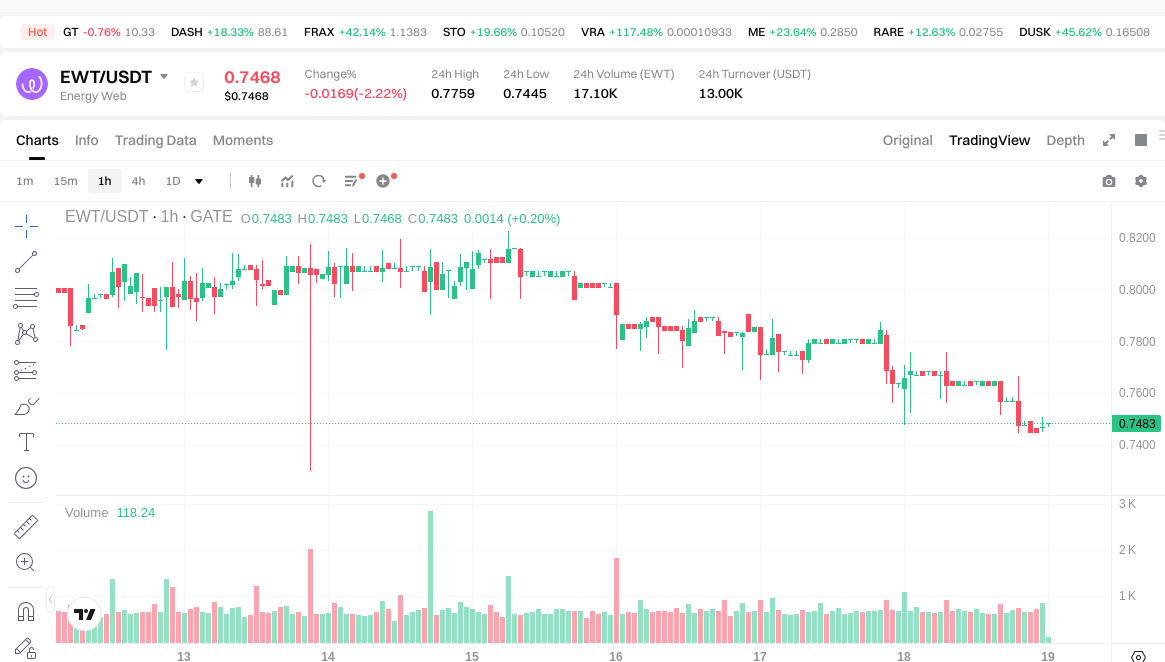
EWT Historical Performance: Energy Web Token (EWT) reached an all-time high of $700.65, though the specific date is not available in the reference materials. The token has experienced substantial volatility, with a recorded low of $2.23 in October 2025. Over the past year, EWT has declined by approximately 50.54%, reflecting broader market pressures and sector-specific challenges.
-
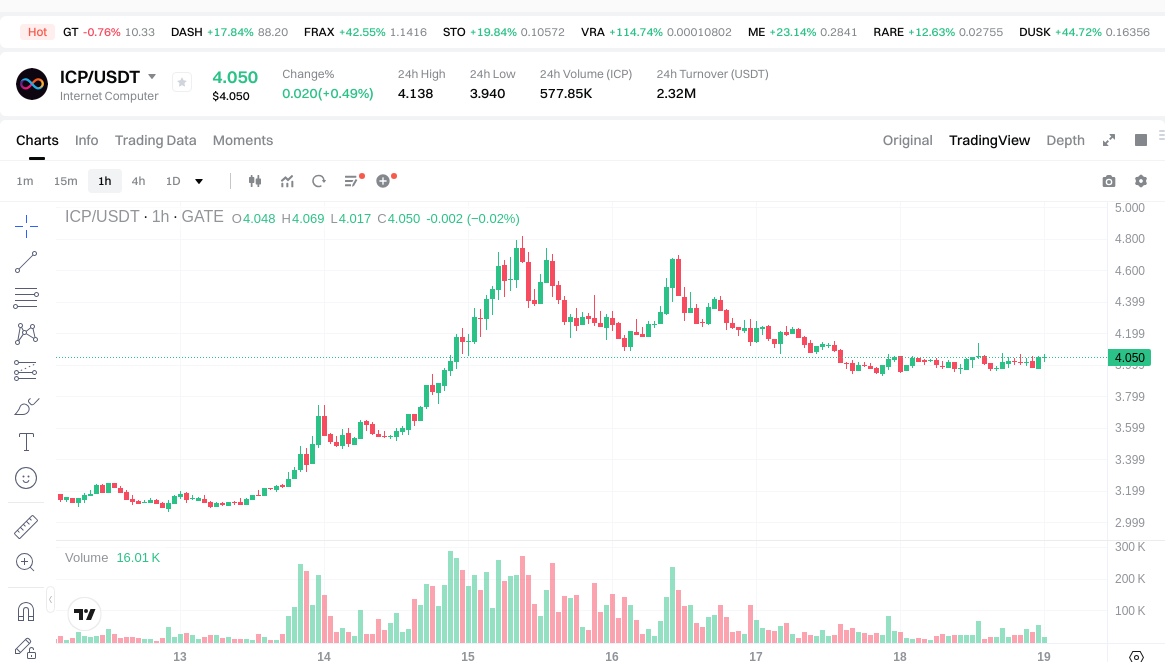
ICP Historical Performance: Internet Computer (ICP) reached its all-time high of $700.65 on May 11, 2021, during a period of heightened market enthusiasm for blockchain infrastructure projects. The token subsequently experienced a significant correction, reaching an all-time low of $2.23 on October 11, 2025. Over the past year, ICP has declined by approximately 64.42%, indicating substantial price pressure.
-
Comparative Analysis: Both tokens have experienced considerable price declines from their peak levels. During recent market cycles, EWT has shown a 1-year decline of 50.54%, while ICP has faced a more pronounced decline of 64.42%. In shorter timeframes, ICP has demonstrated greater volatility, with a 7-day gain of 27.38% compared to EWT's 7-day decline of 5.29%.
Current Market Status (January 19, 2026)
- EWT Current Price: $0.7468
- ICP Current Price: $4.033
- 24-Hour Trading Volume: EWT recorded $12,973.10 in trading volume, while ICP recorded substantially higher volume at $2,272,706.60
- Market Sentiment Index (Fear & Greed Index): 49 (Neutral)
View real-time prices:
II. Core Factors Influencing Investment Value: EWT vs ICP
Supply Mechanism Comparison (Tokenomics)
-
EWT: According to available information, EWT operates within the energy blockchain sector with tokenomics designed to facilitate energy market transactions. The token features mechanisms that may include deflationary elements or token burn programs, potentially reducing circulating supply over time.
-
ICP: Specific supply mechanism details for ICP were not available in the reference materials.
-
📌 Historical Pattern: Supply mechanism adjustments have historically influenced price cycles in crypto assets, where reduced circulation tends to create upward pressure when demand remains stable or increases.
Institutional Adoption and Market Applications
-
Institutional Holdings: Available data does not provide specific comparison of institutional preference between EWT and ICP.
-
Enterprise Adoption: EWT demonstrates application potential in energy sector blockchain solutions, focusing on optimizing energy market transactions, management, and distribution. This positions it within specialized enterprise use cases related to energy democratization and decentralization.
-
Regulatory Landscape: Cryptocurrency industry faces varying regulatory policies across different jurisdictions. Platforms and tokens must allocate resources to meet compliance requirements, which may affect operational flexibility.
Technology Development and Ecosystem Building
-
EWT Technical Progress: The Energy Web Foundation may introduce new development plans or partnership projects, which could strengthen market confidence. The token operates within energy blockchain applications aiming to improve efficiency in energy producer-consumer transactions.
-
ICP Technical Development: Technical upgrade information for ICP was not available in the reference materials.
-
Ecosystem Comparison: EWT has established recognition and application scenarios within the energy blockchain field. Broader ecosystem details regarding DeFi, NFT, payment systems, and smart contract implementations for both tokens were not comprehensively covered in available materials.
Macroeconomic Factors and Market Cycles
-
Performance in Inflationary Environments: Reference materials indicate that overall cryptocurrency market conditions influence individual token performance. During bull markets, increased investor risk appetite may benefit tokens with growth potential.
-
Macro Monetary Policy: Broader cryptocurrency market trends, including factors like market sentiment and cyclical patterns, affect token valuations. Specific impacts of interest rates and dollar index movements on EWT versus ICP were not detailed in available sources.
-
Geopolitical Factors: The energy sector represents a fundamental component of the global economy, with blockchain technology showing potential for widespread application in this domain. This positioning may provide EWT with exposure to cross-border energy transaction dynamics.
III. 2026-2031 Price Prediction: EWT vs ICP
Short-term Prediction (2026)
- EWT: Conservative $0.52-$0.75 | Optimistic $0.75-$0.86
- ICP: Conservative $2.99-$4.04 | Optimistic $4.04-$5.38
Mid-term Prediction (2028-2029)
- EWT may enter a consolidation phase, with projected price range of $0.66-$1.57
- ICP may enter a growth phase, with projected price range of $3.42-$7.41
- Key drivers: institutional capital inflows, ETF developments, ecosystem expansion
Long-term Prediction (2030-2031)
- EWT: Baseline scenario $1.21-$1.32 | Optimistic scenario $1.71-$1.92
- ICP: Baseline scenario $4.49-$7.64 | Optimistic scenario $8.58-$8.94
View detailed price predictions for EWT and ICP
Disclaimer
EWT:
| Year |
Predicted High Price |
Predicted Average Price |
Predicted Low Price |
Price Change |
| 2026 |
0.860545 |
0.7483 |
0.516327 |
0 |
| 2027 |
1.1261915 |
0.8044225 |
0.6113611 |
7 |
| 2028 |
1.14871533 |
0.965307 |
0.65640876 |
29 |
| 2029 |
1.57494663585 |
1.057011165 |
0.83503882035 |
41 |
| 2030 |
1.7107725705525 |
1.315978900425 |
1.210700588391 |
76 |
| 2031 |
1.921987184070712 |
1.51337573548875 |
1.256101860455662 |
102 |
ICP:
| Year |
Predicted High Price |
Predicted Average Price |
Predicted Low Price |
Price Change |
| 2026 |
5.37586 |
4.042 |
2.99108 |
0 |
| 2027 |
6.8750378 |
4.70893 |
3.4375189 |
16 |
| 2028 |
7.413739392 |
5.7919839 |
3.417270501 |
43 |
| 2029 |
6.80094749538 |
6.602861646 |
6.07463271432 |
63 |
| 2030 |
8.5784378504832 |
6.70190457069 |
4.4902760623623 |
66 |
| 2031 |
8.939000316386322 |
7.6401712105866 |
4.58410272635196 |
89 |
IV. Investment Strategy Comparison: EWT vs ICP
Long-term vs Short-term Investment Strategies
-
EWT: May suit investors focused on specialized sector applications, particularly those interested in energy blockchain infrastructure and decentralization of energy markets. The token's positioning in the energy sector could appeal to investors seeking exposure to fundamental economic infrastructure with potential long-term transformation narratives.
-
ICP: May suit investors seeking exposure to decentralized cloud infrastructure and AI-enabled blockchain platforms. The token's broader technological scope in hosting applications and enterprise systems could attract investors interested in diversified blockchain utility beyond specialized sectors.
Risk Management and Asset Allocation
-
Conservative Investors: Consider a balanced approach with portfolio allocation that accounts for volatility exposure. Conservative portfolios might limit exposure to any single high-volatility asset, potentially favoring tokens with more established liquidity profiles.
-
Aggressive Investors: May consider higher allocation to tokens demonstrating stronger short-term momentum or sector-specific catalysts. Risk tolerance and investment horizon should guide allocation decisions between specialized infrastructure tokens like EWT and broader platform tokens like ICP.
-
Hedging Tools: Stablecoin reserves for volatility management, diversified cross-token holdings to reduce single-asset concentration risk, and portfolio rebalancing strategies during significant market movements.
V. Potential Risk Comparison
Market Risk
-
EWT: Faces sector-specific risks tied to energy market adoption of blockchain technology. The token has demonstrated significant volatility, with a 50.54% decline over the past year. Lower trading volume ($12,973.10 in 24-hour volume) may indicate reduced liquidity during market stress periods.
-
ICP: Experienced substantial price pressure with a 64.42% decline over the past year from peak levels. However, the token maintains considerably higher trading volume ($2,272,706.60 in 24-hour volume), potentially providing better liquidity for position adjustments. Recent 7-day performance showed 27.38% gains, indicating higher short-term volatility.
Technical Risk
-
EWT: Technical development risks include execution challenges in specialized energy blockchain applications, potential delays in enterprise adoption cycles, and dependency on energy sector digital transformation timelines.
-
ICP: Operational risks may include technical complexity in maintaining decentralized cloud infrastructure, potential scalability challenges as adoption grows, and competitive pressures from alternative blockchain platforms.
Regulatory Risk
- Global regulatory frameworks continue evolving for cryptocurrency assets, with varying approaches across jurisdictions. Both tokens face compliance requirements that may affect operational flexibility and market access. Energy-focused tokens like EWT may encounter additional sector-specific regulations related to energy markets, while platform tokens like ICP may face scrutiny regarding decentralized application hosting and data management practices.
VI. Conclusion: Which Is the Better Buy?
📌 Investment Value Summary:
-
EWT Advantages: Specialized positioning in energy blockchain infrastructure, potential exposure to energy sector digital transformation, and focused application scope in fundamental economic infrastructure.
-
ICP Advantages: Higher trading liquidity with 24-hour volume exceeding $2.27 million, broader technological scope encompassing decentralized cloud and AI-enabled platforms, and demonstrated short-term momentum with recent 7-day gains.
✅ Investment Recommendations:
-
Novice Investors: Should prioritize understanding fundamental differences between specialized infrastructure tokens and broader platform tokens. Consider starting with smaller position sizes, maintaining diversified holdings beyond any single asset, and focusing on established liquidity profiles to facilitate entry and exit flexibility.
-
Experienced Investors: May evaluate sector-specific narratives for EWT in energy blockchain adoption versus broader platform utility for ICP. Assessment should incorporate technical development progress, ecosystem expansion metrics, and correlation with overall market cycles. Portfolio construction might balance specialized exposure with broader blockchain infrastructure holdings.
-
Institutional Investors: Should conduct comprehensive due diligence on enterprise adoption trajectories, regulatory compliance frameworks, and long-term technological viability. Evaluation criteria might include liquidity depth for position sizing, custodial infrastructure availability, and alignment with broader portfolio sector allocations.
⚠️ Risk Warning: Cryptocurrency markets exhibit extreme volatility. This analysis does not constitute investment advice. Market conditions, technological developments, and regulatory environments may change materially. Investors should conduct independent research, assess personal risk tolerance, and consider consulting qualified financial advisors before making investment decisions.
VII. FAQ
Q1: Which token has better liquidity for trading—EWT or ICP?
ICP demonstrates significantly superior liquidity. As of January 19, 2026, ICP recorded 24-hour trading volume of $2,272,706.60, compared to EWT's $12,973.10—a difference of approximately 175x. This substantial liquidity advantage means ICP investors can execute larger position adjustments with minimal price impact, while EWT holders may face slippage challenges during market stress periods. Higher liquidity generally reduces execution risk and provides better price discovery mechanisms.
Q2: How do the recent price performances of EWT and ICP compare?
ICP has shown stronger short-term momentum, gaining 27.38% over the past 7 days, while EWT declined 5.29% during the same period. However, over the past year, EWT has demonstrated relatively better resilience with a 50.54% decline compared to ICP's more pronounced 64.42% drop. Both tokens remain well below their all-time highs, with ICP having peaked at $700.65 on May 11, 2021, and currently trading at $4.033, while EWT trades at $0.7468.
Q3: What are the primary use cases distinguishing EWT from ICP?
EWT specializes in energy blockchain infrastructure, focusing on optimizing energy market transactions, management, and distribution between producers and consumers. It serves as a first-layer utility token supported by major energy sector companies. In contrast, ICP positions itself as a decentralized cloud blockchain capable of hosting applications, websites, and enterprise systems, while also functioning as a "self-writing cloud" enabling AI-created applications. Essentially, EWT addresses specialized energy sector needs, while ICP targets broader decentralized computing infrastructure.
Q4: Which token is more suitable for conservative investors?
Neither token presents a typical conservative investment profile due to cryptocurrency market volatility. However, ICP may offer slightly better risk management characteristics for conservative approaches due to its substantially higher liquidity ($2.27M vs $12.97K daily volume), enabling easier position adjustments. Conservative investors considering either token should limit single-asset exposure, maintain stablecoin reserves for volatility management, and implement strict portfolio allocation limits. Both tokens have experienced significant drawdowns exceeding 50% over the past year, underscoring the importance of risk management protocols.
Q5: What are the long-term price projections for EWT and ICP through 2031?
Based on baseline scenarios, EWT is projected to reach $1.21-$1.32 by 2030-2031, representing approximately 62-77% potential upside from current levels of $0.7468. ICP's baseline projections suggest $4.49-$7.64 for the same period, indicating 11-89% potential upside from the current $4.033 price. Optimistic scenarios project EWT at $1.71-$1.92 and ICP at $8.58-$8.94 by 2031. These projections assume continued ecosystem development, institutional adoption, and favorable macroeconomic conditions—all factors subject to substantial uncertainty.
Q6: How does institutional adoption differ between EWT and ICP?
EWT benefits from validator network support comprising major energy sector companies, providing sector-specific institutional backing. This positioning targets enterprise adoption within energy market infrastructure and decentralization initiatives. ICP's institutional adoption profile focuses on decentralized cloud infrastructure and enterprise system hosting capabilities. While specific institutional holding comparisons were not available in reference materials, EWT's specialized energy sector focus versus ICP's broader platform approach suggests different institutional investor profiles—energy-focused entities for EWT versus technology and cloud infrastructure investors for ICP.
Q7: What are the key regulatory risks facing EWT versus ICP?
Both tokens face evolving global cryptocurrency regulatory frameworks with varying jurisdictional approaches. EWT encounters dual-layer regulatory exposure: general cryptocurrency compliance requirements plus sector-specific energy market regulations that may govern blockchain-based energy transactions and grid management systems. ICP faces scrutiny regarding decentralized application hosting, data management practices, and potential classification issues related to cloud computing services. Energy-focused tokens like EWT may experience longer regulatory clarification timelines due to intersection with traditional energy sector oversight, while platform tokens like ICP navigate technology infrastructure regulatory frameworks.
Q8: Which token demonstrates better short-term trading opportunities?
ICP presents more viable short-term trading opportunities based on current metrics. The token's 27.38% gain over the past 7 days demonstrates stronger momentum, while its substantially higher trading volume ($2.27M daily) provides better liquidity for active trading strategies. EWT's lower volume ($12.97K daily) may create execution challenges for traders seeking to capitalize on short-term price movements. However, higher volatility in ICP also increases downside risk during market corrections. Short-term traders should implement strict stop-loss protocols and position sizing appropriate to the heightened volatility exhibited by both tokens.
* The information is not intended to be and does not constitute financial advice or any other recommendation of any sort offered or endorsed by Gate.