The article "FDUSD vs SAND: Comparing Stablecoin Stability and Metaverse Potential in the Crypto Market" provides a comprehensive analysis of FDUSD and SAND, two distinct cryptocurrency assets. It aims to guide investors by exploring their historical price performance, supply mechanics, institutional adoption, technical developments, and macroeconomic impacts. The article addresses key concerns like price stability, volatility, and potential growth, making it suitable for both novice and experienced investors. The structured approach aids quick scanning, emphasizing stability with FDUSD and high-growth potential with SAND. Check FDUSD and SAND market prices on Gate for real-time updates.
Introduction: FDUSD vs SAND Investment Comparison
In the cryptocurrency market, the comparison between FDUSD vs SAND has always been an unavoidable topic for investors. The two not only show significant differences in market cap ranking, application scenarios, and price performance but also represent different crypto asset positioning.
FDUSD (FDUSD): Since its launch in 2023, it has gained market recognition for its efficiency in financial transactions and cross-border payments.
SAND (SAND): Introduced in 2020, it has been hailed as a virtual game world token, representing one of the leading projects in the blockchain gaming sector.
This article will comprehensively analyze the investment value comparison between FDUSD vs SAND, focusing on historical price trends, supply mechanisms, institutional adoption, technical ecosystems, and future predictions, attempting to answer the question most concerning to investors:
"Which is the better buy right now?"
I. Price History Comparison and Current Market Status
FDUSD and SAND Historical Price Trends
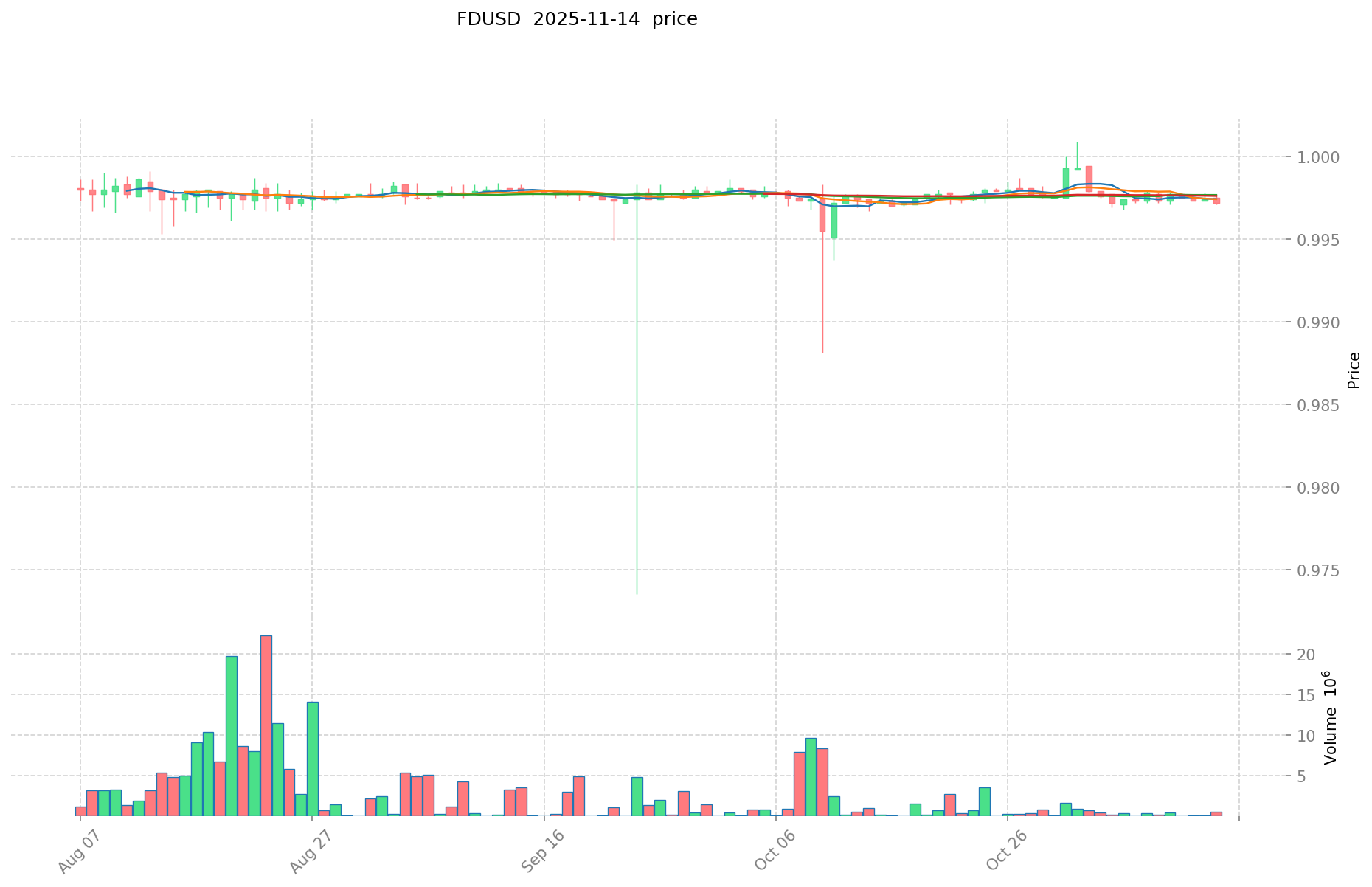
- 2024: FDUSD reached its all-time high of $1.0093 on December 24, 2024.
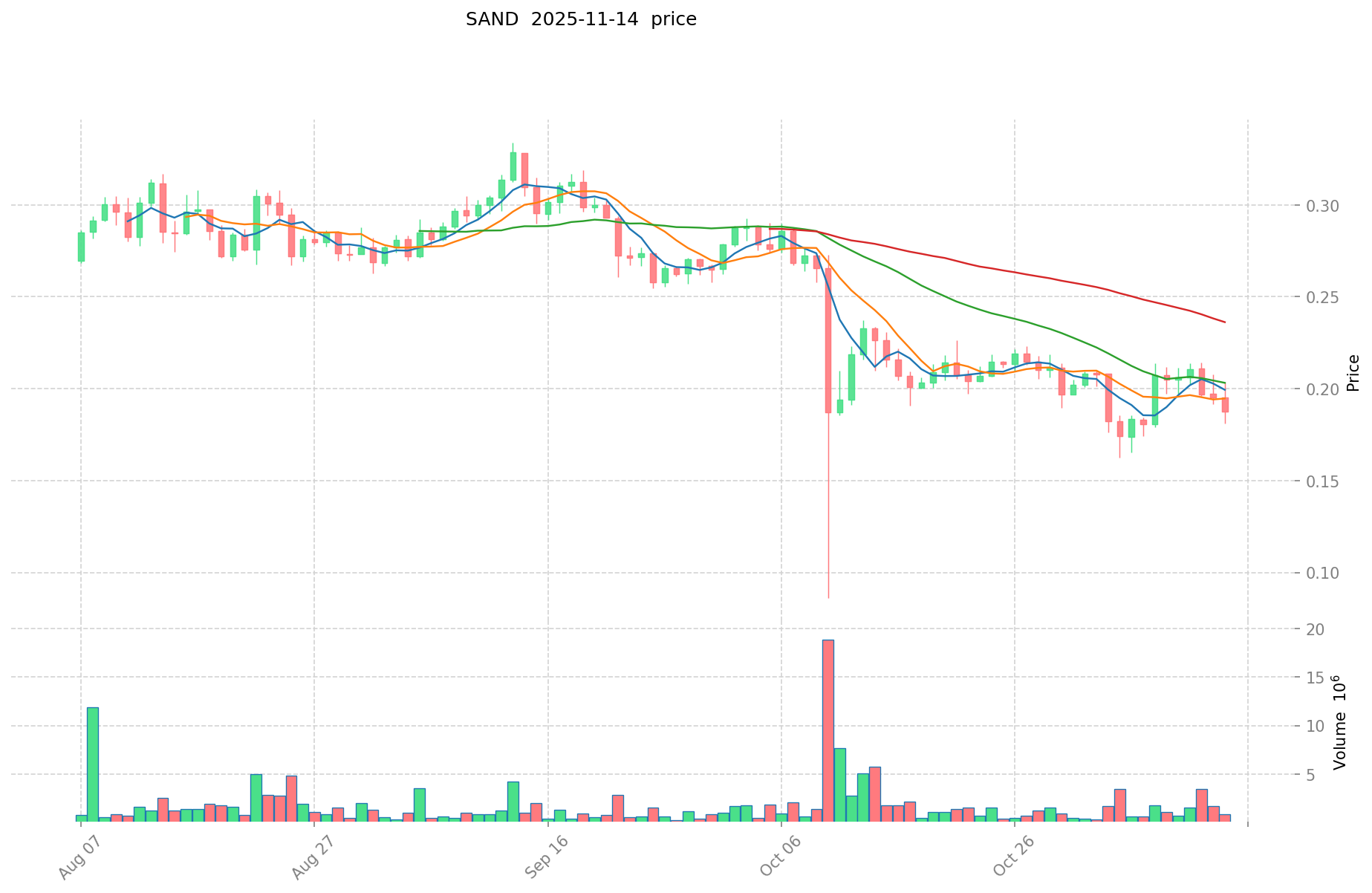
- 2025: SAND experienced a significant decline, with its price dropping to $0.1848 as of November 15, 2025.
- Comparative analysis: In the current market cycle, FDUSD has maintained relative stability near its $1 peg, while SAND has seen a substantial decrease from its all-time high of $8.4 in November 2021 to its current price.
Current Market Situation (2025-11-15)
- FDUSD current price: $0.9971
- SAND current price: $0.1848
- 24-hour trading volume: FDUSD $267,501.53 vs SAND $250,505.99
- Market Sentiment Index (Fear & Greed Index): 16 (Extreme Fear)
Click to view real-time prices:
- Check FDUSD current price Market Price
- Check SAND current price Market Price
II. Core Factors Affecting the Investment Value of FDUSD vs SAND
Supply Mechanisms Comparison (Tokenomics)
-
FDUSD: Fully backed stablecoin with 1:1 USD reserves, maintaining a stable $1 value by design
-
SAND: Limited supply of 3 billion tokens with deflationary mechanisms through token burns and staking rewards
-
📌 Historical Pattern: While FDUSD maintains price stability as a stablecoin, SAND experiences price volatility based on demand, with potential appreciation during increased platform adoption and market bull cycles.
Institutional Adoption and Market Applications
- Institutional Holdings: FDUSD appears more attractive to institutions seeking stable treasury management solutions, while SAND attracts metaverse-focused investors
- Enterprise Adoption: FDUSD serves as a settlement layer for exchanges and payment processors; SAND functions as the utility token powering The Sandbox ecosystem transactions
- Regulatory Attitudes: Stablecoins like FDUSD face increasing regulatory scrutiny globally, while metaverse tokens like SAND operate in a relatively less regulated environment currently
Technical Development and Ecosystem Building
- FDUSD Technical Upgrade: Integration with major exchanges including Binance and expanding use cases across DeFi platforms
- SAND Technical Development: Ongoing development of The Sandbox metaverse platform with partnerships across gaming, entertainment, and fashion industries
- Ecosystem Comparison: FDUSD primarily serves as a trading pair and settlement layer across DeFi platforms, while SAND has established a robust NFT marketplace, virtual land economy, and game development ecosystem
Macroeconomic and Market Cycles
- Performance in Inflationary Environments: FDUSD designed to maintain stable value regardless of inflation, while SAND may serve as a higher-risk inflation hedge through digital asset exposure
- Macroeconomic Monetary Policy: Interest rate hikes typically pressure speculative assets like SAND more significantly than stablecoins like FDUSD
- Geopolitical Factors: FDUSD may benefit from increased cross-border transaction demand during uncertainty, while SAND depends more on global entertainment and virtual world adoption trends
III. 2025-2030 Price Prediction: FDUSD vs SAND
Short-term Prediction (2025)
- FDUSD: Conservative $0.67-$1.00 | Optimistic $1.00-$1.04
- SAND: Conservative $0.17-$0.19 | Optimistic $0.19-$0.24
Mid-term Prediction (2027)
- FDUSD may enter a growth phase, with an estimated price range of $0.86-$1.37
- SAND may enter a volatile phase, with an estimated price range of $0.15-$0.34
- Key drivers: Institutional capital inflow, ETFs, ecosystem development
Long-term Prediction (2030)
- FDUSD: Base scenario $1.51-$1.60 | Optimistic scenario $1.60-$1.91
- SAND: Base scenario $0.27-$0.35 | Optimistic scenario $0.35-$0.42
View detailed price predictions for FDUSD and SAND
Disclaimer: This analysis is based on historical data and market projections. Cryptocurrency markets are highly volatile and unpredictable. This information should not be considered as financial advice. Always conduct your own research before making investment decisions.
FDUSD:
| 年份 |
预测最高价 |
预测平均价格 |
预测最低价 |
涨跌幅 |
| 2025 |
1.037088 |
0.9972 |
0.668124 |
0 |
| 2026 |
1.10868696 |
1.017144 |
0.52891488 |
2 |
| 2027 |
1.3711609692 |
1.06291548 |
0.8609615388 |
6 |
| 2028 |
1.606490456472 |
1.2170382246 |
1.15618631337 |
22 |
| 2029 |
1.79294071248072 |
1.411764340536 |
1.17176440264488 |
41 |
| 2030 |
1.906799506544948 |
1.60235252650836 |
1.506211374917858 |
60 |
SAND:
| 年份 |
预测最高价 |
预测平均价格 |
预测最低价 |
涨跌幅 |
| 2025 |
0.244992 |
0.1856 |
0.165184 |
0 |
| 2026 |
0.2583552 |
0.215296 |
0.16577792 |
16 |
| 2027 |
0.341028864 |
0.2368256 |
0.149200128 |
28 |
| 2028 |
0.33515558912 |
0.288927232 |
0.1733563392 |
56 |
| 2029 |
0.3806905208832 |
0.31204141056 |
0.2309106438144 |
68 |
| 2030 |
0.41563915886592 |
0.3463659657216 |
0.266701793605632 |
87 |
IV. Investment Strategy Comparison: FDUSD vs SAND
Long-term vs Short-term Investment Strategies
- FDUSD: Suitable for investors focused on stable value preservation and efficient transactions
- SAND: Suitable for investors interested in metaverse potential and gaming ecosystems
Risk Management and Asset Allocation
- Conservative investors: FDUSD: 80% vs SAND: 20%
- Aggressive investors: FDUSD: 40% vs SAND: 60%
- Hedging tools: Stablecoin allocation, options, cross-currency portfolios
V. Potential Risk Comparison
Market Risks
- FDUSD: Potential loss of USD peg, market liquidity risks
- SAND: High volatility, susceptibility to gaming and metaverse market trends
Technical Risks
- FDUSD: Smart contract vulnerabilities, centralization risks
- SAND: Platform scalability, network stability, potential security breaches
Regulatory Risks
- Global regulatory policies may impact stablecoins like FDUSD more heavily than metaverse tokens like SAND
VI. Conclusion: Which Is the Better Buy?
📌 Investment Value Summary:
- FDUSD advantages: Stability, efficient transactions, growing DeFi ecosystem integration
- SAND advantages: Metaverse exposure, potential for high growth, established gaming ecosystem
✅ Investment Advice:
- New investors: Consider a higher allocation to FDUSD for stability
- Experienced investors: Balanced portfolio with both FDUSD and SAND based on risk tolerance
- Institutional investors: FDUSD for treasury management, SAND for metaverse sector exposure
⚠️ Risk Warning: Cryptocurrency markets are highly volatile. This analysis does not constitute investment advice.
None
VII. FAQ
Q1: What are the main differences between FDUSD and SAND?
A: FDUSD is a stablecoin pegged to the US dollar, designed for stable value and efficient transactions. SAND is a utility token for The Sandbox metaverse, used in gaming and virtual world transactions. FDUSD aims for price stability, while SAND's value fluctuates based on market demand and platform adoption.
Q2: Which token is considered safer for investment?
A: FDUSD is generally considered safer due to its stable value pegged to the US dollar. However, it still carries risks such as potential loss of peg or regulatory challenges. SAND offers higher growth potential but comes with greater volatility and market risks.
Q3: How do macroeconomic factors affect FDUSD and SAND differently?
A: FDUSD is designed to maintain stable value regardless of inflation, while SAND may serve as a higher-risk inflation hedge. Interest rate hikes typically pressure speculative assets like SAND more significantly than stablecoins like FDUSD.
Q4: What are the key drivers for future price growth for each token?
A: For FDUSD, key drivers include institutional adoption, integration with major exchanges, and expansion in DeFi platforms. For SAND, growth depends on the development of The Sandbox metaverse, partnerships in gaming and entertainment, and overall adoption of virtual worlds.
Q5: How do the supply mechanisms differ between FDUSD and SAND?
A: FDUSD is fully backed by USD reserves with a 1:1 ratio, maintaining a stable $1 value. SAND has a limited supply of 3 billion tokens with deflationary mechanisms through token burns and staking rewards.
Q6: What are the main risks associated with investing in FDUSD and SAND?
A: FDUSD risks include potential loss of USD peg, market liquidity risks, and regulatory challenges. SAND risks involve high volatility, dependence on gaming and metaverse trends, platform scalability issues, and potential security breaches.
Q7: How might institutional investors view FDUSD vs SAND?
A: Institutional investors may prefer FDUSD for treasury management and stable value preservation, while considering SAND for exposure to the metaverse and gaming sectors. The choice depends on the institution's risk tolerance and investment strategy.
* The information is not intended to be and does not constitute financial advice or any other recommendation of any sort offered or endorsed by Gate.













