This comprehensive guide examines Bitcoin's price dynamics amid Federal Reserve monetary policy uncertainty. As rate-cut expectations collapse from 70% to 40-50%, Bitcoin faces consolidation between $60,000-$80,000 through year-end if the Fed maintains its current stance. Despite recent pullbacks, record-high stablecoin reserves of $72.2 billion signal substantial sidelined liquidity ready for deployment on Gate and other platforms. The article explores how Fed policy directly impacts Bitcoin's liquidity conditions, analyzes institutional market foundations showing strength despite volatility, and provides strategic guidance for investors navigating macro-driven corrections. Expert analysis suggests this downturn differs from previous crypto winters, with improved infrastructure and regulatory clarity supporting long-term resilience. Ideal for investors seeking clarity on Fed policy impacts and market positioning strategies.
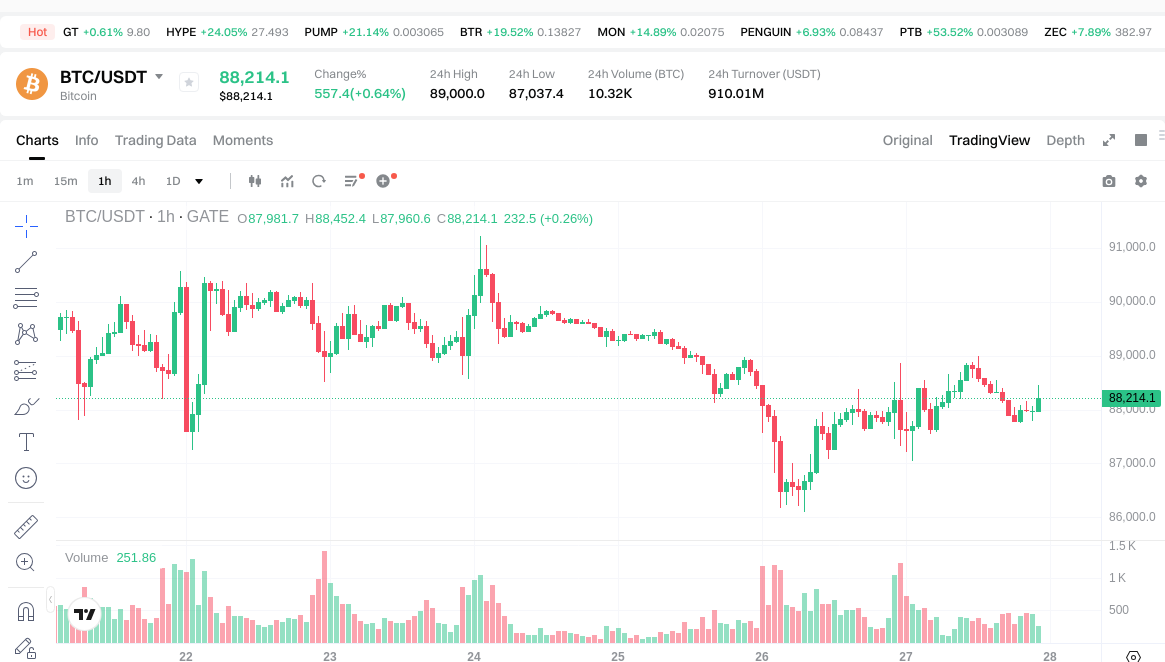
Bitcoin could remain trapped in a tight trading band into late December if the Federal Reserve opts against cutting interest rates at its highly anticipated meeting in the upcoming December session, according to an analysis shared by XWIN Research Japan. Market analysts suggest that Bitcoin may stay locked between $60,000 and $80,000 if the Fed holds rates steady, while falling cut expectations have already drained liquidity from risk assets, pushing Bitcoin below $90,000.
 However, a record $72.2 billion in stablecoin reserves signals strong sidelined liquidity waiting for deployment.
The December Federal Open Market Committee (FOMC) meeting is shaping up to be one of the most unpredictable in recent years. After the US government shutdown forced the Bureau of Labor Statistics to cancel the October jobs report and delay both October and November data releases, policymakers will head into the meeting with significantly limited economic visibility. This data vacuum creates additional uncertainty around monetary policy decisions, making it harder for the Fed to justify aggressive rate adjustments.
The absence of critical employment data compounds the challenge facing Fed officials, as labor market indicators have historically been key drivers of rate decisions. Without these metrics, the committee must rely on incomplete information, potentially leading to a more conservative approach. This cautious stance could have significant implications for risk assets, particularly cryptocurrencies like Bitcoin that are sensitive to liquidity conditions.
Fed Rate-Cut Odds Collapse to 40–50% as Officials Split
Rate-cut expectations, which were once comfortably above 70% in earlier projections, have now fallen into the 40%–50% range, with Fed minutes revealing a sharply divided committee on the appropriate path forward. This dramatic shift in market expectations reflects growing uncertainty about the Fed's willingness to ease monetary policy in the current environment.
A pause in rate cuts would signal that the Federal Reserve remains wary of easing while inflation hovers near 3%—still above the Fed's 2% target—and key labor indicators remain missing due to the data delays. Historically, tight monetary conditions drain liquidity from risk assets, a pattern already observed in recent weeks when falling cut expectations triggered sharp drawdowns across both equities and cryptocurrency markets.
Bitcoin reacted immediately to the shifting rate expectations. As cut odds slipped from their peak levels, the leading cryptocurrency fell below $90,000, erasing weeks of gains accumulated during the previous rally. This price action demonstrates Bitcoin's continued sensitivity to macroeconomic policy signals, particularly those related to liquidity conditions.
Analysts suggest the same dynamic is likely to persist if the Fed maintains a cautious stance in December, with leveraged positions becoming increasingly vulnerable in a low-liquidity environment. The correlation between Fed policy expectations and crypto asset performance has strengthened in recent years as institutional participation has increased, making Bitcoin more responsive to traditional financial market dynamics.
However, beneath the surface volatility, there are signs of potential strength. Stablecoin reserves on exchanges have climbed to an all-time high of $72.2 billion, according to the chart shared by XWIN Research Japan. This massive accumulation of dollar-pegged tokens represents sidelined capital that could rapidly deploy into Bitcoin and other cryptocurrencies once market conditions improve.
Historically, every major rally in the current market cycle has started with a similar build-up of stablecoin reserves. These funds represent liquidity waiting on the sidelines for a macro green light—whether that comes from Fed policy clarity, improving economic data, or other catalysts. The current record-high level suggests substantial buying power ready to enter the market.
If no rate cut materializes at the December meeting, XWIN expects Bitcoin to consolidate in a range between $60,000 and $80,000 through year-end. Downward pressure would come from muted risk appetite and tight liquidity conditions, while upside potential remains capped until traders receive greater clarity from the Federal Reserve regarding the future path of monetary policy.
The key question facing the market is whether these substantial stablecoin reserves will remain parked on exchanges or begin rotating into Bitcoin once the December policy risk passes. Historical patterns suggest that once uncertainty resolves, even if the outcome is not immediately favorable, capital tends to deploy as traders adjust to the new reality and position for the next phase.
Experts Reject 'Crypto Winter' Fears, Point to Stronger Market Foundations
Despite the recent pullback in Bitcoin prices, several prominent analysts have noted that the current downturn looks fundamentally different from previous bear markets and more like a macro-driven correction than the start of a prolonged freeze. They point to continued institutional adoption, regulatory progress, and sector resilience as signs that the market foundation remains strong.
Bitwise's Danny Nelson and HashKey's Tim Sun both argued that the market is far from experiencing a full-blown crypto winter comparable to previous cycles. They noted that, unlike previous market collapses, the current cycle has not witnessed a catastrophic event similar to the FTX collapse or other major exchange failures that typically trigger sustained bear markets.
Moreover, infrastructure improvements continue to strengthen the ecosystem during this period of price consolidation. Developments in tokenization, stablecoin expansion, and institutional custody solutions are proceeding regardless of short-term price movements. This ongoing development suggests that the market is maturing rather than collapsing, with fundamental building blocks being put in place for future growth.
Other market analysts have highlighted that the absence of a euphoric peak in the current cycle and the impact of global liquidity conditions make this downturn structurally different from historical bear markets. Previous crypto winters typically followed periods of extreme speculation and unsustainable price appreciation, whereas the current market has shown more measured growth with stronger institutional participation.
Bitwise Chief Investment Officer Matt Hougan has urged investors to look past Bitcoin's sharp pullback, arguing that the cryptocurrency's long-term value proposition has little to do with its recent slide and everything to do with the fundamental service it provides. Hougan emphasizes that Bitcoin's role as a decentralized store of value and hedge against monetary debasement remains intact regardless of short-term price fluctuations.
The institutional infrastructure supporting Bitcoin has also grown substantially compared to previous cycles. Major financial institutions now offer Bitcoin custody, trading, and investment products, creating a more stable foundation for the asset class. This institutional involvement provides a floor of support that was absent in earlier bear markets, potentially limiting downside risk.
Additionally, regulatory clarity has improved in many jurisdictions, with frameworks being established for cryptocurrency businesses and products. While regulatory challenges remain, the overall trajectory is toward greater legitimacy and integration with traditional financial systems, which supports long-term market stability.
The combination of record stablecoin reserves, improved infrastructure, and institutional involvement suggests that any extended consolidation period may be setting the stage for the next growth phase rather than signaling a prolonged winter. As the Federal Reserve's policy path becomes clearer and economic data improves, the substantial sidelined liquidity could provide fuel for Bitcoin's next move higher.
FAQ
What impact does the Federal Reserve's pause on rate hikes have on Bitcoin price?
Fed rate pause typically boosts Bitcoin by reducing opportunity cost of holding non-yielding assets. Lower rates increase liquidity and investor appetite for risk assets, pushing Bitcoin higher. Analysts predict this could support Bitcoin within the $60K–$80K range through year-end as investors seek inflation hedges.
Why do analysts believe Bitcoin will fluctuate in the $60K-$80K range through year-end?
Analysts attribute Bitcoin's expected $60K-$80K range to fed rate pause dynamics, market uncertainty, and investor sentiment shifts. Key factors include economic data volatility, policy changes, and institutional positioning throughout the period.
What is the relationship between Federal Reserve monetary policy and Bitcoin price?
Fed monetary policy significantly impacts Bitcoin prices. When the Fed pauses rate hikes or signals easier policy, liquidity increases, driving Bitcoin demand higher. Conversely, rate hikes reduce risk appetite, pressuring crypto valuations downward. Bitcoin typically thrives in low-rate environments.
During Fed Rate Pause, what strategy should Bitcoin investors adopt?
Investors should adopt a balanced approach: accumulate during dips within the $60K-$80K range, maintain portfolio diversification, monitor Fed policy signals closely, and consider dollar-cost averaging to capitalize on price stability during the pause period.
What is the historical impact of Federal Reserve rate hikes and pauses on Bitcoin?
Fed rate hikes typically pressure Bitcoin prices downward, while pauses or cuts often drive prices upward. Historically, Bitcoin tends to perform strongly during economic downturns and periods of monetary easing.
If the Federal Reserve raises interest rates again before year-end, how will Bitcoin's price change?
If the Fed resumes rate hikes before year-end, Bitcoin price would likely decline. Higher interest rates typically reduce investor risk appetite, making speculative assets like Bitcoin less attractive as capital shifts to safer, yield-bearing instruments.
* The information is not intended to be and does not constitute financial advice or any other recommendation of any sort offered or endorsed by Gate.