This comprehensive comparison analyzes FEG and LTC across multiple investment dimensions to help readers determine which cryptocurrency aligns with their portfolio strategy. The article examines historical price performance, supply mechanisms, institutional adoption, technical ecosystems, and current market status on Gate. FEG, launched in 2021 as a DeFi governance token, demonstrates high volatility with current trading volume of $14,858, while Litecoin operates since 2011 with established infrastructure and $2.5M daily volume. Readers will discover the core differences in tokenomics: Litecoin's fixed 84-million coin supply with halving mechanisms versus FEG's emerging governance model. The guide provides investment strategy recommendations tailored to conservative, moderate, and aggressive investors, alongside detailed risk assessments including market, technical, and regulatory factors. Through detailed analysis, price comparisons, and market data from Gate, investors gain clarity on position sizing and as
Introduction: FEG vs LTC Investment Comparison
In the cryptocurrency market, the comparison between FEG vs LTC has been a topic that investors cannot avoid. The two not only show significant differences in market cap ranking, application scenarios, and price performance, but also represent different crypto asset positioning.
FEG (FEG): Launched in 2021, it has gained market recognition as a SmartDeFi governance token for its fully decentralized trading ecosystem, aiming to provide passive income opportunities for holders.
LTC (LTC): Since its launch in 2011, it has been regarded as digital silver and is one of the cryptocurrencies with high global trading volume and market capitalization, utilizing the memory-intensive Scrypt proof-of-work mining algorithm.
This article will provide a comprehensive analysis of the investment value comparison between FEG vs LTC around historical price trends, supply mechanisms, institutional adoption, technical ecosystems, and future predictions, and attempt to answer the question that investors are most concerned about:
"Which is the better buy right now?"
I. Historical Price Comparison and Current Market Status
FEG Token and Litecoin Historical Price Trends
-
2021: FEG Token experienced significant volatility following its launch in February 2021, with an initial price of $0.001091. The token underwent substantial price fluctuations during the DeFi market expansion period.
-
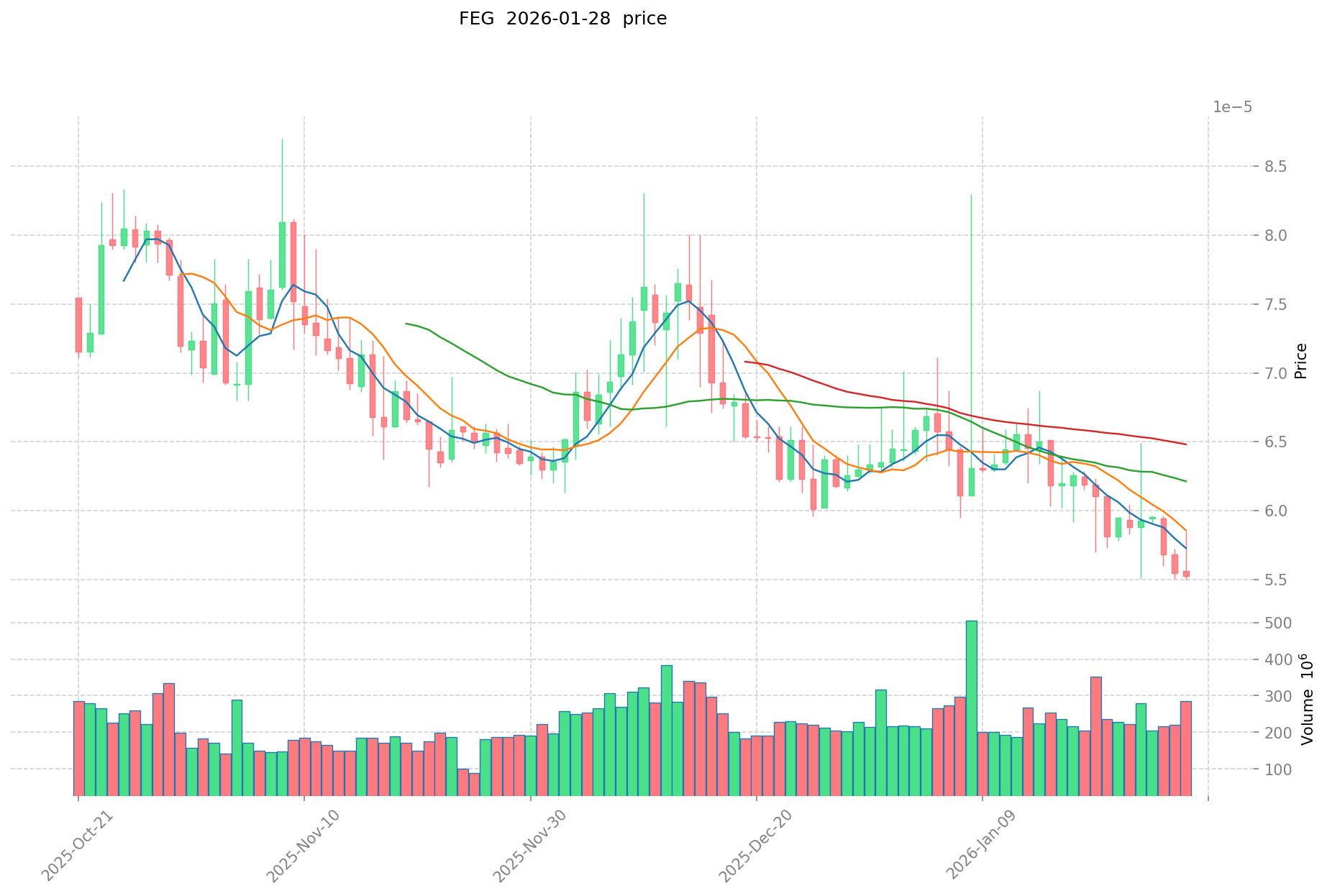
2024: FEG Token reached its all-time high of $0.0013903 on January 31, 2024, before experiencing a notable correction. Later in December 2024, the token recorded its all-time low of $0.0000056 on December 30, 2024.
-
2011-2021: Litecoin, launched in November 2011 at $4.30, demonstrated a long-term growth trajectory. The asset reached its all-time high of $410.26 on May 10, 2021, during the broader cryptocurrency market rally.
-
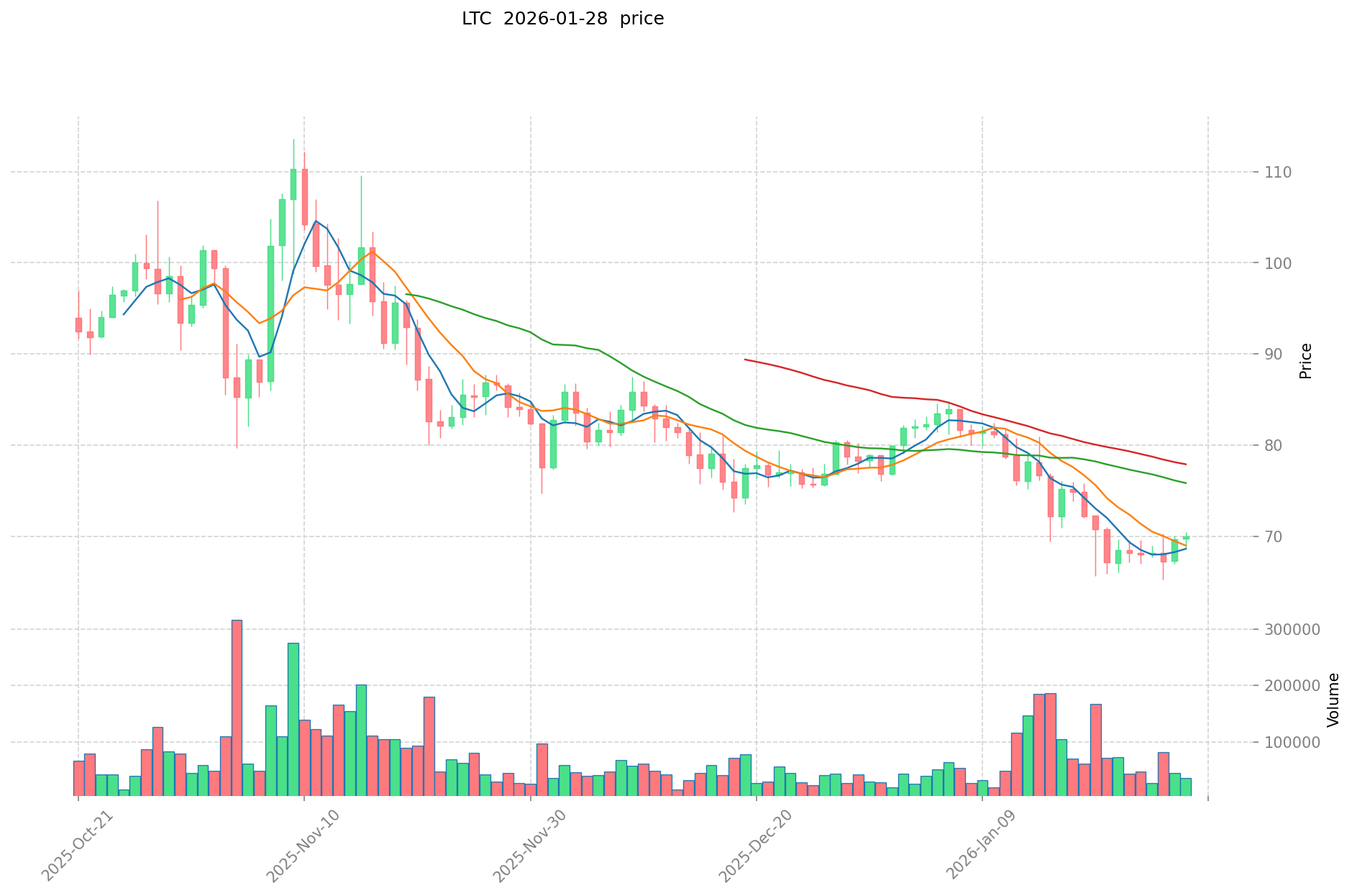
2024-2025: Litecoin experienced price adjustments following its peak, with the price declining from elevated levels to a range between $65-$70 during late 2024 and early 2026.
-
Comparative Analysis: During recent market cycles, FEG Token has demonstrated higher volatility with a price range from $0.0013903 to $0.0000056, representing substantial percentage movements. In contrast, Litecoin has shown relatively more stable price action, maintaining a trading range with less extreme percentage fluctuations despite absolute price changes.
Current Market Status (January 29, 2026)
- FEG Token Current Price: $0.00005445
- Litecoin Current Price: $69.44
- 24-Hour Trading Volume: FEG Token $14,858.08 vs Litecoin $2,533,804.09
- Market Sentiment Index (Fear & Greed Index): 29 (Fear)
View Real-Time Prices:
II. Core Factors Influencing FEG vs LTC Investment Value
Supply Mechanism Comparison (Tokenomics)
- LTC: Litecoin operates on a fixed supply model with a maximum cap of 84 million coins, employing a halving mechanism approximately every four years to reduce block rewards, similar to Bitcoin's deflationary approach.
- FEG: Information regarding FEG's supply mechanism was not found in the provided materials.
- 📌 Historical Pattern: Supply mechanisms, particularly halving events in proof-of-work cryptocurrencies, have historically influenced price cycles by creating scarcity and affecting mining economics.
Institutional Adoption and Market Applications
- Institutional Holdings: The materials mention institutional interest in the broader cryptocurrency market, with references to institutional participants bringing liquidity and structure. However, specific comparative data on institutional preference between FEG and LTC was not available in the provided sources.
- Enterprise Adoption: Litecoin has been referenced in contexts related to cross-border payments and efficiency improvements. The materials note discussions around blockchain integration with traditional financial systems, though specific enterprise adoption comparisons between FEG and LTC were not detailed.
- National Policies: The materials reference regulatory developments, including the U.S. SEC's evolving stance on digital assets and financial markets moving toward "on-chain" operations, though country-specific policies comparing treatment of these two assets were not provided.
Technology Development and Ecosystem Building
- LTC Technology Upgrades: The materials reference Litecoin's efficiency and scalability improvements as key factors, alongside mentions of Lightning Network development for enhanced transaction capabilities.
- FEG Technology Development: Specific information regarding FEG's technical development was not available in the provided materials.
- Ecosystem Comparison: The materials discuss broader cryptocurrency ecosystem developments including DeFi infrastructure, institutional-grade lending markets (referenced at $25 billion), and integration of blockchain technology with artificial intelligence. However, specific ecosystem comparisons between FEG and LTC regarding DeFi, NFT, payment solutions, and smart contract implementations were not detailed in the sources.
Macroeconomic Factors and Market Cycles
- Performance in Inflationary Environments: While the materials do not provide specific comparative data, cryptocurrencies with fixed supply mechanisms like Litecoin are often discussed in the context of potential inflation hedging properties.
- Macroeconomic Monetary Policy: The materials reference market volatility patterns and institutional participation, with academic research indicating peak trading activity during overlapping European and U.S. market hours (16:00-17:00 UTC). Interest rate policies and dollar index movements were implied as influencing factors, though specific impacts on FEG and LTC were not detailed.
- Geopolitical Factors: References in the materials include cross-border transaction needs and blockchain adoption in international banking pilots, though specific geopolitical analyses comparing FEG and LTC were not provided.
III. 2026-2031 Price Forecast: FEG vs LTC
Short-term Forecast (2026)
- FEG: Conservative scenario suggests a range of $0.000031581 to $0.00005445 | Optimistic scenario targets $0.0000756855
- LTC: Conservative scenario suggests a range of $40.2694 to $69.43 | Optimistic scenario targets $76.373
Mid-term Forecast (2028-2029)
- FEG may enter a gradual growth phase, with projected price range of $0.000044506341 to $0.00010327696429
- LTC may enter a recovery and expansion phase, with projected price range of $55.648922616 to $122.9994108
- Key drivers: institutional capital inflows, ETF developments, ecosystem expansion
Long-term Forecast (2031)
- FEG: Base scenario $0.000059388844554 to $0.000106051508132 | Optimistic scenario $0.000148472111385
- LTC: Base scenario $107.6009018062104 to $125.11732768164 | Optimistic scenario $186.4248182456436
View detailed price predictions for FEG and LTC
Disclaimer
The information provided herein is for reference purposes only and does not constitute investment advice. Cryptocurrency markets are highly volatile and subject to various risks. Past performance does not guarantee future results. Users should conduct independent research and consult with professional advisors before making any investment decisions.
FEG:
| Year |
Predicted High Price |
Predicted Average Price |
Predicted Low Price |
Price Change |
| 2026 |
0.0000756855 |
0.00005445 |
0.000031581 |
0 |
| 2027 |
0.00008328672 |
0.00006506775 |
0.00004164336 |
19 |
| 2028 |
0.00008975445435 |
0.000074177235 |
0.000044506341 |
36 |
| 2029 |
0.00010327696429 |
0.000081965844675 |
0.000045900873018 |
50 |
| 2030 |
0.000119481611782 |
0.000092621404482 |
0.00005001555842 |
70 |
| 2031 |
0.000148472111385 |
0.000106051508132 |
0.000059388844554 |
94 |
LTC:
| Year |
Predicted High Price |
Predicted Average Price |
Predicted Low Price |
Price Change |
| 2026 |
76.373 |
69.43 |
40.2694 |
0 |
| 2027 |
93.31392 |
72.9015 |
67.798395 |
4 |
| 2028 |
122.9994108 |
83.10771 |
78.1212474 |
19 |
| 2029 |
116.450523252 |
103.0535604 |
55.648922616 |
48 |
| 2030 |
140.48261353728 |
109.752041826 |
102.06939889818 |
58 |
| 2031 |
186.4248182456436 |
125.11732768164 |
107.6009018062104 |
80 |
IV. Investment Strategy Comparison: FEG vs LTC
Long-term vs Short-term Investment Strategies
-
FEG: May appeal to investors with higher risk tolerance seeking exposure to emerging DeFi governance tokens with significant volatility characteristics. The asset's historical price movements suggest suitability for traders comfortable with substantial percentage fluctuations and shorter trading horizons.
-
LTC: May appeal to investors seeking exposure to established cryptocurrency infrastructure with longer operational history. The asset's relative price stability compared to newer tokens and its fixed supply mechanism may attract participants focused on longer holding periods.
Risk Management and Asset Allocation
-
Conservative Investors: A portfolio weighting consideration might include FEG: 5-10% vs LTC: 15-25%, with the remainder allocated to more stable assets. Conservative approaches typically emphasize lower exposure to high-volatility assets.
-
Aggressive Investors: A portfolio weighting consideration might include FEG: 20-30% vs LTC: 30-40%, with higher allocation to cryptocurrency assets overall. Aggressive strategies involve acceptance of greater volatility in pursuit of potential returns.
-
Hedging Tools: Portfolio risk management approaches may include stablecoin allocations for liquidity management, derivatives instruments where available, and diversification across multiple digital assets with varying correlation patterns.
V. Potential Risk Comparison
Market Risk
-
FEG: The token has demonstrated substantial price volatility, with movements from all-time highs of $0.0013903 to lows of $0.0000056 recorded in 2024. Such volatility patterns indicate significant market risk exposure, with potential for rapid value fluctuations during periods of broader market stress or liquidity constraints.
-
LTC: While exhibiting more moderate volatility patterns compared to newer tokens, Litecoin remains subject to cryptocurrency market dynamics. Price movements from peaks above $400 to ranges around $65-$70 demonstrate ongoing market risk, though with comparatively less extreme percentage variations than emerging tokens.
Technical Risk
-
FEG: Specific technical risk factors related to network architecture, smart contract implementations, and protocol security were not detailed in available materials. Emerging tokens generally face considerations around code maturity and ecosystem development stages.
-
LTC: Operating since 2011, Litecoin utilizes the Scrypt proof-of-work algorithm with considerations around mining distribution and network security maintenance. Long-term operational history provides some technical track record, though ongoing network maintenance and upgrade implementation remain relevant factors.
Regulatory Risk
- Global regulatory developments continue to evolve, with materials referencing the U.S. SEC's evolving stance on digital assets and discussions of financial markets moving toward blockchain integration. Established cryptocurrencies with longer operational histories and broader recognition may experience different regulatory treatment compared to newer governance tokens. Cross-border regulatory variations and ongoing policy development present ongoing considerations for both asset categories.
VI. Conclusion: Which Is the Better Buy?
📌 Investment Value Summary:
-
FEG Characteristics: Represents exposure to DeFi governance token sector with higher volatility profile. Current trading volume of approximately $14,858 indicates relatively limited liquidity compared to more established assets. Price forecast scenarios suggest potential for percentage gains, though accompanied by corresponding risk factors.
-
LTC Characteristics: Offers exposure to established cryptocurrency infrastructure with operational history since 2011. Trading volume of approximately $2.5 million indicates substantially greater liquidity. Fixed supply mechanism of 84 million coins with halving schedule provides defined tokenomics. Price forecast scenarios suggest more moderate percentage movements with comparatively lower volatility expectations.
✅ Investment Considerations:
-
Beginning Investors: May consider starting with more established cryptocurrencies that offer greater liquidity, longer operational track records, and relatively more stable price patterns. Smaller initial positions and thorough research before any allocation remain important considerations.
-
Experienced Investors: May evaluate portfolio diversification across both established and emerging digital assets based on individual risk tolerance and investment objectives. Position sizing relative to overall portfolio and understanding of volatility characteristics warrant careful consideration.
-
Institutional Participants: May prioritize assets with greater liquidity depth, established custody solutions, regulatory clarity, and integration with existing financial infrastructure. Due diligence processes typically emphasize operational history and market structure analysis.
⚠️ Risk Disclosure: Cryptocurrency markets exhibit substantial volatility and carry significant risks including potential loss of capital. This content provides informational analysis and does not constitute investment advice, financial guidance, or recommendations to buy or sell any assets. Market conditions, regulatory environments, and asset characteristics may change materially. Individuals should conduct independent research and consult qualified financial advisors before making any investment decisions.
VII. FAQ
Q1: What is the main difference between FEG and LTC in terms of market maturity?
FEG is a newly launched DeFi governance token (2021) with limited operational history, while LTC is an established cryptocurrency operating since 2011 with over 14 years of market presence. Specifically, Litecoin has demonstrated sustained market participation with significantly higher trading volume ($2.5 million vs $14,858 daily), broader institutional recognition, and integration into established cryptocurrency infrastructure. FEG represents emerging DeFi governance token exposure with higher volatility characteristics, whereas Litecoin offers exposure to proven blockchain technology with a fixed 84 million coin supply mechanism and established mining infrastructure.
Q2: Which asset exhibits greater price volatility?
FEG demonstrates substantially greater price volatility compared to LTC. Historical data shows FEG experienced extreme price fluctuations from an all-time high of $0.0013903 to a low of $0.0000056 within 2024 alone, representing massive percentage swings. In contrast, Litecoin's price movements from peaks above $400 to ranges around $65-$70, while significant in absolute terms, represent comparatively moderate percentage variations. This volatility difference reflects FEG's status as an emerging token versus Litecoin's position as an established cryptocurrency with deeper liquidity and broader market participation.
Q3: What are the key supply mechanism differences between these assets?
Litecoin operates on a transparent fixed supply model with a maximum cap of 84 million coins and implements a halving mechanism approximately every four years, similar to Bitcoin's deflationary approach. This creates predictable scarcity economics and defined long-term supply dynamics. Information regarding FEG's specific supply mechanism, maximum supply cap, or emission schedule was not available in the provided materials, making direct tokenomics comparison challenging. The defined supply characteristics of Litecoin provide clearer long-term economic modeling compared to assets without documented supply parameters.
Q4: Which investment strategy suits each asset?
FEG may align with higher risk tolerance strategies focused on emerging DeFi governance tokens, potentially suitable for aggressive investors willing to accept substantial volatility with portfolio allocations of 20-30% in cryptocurrency assets. Litecoin may appeal to both conservative and moderate strategies seeking exposure to established cryptocurrency infrastructure, with suggested allocations ranging from 15-25% for conservative approaches to 30-40% for more aggressive portfolios. Conservative investors typically emphasize lower exposure to high-volatility assets, while aggressive strategies involve acceptance of greater volatility in pursuit of potential returns.
Q5: What liquidity differences exist between FEG and LTC?
Litecoin demonstrates substantially greater market liquidity with daily trading volume of approximately $2,533,804 compared to FEG's volume of approximately $14,858 as of January 29, 2026. This represents a volume difference of over 170x, indicating significantly deeper market participation for Litecoin. Higher liquidity generally facilitates easier position entry and exit, tighter bid-ask spreads, and reduced slippage impact during trading. Limited liquidity in FEG may present challenges for larger position sizes and could contribute to greater price volatility during periods of market stress.
Q6: What are the projected price ranges for 2031?
According to the forecast models, FEG's 2031 price projections range from a low scenario of $0.000059388844554 to a high scenario of $0.000148472111385, representing potential growth of 94% from 2026 levels. Litecoin's 2031 projections range from $107.6009018062104 to $186.4248182456436, representing potential growth of 80% from 2026 levels. These projections are based on various scenario analyses and should be understood as potential outcomes rather than guaranteed results. Cryptocurrency markets remain highly unpredictable, and actual performance may differ materially from any forecast models.
Q7: What regulatory considerations apply to these assets?
Both assets operate within evolving global regulatory frameworks, with materials referencing the U.S. SEC's developing stance on digital assets and discussions of blockchain integration with traditional financial systems. Established cryptocurrencies like Litecoin with longer operational histories and broader recognition may experience different regulatory treatment compared to newer governance tokens like FEG. Cross-border regulatory variations, ongoing policy development, and potential classification differences between established cryptocurrencies and DeFi governance tokens present ongoing considerations. Investors should monitor regulatory developments in relevant jurisdictions as policies continue to evolve.
Q8: Which asset is more suitable for beginning investors?
Beginning investors may consider starting with more established cryptocurrencies like Litecoin that offer greater liquidity, longer operational track records (since 2011), and relatively more stable price patterns compared to emerging tokens. Litecoin's established market presence, transparent supply mechanism, and deeper liquidity provide characteristics that may align better with investors building initial cryptocurrency exposure. Smaller initial positions, thorough independent research, and understanding of basic cryptocurrency concepts remain important considerations regardless of asset selection. Beginning investors should prioritize education and risk management before any allocation decisions.
* The information is not intended to be and does not constitute financial advice or any other recommendation of any sort offered or endorsed by Gate.